
The Juno Mission is one of the most ambitious space exploration efforts ever undertaken to study the largest planet in our solar system—Jupiter. Launched by NASA, Juno has transformed our understanding of how gas giants form, evolve, and influence planetary systems.
In this guide, we’ll explore what Juno is, why it matters, and what groundbreaking discoveries it has made since arriving at Jupiter.
What Is the Juno Mission?
The Juno Mission is a robotic space probe designed to study Jupiter’s atmosphere, magnetic field, gravity, and internal structure.
Key Facts About Juno
- Launch Date: August 5, 2011
- Arrival at Jupiter: July 4, 2016
- Mission Type: Polar orbiting spacecraft
- Primary Goal: Understand Jupiter’s origin and evolution
Unlike previous missions that stayed near the equator, Juno orbits Jupiter from pole to pole, giving scientists a completely new perspective.
Why Study Jupiter?
Jupiter isn’t just another planet—it holds clues to how the entire solar system formed.
Scientific Importance
- Jupiter is the largest planet, containing more mass than all other planets combined
- It likely formed early and influenced the formation of other planets
- Its strong gravity affects asteroid belts and comet paths
By studying Jupiter, scientists gain insights into planetary formation across the universe.
How Juno Works
Juno uses a suite of advanced scientific instruments to gather data while orbiting Jupiter in an elliptical (elongated) path.
Key Instruments Onboard
- Microwave Radiometer (MWR): Probes beneath Jupiter’s clouds
- Magnetometer (MAG): Measures magnetic fields
- Gravity Science System: Maps internal structure
- JunoCam: Captures stunning images of the planet
Unique Orbit Design
Juno follows a highly elliptical orbit that:
- Minimizes exposure to intense radiation
- Allows close flybys of Jupiter’s cloud tops
- Provides detailed data during each pass
Major Discoveries of the Juno Mission
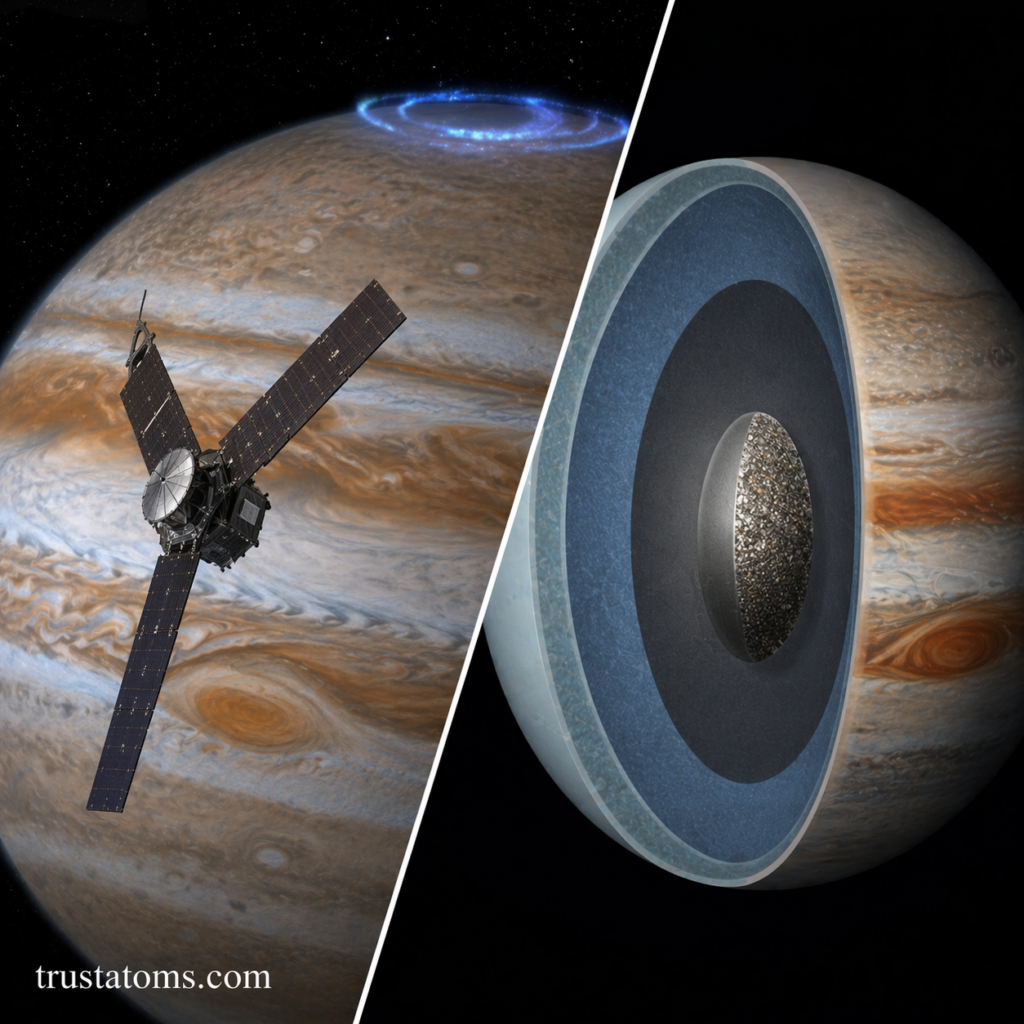
Since 2016, Juno has made groundbreaking discoveries that challenged previous assumptions about Jupiter.
1. Jupiter’s Core Is “Fuzzy”
Scientists expected a solid core, but Juno revealed:
- A diffuse, partially mixed core
- Heavy elements spread throughout the interior
This suggests Jupiter may have formed through massive collisions early in its history.
2. Powerful and Complex Magnetic Field
Juno discovered that Jupiter’s magnetic field is:
- Stronger than expected
- Uneven and highly irregular
- Concentrated in certain regions
This indicates a more complex internal dynamo than previously thought.
3. Massive Polar Cyclones
At Jupiter’s poles, Juno found:
- Giant storms arranged in geometric patterns
- Persistent cyclones lasting years
- Storms larger than Earth itself
These polar weather systems are unlike anything seen on other planets.
4. Deep Atmospheric Layers
Juno’s instruments revealed that:
- Jupiter’s weather extends thousands of miles deep
- Jet streams penetrate far below the visible clouds
- The atmosphere is more dynamic than expected
Juno’s Stunning Contributions to Space Imaging
Although Juno is primarily a science mission, its onboard camera has captured some of the most breathtaking images of Jupiter ever seen.
What Makes JunoCam Special
- Provides high-resolution views of cloud formations
- Reveals swirling storms and colorful bands
- Engages the public through citizen science
These images have helped both scientists and the public visualize Jupiter in unprecedented detail.
Challenges of the Mission
Studying Jupiter is extremely difficult due to its harsh environment.
Major Obstacles
- Intense radiation belts that can damage electronics
- Extreme gravitational forces
- Vast distance from Earth (communication delays)
To survive, Juno is equipped with:
- Radiation shielding
- Autonomous systems
- Precision navigation technology
Extended Mission and Future Goals
Originally planned for a shorter duration, the Juno mission has been extended due to its success.
New Areas of Study
- Jupiter’s moons, including Ganymede and Europa
- Continued monitoring of atmospheric changes
- Deeper analysis of magnetic and gravitational fields
Juno continues to provide valuable data that shapes future space missions.
Why the Juno Mission Matters
The Juno Mission is more than just a study of Jupiter—it’s a window into the origins of planetary systems.
Key Takeaways
- Helps explain how gas giants form
- Improves understanding of planetary atmospheres
- Provides insights into magnetic field generation
- Supports future exploration of outer planets
Final Thoughts
The Juno Mission to Jupiter has redefined what we know about the solar system’s largest planet. From uncovering a “fuzzy” core to mapping powerful storms and magnetic fields, Juno continues to push the boundaries of space science.
As it orbits high above Jupiter’s clouds, Juno reminds us that even the most familiar planets still hold mysteries waiting to be discovered.