Microgravity experiments are among the most valuable scientific activities conducted in space. By studying how materials, living organisms, fluids, and physical systems behave in near-weightless conditions, scientists gain insights that are difficult or impossible to achieve on Earth.
Space stations such as the International Space Station (ISS) serve as orbital laboratories where astronauts and researchers perform experiments in biology, medicine, physics, engineering, and materials science.
Microgravity research not only improves our understanding of life and physics in space but also contributes to advances in healthcare, manufacturing, agriculture, and future deep-space exploration.
This guide explores what microgravity is, how microgravity experiments work, major research areas, and why these studies are important for science and humanity.
What Is Microgravity?
Microgravity is a condition in which objects experience very weak apparent gravity.
Astronauts aboard orbiting spacecraft often appear weightless because they are continuously falling around Earth while remaining in orbit.
Although gravity still exists in orbit, the constant free-fall environment creates the sensation of near-weightlessness.
This environment changes how:
- Fluids move
- Flames burn
- Cells grow
- Materials form
- Human bodies function
These changes make microgravity ideal for unique scientific experiments.
Why Scientists Conduct Microgravity Experiments
Many natural processes on Earth are strongly influenced by gravity.
In microgravity, researchers can isolate other physical effects and observe behaviors hidden under Earth’s gravitational forces.
Microgravity experiments help scientists:
- Understand fundamental physics
- Improve medical treatments
- Develop advanced materials
- Study human adaptation to space
- Prepare for long-duration missions
The results often benefit both space exploration and life on Earth.
Where Microgravity Experiments Are Performed
International Space Station (ISS)
The ISS is the primary laboratory for long-duration microgravity research.
Astronauts aboard the station conduct experiments involving:
- Biology
- Physics
- Chemistry
- Human health
- Robotics
- Agriculture
Because the ISS remains in orbit continuously, it allows experiments to run for weeks, months, or even years.
Parabolic Flights
Special aircraft perform steep flight maneuvers that create short periods of weightlessness.
These flights provide researchers with brief opportunities to test equipment and conduct short experiments.
Drop Towers
Drop towers create temporary microgravity conditions by allowing experiment chambers to fall freely for a few seconds.
Scientists use these facilities for rapid testing and educational research.
Sounding Rockets
Suborbital rockets can provide several minutes of microgravity during flight.
These missions allow researchers to perform experiments above Earth’s atmosphere without full orbital missions.
Types of Microgravity Experiments
Microgravity research covers many scientific fields.
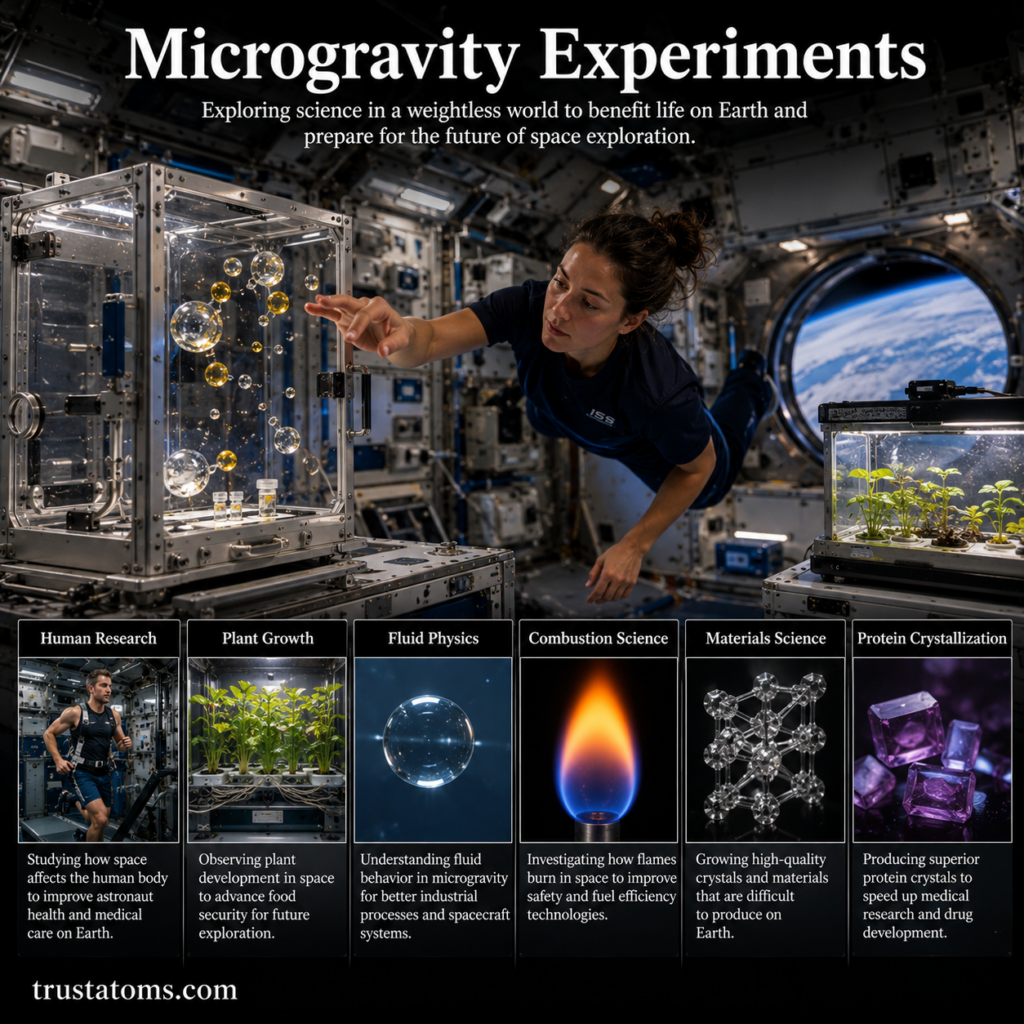
Human Biology Experiments
One major focus is understanding how space affects the human body.
Researchers study:
- Muscle loss
- Bone density reduction
- Immune system changes
- Cardiovascular adaptation
- Sleep patterns
- Vision changes
This research helps protect astronauts during long missions while also improving healthcare knowledge on Earth.
Plant Growth Experiments
Scientists study how plants grow in space to support future long-duration missions.
Research areas include:
- Root development
- Water distribution
- Nutrient absorption
- Pollination
- Crop sustainability
Space agriculture may eventually support lunar bases and Mars habitats.
Fluid Physics Experiments
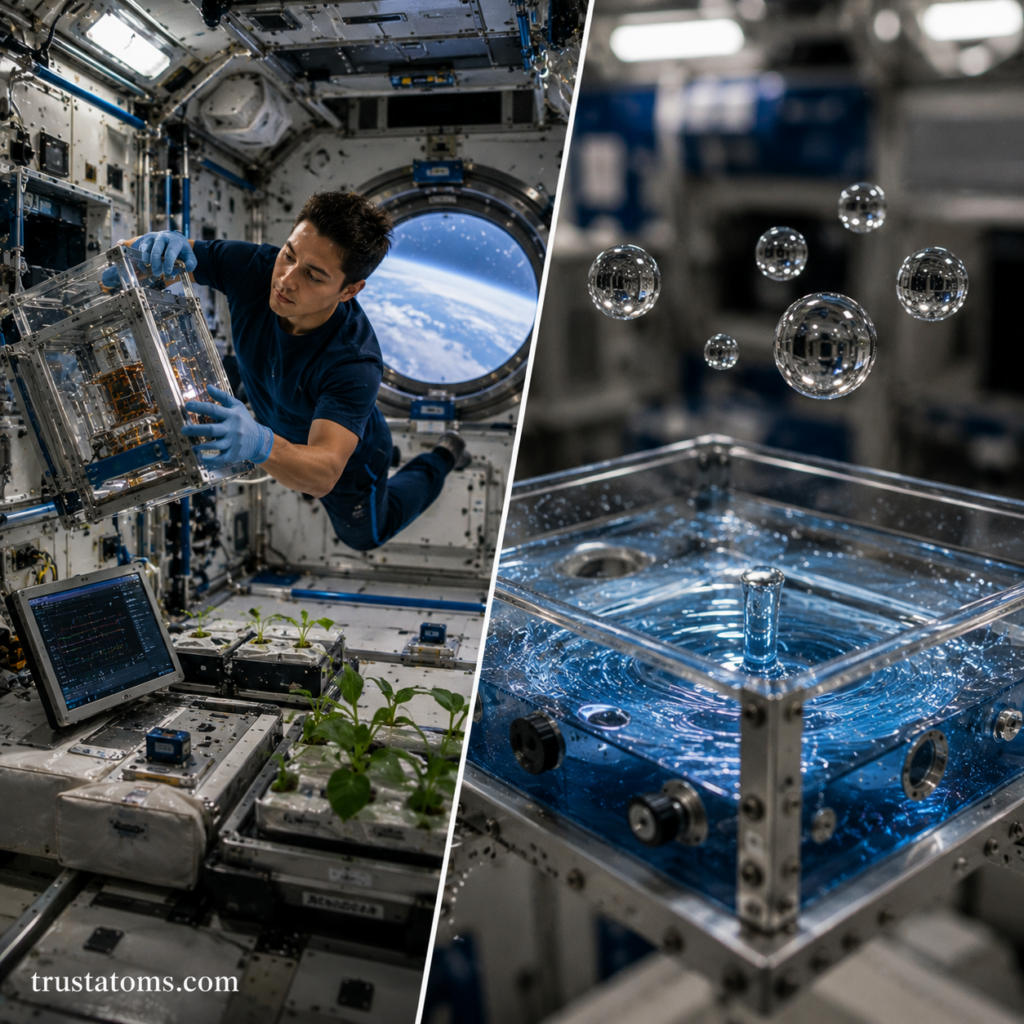
On Earth, gravity strongly affects how liquids behave.
In microgravity, fluids move differently because buoyancy and sedimentation are reduced.
Researchers study:
- Surface tension
- Bubble formation
- Fluid mixing
- Fuel behavior
- Cooling systems
These experiments help improve spacecraft engineering and industrial technologies.
Combustion Experiments
Fire behaves differently in microgravity.
Flames may become:
- More spherical
- Cooler
- Slower burning
Researchers study combustion to improve:
- Fire safety systems
- Fuel efficiency
- Engine technologies
Understanding fire in space is essential for astronaut safety.
Materials Science Experiments
Microgravity allows scientists to create and study materials without gravity-driven distortion.
Research includes:
- Crystal growth
- Alloy formation
- Semiconductor manufacturing
- Fiber optics development
Some materials formed in microgravity may have unique properties difficult to reproduce on Earth.
Protein Crystal Research
Microgravity can improve the growth of protein crystals used in medical research.
Better crystal structures help scientists understand diseases and design medications more effectively.
This research may contribute to future treatments for various illnesses.
How Microgravity Affects the Human Body
Human bodies evolved under Earth’s gravity.
In space, astronauts experience many physical changes.
Muscle Atrophy
Without gravity, muscles do less work and begin weakening over time.
Astronauts must exercise regularly to reduce muscle loss.
Bone Density Loss
Bones gradually lose minerals in microgravity because they no longer support body weight normally.
This can increase fracture risks after long missions.
Fluid Shifts
Fluids move upward in the body during microgravity exposure.
This can cause:
- Facial swelling
- Pressure changes
- Vision issues
Researchers continue studying these effects.
Balance and Coordination Changes
The inner ear relies on gravity for orientation.
Microgravity affects balance and spatial awareness, especially during the first days of a mission.
Technology Used in Microgravity Research
Microgravity experiments require specialized equipment designed for space conditions.
Research Modules
Space stations contain laboratory modules with advanced experiment systems.
These modules support:
- Biological research
- Physics experiments
- Chemical studies
- Material testing
Automated Experiment Systems
Some experiments operate automatically with minimal astronaut involvement.
Automation helps researchers conduct long-duration studies efficiently.
Remote Monitoring
Scientists on Earth monitor many experiments remotely using spacecraft communication systems.
This allows researchers worldwide to participate in space-based science.
Challenges of Conducting Experiments in Space
Microgravity research presents unique difficulties.
Limited Space and Resources
Spacecraft have limited room, power, and equipment capacity.
Experiments must be carefully designed to maximize efficiency.
Equipment Reliability
Repairs can be difficult in orbit.
Scientific systems must function reliably for long periods.
Launch Constraints
Experiments must survive:
- Rocket vibrations
- Acceleration forces
- Temperature changes
Equipment design is critical for mission success.
Crew Time Limitations
Astronauts have demanding schedules.
Researchers must plan experiments carefully to use crew time efficiently.
Benefits of Microgravity Research on Earth
Space-based experiments often lead to Earth-based innovations.
Medical Advances
Research contributes to:
- Osteoporosis studies
- Muscle degeneration research
- Drug development
- Cardiovascular understanding
Improved Materials
Microgravity research may help create stronger or more efficient materials for industries on Earth.
Water and Air Systems
Life support technologies developed for spacecraft often improve:
- Water purification
- Air filtration
- Recycling systems
These technologies can support remote or disaster-prone regions on Earth.
Future of Microgravity Experiments
Microgravity research is expected to expand significantly in coming decades.
Commercial Space Laboratories
Private companies are developing commercial orbital laboratories for research and manufacturing.
This may increase access to space-based science.
Lunar and Mars Research
Future habitats on the Moon and Mars will provide opportunities to study reduced-gravity environments.
Scientists will investigate how partial gravity affects:
- Human health
- Agriculture
- Construction
- Industrial systems
Long-Duration Human Research
As missions become longer, understanding human adaptation to space becomes even more important.
Future research will focus heavily on sustaining human life during deep-space exploration.
The Importance of Microgravity Experiments
Microgravity experiments help scientists understand both space and Earth more deeply.
These studies contribute to:
- Human space exploration
- Medicine
- Engineering
- Environmental science
- Industrial innovation
Many discoveries made in orbit eventually benefit people on Earth through improved technology and scientific understanding.
Final Thoughts
Microgravity experiments provide scientists with unique opportunities to study how life, materials, and physical systems behave in near-weightless environments.
From human health research and plant growth studies to fluid physics and advanced material development, microgravity science plays a major role in both modern space exploration and technological advancement.
As humanity prepares for longer missions and permanent habitats beyond Earth, microgravity research will remain essential for improving astronaut safety, developing sustainable systems, and expanding scientific knowledge throughout the solar system.