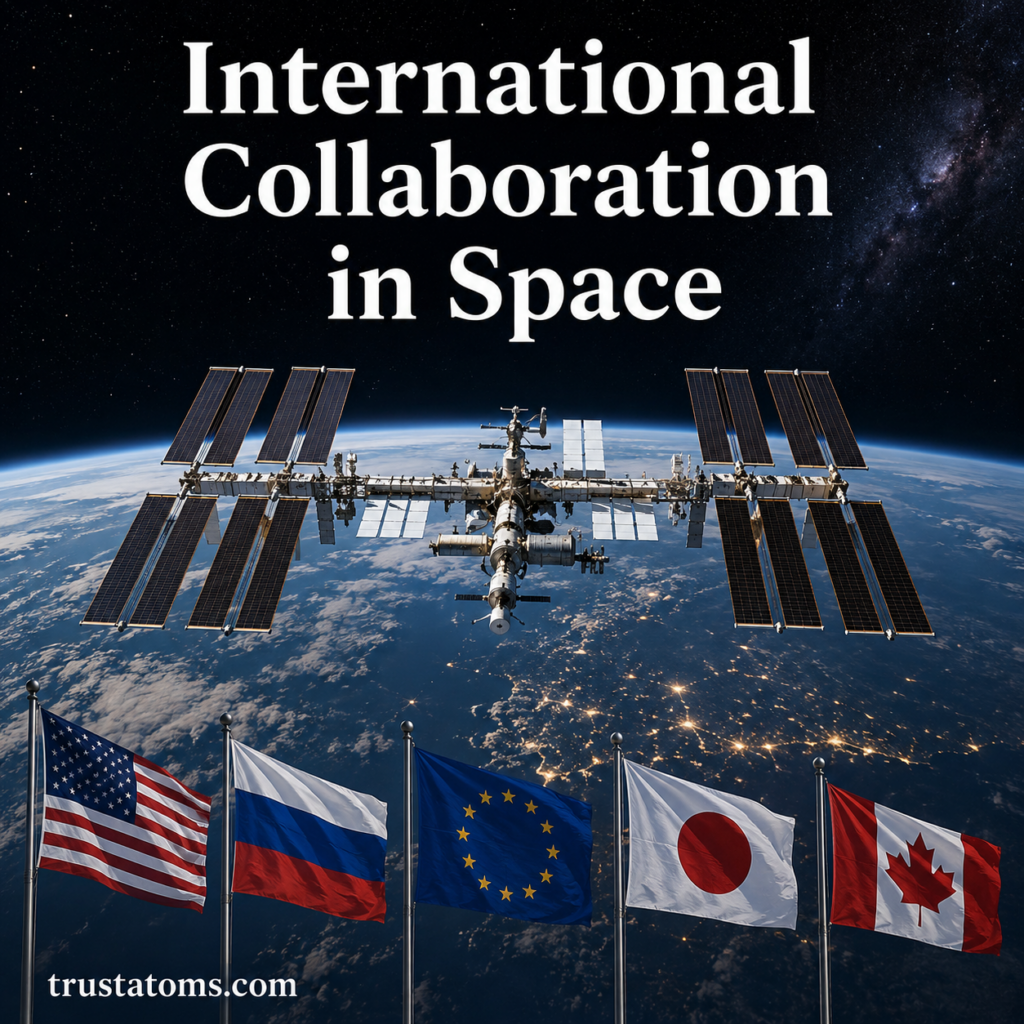
Space exploration has evolved from a competition between nations into one of humanity’s greatest examples of international teamwork. Modern space missions often involve multiple countries, agencies, universities, and private companies working together to share knowledge, reduce costs, and solve complex scientific challenges.
From orbiting laboratories to deep-space telescopes, international collaboration in space has helped advance science, strengthen diplomacy, and expand our understanding of the universe. As missions become more ambitious and expensive, cooperation between nations is becoming increasingly important for the future of astronomy and space exploration.
Why International Collaboration Matters in Space
Space missions are incredibly complex and costly. Building spacecraft, training astronauts, launching rockets, and maintaining scientific instruments require enormous resources.
By working together, countries can:
- Share financial costs
- Combine scientific expertise
- Reduce duplication of effort
- Improve mission safety
- Access advanced technology
- Strengthen peaceful global relationships
International partnerships also allow scientists from around the world to contribute ideas and discoveries that benefit all of humanity.
The History of Space Cooperation
Early Competition During the Space Race
In the 1950s and 1960s, space exploration was largely driven by rivalry between the United States and the Soviet Union during the Cold War.
Major milestones included:
- Launch of Sputnik 1 in 1957
- Yuri Gagarin becoming the first human in space
- The Apollo Moon landings
Although competition accelerated technological progress, cooperation was limited during this period.
The Shift Toward Cooperation
By the 1970s, countries began recognizing the benefits of working together.
One important milestone was the Apollo-Soyuz Test Project in 1975, where American and Soviet spacecraft docked in orbit. This mission symbolized a move toward peaceful cooperation in space.
Since then, international partnerships have become a central part of many major space programs.
The International Space Station (ISS)
One of the greatest examples of global teamwork in space is the International Space Station.
Countries Involved
The ISS is a partnership between:
- NASA (United States)
- Roscosmos (Russia)
- ESA (European Space Agency)
- JAXA (Japan Aerospace Exploration Agency)
- CSA (Canadian Space Agency)
Astronauts and researchers from many additional countries have also participated in ISS missions.
What the ISS Does
The ISS serves as:
- A scientific research laboratory
- A technology testing platform
- A long-duration human spaceflight experiment
- A center for international cooperation
Research aboard the ISS includes:
- Human health in microgravity
- Astronomy observations
- Materials science
- Plant growth experiments
- Climate monitoring
The station has continuously hosted astronauts since 2000, making it one of the longest-running cooperative scientific projects in history.
International Partnerships in Astronomy
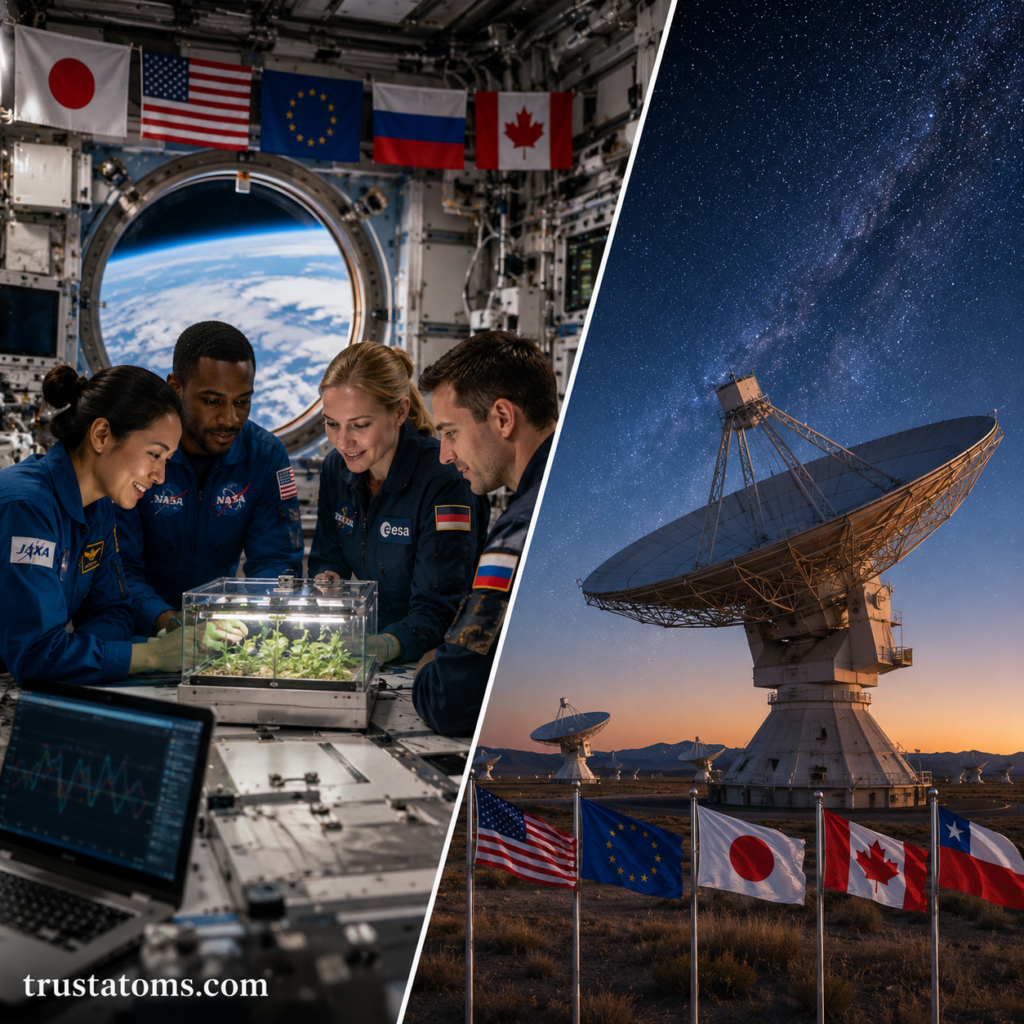
Modern astronomy often relies on large-scale international cooperation because advanced observatories are expensive and technically demanding.
Space Telescopes
Several major space telescopes involve contributions from multiple nations.
Hubble Space Telescope
The Hubble Space Telescope was primarily developed by NASA with important support from the European Space Agency.
Hubble has transformed astronomy by helping scientists:
- Measure the age of the universe
- Study distant galaxies
- Observe black holes
- Discover exoplanets
James Webb Space Telescope
The James Webb Space Telescope is another major collaborative mission involving:
- NASA
- ESA
- CSA
Different agencies contributed instruments, launch support, engineering expertise, and operational assistance.
The telescope is helping scientists study:
- Early galaxy formation
- Planetary atmospheres
- Star birth regions
- Potentially habitable worlds
International Lunar Exploration
Many countries are now participating in renewed Moon exploration efforts.
Artemis Program
NASA’s Artemis program aims to return humans to the Moon and establish long-term lunar exploration.
International partners include:
- Canada
- Japan
- European nations
- Australia and others
The Artemis Accords establish guidelines for peaceful cooperation, scientific transparency, and responsible exploration.
China’s Lunar Program
China has developed its own advanced lunar exploration missions and has collaborated with multiple countries on scientific payloads and experiments.
Future lunar projects may involve:
- Shared lunar bases
- Resource research
- International science stations
- Robotic cooperation missions
Mars Exploration and Global Science
Mars missions increasingly involve international scientific cooperation.
Shared Scientific Instruments
Different countries often contribute:
- Cameras
- Weather sensors
- Spectrometers
- Communication systems
- Landing technologies
This allows missions to collect more scientific data while reducing costs for individual agencies.
Global Research Teams
Scientists from around the world analyze Mars data together, leading to discoveries about:
- Ancient water on Mars
- Atmospheric changes
- Surface geology
- Potential habitability
International research teams often publish findings collaboratively.
Benefits of International Collaboration in Space
Faster Scientific Progress
When scientists share data and research, discoveries can happen more quickly.
Global collaboration improves:
- Data analysis
- Technology development
- Problem-solving
- Innovation
Reduced Costs
Large missions can cost billions of dollars.
Sharing expenses allows countries to participate in projects that might otherwise be too expensive independently.
Peaceful Diplomacy
Space cooperation can improve relationships between nations, even during political tensions on Earth.
Scientific partnerships often encourage:
- Communication
- Mutual trust
- Shared goals
- Cultural understanding
Educational Opportunities
International missions inspire students worldwide to pursue careers in:
- Astronomy
- Engineering
- Physics
- Robotics
- Computer science
Educational exchange programs also strengthen scientific communities globally.
Challenges of International Space Collaboration
Although cooperation offers many advantages, it also presents challenges.
Political Tensions
Changes in international relations can affect space partnerships.
Disagreements between governments may impact:
- Funding
- Technology sharing
- Joint missions
- Launch access
Technical Standards
Different countries may use different engineering systems and procedures.
Teams must coordinate:
- Software compatibility
- Safety protocols
- Communication standards
- Mission operations
Budget Differences
Economic conditions vary between countries, which can influence mission timelines and contributions.
Intellectual Property Concerns
Collaborative missions sometimes involve sensitive technology and research data, requiring careful agreements on sharing information.
The Role of Private Space Companies
Private aerospace companies are becoming major participants in international space activity.
Companies like:
- SpaceX
- Blue Origin
- Arianespace
- Rocket Lab
often work with multiple governments and scientific organizations.
Private companies help by:
- Reducing launch costs
- Developing reusable rockets
- Supporting satellite deployment
- Expanding access to space technology
This growing public-private partnership is reshaping the future of global space exploration.
Future International Space Projects
Lunar Bases
Future Moon bases may involve contributions from many countries, including shared habitats, scientific labs, and communication systems.
Mars Missions
Human missions to Mars will likely require massive international cooperation due to their complexity and cost.
Planetary Defense
Global cooperation is important for tracking asteroids and developing strategies to protect Earth from potential impacts.
Space Sustainability
Countries are increasingly working together to address:
- Space debris
- Satellite traffic management
- Orbital safety
- Responsible resource use
International agreements will play a major role in keeping space accessible for future generations.
How International Cooperation Benefits Humanity
Space collaboration does more than advance astronomy. It demonstrates what humanity can achieve when nations work together toward shared scientific goals.
International partnerships help:
- Expand scientific knowledge
- Improve global communication
- Encourage peaceful cooperation
- Inspire future generations
- Advance technologies used on Earth
Many everyday technologies, including satellite navigation, weather forecasting, and communication systems, benefit from cooperative space research.
Final Thoughts
International collaboration in space has become essential for modern astronomy and exploration. As missions grow larger and more complex, no single nation can easily accomplish every goal alone.
Projects like the International Space Station, global telescope partnerships, and future Moon and Mars missions show how scientific cooperation can unite countries in pursuit of discovery.
The future of space exploration will likely depend on even greater collaboration between governments, scientists, engineers, and private companies worldwide. By working together, humanity can continue exploring the universe while building stronger connections here on Earth.