One of the most important discoveries in modern astronomy is that the universe is expanding. Galaxies are not stationary—they are moving away from each other, and space itself is stretching over time.
This idea is not based on theory alone. It is supported by multiple lines of observational evidence collected over decades. Together, these observations form the foundation of modern cosmology.
What Does “Expansion of the Universe” Mean?
When scientists say the universe is expanding, they don’t mean galaxies are flying through empty space like debris from an explosion. Instead, space itself is expanding, carrying galaxies along with it.
Key Concept
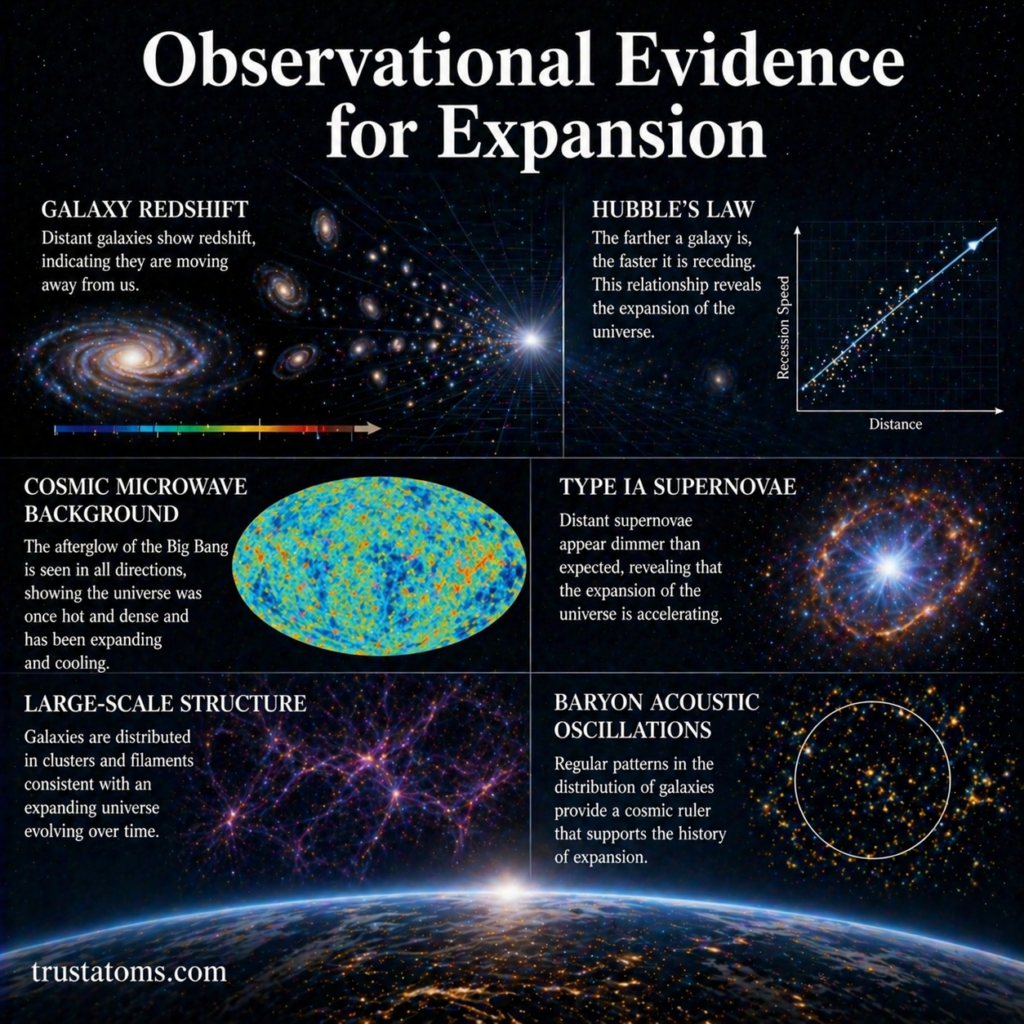
- The farther away a galaxy is, the faster it appears to move away
- This relationship is known as the expansion of space
This insight revolutionized our understanding of the cosmos.
Redshift: The First Major Clue
The strongest early evidence for expansion came from observing the light of distant galaxies.
What Is Redshift?
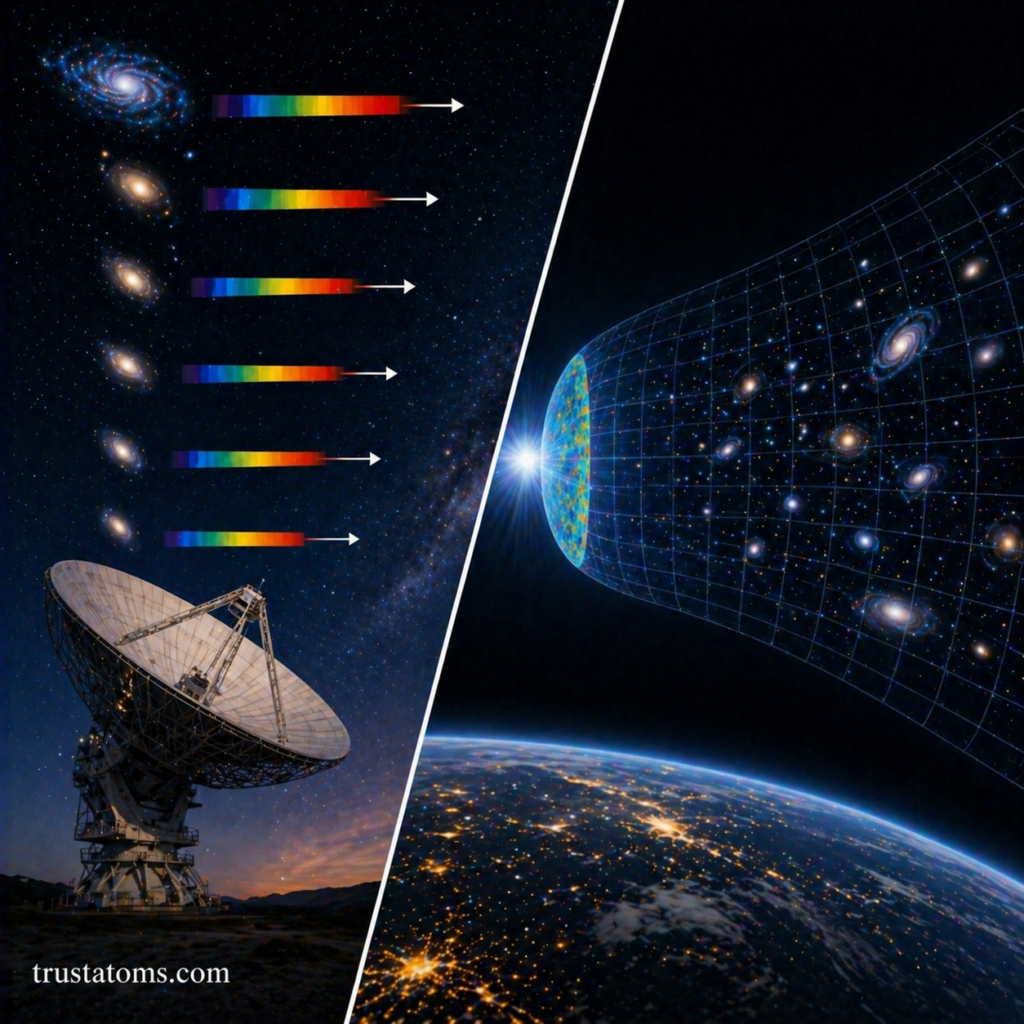
Redshift occurs when light stretches to longer (redder) wavelengths as objects move away.
How It Works
- Light from distant galaxies shifts toward the red end of the spectrum
- The amount of shift indicates how fast the galaxy is receding
- Greater distance = greater redshift
Why It Matters
Redshift shows that most galaxies are moving away from us, suggesting the universe is expanding in all directions.
Hubble’s Law
The relationship between distance and recession speed is described by Hubble’s Law.
Key Idea
- The farther a galaxy is, the faster it recedes
What This Means
- Expansion is uniform on large scales
- There is no central point of expansion
- Every observer sees other galaxies moving away
This discovery provided the first quantitative proof of expansion.
Cosmic Microwave Background (CMB)
Another major piece of evidence comes from the Cosmic Microwave Background.
What Is the CMB?
- Faint radiation left over from the early universe
- Detected in all directions
- Nearly uniform in temperature
Why It Supports Expansion
- Indicates the universe was once hot and dense
- Shows that it has cooled over time as it expanded
- Provides a snapshot of the universe about 380,000 years after its beginning
The CMB is one of the strongest confirmations of the expanding universe model.
Supernova Observations
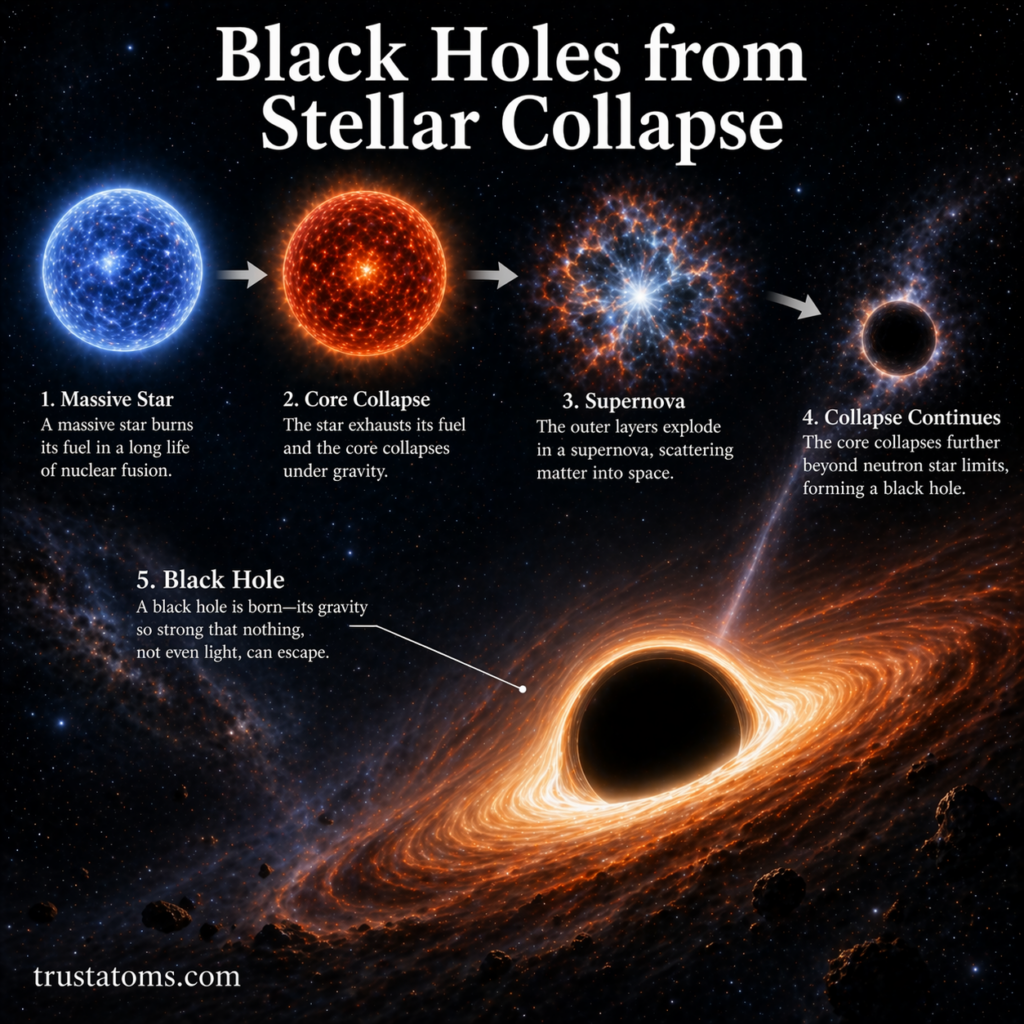
Type Ia supernovae provide crucial evidence for how expansion behaves over time.
Why Supernovae Are Useful
- They have consistent brightness (standard candles)
- Their distance can be accurately measured
What Observations Show
- Distant supernovae are dimmer than expected
- This suggests the universe’s expansion is accelerating
Key Discovery
This led to the conclusion that dark energy is driving accelerated expansion.
Large-Scale Structure of the Universe
The distribution of galaxies also supports expansion.
Observational Evidence
- Galaxies are arranged in clusters and filaments
- These structures formed over time as the universe expanded
- Simulations of expansion match observed structures
The large-scale structure aligns with predictions from expansion models.
Baryon Acoustic Oscillations (BAO)
Another important line of evidence comes from patterns in galaxy distribution.
What Are BAO?
- Regular spacing patterns in galaxy clusters
- Caused by sound waves in the early universe
Why They Matter
- Provide a “standard ruler” for measuring cosmic distances
- Confirm expansion history over time
These patterns offer independent verification of expansion models.
Time Dilation in Distant Objects
Expansion affects not just space, but also how we observe time.
What Scientists Observe
- Light from distant supernovae appears stretched in time
- Events take longer to unfold compared to nearby ones
Why This Happens
- Expansion stretches both light and time intervals
- This effect is consistent with an expanding universe
Key Takeaways
- Redshift shows galaxies are moving away from us
- Hubble’s Law links distance and recession speed
- The Cosmic Microwave Background confirms an early hot universe
- Supernova observations reveal accelerating expansion
- Large-scale structure and BAO support expansion models
- Time dilation provides additional confirmation
Final Thoughts
The expansion of the universe is one of the most well-supported ideas in modern science. Multiple independent observations—from galaxy redshifts to cosmic background radiation—point to the same conclusion: the universe is growing over time.
As new technologies improve our ability to observe distant objects, scientists continue refining measurements of expansion, uncovering deeper insights into the universe’s past, present, and future.