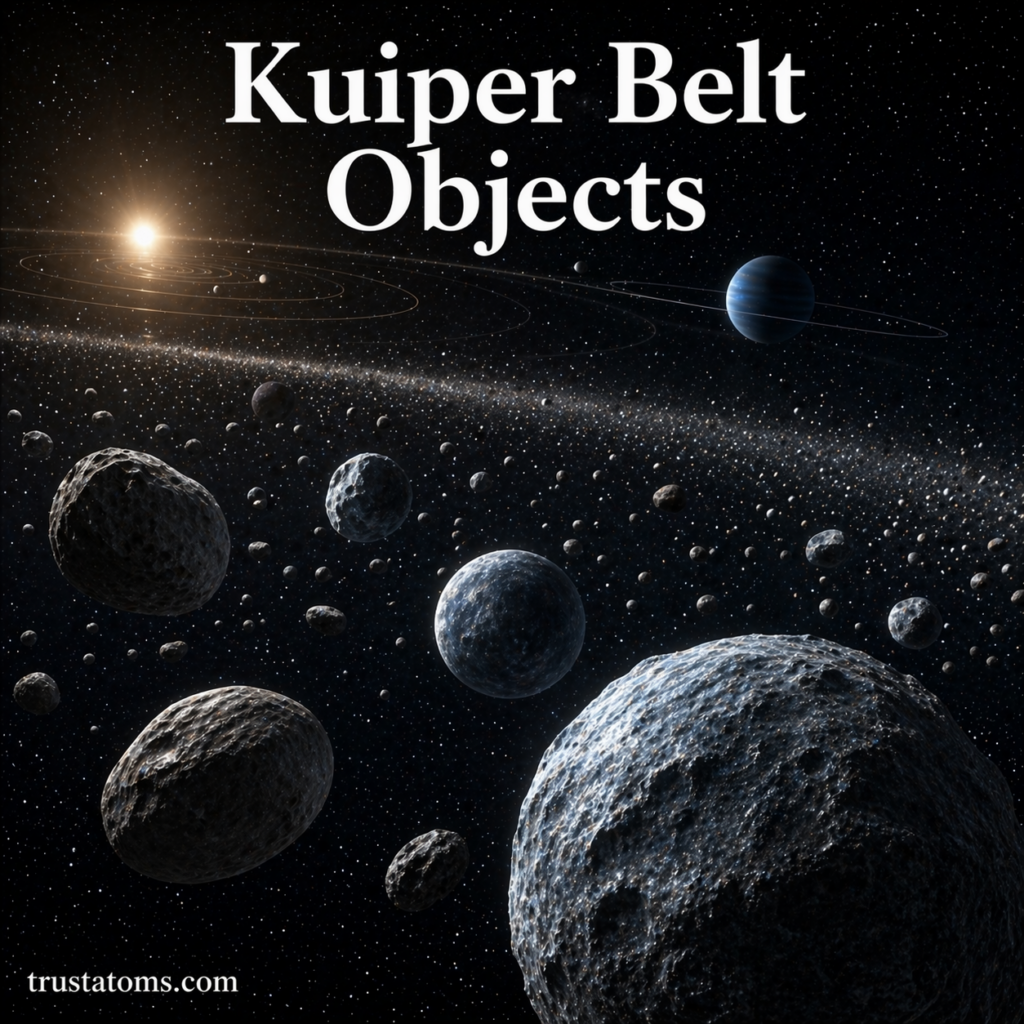
Far beyond the orbit of Neptune lies a vast region filled with icy remnants from the early solar system. This region, known as the Kuiper Belt, is home to a diverse group of celestial bodies called Kuiper Belt Objects (KBOs).
These distant objects offer valuable insights into how our solar system formed and evolved. In this guide, you’ll learn what Kuiper Belt Objects are, their characteristics, and why they matter in modern astronomy.
What Is the Kuiper Belt?
The Kuiper Belt is a disk-shaped region of space that extends beyond Neptune’s orbit, roughly from 30 to 55 astronomical units (AU) from the Sun.
It contains millions of icy objects, ranging from small comet-like bodies to dwarf planets.
Key Features of the Kuiper Belt
- Located beyond Neptune
- Composed mainly of ice and rock
- Much larger and more massive than the asteroid belt
- Source of many short-period comets
What Are Kuiper Belt Objects (KBOs)?
Kuiper Belt Objects are the icy bodies that inhabit this distant region. They are considered leftovers from the formation of the solar system about 4.6 billion years ago.
Composition of KBOs
- Water ice
- Methane and ammonia ice
- Rocky material
- Organic compounds
Because they formed far from the Sun, these objects retained volatile substances that would have evaporated closer in.
Types of Kuiper Belt Objects
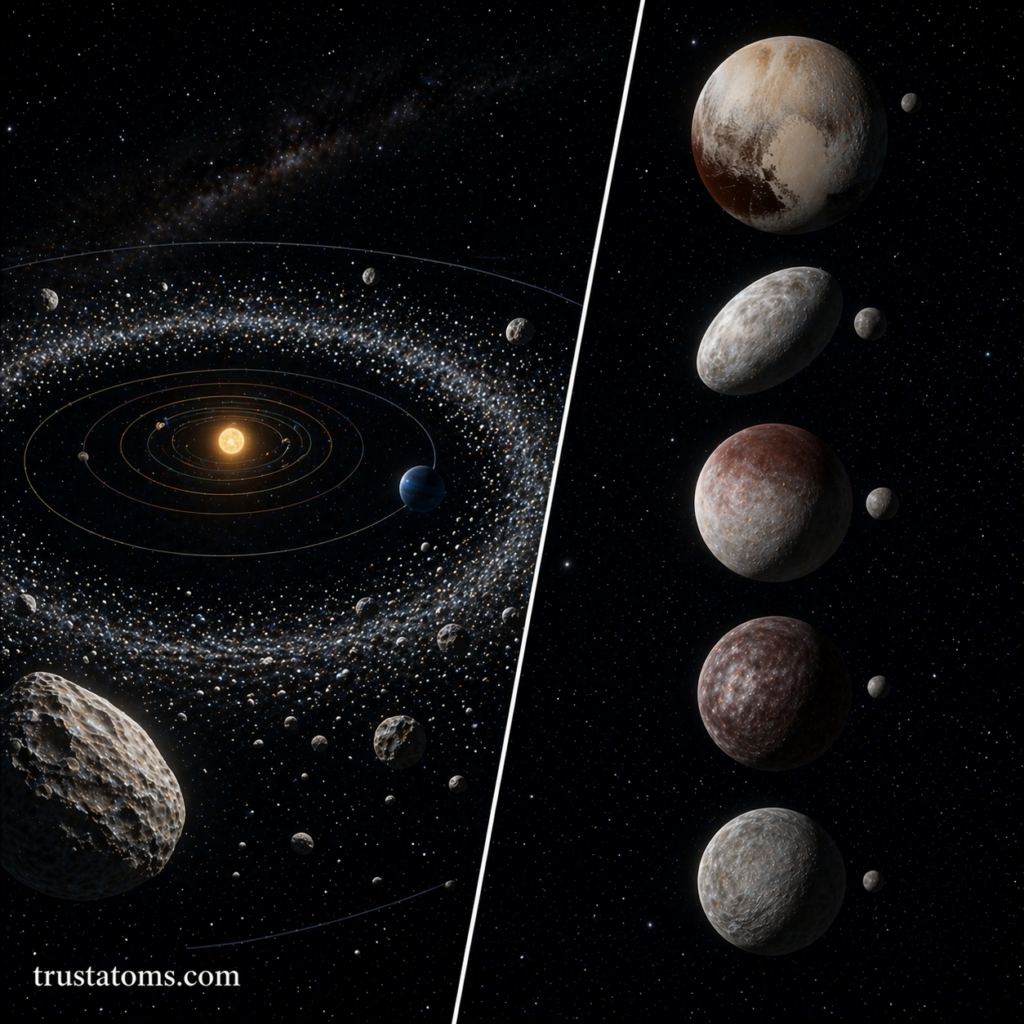
Astronomers classify KBOs based on their orbital behavior and relationship with Neptune.
1. Classical Kuiper Belt Objects
- Stable, nearly circular orbits
- Not strongly influenced by Neptune
- Sometimes called “cold classicals”
These objects are thought to be the most pristine remnants of the early solar system.
2. Resonant Objects
- Locked in orbital resonance with Neptune
- Their orbits are stabilized by gravitational interactions
The most famous example is Pluto, which is in a 3:2 resonance with Neptune.
3. Scattered Disk Objects
- Highly elliptical and tilted orbits
- Strongly influenced by Neptune’s gravity
- Can travel far beyond the Kuiper Belt
These objects are more dynamic and less stable than other KBOs.
Dwarf Planets in the Kuiper Belt
Some of the largest Kuiper Belt Objects are classified as dwarf planets.
Notable Examples
- Pluto
- Haumea
- Makemake
These objects are large enough to be spherical but have not cleared their orbital neighborhoods.
How Kuiper Belt Objects Move
KBOs follow a wide variety of orbital paths.
Orbital Characteristics
- Generally lie in the same plane as the planets
- Can have circular or highly elliptical orbits
- Orbital periods can range from decades to thousands of years
Their motion is heavily influenced by Neptune’s gravity, which shapes their long-term stability.
Why Kuiper Belt Objects Are Important
Kuiper Belt Objects are considered cosmic “time capsules” because they have remained relatively unchanged since the solar system formed.
Scientific Importance
- Preserve early solar system materials
- Help scientists understand planetary formation
- Provide clues about the migration of giant planets
Studying KBOs allows astronomers to test theories about how the outer solar system evolved.
Kuiper Belt and Comets
Many short-period comets originate from the Kuiper Belt.
When gravitational interactions disturb KBOs, they can be sent toward the inner solar system, becoming visible comets.
This connection makes the Kuiper Belt a key source of cometary activity.
Exploration of the Kuiper Belt
Direct exploration of the Kuiper Belt is challenging due to its distance. However, space missions have provided valuable data.
The New Horizons mission, launched by NASA, gave humanity its first close-up look at Pluto and later visited other Kuiper Belt Objects.
What We’ve Learned
- KBOs have diverse surfaces and compositions
- Some show signs of geological activity
- Many have moons or binary companions
These discoveries have reshaped our understanding of the outer solar system.
Common Misconceptions About the Kuiper Belt
“It’s the edge of the solar system”
The Kuiper Belt is just one region. Beyond it lies the distant Oort Cloud.
“All objects are small and similar”
KBOs vary greatly in size, shape, and composition.
“Pluto is the only major object”
Pluto is just one of many large bodies in this region.
Final Thoughts
Kuiper Belt Objects represent one of the most important frontiers in astronomy. These icy remnants provide a direct link to the early solar system, helping scientists understand how planets formed and migrated over time.
As exploration continues, the Kuiper Belt will likely reveal even more surprises—reshaping our view of the solar system and its distant boundaries.