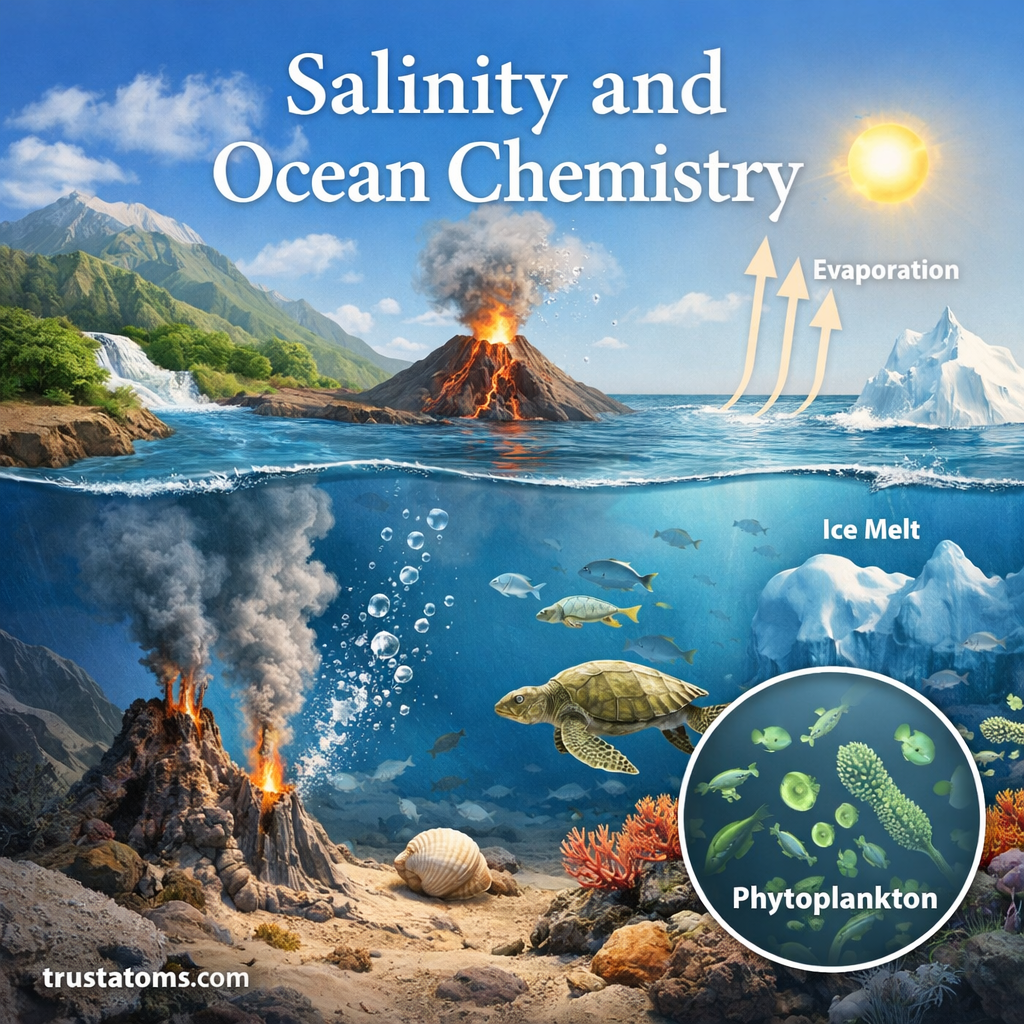
The ocean isn’t just water—it’s a complex chemical system filled with dissolved salts, minerals, gases, and nutrients that support life on Earth.
Salinity, or the concentration of dissolved salts in seawater, plays a crucial role in ocean circulation, marine ecosystems, and even global climate patterns. Understanding ocean chemistry helps explain everything from why the ocean is salty to how life thrives beneath the surface.
What Is Salinity?
Salinity refers to the total amount of dissolved salts in seawater, usually measured in parts per thousand (‰ or ppt).
On average, ocean water has a salinity of about 35 ppt, meaning there are 35 grams of dissolved salts in every kilogram of seawater.
What Makes Up Ocean Salts?
The majority of ocean salinity comes from a few key ions:
- Chloride (Cl⁻)
- Sodium (Na⁺)
- Sulfate (SO₄²⁻)
- Magnesium (Mg²⁺)
- Calcium (Ca²⁺)
- Potassium (K⁺)
Together, sodium and chloride form common table salt (NaCl), which makes up about 85% of all dissolved salts in the ocean.
Where Do Ocean Salts Come From?
Salts in the ocean originate from both land and the seafloor.
1. Weathering of Rocks (Primary Source)
- Rainwater absorbs carbon dioxide from the atmosphere, forming weak carbonic acid.
- This acidic water breaks down rocks on land.
- Minerals and ions are carried by rivers into the ocean.
2. Hydrothermal Vents
- Located along mid-ocean ridges
- Release dissolved minerals directly from Earth’s interior
- Add elements like iron, manganese, and sulfur
3. Volcanic Activity
- Underwater volcanoes release gases and minerals
- Contribute additional chemical components to seawater
Why Doesn’t the Ocean Keep Getting Saltier?
At first glance, it might seem like salinity should continuously increase—but it remains relatively stable over time.
This balance is maintained through:
- Biological processes: Marine organisms use ions like calcium to build shells and skeletons
- Chemical reactions: Some salts precipitate and settle on the ocean floor
- Sedimentation: Minerals become trapped in sediments over long periods
This dynamic balance is known as a steady-state system.
Factors That Affect Salinity
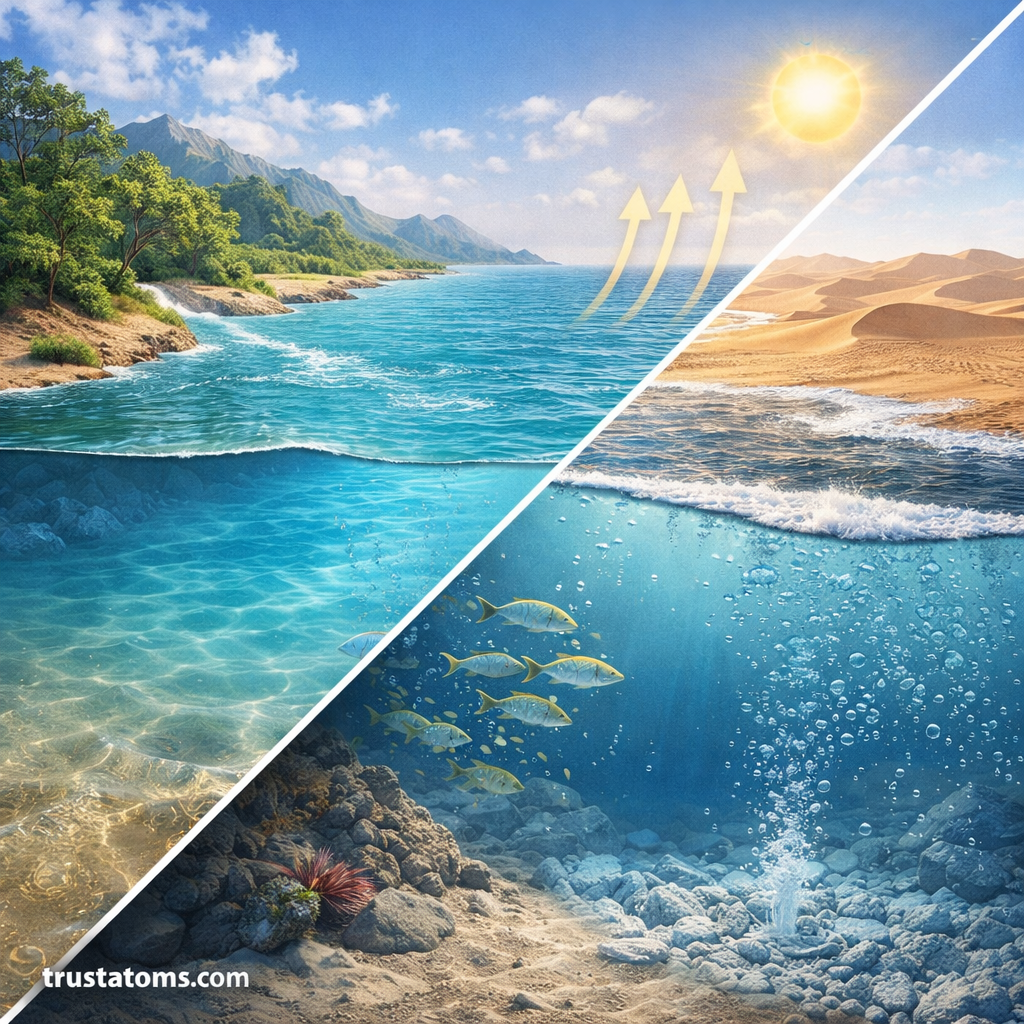
Salinity is not uniform across the ocean. It varies depending on environmental conditions.
Evaporation
- Removes water but leaves salts behind
- Increases salinity
- Common in warm, dry regions
Precipitation
- Adds fresh water
- Dilutes seawater
- Decreases salinity
River Input
- Freshwater from rivers lowers salinity near coastlines
Ice Formation and Melting
- When sea ice forms, salt is left behind, increasing surrounding salinity
- When ice melts, it dilutes seawater
Ocean Chemistry Beyond Salt
Salinity is just one part of a broader chemical system.
Dissolved Gases
The ocean contains important gases such as:
- Oxygen (O₂) — essential for marine life
- Carbon dioxide (CO₂) — plays a role in regulating Earth’s climate
Oceans absorb large amounts of CO₂ from the atmosphere, helping to moderate global temperatures.
Nutrients
Key nutrients support marine ecosystems:
- Nitrogen (N)
- Phosphorus (P)
- Silicon (Si)
These nutrients are essential for phytoplankton, the foundation of the ocean food web.
pH and Ocean Acidity
Ocean water is slightly alkaline, with an average pH of about 8.1.
However, increasing atmospheric CO₂ leads to more CO₂ dissolving in seawater, forming carbonic acid. This process lowers pH and contributes to ocean acidification.
Effects of ocean acidification include:
- Difficulty for organisms to build shells and skeletons
- Disruption of marine food chains
- Potential impacts on fisheries and ecosystems
Why Salinity Matters
Salinity is a key driver of ocean processes and global systems.
Ocean Circulation
Differences in salinity and temperature affect water density, which drives thermohaline circulation—a global system of deep ocean currents.
This circulation helps:
- Distribute heat around the planet
- Regulate climate
- Transport nutrients and oxygen
Marine Life Adaptation
Marine organisms are adapted to specific salinity ranges.
- Fish regulate internal salt levels through osmoregulation
- Coral reefs thrive in stable salinity conditions
- Estuarine species tolerate wide salinity variations
Changes in salinity can stress or even harm marine ecosystems.
Climate Influence
Salinity patterns influence:
- Rainfall distribution
- Ocean-atmosphere interactions
- Climate systems such as El Niño and La Niña
Even small changes in salinity can signal shifts in global climate patterns.
How Scientists Measure Salinity
Modern oceanographers use advanced tools to measure salinity accurately.
Common Methods
- CTD sensors (Conductivity, Temperature, Depth)
- Satellite observations
- Water sampling and laboratory analysis
Conductivity is often used because saltier water conducts electricity more efficiently.
Real-World Examples of Salinity Variation
High Salinity Areas
- Subtropical regions with high evaporation
- Enclosed seas like the Red Sea
Low Salinity Areas
- Polar regions due to melting ice
- Coastal areas with large river inputs
- Regions with heavy rainfall
These variations help scientists track environmental changes and ocean health.
Final Thoughts
Salinity and ocean chemistry are fundamental to understanding how Earth’s oceans function. From regulating climate to supporting marine life, the balance of salts, gases, and nutrients shapes the ocean’s role in the global system.
As human activity continues to influence ocean chemistry—especially through increased carbon emissions—understanding these processes becomes more important than ever.