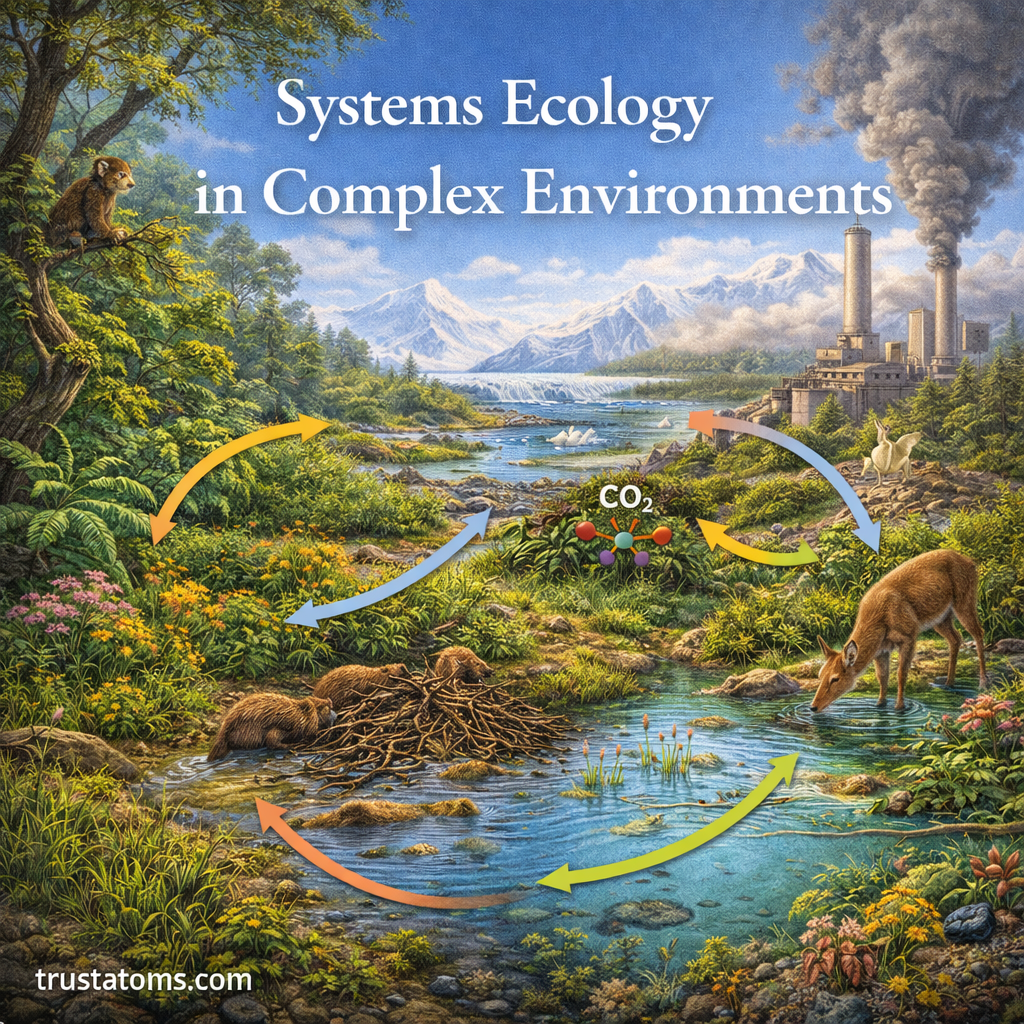
Systems ecology is the study of how the different parts of an ecosystem work together as one interconnected system. It examines how living organisms, physical environments, energy, and nutrients interact to shape the behavior of entire ecosystems. This approach combines ideas from the science of biology with mathematics, environmental science, and systems thinking.
Ecosystems are made up of many interconnected parts, including living organisms, physical environments, and the energy and nutrients that move between them. Systems ecology is the scientific approach that studies ecosystems as integrated systems rather than isolated components, building on the principles of ecology and environmental interactions.
For example, a change in rainfall can affect plant growth, which influences herbivore populations, predators, soil nutrients, and water availability. Systems ecology helps scientists trace these connections and investigate how changes spread through complex environments.
What Is Systems Ecology?
Systems ecology is a branch of ecology that investigates ecosystems as networks of interacting components. Instead of studying a species or environmental factor in isolation, researchers examine relationships among organisms, resources, and physical conditions.
The approach often uses diagrams, mathematical equations, and computer models to represent how ecosystems function. Researchers can then explore what might happen when temperature, population size, nutrient availability, or another condition changes.
A related field, Functional Ecology, investigates how the characteristics and activities of organisms influence ecological processes, providing information that systems ecologists can incorporate into broader models.
The Living and Nonliving Parts of an Ecosystem
Ecological systems contain two broad categories of components: biotic and abiotic. Both must be considered to understand how an ecosystem operates.
Biotic Components
Biotic components are the living parts of an ecosystem, including plants, animals, fungi, bacteria, and other microorganisms. They interact through feeding, competition, decomposition, and sometimes mutually beneficial relationships.
In a forest, trees provide food and shelter, insects consume vegetation, birds feed on insects, and fungi break down dead organic matter. Changes affecting one group can influence several others.
Abiotic Components
Abiotic components are nonliving environmental factors such as sunlight, water, temperature, soil minerals, atmospheric gases, and physical terrain. They determine many of the conditions under which organisms survive.
For example, a prolonged drought reduces soil moisture and can limit plant growth. That reduction may affect food availability, animal populations, decomposition rates, and the movement of nutrients through the ecosystem.
How Energy Moves Through Ecological Systems
Energy flows through ecosystems as organisms obtain and use resources. In most ecosystems, sunlight is the primary energy source. Plants and other photosynthetic organisms capture solar energy and store some of it in organic compounds.
Energy then moves through feeding relationships:
- Primary producers, such as plants and algae, convert sunlight into chemical energy.
- Primary consumers, such as herbivores, obtain energy by eating producers.
- Secondary and higher-level consumers obtain energy by eating other organisms.
- Decomposers obtain energy from dead organisms and organic waste.
At each feeding level, organisms use energy for metabolism, movement, growth, and maintenance. Much of that energy eventually dissipates as heat, leaving less available to support organisms at higher trophic levels.
Unlike nutrients, energy is not continuously recycled through an ecosystem. A continuing energy supply is needed to sustain ecological activity.
How Nutrients Cycle Between Organisms and the Environment
Nutrients move repeatedly between living organisms and their surroundings. Plants absorb nutrients from soil or water, animals obtain them through food, and decomposers release nutrients from dead material and waste.
Systems ecologists examine several interconnected cycles:
- Carbon cycle: Carbon moves among organisms, the atmosphere, water, and geological reservoirs.
- Nitrogen cycle: Microorganisms transform nitrogen into chemical forms that plants and other organisms can use.
- Phosphorus cycle: Phosphorus moves through rocks, soil, water, and living organisms.
- Water cycle: Water moves through evaporation, condensation, precipitation, infiltration, and biological processes.
These cycles are connected. For instance, heavy rainfall can transport nutrients from soil into rivers, changing nutrient availability on land and potentially stimulating algal growth downstream.
Feedback Loops and Ecological Stability
A feedback loop occurs when a change in a system produces effects that influence the original change. Feedback loops help regulate ecological stability.
Positive Feedback Amplifies Change
Positive feedback reinforces an initial change. For example, warming can melt reflective snow and ice, exposing darker surfaces that absorb more solar energy. This additional absorption can contribute to further warming.
Positive feedback does not necessarily mean a beneficial outcome. It simply means that the process strengthens the original change.
Negative Feedback Counteracts Change
Negative feedback reduces or opposes an initial change. In a simplified predator-prey system, increasing prey abundance can support more predators. Greater predation may then reduce prey numbers, eventually limiting the predator population.
Real ecosystems contain delays and overlapping feedback loops. Negative feedback can moderate fluctuations, but it does not guarantee that an ecosystem will remain stable under every disturbance.
Complex Environments and Ecosystem Interactions
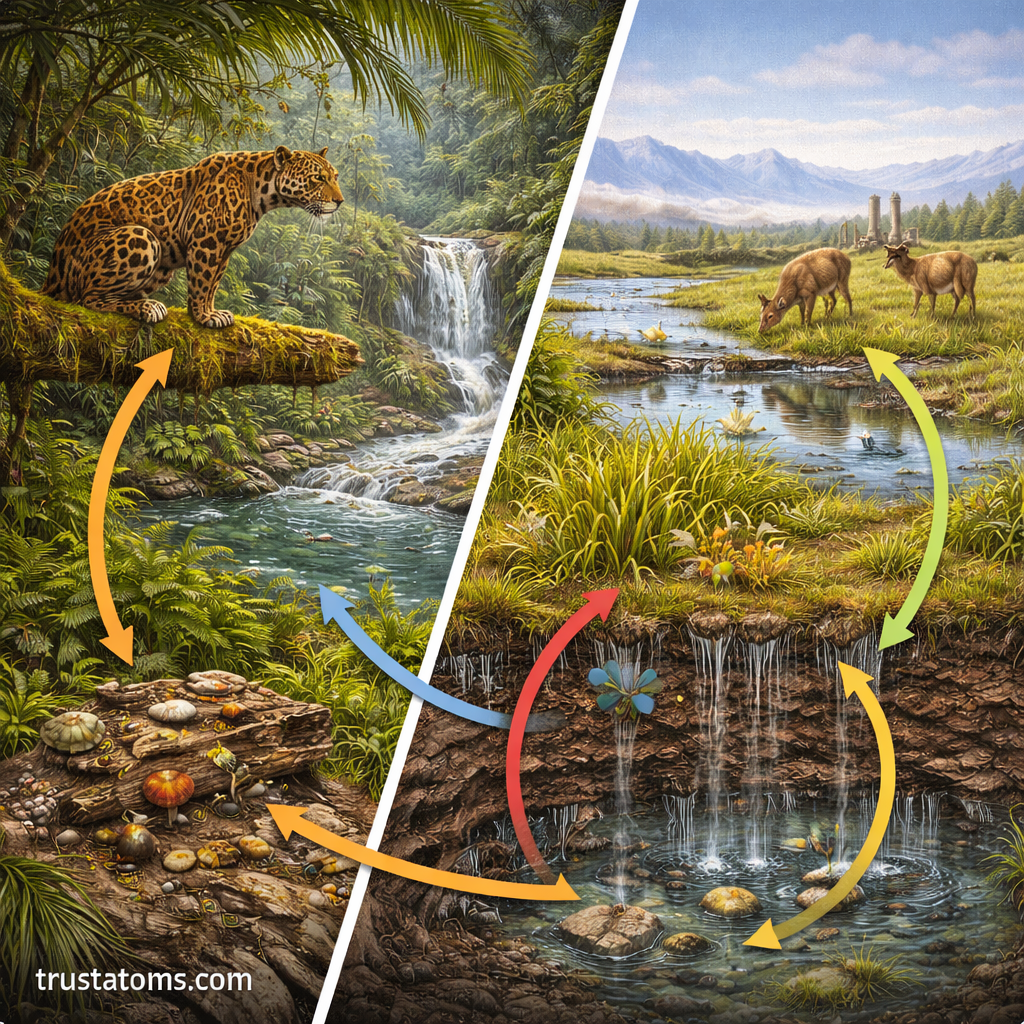
Complex environments contain numerous interacting species, physical conditions, and ecological processes. Tropical rainforests, wetlands, coral reefs, tundra ecosystems, and coastal estuaries provide examples of environments where many processes influence one another.
One useful measure is the amount of living material present in different organisms and locations. Studying Biomass Distribution helps researchers understand how biological material is allocated among producers, consumers, and other ecosystem components.
A rainforest and a tundra wetland may contain similar categories of organisms, yet their temperature, sunlight, growing seasons, and decomposition conditions produce different patterns of energy flow and nutrient cycling.
Real-World Example: How Fertilizer Runoff Changes a Lake
Consider a freshwater lake surrounded by agricultural land. Under ordinary conditions, algae, aquatic plants, fish, microorganisms, and water chemistry interact within a functioning ecological system.
Now imagine that heavy rainfall carries excess fertilizer into the lake. A systems ecology approach follows the chain of effects:
- Nutrient input increases: Additional nitrogen and phosphorus enter the water.
- Algae may multiply: If nutrients were limiting growth, the added supply can stimulate an algal bloom.
- Light availability changes: Dense algae can reduce sunlight reaching submerged aquatic plants.
- Decomposition increases: When algae die, microorganisms break down their organic matter and consume dissolved oxygen.
- Aquatic animals experience stress: Low oxygen conditions can harm fish and other oxygen-dependent organisms.
This process is an example of nutrient enrichment contributing to eutrophication. Its severity depends on factors such as water temperature, lake depth, mixing, nutrient supply, and water exchange.
Rather than examining algae or fish alone, systems ecologists investigate how nutrient inputs, biological growth, oxygen levels, and water circulation interact. Their findings can help identify which changes might most effectively improve water quality.
How Scientists Model and Predict Ecosystem Changes
Because ecosystems contain many interacting variables, scientists use models to simplify their structure while preserving important relationships.
A model might track plant biomass, herbivore populations, rainfall, and soil nutrients over time. Researchers use observations to estimate relationships, then compare model predictions with measurements from the real ecosystem.
Models can help evaluate scenarios such as reduced rainfall, habitat restoration, increased nutrient pollution, or changes in species abundance. However, their predictions depend on assumptions, available data, and how accurately the model represents ecological processes.
Using Systems Ecology for Conservation and Restoration
Systems ecology can support conservation by revealing connections that might be overlooked when individual species are considered separately.
For example, restoring a wetland may involve more than planting vegetation. Scientists may also need to examine water movement, sediment, nutrient inputs, microbial activity, and nearby land use.
Human activities such as deforestation, pollution, resource extraction, and greenhouse gas emissions can affect multiple parts of an ecological system. Understanding those connections helps researchers evaluate restoration strategies, anticipate unintended consequences, and monitor ecological recovery.
Frequently Asked Questions
How is systems ecology different from traditional ecology?
Systems ecology emphasizes the relationships and feedbacks connecting different ecosystem components, often using mathematical or computational models. Other ecological approaches may focus more narrowly on individual organisms, populations, communities, or specific interactions. These approaches complement one another.
What is an example of a system in ecology?
A freshwater lake is an ecological system because its fish, algae, microorganisms, nutrients, sunlight, oxygen, and water conditions interact. A change in one component, such as nutrient availability, can affect several others.
Can systems ecology predict ecosystem collapse?
Systems ecology can help identify vulnerabilities, feedback mechanisms, and conditions associated with major ecosystem changes. Models can estimate possible outcomes, but predicting the exact timing or severity of an ecosystem collapse is difficult because natural systems contain uncertainty and complex interactions.
Systems ecology shows that understanding an ecosystem requires examining the connections among organisms, resources, and environmental conditions. By tracing energy, nutrients, and feedbacks through these networks, scientists can better explain ecological change and make more informed decisions about conservation and restoration.
Sources: Eugene P. Odum and Gary W. Barrett, Fundamentals of Ecology; Howard T. Odum, Systems Ecology: An Introduction; U.S. Environmental Protection Agency, Nutrient Pollution.