Cosmology seeks to answer some of the biggest questions in science: How did the universe begin? How is it evolving? What is its ultimate fate? To explore these questions, scientists use cosmological models—theoretical frameworks that describe the structure and behavior of the universe.
Over time, several models have been proposed, tested, refined, or replaced. Comparing these models helps us understand not only what we know about the universe, but also what remains uncertain.
What Is a Cosmological Model?
A cosmological model is a scientific description of the universe based on observations, physical laws, and mathematical equations.
Key Elements of a Model
- The origin of the universe
- The rate of expansion
- The composition (matter, dark matter, dark energy)
- The large-scale structure
- The long-term fate of the universe
Models are constantly updated as new data becomes available.
The Big Bang Model
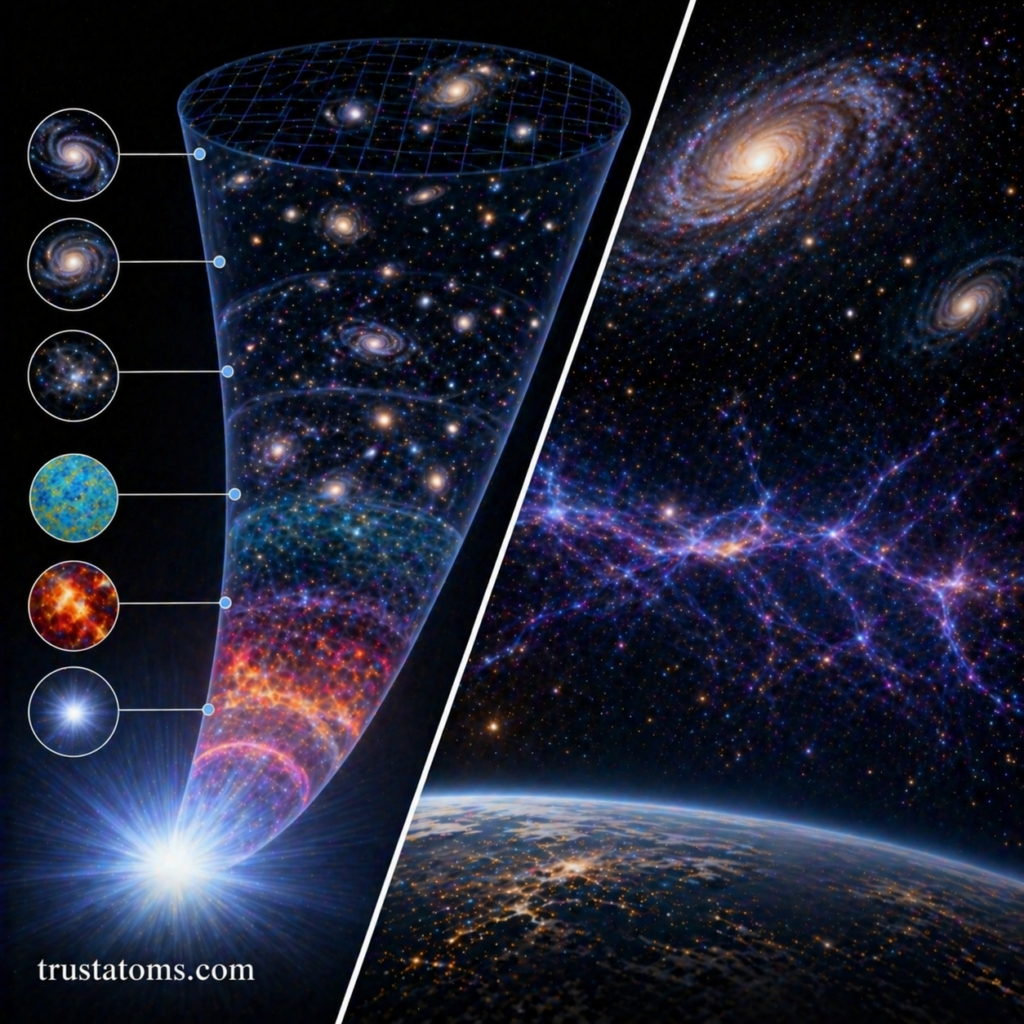
The Big Bang model is the most widely accepted cosmological model today.
Core Idea
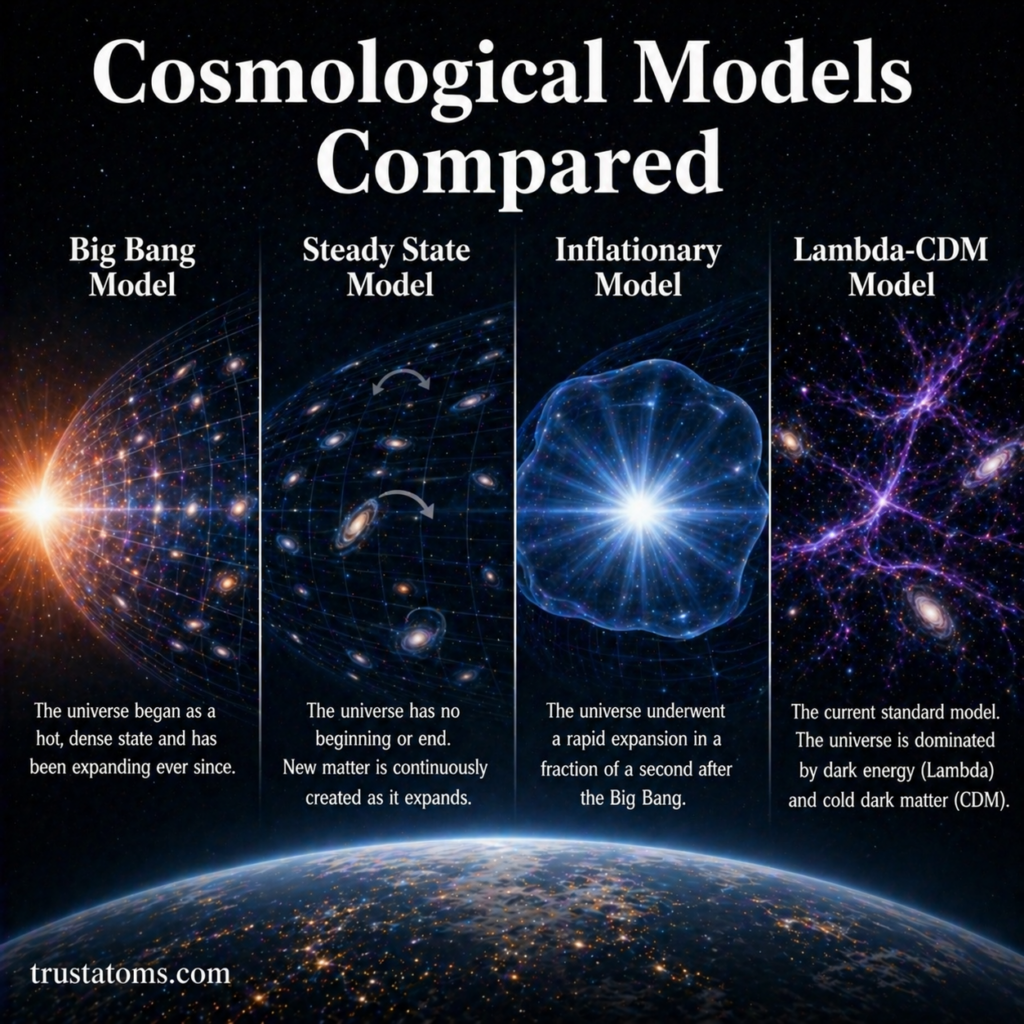
The universe began as an extremely hot, dense state and has been expanding ever since.
Key Evidence
- Expansion of the universe (galaxy redshift)
- Cosmic Microwave Background (CMB) radiation
- Abundance of light elements (hydrogen, helium)
Strengths
- Strong observational support
- Explains early universe conditions
- Predicts cosmic background radiation
Limitations
- Does not fully explain what caused the Big Bang
- Requires additional components like dark matter and dark energy
The Steady State Model
The Steady State model was an alternative to the Big Bang theory.
Core Idea
The universe has always existed in a constant state, with new matter continuously created as it expands.
Key Features
- No beginning or end
- Constant density over time
- Continuous matter creation
Why It Was Rejected
- Cannot explain the Cosmic Microwave Background
- Conflicts with observed galaxy evolution
- Lacks supporting evidence
Today, it is largely considered outdated.
The Inflationary Model
The inflationary model expands on the Big Bang theory by describing a rapid early expansion.
Core Idea
A brief period of extremely fast expansion occurred just after the Big Bang.
What It Explains
- Uniform temperature of the universe
- Large-scale structure formation
- Small density fluctuations
Strengths
- Solves key problems in the standard Big Bang model
- Supported by CMB observations
Ongoing Questions
- What caused inflation?
- What field or mechanism drove it?
The Lambda-CDM Model (Standard Model of Cosmology)
The Lambda-CDM model is currently the standard model used in cosmology.
Core Components
- Lambda (Λ): Represents dark energy
- CDM: Cold Dark Matter
What It Describes
- Universe dominated by dark energy and dark matter
- Accelerating expansion
- Formation of galaxies within dark matter structures
Strengths
- Matches a wide range of observations
- Successfully explains large-scale structure
- Supported by precise measurements of the CMB
Limitations
- Nature of dark matter and dark energy is still unknown
- Some small-scale inconsistencies remain
Alternative and Emerging Models
Scientists continue exploring new models to address unresolved questions.
Examples
- Cyclic or oscillating universe models
- Multiverse theories
- Modified gravity models
- Quantum cosmology approaches
These models are still under investigation and require more evidence.
Comparing Cosmological Models
Key Differences
| Feature | Big Bang | Steady State | Inflationary | Lambda-CDM |
|---|---|---|---|---|
| Beginning | Yes | No | Yes | Yes |
| Expansion | Yes | Yes | Rapid early expansion | Accelerating |
| Dark Energy | Included | Not required | Included | Central role |
| Observational Support | Strong | Weak | Strong | Very strong |
Why Comparing Models Matters
Evaluating different cosmological models helps scientists:
- Test the limits of current theories
- Identify gaps in understanding
- Improve predictions about the universe
- Guide future observations and experiments
Science advances by comparing ideas and refining them based on evidence.
The Future of Cosmology
As technology improves, new data will continue to shape cosmological models.
What to Expect
- More precise measurements of cosmic expansion
- Better understanding of dark matter and dark energy
- Advanced simulations of the universe
- New insights from gravitational wave astronomy
These developments may confirm current models—or lead to entirely new ones.
Key Takeaways
- Cosmological models describe the origin, structure, and evolution of the universe
- The Big Bang model is the foundation of modern cosmology
- The Lambda-CDM model is the current standard framework
- Alternative models explore unanswered questions
- Ongoing research continues to refine our understanding
Final Thoughts
Cosmological models are essential tools for understanding the universe at the largest scale. While the current standard model explains much of what we observe, important mysteries remain—especially regarding dark matter, dark energy, and the earliest moments of the universe.
By comparing models and testing them against new evidence, scientists move closer to uncovering the true nature of the cosmos.