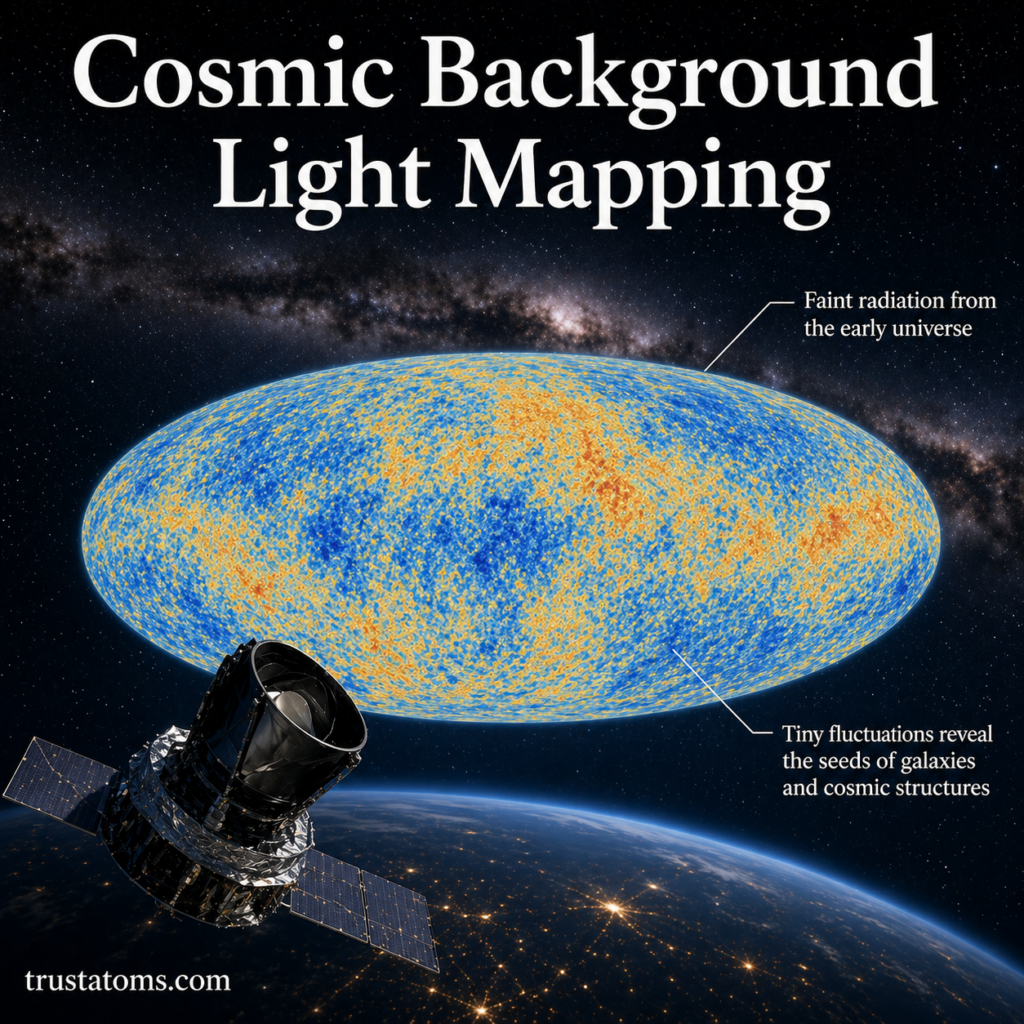
Cosmic background light mapping is one of the most powerful tools astronomers use to understand the universe. By studying faint radiation that fills space, scientists can reconstruct the early conditions of the cosmos and trace how galaxies and large-scale structures formed over billions of years.
This field combines advanced telescopes, precise measurements, and sophisticated data analysis to create detailed maps of the universe’s oldest light.
What Is Cosmic Background Light?
Cosmic background light refers to radiation that exists throughout the universe as a remnant of earlier cosmic events.
There are two main types:
Cosmic Microwave Background (CMB)
- The oldest observable light in the universe
- Released about 380,000 years after the Big Bang
- Provides a snapshot of the early universe
Extragalactic Background Light (EBL)
- Light accumulated from all stars and galaxies over cosmic time
- Includes visible, infrared, and ultraviolet wavelengths
- Helps track galaxy formation and evolution
Together, these background signals act like a cosmic fossil record, preserving information about the universe’s history.
What Is Cosmic Background Light Mapping?
Cosmic background light mapping is the process of:
- Measuring faint radiation across the sky
- Recording tiny variations in intensity and temperature
- Converting those measurements into detailed maps
These maps allow scientists to:
- Identify patterns in the early universe
- Study how matter was distributed
- Understand how cosmic structures formed
Even extremely small variations—often less than one part in 100,000—carry crucial information.
Why Mapping Background Light Matters
Mapping cosmic background light helps answer some of the biggest questions in astronomy.
Understanding the Early Universe
- Reveals conditions shortly after the Big Bang
- Shows how matter and energy were distributed
Tracing Structure Formation
- Explains how small fluctuations grew into galaxies
- Connects early universe physics to present-day structures
Testing Cosmological Models
- Confirms or challenges theories like inflation
- Helps refine measurements of key values such as:
- Expansion rate
- Matter density
- Dark energy influence
How Scientists Map Cosmic Background Light
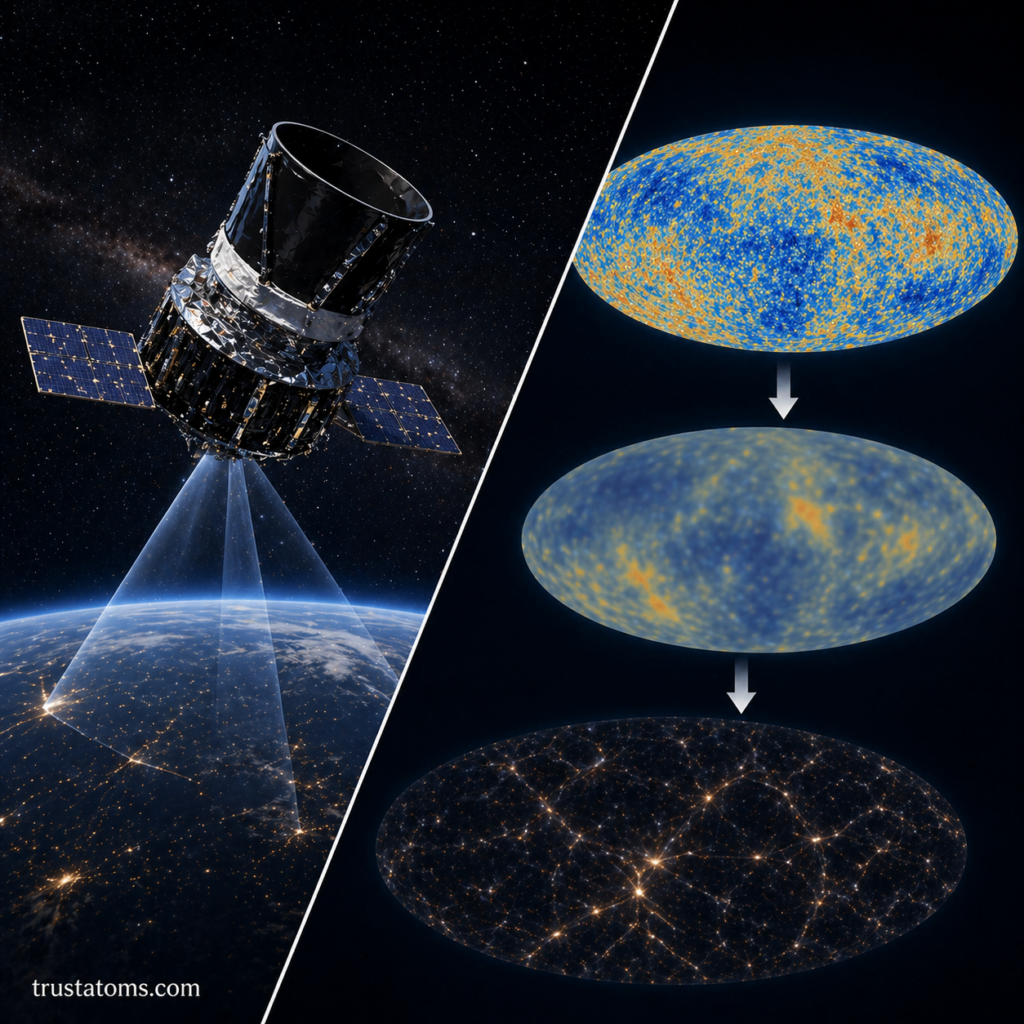
Mapping background light is a highly precise and complex process.
Step 1: Detecting Radiation
- Space-based observatories collect signals across the sky
- Instruments are designed to detect extremely faint radiation
Step 2: Filtering Noise
- Remove interference from:
- Earth’s atmosphere
- Local galaxies
- Instrumental noise
Step 3: Measuring Tiny Variations
- Identify slight differences in temperature or brightness
- These variations represent early density fluctuations
Step 4: Building Sky Maps
- Data is compiled into full-sky images
- Color coding is often used to represent variations
Key Missions and Observatories
Several major missions have advanced cosmic background light mapping.
COBE (Cosmic Background Explorer)
- First mission to detect variations in the CMB
- Confirmed the Big Bang model’s predictions
WMAP (Wilkinson Microwave Anisotropy Probe)
- Produced more detailed maps of temperature fluctuations
- Improved measurements of the universe’s age and composition
Planck Satellite
- Delivered the most precise full-sky CMB map to date
- Refined cosmological parameters with high accuracy
These missions transformed our understanding of the universe’s structure and evolution.
What the Maps Reveal
Cosmic background light maps are not just images—they are data-rich tools.
Temperature Fluctuations
- Tiny differences indicate density variations
- These variations are the seeds of galaxies
Acoustic Peaks
- Patterns caused by sound waves in the early universe
- Provide insights into matter and energy distribution
Large-Scale Structure Clues
- Show how matter clustered over time
- Help connect early fluctuations to galaxy formation
Challenges in Cosmic Mapping
Mapping background light is not straightforward. Scientists face several obstacles:
Weak Signals
- Background radiation is extremely faint
- Requires highly sensitive instruments
Foreground Contamination
- Signals from nearby sources can interfere
- Must be carefully removed
Data Complexity
- Massive datasets require advanced processing
- Statistical analysis is essential to extract meaning
Despite these challenges, improvements in technology continue to refine the accuracy of these maps.
Beyond the CMB: Expanding the Field
While the CMB is the most well-known, mapping efforts now extend beyond it.
Infrared Background Mapping
- Tracks light from early stars and galaxies
- Helps study star formation history
Gamma-Ray Background Studies
- Provides insight into high-energy cosmic events
- Reveals activity from black holes and quasars
3D Cosmic Mapping
- Combines background light with galaxy surveys
- Creates a more complete picture of cosmic evolution
Common Misconceptions
“Background light is just noise”
It’s actually one of the most important sources of information about the universe.
“The maps are simple pictures”
They represent highly detailed datasets with deep physical meaning.
“All regions of the universe are identical”
Small differences in background radiation are essential—they explain why structure exists at all.
Final Thoughts
Cosmic background light mapping has revolutionized modern astronomy. By studying faint radiation left behind from the early universe, scientists have been able to:
- Reconstruct the universe’s infancy
- Understand how galaxies formed
- Test and refine cosmological theories
What once seemed like uniform, featureless radiation is now recognized as a rich source of information about the cosmos.
As technology advances, future missions will create even more detailed maps, bringing us closer to answering fundamental questions about the universe’s origin, structure, and ultimate fate.