The universe is vast, complex, and filled with mysteries that challenge our understanding of physics and cosmology. One of the most intriguing puzzles is the horizon problem—a question that arises when scientists study the large-scale uniformity of the universe.
Despite regions of space being incredibly far apart and seemingly disconnected, they appear to share nearly identical properties. How is that possible? This article breaks down the horizon problem, why it matters, and how modern cosmology attempts to solve it.
What Is the Horizon Problem?
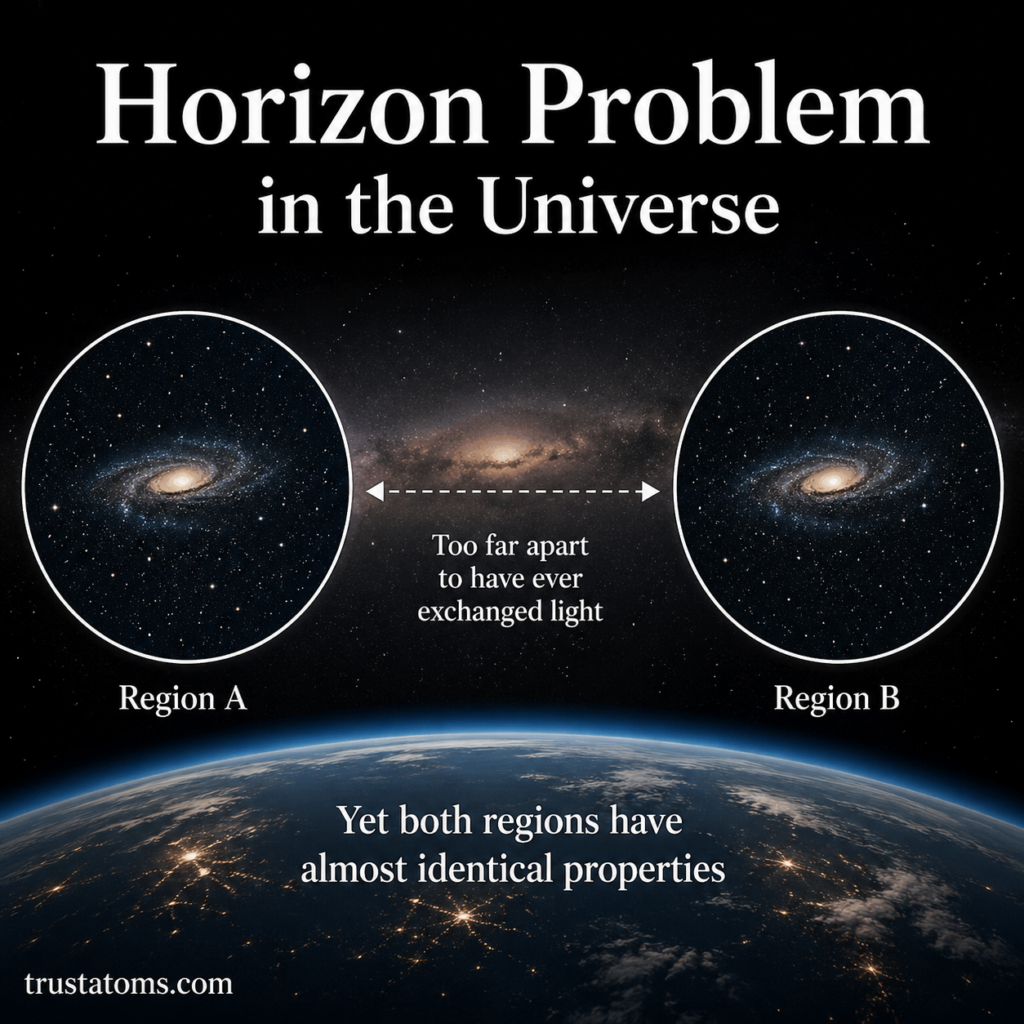
The horizon problem refers to a contradiction between observations of the universe and what we would expect based on the known laws of physics.
In simple terms:
- The universe looks remarkably uniform in all directions.
- Distant regions of space have almost identical temperatures and densities.
- However, these regions are so far apart that they should never have interacted.
This creates a problem: if they were never in contact, how did they end up so similar?
Understanding Cosmic Horizons
To grasp the horizon problem, you need to understand the concept of a cosmic horizon.
A cosmic horizon is the maximum distance over which information or light could have traveled since the beginning of the universe.
Key idea:
- Light travels at a finite speed (the speed of light).
- The universe has a finite age (about 13.8 billion years).
- Therefore, there’s a limit to how far signals could have traveled.
This means:
- Regions beyond each other’s horizon could not have exchanged energy or information.
- They should have evolved independently.
Yet, observations show otherwise.
Evidence: The Cosmic Microwave Background
The strongest evidence for the horizon problem comes from the cosmic microwave background (CMB).
The CMB is:
- Radiation left over from the early universe
- A snapshot of the universe about 380,000 years after the Big Bang
What scientists observe:
- The temperature of the CMB is almost perfectly uniform across the sky
- Variations are incredibly tiny—about 1 part in 100,000
This uniformity exists even between regions that:
- Are separated by vast distances
- Should never have been in causal contact
This is the core of the horizon problem.
Why the Horizon Problem Matters
The horizon problem isn’t just a technical detail—it challenges fundamental assumptions about how the universe evolved.
If left unresolved, it would imply:
- Our understanding of the early universe is incomplete
- The Big Bang model alone cannot explain observed uniformity
- There may be missing physics in our current theories
In short, it forces scientists to rethink how the universe behaved in its earliest moments.
The Standard Big Bang Limitation
In the traditional Big Bang model:
- The universe begins in a hot, dense state
- It expands over time
- Regions move farther apart
But there’s a catch:
- Expansion happens too slowly (in this model) to allow distant regions to interact early on
- There simply isn’t enough time for heat or energy to spread evenly
So, without additional mechanisms, the uniformity we observe today should not exist.
The Leading Solution: Cosmic Inflation
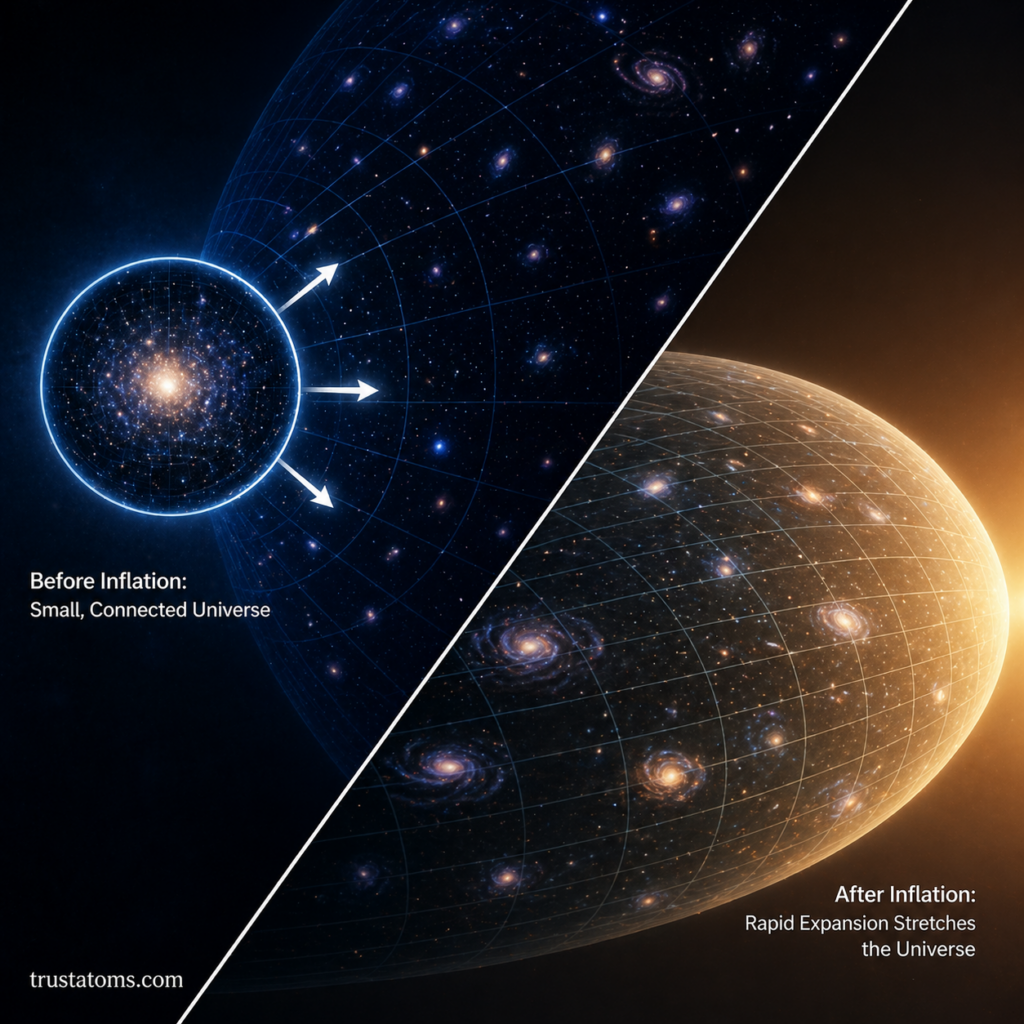
The most widely accepted solution to the horizon problem is cosmic inflation.
What Is Inflation?
Inflation is a theory that proposes:
- The universe underwent a brief period of extremely rapid expansion
- This occurred fractions of a second after the Big Bang
During this phase:
- Space expanded faster than the speed of light (this does not violate relativity because space itself is expanding)
- Tiny, connected regions were stretched to enormous scales
How Inflation Solves the Horizon Problem
Inflation explains the uniformity like this:
- Before inflation, the universe was small and well-connected
- Energy and temperature had time to even out
- Inflation then stretched this uniform region across vast distances
As a result:
- Regions that appear disconnected today were once close together
- They share the same initial conditions
This neatly resolves the horizon problem.
Additional Benefits of Inflation
Inflation doesn’t just solve the horizon problem—it also addresses other cosmological puzzles.
Flatness Problem
- Explains why the universe appears geometrically “flat”
Structure Formation
- Small quantum fluctuations during inflation become:
- Galaxies
- Clusters
- Large-scale cosmic structures
Predictive Power
- Inflation predicts patterns in the CMB that match observations remarkably well
Alternative Ideas and Ongoing Research
While inflation is widely accepted, scientists continue exploring alternative explanations.
Some ideas include:
- Variable speed of light theories
Suggest that light traveled faster in the early universe - Cyclic universe models
Propose that the universe undergoes repeated expansions and contractions - Quantum gravity effects
Explore how space and time behave at extremely small scales
These alternatives are still under investigation and lack the same level of observational support as inflation.
Common Misconceptions
“Everything expanded faster than light—doesn’t that break physics?”
No. The expansion of space itself can exceed the speed of light without violating relativity.
“The universe is perfectly uniform”
Not exactly. There are tiny variations that are crucial for forming galaxies and stars.
“The horizon problem means the Big Bang is wrong”
Not at all. It means the standard Big Bang model needs refinement, which inflation provides.
Final Thoughts
The horizon problem highlights one of the most fascinating aspects of cosmology: the universe behaves in ways that are not immediately intuitive.
At first glance, the uniformity of distant regions seems impossible. But with the introduction of cosmic inflation, scientists have developed a compelling explanation that fits both theory and observation.
Still, the horizon problem remains a powerful reminder:
- Our understanding of the universe is always evolving
- Even well-established theories can have gaps
- The early universe holds many secrets yet to be uncovered
As research continues, future discoveries may refine—or even revolutionize—how we understand the origins of the cosmos.