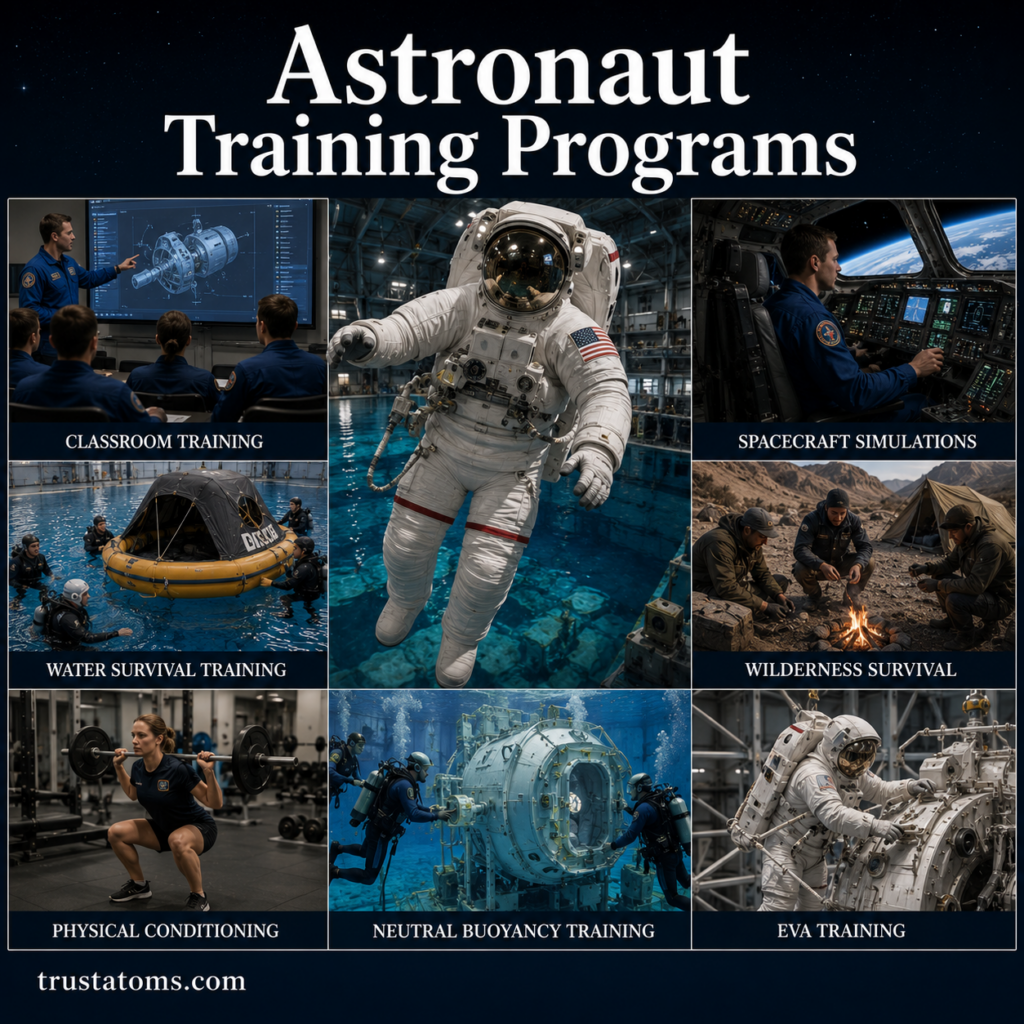
Astronaut training programs are among the most demanding and advanced training systems in the world. Before astronauts can travel into space, they must develop the physical, mental, technical, and survival skills necessary to operate safely in one of the harshest environments humans have ever faced.
Space missions involve extreme conditions, complex technology, isolation, and high-risk situations. Astronauts must learn how to respond to emergencies, operate spacecraft systems, perform scientific experiments, and work effectively in microgravity.
Modern astronaut training programs prepare crews for missions aboard spacecraft, space stations, lunar exploration missions, and future journeys to Mars.
This guide explores how astronauts are selected, what training involves, the skills required for space missions, and how future programs may evolve for deep-space exploration.
What Is an Astronaut Training Program?
An astronaut training program is a structured process designed to prepare astronauts for space missions.
Training combines:
- Scientific education
- Technical instruction
- Physical conditioning
- Emergency preparedness
- Psychological adaptation
- Mission simulations
Programs are managed by national and international space agencies as well as some private aerospace organizations.
The goal is to ensure astronauts can survive, work, and solve problems effectively in space.
Why Astronaut Training Is Necessary
Space is an extremely dangerous environment.
Astronauts face challenges such as:
- Microgravity
- Radiation exposure
- Isolation
- Equipment malfunctions
- Limited resources
- Harsh launch and landing forces
Training reduces risks by helping astronauts respond confidently under pressure.
Even routine tasks in space require specialized preparation because everyday Earth conditions do not exist in orbit.
Astronaut Selection Requirements
Before training even begins, astronaut candidates must meet strict qualifications.
Educational Background
Most astronauts have advanced education in fields such as:
- Engineering
- Physics
- Biology
- Mathematics
- Medicine
- Computer science
Scientific and technical expertise is essential for modern missions.
Professional Experience
Candidates often need years of professional experience involving:
- Research
- Aviation
- Military service
- Engineering operations
- Medical practice
Pilots and military personnel have historically played major roles in astronaut programs.
Physical Fitness
Astronauts must meet strict medical and fitness standards.
Requirements may include:
- Excellent cardiovascular health
- Strong vision and hearing
- Physical endurance
- Coordination and balance
- Ability to tolerate high G-forces
Good health is essential because medical emergencies are difficult to manage in space.
Psychological Stability
Long-duration missions require emotional resilience and teamwork.
Astronaut candidates are evaluated for:
- Stress management
- Communication skills
- Problem-solving ability
- Leadership
- Adaptability
Mental performance is just as important as physical ability.
Basic Astronaut Training
Once selected, astronaut candidates begin years of intensive preparation.
Classroom Education
Astronauts study topics including:
- Spacecraft systems
- Orbital mechanics
- Robotics
- Navigation
- Space medicine
- Emergency procedures
Technical understanding helps astronauts operate spacecraft safely.
Spacecraft Systems Training
Astronauts learn how spacecraft function, including:
- Power systems
- Communication equipment
- Life support systems
- Navigation controls
- Docking systems
They must understand both normal operations and emergency responses.
Physical Conditioning
Astronauts train regularly to improve strength, endurance, and flexibility.
Training often includes:
- Cardiovascular exercise
- Resistance training
- Swimming
- Mobility exercises
Physical fitness helps astronauts adapt to launch forces and microgravity.
Microgravity Training
One of the biggest challenges astronauts face is adapting to weightlessness.
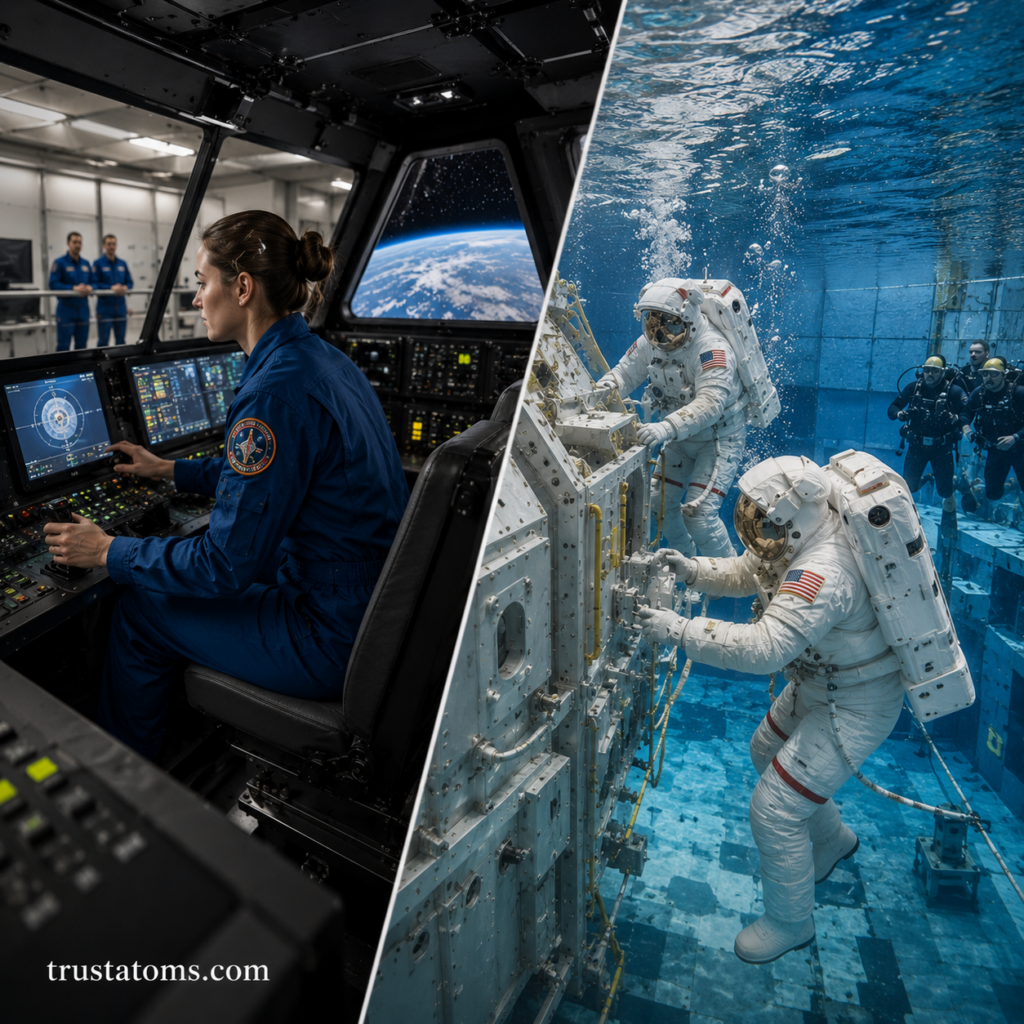
Neutral Buoyancy Training
Large underwater training facilities simulate microgravity conditions.
Astronauts wear weighted spacesuits underwater while practicing:
- Spacewalks
- Equipment repairs
- Tool handling
- Station maintenance
This helps prepare them for extravehicular activities (EVAs).
Parabolic Flights
Special aircraft create short periods of weightlessness during steep flight maneuvers.
These flights allow astronauts to experience:
- Floating movement
- Object handling in microgravity
- Balance adaptation
Although brief, these sessions provide valuable preparation.
Survival Training
Astronauts must prepare for emergency landings in remote environments.
Water Survival Training
Crews practice escaping spacecraft and surviving in open water.
Training may include:
- Raft deployment
- Emergency signaling
- Rescue coordination
Wilderness Survival
Astronauts may train in deserts, forests, or cold-weather environments.
These exercises help crews prepare for unexpected landing conditions after reentry.
Fire and Emergency Response
Astronauts train to manage onboard emergencies such as:
- Fires
- Air leaks
- Toxic contamination
- Equipment failures
Fast, coordinated responses are critical for survival.
Spacesuit and EVA Training
Spacewalks are some of the most difficult astronaut activities.
Astronauts spend many hours learning how to:
- Operate spacesuits
- Use specialized tools
- Move safely in microgravity
- Repair external systems
- Manage oxygen supplies
Spacesuits function like miniature spacecraft and require careful operation.
Robotics and Docking Simulations
Modern missions often involve robotic systems and spacecraft docking procedures.
Astronauts train using advanced simulators to practice:
- Robotic arm operation
- Cargo handling
- Spacecraft docking
- Precision maneuvering
Simulation training allows crews to rehearse complex missions repeatedly.
Teamwork and Communication Training
Space missions depend heavily on teamwork.
Astronauts train to:
- Communicate clearly
- Solve problems collaboratively
- Manage stress
- Resolve conflicts
- Support international crews
Many missions involve astronauts from different countries and cultural backgrounds.
International Space Station Training
Astronauts assigned to the International Space Station receive specialized preparation.
ISS training includes:
- Station operations
- Scientific experiments
- Emergency drills
- Maintenance procedures
- International coordination
Because the ISS is a multinational project, astronauts often train in multiple countries.
Psychological Preparation for Space Missions
Long-duration missions can be mentally demanding.
Astronauts may experience:
- Isolation
- Confinement
- Sleep disruption
- Separation from family
- Stress from mission risks
Psychological support and resilience training help crews maintain performance during missions.
Astronaut Simulations and Mock Missions
Simulated missions help astronauts practice realistic scenarios.
Mission Simulators
Simulators recreate spacecraft controls and mission conditions.
Astronauts rehearse:
- Launch procedures
- Docking operations
- Emergency situations
- Landing sequences
Isolation Experiments
Some training programs place crews in isolated environments for weeks or months.
These experiments help researchers study:
- Group dynamics
- Mental health
- Communication under stress
Such research is especially important for future Mars missions.
Future Astronaut Training Programs
Future missions will require even more advanced preparation.
Lunar Mission Training
Astronauts preparing for Moon missions may train in:
- Volcanic landscapes
- Simulated lunar terrain
- Reduced-gravity systems
These exercises help crews prepare for surface exploration.
Mars Mission Preparation
Mars missions may last several years.
Future training could include:
- Long-term habitat simulations
- Autonomous medical care
- Delayed communication exercises
- Resource management training
Mars astronauts may need to solve problems independently without immediate support from Earth.
Commercial Spaceflight Training
Private space tourism is creating new types of astronaut training programs.
Commercial passengers may receive shorter training focused on:
- Safety procedures
- Weightlessness adaptation
- Emergency responses
As commercial spaceflight expands, training programs may become more accessible to civilians.
Challenges of Astronaut Training
Training astronauts is expensive and time-intensive.
Major challenges include:
- High operational costs
- Limited training facilities
- Complex mission requirements
- Rapid technological changes
- Psychological demands
Despite these challenges, training remains essential for mission success and crew safety.
The Importance of Astronaut Training in Space Exploration
Astronaut training programs are critical to the success of human spaceflight.
They help astronauts:
- Operate advanced spacecraft
- Conduct scientific research
- Survive emergencies
- Adapt to microgravity
- Work effectively as teams
Every successful mission depends heavily on preparation completed long before launch.
Final Thoughts
Astronaut training programs combine science, engineering, physical conditioning, and psychological preparation to help humans survive and work safely in space.
From underwater EVA practice and spacecraft simulations to wilderness survival and long-duration isolation studies, astronauts undergo years of intensive preparation before reaching orbit.
As humanity prepares for lunar bases, Mars exploration, and commercial space travel, astronaut training programs will continue evolving to meet the demands of deeper and longer missions beyond Earth.