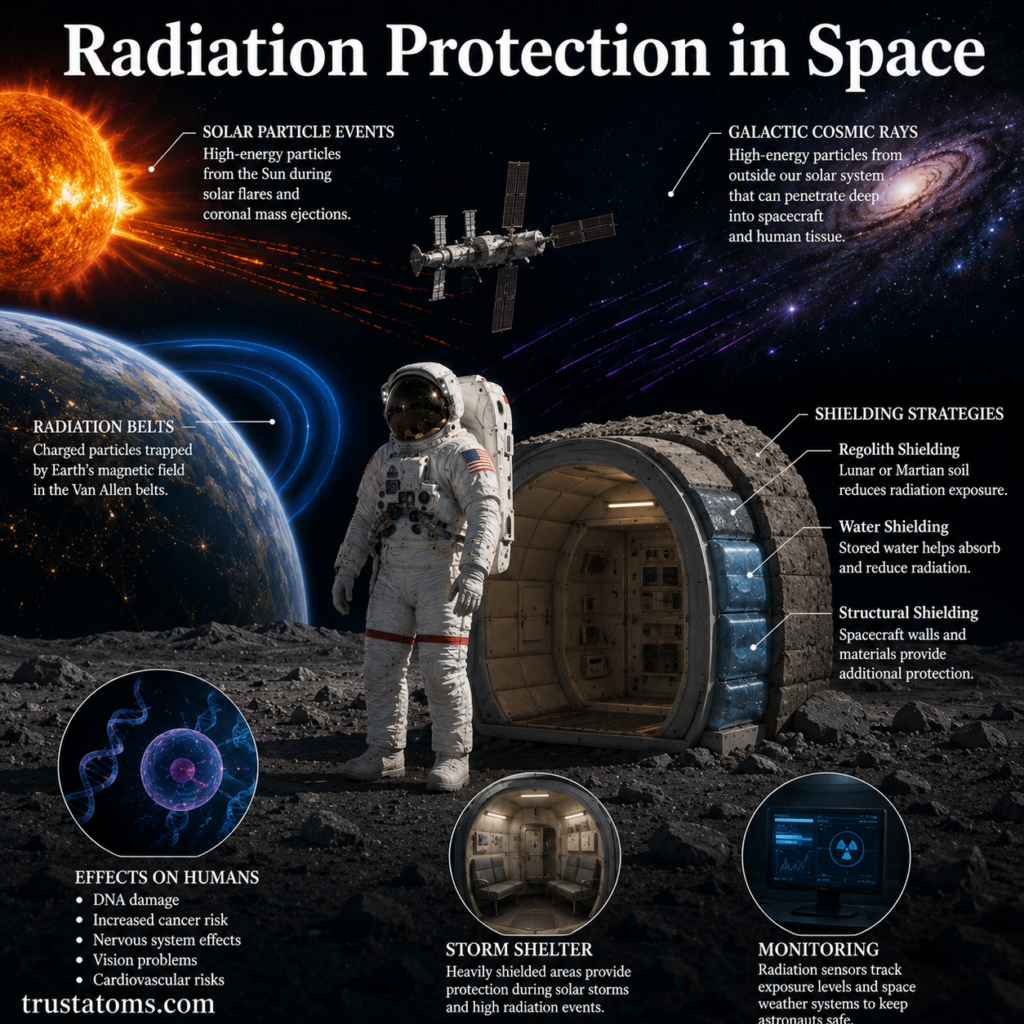
Radiation protection in space is one of the most important challenges in modern space exploration. Outside Earth’s atmosphere and magnetic field, astronauts are exposed to dangerous forms of radiation that can damage cells, increase cancer risks, and threaten long-term human survival during deep-space missions.
As space agencies prepare for lunar bases, Mars missions, and extended human presence beyond Earth orbit, developing effective radiation protection systems has become a major scientific and engineering priority.
This guide explores the types of space radiation, how it affects astronauts and spacecraft, current protection technologies, and the future of radiation shielding in space exploration.
What Is Space Radiation?
Space radiation refers to high-energy particles traveling through space at extremely high speeds.
Unlike radiation exposure on Earth, space radiation is more intense because Earth’s atmosphere and magnetic field no longer provide full protection.
Space radiation can penetrate:
- Human tissue
- Electronics
- Spacecraft materials
- Space suits
Long-term exposure presents serious health and operational risks during space missions.
Why Radiation Protection Matters in Space
Earth naturally shields humans from most harmful cosmic radiation.
In space, astronauts lose much of this protection.
Without proper shielding, radiation exposure can lead to:
- DNA damage
- Increased cancer risk
- Nervous system damage
- Vision problems
- Cardiovascular effects
- Acute radiation sickness
Protecting astronauts becomes increasingly difficult during long-duration missions beyond low Earth orbit.
Main Sources of Space Radiation
There are several major types of radiation in space.
Galactic Cosmic Rays (GCRs)
Galactic cosmic rays originate outside our solar system.
They are composed of extremely energetic particles such as:
- Protons
- Heavy ions
- Atomic nuclei
GCRs travel at nearly the speed of light and can penetrate spacecraft materials deeply.
Because they are difficult to block completely, they represent one of the biggest long-term challenges for deep-space exploration.
Solar Particle Events (SPEs)
Solar particle events occur when the Sun releases bursts of energetic particles during solar storms and solar flares.
These events can happen suddenly and may expose astronauts to dangerous radiation doses over short periods.
Solar particle events are particularly important because they can:
- Damage spacecraft electronics
- Interrupt communications
- Threaten astronaut safety
Early warning systems are critical for solar radiation protection.
Trapped Radiation Belts
Earth’s magnetic field traps charged particles in regions known as the Van Allen radiation belts.
Spacecraft traveling through these belts may encounter elevated radiation levels during certain missions.
Most low Earth orbit missions minimize exposure by carefully planning orbital paths.
How Radiation Affects the Human Body
Radiation damages living tissue by altering cells and DNA.
DNA Damage
Radiation can break DNA strands inside cells.
Damaged DNA may lead to:
- Cell death
- Mutations
- Cancer development
Human cells can repair some damage, but repeated exposure increases long-term risks.
Nervous System Effects
Research suggests space radiation may affect the brain and nervous system.
Potential effects include:
- Cognitive decline
- Memory problems
- Reduced reaction times
- Behavioral changes
These risks are especially concerning for long-duration Mars missions.
Cardiovascular Risks
Radiation exposure may increase the risk of cardiovascular disease over time.
Scientists continue studying how prolonged exposure affects the heart and blood vessels.
Vision Problems
Some astronauts report seeing flashes of light caused by radiation particles passing through the eyes.
Long-term exposure may also contribute to cataract formation.
Natural Protection on Earth
Earth provides multiple layers of radiation protection.
Atmosphere
Earth’s atmosphere absorbs and scatters many harmful radiation particles before they reach the surface.
Magnetic Field
Earth’s magnetic field deflects many charged particles from the Sun and deep space.
This protective shield is one reason life can exist safely on Earth.
Radiation Protection Methods in Spacecraft
Spacecraft use several strategies to reduce radiation exposure.
Physical Shielding
Shielding materials absorb or slow incoming radiation particles.
Common shielding materials include:
- Aluminum
- Polyethylene
- Water
- Specialized composites
Hydrogen-rich materials are often effective because they help reduce secondary radiation effects.
Water as Radiation Shielding
Water can serve multiple purposes aboard spacecraft.
In addition to supporting life support systems, stored water may help shield astronauts from radiation.
Future spacecraft designs may strategically place water tanks around crew areas.
Storm Shelters
Some spacecraft designs include heavily shielded emergency shelters.
Astronauts may temporarily move into these areas during major solar storms.
Storm shelters could include additional shielding using:
- Water
- Food supplies
- Fuel
- Specialized materials
Spacecraft Design Strategies
Engineers carefully design spacecraft layouts to minimize exposure.
Strategies include:
- Positioning crew quarters in protected areas
- Using equipment as additional shielding
- Reducing time spent in high-radiation regions
Even small design improvements can significantly reduce cumulative exposure.
Radiation Protection in Space Suits
Space suits provide limited radiation protection compared to spacecraft.
Suit engineering focuses mainly on:
- Mobility
- Pressure regulation
- Thermal control
- Micrometeoroid protection
Future exploration suits may require improved radiation-resistant materials for lunar and Mars surface operations.
Radiation Risks on the Moon and Mars
Lunar Radiation Exposure
The Moon lacks both a thick atmosphere and a global magnetic field.
This leaves lunar astronauts vulnerable to:
- Solar radiation
- Cosmic rays
- Surface radiation exposure
Future lunar habitats may require underground or shielded structures.
Mars Radiation Exposure
Mars has a thin atmosphere and weak magnetic protection.
Astronauts traveling to and living on Mars may face radiation exposure for years.
Radiation remains one of the biggest barriers to safe human missions to Mars.
Future Radiation Protection Technologies
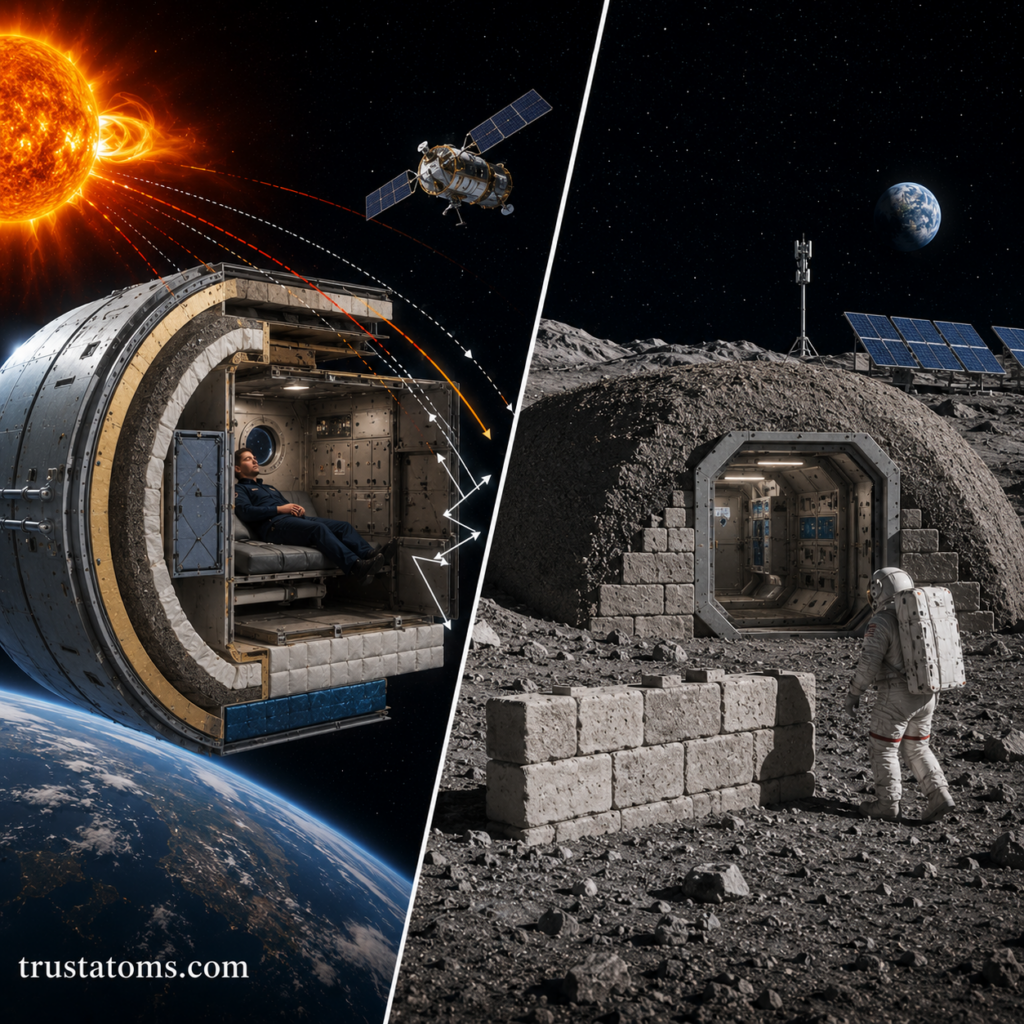
Scientists are exploring advanced solutions for future missions.
Advanced Shielding Materials
Researchers are developing lightweight materials with improved shielding capabilities.
Potential technologies include:
- Hydrogen-rich polymers
- Nanomaterials
- Composite shielding systems
Reducing weight is important because launch costs increase with spacecraft mass.
Magnetic Shielding Concepts
Some future designs propose generating artificial magnetic fields around spacecraft.
These systems could potentially deflect charged radiation particles similarly to Earth’s magnetic field.
Although still experimental, magnetic shielding may become important for deep-space travel.
Plasma Shielding
Scientists are also studying plasma-based shielding systems.
These concepts aim to use charged plasma fields to reduce incoming radiation exposure.
Research is ongoing, and practical implementation remains challenging.
Underground and Regolith Habitats
Future lunar and Martian habitats may use local soil, called regolith, as natural shielding.
Possible habitat designs include:
- Underground bases
- Buried structures
- Thick regolith-covered habitats
Using local materials could improve protection while reducing launch requirements.
Monitoring Radiation in Space
Continuous monitoring is essential for astronaut safety.
Radiation Detectors
Spacecraft carry radiation monitoring equipment to track exposure levels.
These systems help crews:
- Monitor cumulative doses
- Detect solar storms
- Adjust operational activities
Space Weather Forecasting
Scientists monitor solar activity to predict dangerous radiation events.
Improved forecasting allows astronauts to seek shelter before major solar storms occur.
Challenges of Radiation Protection
Despite advances, major challenges remain.
Weight Limitations
Effective shielding materials can be heavy.
Spacecraft designers must balance:
- Protection
- Launch cost
- Fuel efficiency
- Structural limitations
Long-Term Exposure
Deep-space missions may expose astronauts to radiation for months or years.
Current shielding technologies cannot eliminate all risks completely.
Secondary Radiation
Some shielding materials can create secondary radiation particles when struck by cosmic rays.
Engineers must carefully select materials to minimize this effect.
The Importance of Radiation Research
Understanding radiation protection is essential for the future of human spaceflight.
Research helps improve:
- Astronaut safety
- Spacecraft design
- Medical countermeasures
- Habitat engineering
- Mission planning
The lessons learned may eventually support permanent human settlements beyond Earth.
Final Thoughts
Radiation protection in space is one of the most complex challenges facing future exploration missions.
Outside Earth’s natural shielding systems, astronauts are exposed to dangerous cosmic rays, solar radiation, and high-energy particles that can threaten both health and mission success.
Through improved spacecraft shielding, advanced materials, habitat engineering, and future technologies such as magnetic protection systems, scientists and engineers continue working toward safer long-duration missions.
As humanity prepares for lunar bases, Mars exploration, and deeper journeys into space, radiation protection will remain a critical part of making sustainable human space travel possible.