Dark matter is one of the biggest mysteries in modern astronomy and physics. Although scientists cannot directly see it, strong evidence suggests that an enormous amount of invisible matter exists throughout the universe.
Observations of galaxies, galaxy clusters, gravitational lensing, and cosmic background radiation all indicate that visible matter alone cannot explain the behavior of cosmic structures.
Today, scientists estimate that ordinary matter — everything made of atoms, stars, planets, and living organisms — represents only a small fraction of the universe’s total mass-energy content.
Understanding dark matter evidence helps explain how galaxies form, how gravity behaves on cosmic scales, and why the universe appears structured the way it does.
What Is Dark Matter?
Dark matter is a hypothetical form of matter that does not emit, absorb, or reflect light.
Because it does not interact significantly with electromagnetic radiation, it cannot be observed directly using traditional telescopes.
However, dark matter appears to exert gravitational influence on visible matter and spacetime.
Scientists infer its existence through its effects on:
- Galaxy rotation
- Gravitational lensing
- Galaxy cluster motion
- Cosmic structure formation
- Background radiation patterns
Dark matter is called “dark” because it is invisible to current electromagnetic observation methods.
Why Scientists Proposed Dark Matter
The idea of dark matter emerged when astronomers noticed that visible matter alone could not explain certain gravitational behaviors.
Missing Mass Problem
Galaxies and galaxy clusters appeared to contain far more gravity than observable stars and gas could account for.
Without additional unseen mass:
- Galaxies should rotate differently
- Clusters should fly apart
- Large cosmic structures would not form properly
Scientists proposed invisible matter as a possible explanation.
Galaxy Rotation Curves
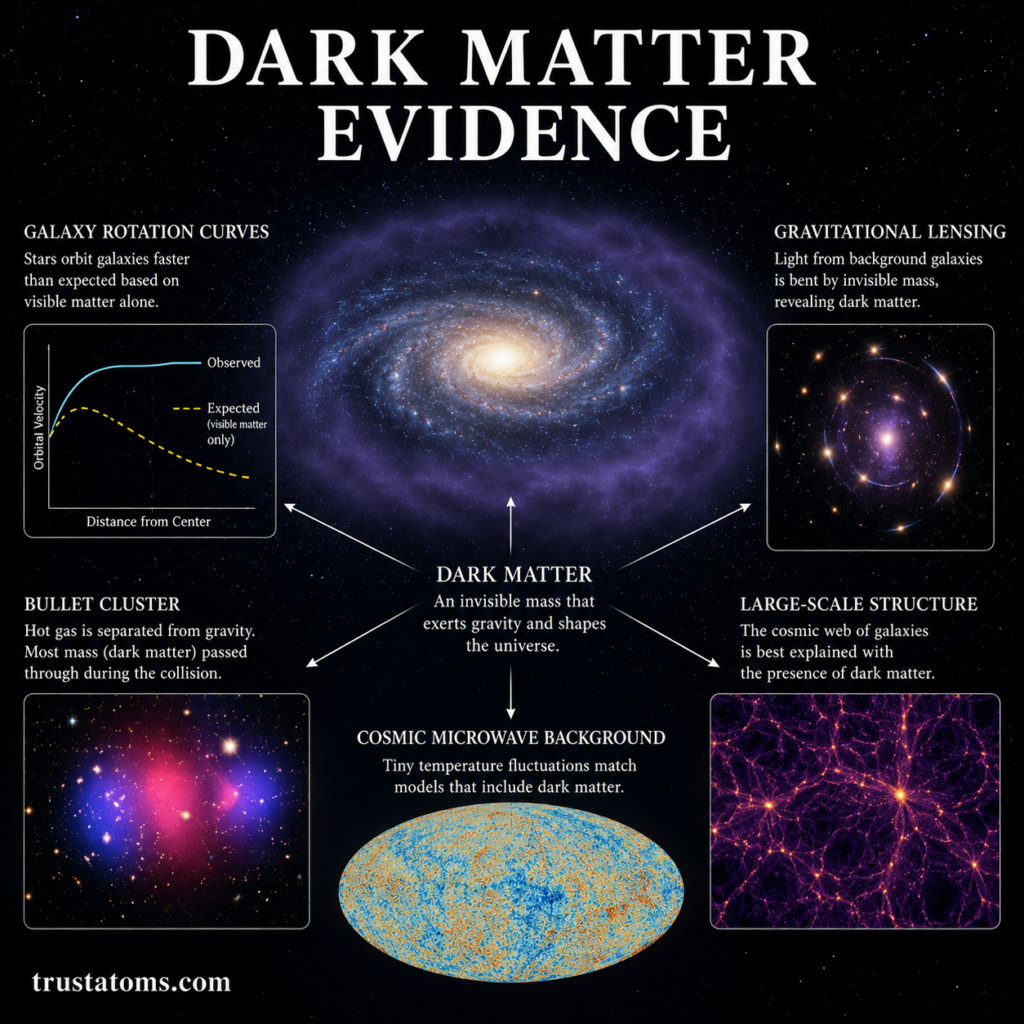
One of the strongest pieces of dark matter evidence comes from galaxy rotation curves.
Expected Rotation Speeds
In a galaxy, stars orbit around the galactic center.
Based on visible matter alone:
- Stars farther from the center should move slower
- Outer orbital speeds should decrease with distance
This behavior resembles planets orbiting the Sun.
What Astronomers Observed
Instead, astronomers discovered that outer stars move unexpectedly fast.
Their speeds remain nearly constant even far from galactic centers.
This suggests galaxies contain much more mass than visible stars and gas provide.
Vera Rubin’s Contribution
Astronomer Vera Rubin played a major role in studying galaxy rotation curves.
Her observations provided some of the most convincing evidence supporting dark matter.
The results suggested galaxies are surrounded by massive invisible halos.
Dark Matter Halos
Scientists believe galaxies exist within large dark matter halos.
These halos:
- Extend far beyond visible galaxy edges
- Provide additional gravitational pull
- Help stabilize galaxy structures
Without dark matter halos, many galaxies could not maintain their observed rotational behavior.
Dark matter may represent most of a galaxy’s total mass.
Galaxy Clusters and Fritz Zwicky
Dark matter evidence also appears in galaxy clusters.
The Coma Cluster
In the 1930s, astronomer Fritz Zwicky studied the Coma Cluster of galaxies.
He discovered that galaxies inside the cluster moved too rapidly for visible mass alone to hold the cluster together gravitationally.
Zwicky proposed the existence of “missing mass” to explain the observations.
This became one of the earliest dark matter hypotheses.
Gravitational Lensing Evidence
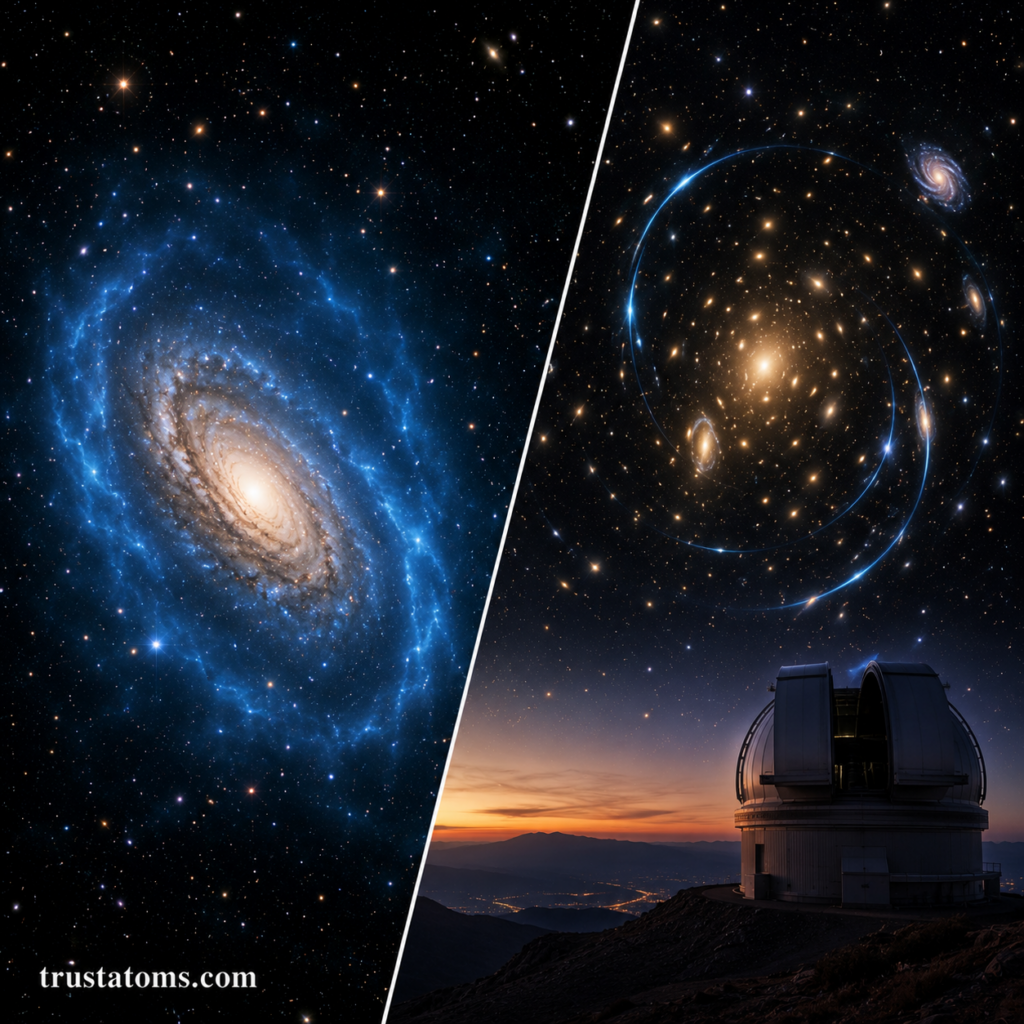
Einstein’s theory of general relativity predicts that gravity bends light.
This phenomenon is called gravitational lensing.
How Gravitational Lensing Works
Massive objects warp spacetime, causing light traveling nearby to bend.
This can produce:
- Distorted galaxy images
- Magnified distant objects
- Multiple light images
- Curved arcs of light
Dark Matter and Lensing
Scientists compare visible matter with observed lensing effects.
In many cases:
- Visible matter cannot explain the total lensing strength
- Additional invisible mass appears necessary
Gravitational lensing allows scientists to map dark matter distributions indirectly.
The Bullet Cluster
The Bullet Cluster provides some of the strongest observational evidence for dark matter.
What Happened
The Bullet Cluster formed when two galaxy clusters collided.
During the collision:
- Hot gas clouds slowed and interacted
- Galaxies mostly passed through
- Gravitational mass became separated from visible gas
Why This Matters
Most ordinary matter in galaxy clusters exists as hot gas.
However, gravitational lensing showed that most mass remained separate from the gas after collision.
This suggests invisible matter passed through relatively unaffected.
Many scientists consider the Bullet Cluster one of the clearest dark matter observations.
Cosmic Microwave Background Radiation
The cosmic microwave background (CMB) also supports dark matter theories.
What Is the CMB?
The CMB is leftover radiation from the early universe shortly after the Big Bang.
Tiny temperature variations within the CMB reveal information about early cosmic structure.
Dark Matter’s Role
Computer models show that observed CMB patterns match a universe containing dark matter.
Without dark matter:
- Large galaxies would struggle to form
- Cosmic structure growth would differ significantly
- Observed temperature fluctuations would not align with measurements
CMB observations strongly support current cosmological models involving dark matter.
Structure Formation in the Universe
Dark matter appears essential for explaining how galaxies and galaxy clusters formed.
Early Universe Conditions
After the Big Bang:
- Matter was distributed unevenly
- Gravity amplified denser regions
- Structures gradually formed
Dark matter likely provided additional gravitational attraction that accelerated this process.
Computer Simulations
Simulations including dark matter produce cosmic structures closely resembling observations.
Without dark matter:
- Galaxies form too slowly
- Large-scale structure patterns fail to match reality
This provides additional indirect evidence.
How Much Dark Matter Exists?
Modern cosmology estimates that ordinary matter makes up only a small portion of the universe.
Approximate composition includes:
- Ordinary matter: about 5%
- Dark matter: about 27%
- Dark energy: about 68%
Dark matter appears to outweigh visible matter by several times.
What Could Dark Matter Be?
Scientists still do not know the exact nature of dark matter.
Several possibilities remain under investigation.
WIMPs
Weakly Interacting Massive Particles (WIMPs) are one major theoretical candidate.
These particles would:
- Have mass
- Interact weakly with ordinary matter
- Produce gravitational effects
Axions
Axions are hypothetical lightweight particles proposed in particle physics.
They may help explain certain quantum phenomena while also functioning as dark matter.
Primordial Black Holes
Some theories suggest tiny black holes formed shortly after the Big Bang could contribute to dark matter.
However, evidence remains limited.
Why Dark Matter Is Hard to Detect
Dark matter appears to interact primarily through gravity.
This makes direct detection extremely difficult.
Lack of Electromagnetic Interaction
Dark matter does not appear to:
- Emit light
- Reflect light
- Absorb light significantly
Traditional telescopes therefore cannot observe it directly.
Extremely Weak Interactions
If dark matter particles exist, they may rarely interact with ordinary matter.
Sensitive underground detectors attempt to observe these rare interactions.
Dark Matter Detection Experiments
Scientists worldwide conduct experiments searching for dark matter particles.
Underground Laboratories
Many detectors operate deep underground to reduce interference from cosmic radiation.
Experiments search for:
- Tiny particle collisions
- Weak energy signals
- Rare nuclear interactions
Particle Accelerators
Facilities like the Large Hadron Collider investigate whether dark matter particles can be produced during high-energy collisions.
So far, direct detection remains unconfirmed.
Alternative Theories
Not all scientists agree dark matter is the only explanation.
Some researchers propose modified gravity theories instead.
MOND Theory
Modified Newtonian Dynamics (MOND) suggests gravity behaves differently at extremely low accelerations.
While MOND explains some galaxy rotation behavior, it struggles to fully explain all dark matter evidence.
Most cosmologists currently favor dark matter models because they better fit multiple observations simultaneously.
Why Dark Matter Matters
Dark matter plays a central role in modern cosmology.
Understanding it may help explain:
- Galaxy formation
- Cosmic evolution
- Fundamental particle physics
- Gravity itself
Dark matter research connects astronomy with quantum physics and high-energy particle science.
Discovering its true nature could transform our understanding of the universe.
Future Research and Technology
Future observatories and experiments may provide deeper insights into dark matter.
Upcoming research areas include:
- Advanced gravitational lensing surveys
- More sensitive underground detectors
- Space telescopes
- Particle accelerator experiments
- Precision cosmology studies
Scientists continue searching for direct evidence of dark matter particles.
Final Thoughts
Dark matter evidence comes from multiple independent observations across astronomy and cosmology.
Galaxy rotation curves, gravitational lensing, galaxy cluster behavior, cosmic background radiation, and large-scale structure formation all suggest that invisible matter exerts enormous gravitational influence throughout the universe.
Although dark matter has never been directly observed, the evidence supporting its existence remains strong.
Solving the dark matter mystery may become one of the most important scientific breakthroughs of the modern era, potentially reshaping our understanding of matter, gravity, and the evolution of the cosmos itself.