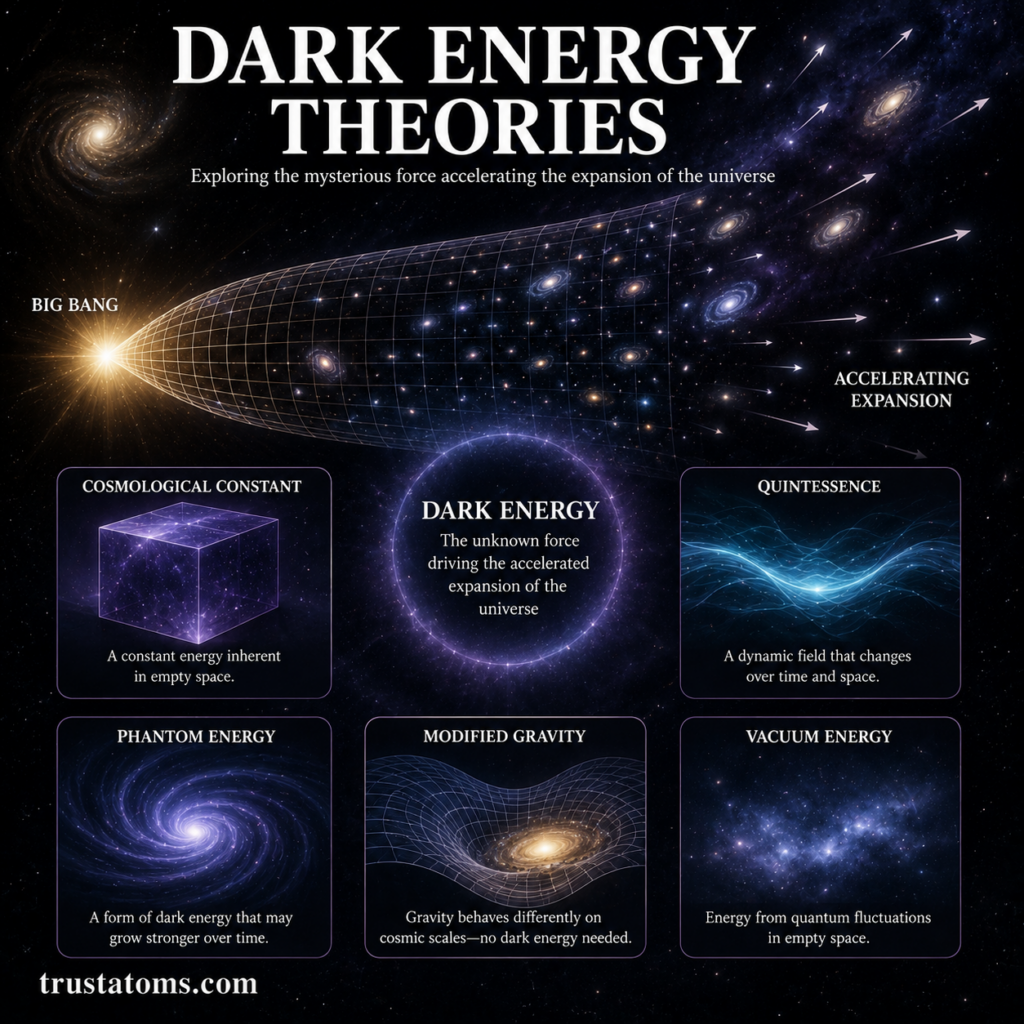
Dark energy theories attempt to explain why the expansion of the universe is accelerating rather than slowing under gravity. The leading explanation is a cosmological constant, although scientists also investigate changing energy fields and possible modifications to gravity.
This question sits at the intersection of astronomy and cosmology, where researchers use distant galaxies, exploding stars, and patterns in cosmic matter to test how the universe evolves. Although accelerating expansion is supported by multiple observations, the physical explanation remains uncertain.
What Is Dark Energy?
Dark energy is the name given to the unknown component or physical effect used to explain the observed acceleration of cosmic expansion. In the standard cosmological model, it behaves like energy distributed uniformly throughout space.
To explain this unexpected acceleration, researchers proposed the existence of dark energy — an unknown form of energy thought to permeate space itself.
According to measurements interpreted through the standard Lambda-CDM model, dark energy accounts for approximately 68% of the universe’s total energy density. Dark matter contributes about 27%, while ordinary matter makes up roughly 5%.
Dark energy differs from dark matter. Dark matter attracts other matter gravitationally and helps galaxies and clusters form. Dark energy, as represented by a cosmological constant, contributes to accelerated expansion on very large scales.
Scientists have not directly identified a dark energy particle or field. Instead, they infer its properties by comparing astronomical observations with predictions from general relativity and cosmological models.
How Astronomers Discovered Accelerating Expansion
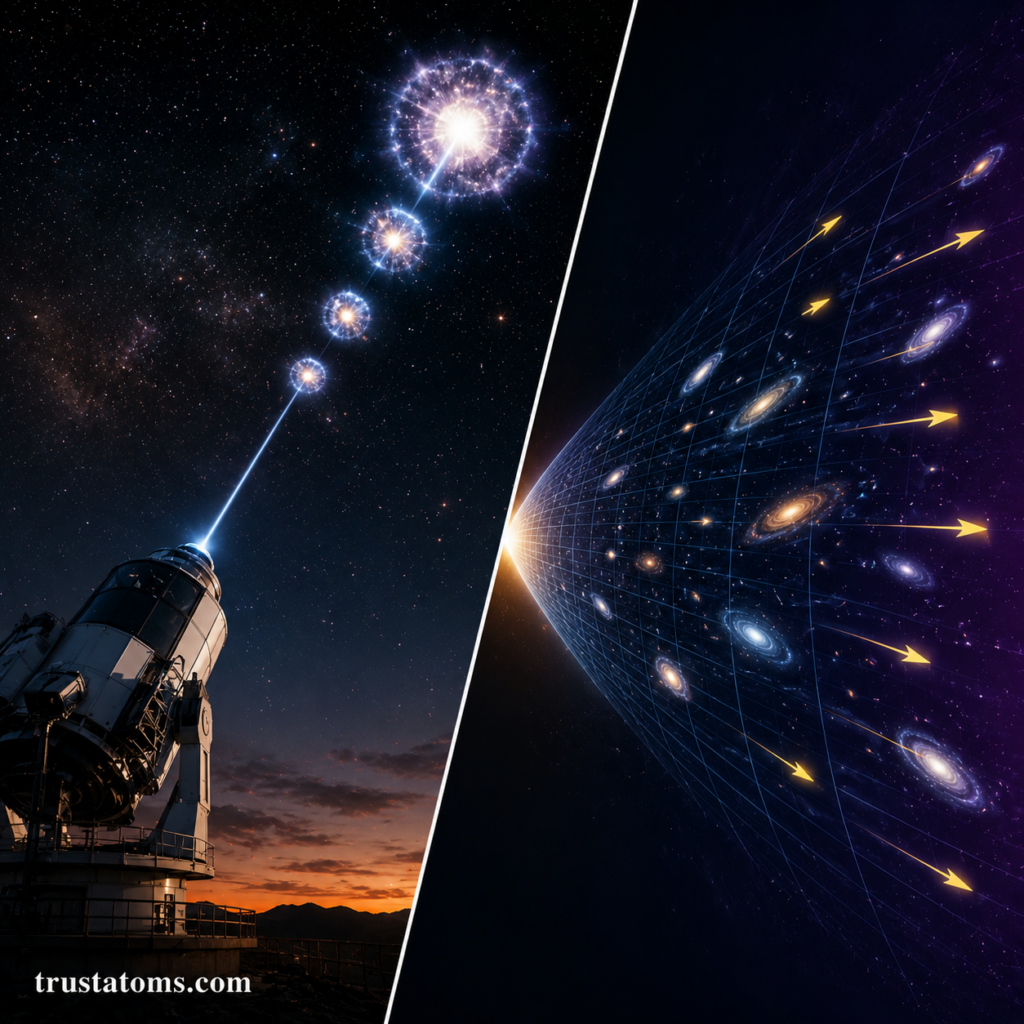
In the late 1990s, two research teams studying distant Type Ia supernovae found evidence that the universe’s expansion was accelerating.
Type Ia supernovae are useful distance indicators because astronomers can estimate their intrinsic brightness after accounting for measurable differences between events. Comparing that estimated brightness with how bright a supernova appears reveals its distance.
The researchers combined these distances with redshift measurements, which indicate how much the universe expanded while the light traveled toward Earth.
The distant supernovae appeared dimmer than expected in models where expansion was slowing in the anticipated way. Their distances indicated that cosmic expansion had accelerated during more recent cosmic history.
Saul Perlmutter, Brian Schmidt, and Adam Riess received the 2011 Nobel Prize in Physics for work associated with this discovery.
Expansion of the Universe and Hubble’s Law
Scientists originally expected gravity to gradually slow cosmic expansion after the Big Bang. Instead, observations revealed that galaxies are separating in a way that indicates accelerated expansion during the universe’s later history.
In the scientific Big Bang model, space has expanded from an earlier hot, dense state. On sufficiently large scales, the distances between galaxies not bound together by gravity generally increase over time.
Hubble’s law describes the approximate relationship between distance and recession speed for relatively nearby galaxies: recession speed equals the Hubble constant multiplied by distance.
For example, using an illustrative Hubble constant of 70 kilometers per second per megaparsec, a galaxy 100 megaparsecs away would have an estimated recession speed of 7,000 kilometers per second. At 200 megaparsecs, the corresponding estimate would be 14,000 kilometers per second.
This relationship describes recession speed at a particular cosmic time. Accelerating expansion means the cosmic scale factor changes at an accelerating rate; it does not mean every galaxy’s recession speed simply increases by the same amount each year.
Researchers compare explanations of this behavior in cosmological models compared, including the standard model and alternative frameworks.
Additional measurements discussed in observational evidence for expansion show how galaxy redshifts and other observations establish that the universe is growing.
The Cosmological Constant: The Leading Explanation
The simplest dark energy model uses the cosmological constant, represented by the Greek letter Lambda. Albert Einstein introduced this term into his gravitational equations in 1917 while considering a static universe.
In modern cosmology, a positive cosmological constant represents an energy density that remains constant as space expands. Its associated negative pressure can produce accelerating expansion under general relativity.
The Lambda-CDM model combines this cosmological constant with cold dark matter and ordinary matter. It successfully describes many observations, including cosmic microwave background measurements and large-scale galaxy distributions.
Its main advantage is simplicity: one constant parameter describes dark energy’s contribution. Its main limitation is that scientists do not know why the cosmological constant has its observed value.
Vacuum Energy and the Cosmological Constant Problem
Quantum field theory describes empty space as a physical vacuum rather than an absence of all activity. Quantum fields retain properties even in their lowest-energy states.
This raises the possibility that vacuum energy contributes to the cosmological constant. However, relating theoretical vacuum-energy calculations to the observed value presents a major difficulty.
Depending on the assumptions and energy scales used, naive theoretical estimates can be enormously larger than the effective dark energy density inferred from cosmological observations.
This discrepancy is called the cosmological constant problem. It remains unresolved and suggests that scientists do not yet fully understand the relationship between quantum physics and gravity.
Quintessence: Dark Energy That Changes Over Time
Quintessence models propose that dark energy arises from a dynamic field whose energy density can evolve as the universe expands.
Unlike a cosmological constant, which has a fixed energy density, quintessence may produce different expansion histories depending on the field’s properties.
Cosmologists often describe dark energy using an equation-of-state parameter, written as w, that relates pressure to energy density.
- Cosmological constant: Has w equal to −1.
- Typical quintessence: Has w greater than −1 and may vary over time.
- Phantom energy: Has w less than −1 in its simplest descriptions.
Observations that establish a changing equation of state could provide evidence against a strictly constant dark energy component. However, detecting such changes requires highly precise measurements across different periods of cosmic history.
Phantom Energy and the Big Rip Hypothesis
Phantom energy is a speculative class of dark energy models in which the energy density can increase as the universe expands.
In some models, this behavior produces increasingly rapid acceleration. If it continues without changing, the expansion could eventually overcome the forces holding galaxies, planetary systems, and even smaller structures together.
This hypothetical outcome is called the Big Rip.
The Big Rip is not a prediction of the standard Lambda-CDM model. It depends on specific assumptions about phantom energy, and observations have not established that such an extreme future will occur.
Modified Gravity: Could the Explanation Be Different?
Some researchers investigate whether cosmic acceleration reflects limitations in our understanding of gravity rather than a separate dark energy component.
These approaches modify or extend Einstein’s general relativity, particularly on very large scales. Examples include certain scalar-tensor theories and models involving additional terms in the gravitational equations.
A successful alternative must explain more than accelerating expansion. It must also reproduce gravitational lensing, galaxy clustering, cosmic microwave background patterns, and well-tested gravitational behavior within the solar system.
Many modified gravity models face difficulties satisfying all these requirements simultaneously. None has replaced Lambda-CDM as the standard cosmological framework.
How the Major Dark Energy Theories Compare
| Theory | Central Idea | Main Uncertainty |
|---|---|---|
| Cosmological constant | Dark energy density remains constant as space expands. | Why its value is so small. |
| Quintessence | An evolving field produces changing dark energy. | Whether such a field exists. |
| Phantom energy | Dark energy density may increase during expansion. | Whether the required behavior is physically viable. |
| Modified gravity | Cosmic acceleration results from changes to gravitational physics. | Whether one theory can match all observations. |
These theories can predict similar expansion histories over limited periods. Distinguishing them requires combining multiple types of astronomical evidence rather than relying on a single measurement.
Evidence Scientists Use to Test Dark Energy
Dark energy is studied primarily through its effects on cosmic expansion and the growth of structure.
Type Ia Supernovae
Supernova brightness and redshift measurements trace how the relationship between distance and expansion has changed over cosmic history.
Baryon Acoustic Oscillations
Baryon acoustic oscillations are patterns in the distribution of galaxies left by sound waves in the early universe. Their characteristic scale provides a reference for measuring cosmic distances and expansion.
Cosmic Microwave Background
The cosmic microwave background preserves information about early-universe conditions. When combined with later measurements, it constrains the universe’s composition, geometry, and expansion history.
Gravitational Lensing and Galaxy Clustering
Dark energy affects how cosmic structures grow over time. Researchers examine galaxy clustering and gravitational lensing to test whether observed structure formation matches predictions from different theories.
Dark Energy and the Fate of the Universe
The universe’s long-term future depends partly on whether dark energy remains constant, weakens, or changes in another way.
If dark energy behaves as a cosmological constant, the standard model predicts continuing accelerated expansion. Distant galaxies would become increasingly isolated, while stars eventually exhaust their fuel over extremely long timescales.
If dark energy evolves, other outcomes may be possible. Some hypothetical models predict a Big Rip, while models with sufficiently different future behavior could permit expansion to slow or reverse.
These possibilities also depend on matter and gravity. Research into dark matter evidence helps explain the separate gravitational contribution of the matter component.
Current evidence strongly supports accelerated expansion, but it does not establish every detail of the universe’s distant future.
What Future Observations Could Reveal
Researchers are using increasingly detailed galaxy surveys, supernova measurements, and gravitational lensing observations to investigate dark energy’s behavior.
The Dark Energy Spectroscopic Instrument maps millions of galaxies and quasars to measure cosmic expansion across different periods. The European Space Agency’s Euclid mission studies galaxy distributions and gravitational lensing, while NASA’s Nancy Grace Roman Space Telescope is designed to investigate dark energy through several complementary methods.
One central question is whether dark energy’s equation of state remains consistent with w equal to −1. Some combinations of recent measurements have suggested possible deviations, but these indications are not yet conclusive.
Improved observations may reveal that a cosmological constant remains sufficient or that a more complex explanation is needed.
Frequently Asked Questions
Is dark energy the same as dark matter?
No. Dark matter contributes gravitational attraction and helps explain how galaxies and clusters form. Dark energy is the name given to the component or effect associated with accelerated cosmic expansion. Their physical identities remain unknown.
Has dark energy been directly detected?
No dark energy particle or field has been directly identified. Scientists infer dark energy’s behavior from observations of cosmic expansion, galaxy clustering, gravitational lensing, and the cosmic microwave background.
Could dark energy eventually destroy the universe?
Some speculative phantom energy models predict a Big Rip that would eventually disrupt gravitationally bound structures. However, the standard cosmological constant model predicts continued accelerated expansion without this outcome, and observations do not establish that a Big Rip will occur.
Dark energy theories offer competing explanations for the observed acceleration of cosmic expansion, ranging from a constant energy density to evolving fields and modified gravity. The cosmological constant remains the simplest model consistent with a broad range of observations, but its physical origin is unexplained. More precise measurements of expansion and structure growth may reveal whether dark energy changes over time or whether the standard model remains sufficient.
Sources: NASA, dark energy and cosmology educational resources; Planck Collaboration, “Planck 2018 Results. VI. Cosmological Parameters” (2020); Dark Energy Spectroscopic Instrument Collaboration, published cosmological results.