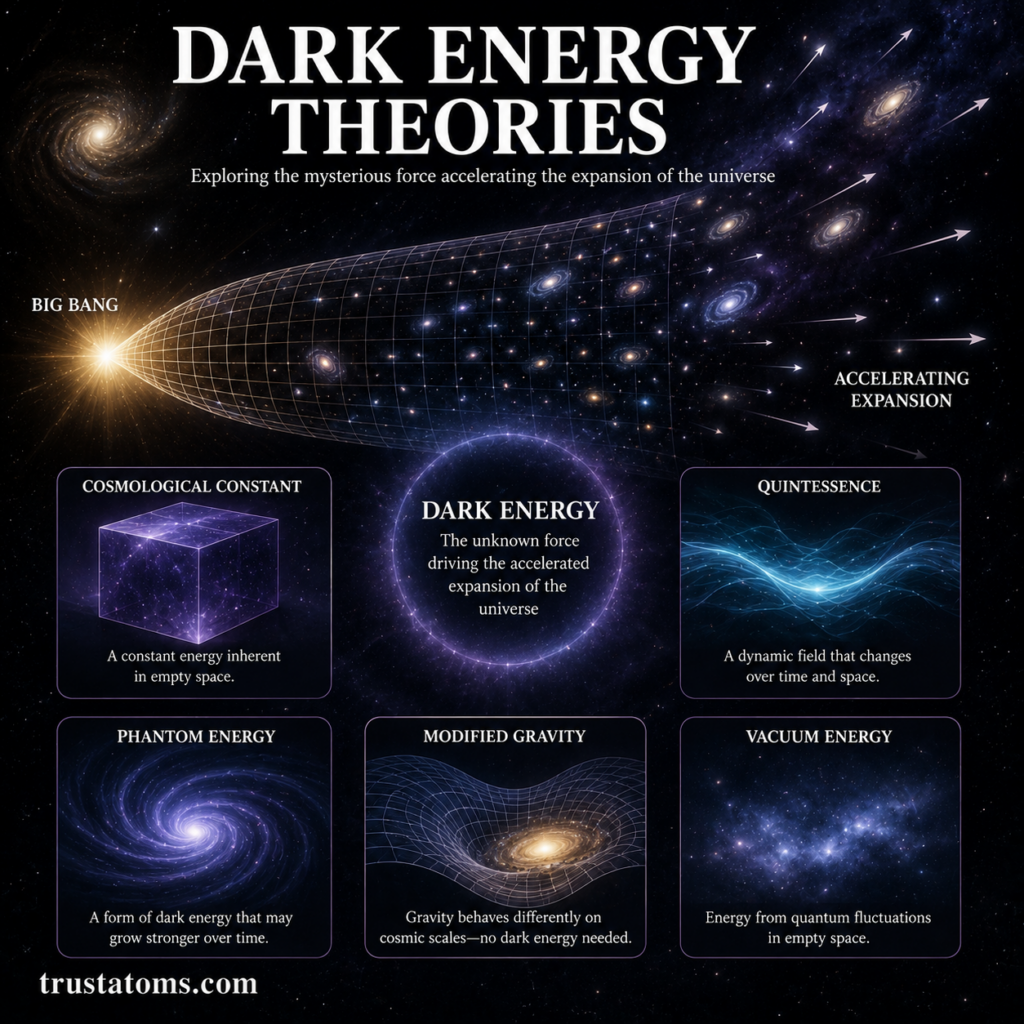
One of the greatest mysteries in modern astronomy is the discovery that the universe is not only expanding, but expanding at an accelerating rate.
Scientists originally expected gravity to gradually slow cosmic expansion after the Big Bang. Instead, observations revealed that galaxies are moving away from one another faster over time.
To explain this unexpected acceleration, researchers proposed the existence of dark energy — an unknown form of energy thought to permeate space itself.
Although dark energy has never been directly observed, it appears to dominate the universe on the largest scales.
Understanding dark energy theories helps scientists investigate the future of the cosmos, the structure of spacetime, and the limits of modern physics.
What Is Dark Energy?
Dark energy is a hypothetical form of energy believed to drive the accelerating expansion of the universe.
Unlike ordinary matter or dark matter:
- Dark energy does not clump into galaxies
- It appears distributed throughout space
- It exerts a repulsive effect on cosmic expansion
Scientists infer its existence from astronomical observations rather than direct detection.
Current cosmological estimates suggest dark energy represents approximately 68% of the universe’s total mass-energy content.
The Discovery of Accelerating Expansion
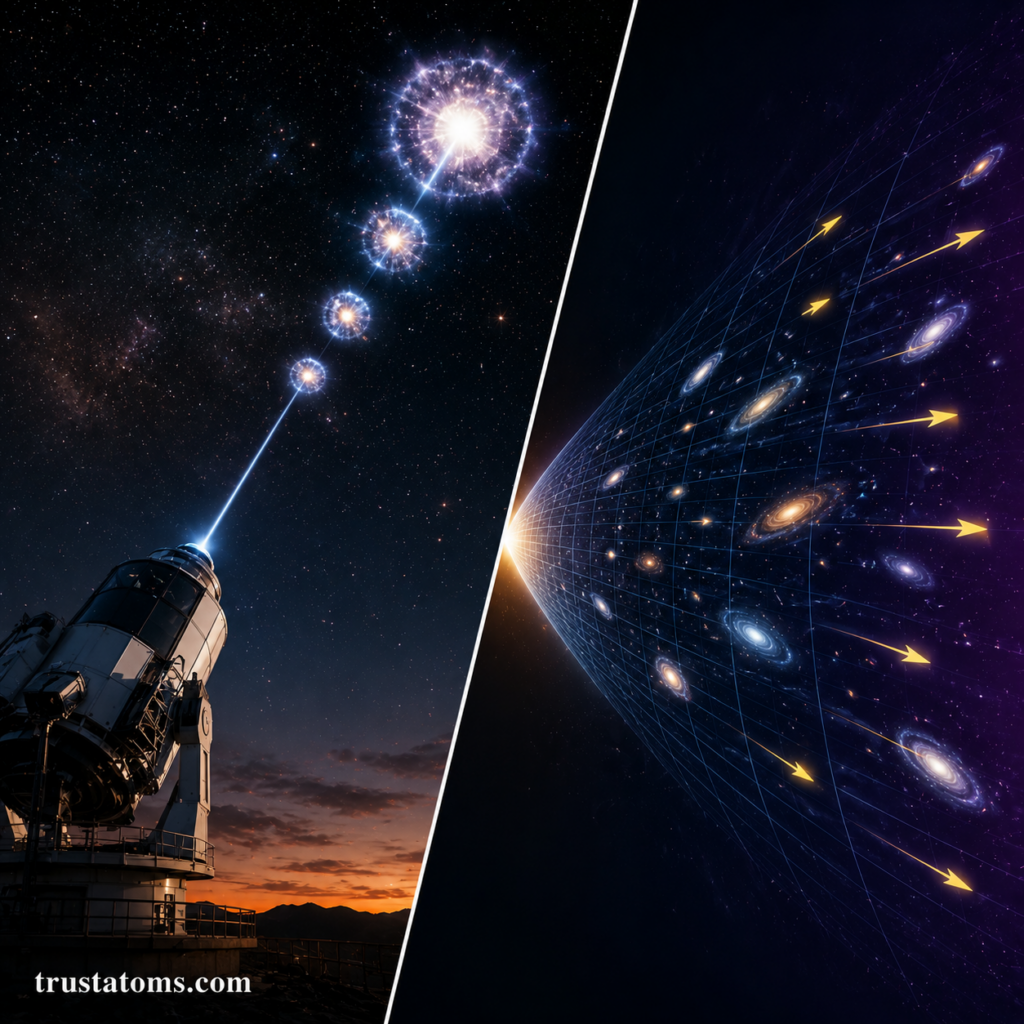
Dark energy theories emerged after observations in the late 1990s.
Type Ia Supernova Observations
Astronomers studied distant Type Ia supernovae, which serve as “standard candles” because they produce predictable brightness levels.
By comparing:
- Actual brightness
- Observed brightness
- Redshift measurements
scientists could estimate cosmic distances and expansion history.
Unexpected Results
Researchers discovered that distant galaxies were farther away than expected.
This indicated that cosmic expansion had accelerated over time rather than slowing down.
The discovery transformed cosmology and earned the 2011 Nobel Prize in Physics.
Expansion of the Universe
The universe has expanded since the Big Bang.
Galaxies generally move apart as spacetime itself stretches.
Hubble’s Law
Astronomer Edwin Hubble discovered that distant galaxies recede faster than nearby ones.
This relationship is summarized by Hubble’s Law.
This equation shows that recession velocity increases with distance.
Dark energy appears to increase this expansion over time.
The Cosmological Constant Theory
The simplest dark energy explanation involves the cosmological constant.
Einstein’s Cosmological Constant
Albert Einstein originally introduced the cosmological constant into general relativity.
Einstein initially used it to create a static universe model before expansion was discovered.
Later, he reportedly considered it a mistake.
Ironically, the cosmological constant later became central to dark energy theory.
Vacuum Energy
In this interpretation:
- Empty space contains intrinsic energy
- Space itself generates repulsive gravitational effects
- Expansion accelerates naturally
The cosmological constant remains the leading dark energy model today.
Vacuum Energy and Quantum Physics
Quantum mechanics predicts that empty space is not truly empty.
Quantum Fluctuations
Even vacuum space contains temporary particle fluctuations.
These fluctuations contribute energy to spacetime.
This vacuum energy could potentially explain dark energy.
The Cosmological Constant Problem
However, theoretical calculations produce values vastly larger than observed dark energy levels.
The discrepancy is enormous and remains unresolved.
This problem is considered one of the biggest unsolved issues in theoretical physics.
Quintessence Theory
Some scientists propose that dark energy changes over time rather than remaining constant.
This idea is called quintessence.
Dynamic Energy Fields
Quintessence models involve evolving scalar fields spread throughout space.
Possible properties include:
- Variable energy density
- Changing expansion effects
- Time-dependent behavior
Unlike the cosmological constant, quintessence may evolve as the universe ages.
Why It Matters
If dark energy changes over time, the long-term future of the universe could differ dramatically from current predictions.
Future observations may help distinguish between constant and dynamic models.
Phantom Energy Theory
Phantom energy represents a more extreme version of dark energy.
Accelerated Expansion
In phantom energy models:
- Expansion accelerates increasingly fast
- Repulsive effects grow stronger over time
This could eventually overpower:
- Galaxies
- Solar systems
- Planets
- Atoms themselves
The Big Rip Scenario
One theoretical outcome is the Big Rip.
In this scenario:
- Galaxies separate completely
- Stars become isolated
- Planetary systems break apart
- Matter itself eventually disintegrates
Although speculative, phantom energy remains a topic of cosmological research.
Modified Gravity Theories
Some scientists question whether dark energy exists at all.
Instead, they suggest gravity itself may behave differently on cosmic scales.
Alternative Gravity Models
Possible ideas include:
- Modified Newtonian dynamics
- Extra-dimensional gravity
- Altered general relativity equations
- Large-scale spacetime modifications
These theories attempt to explain accelerating expansion without introducing unknown energy forms.
Challenges
Modified gravity models must still explain:
- Galaxy observations
- Cosmic microwave background patterns
- Large-scale structure formation
- Gravitational lensing data
Many alternative theories struggle to match all observations simultaneously.
Dark Energy and the Fate of the Universe
Dark energy strongly influences predictions about the universe’s future.
Possible Cosmic Futures
Several scenarios exist depending on dark energy behavior.
Eternal Expansion
If dark energy remains constant:
- Galaxies continue separating
- Stars gradually die out
- The universe becomes colder and darker
This is sometimes called the “heat death” scenario.
Big Rip
If dark energy strengthens over time:
- Expansion accelerates uncontrollably
- Cosmic structures eventually disintegrate
Big Crunch
If dark energy weakens or reverses:
- Expansion could slow
- Gravity might dominate again
- The universe could eventually collapse inward
Current observations favor continued expansion.
Evidence Supporting Dark Energy
Dark energy evidence comes from multiple astronomical observations.
Supernova Measurements
Type Ia supernova studies first revealed accelerated expansion.
Cosmic Microwave Background
The cosmic microwave background supports cosmological models involving dark energy.
Large-Scale Structure
Galaxy distributions and cosmic structure growth align with dark energy predictions.
Baryon Acoustic Oscillations
Patterns in galaxy clustering provide additional evidence for cosmic acceleration.
Together, these observations strongly support modern dark energy models.
Why Dark Energy Is Difficult to Study
Dark energy does not appear to interact directly with matter or light.
Scientists study it indirectly through its effects on cosmic expansion.
Major Challenges
Researchers still do not know:
- What dark energy physically is
- Whether it changes over time
- How it connects to quantum physics
- Why its energy density appears so small
This makes dark energy one of the most difficult topics in cosmology.
Future Dark Energy Research
Scientists continue developing new experiments to study cosmic expansion more precisely.
Major Research Projects
Future missions include:
- Space telescopes
- Galaxy surveys
- Precision supernova measurements
- Dark energy mapping missions
These studies aim to determine:
- Whether dark energy evolves
- How fast expansion changes
- Which theoretical models best match reality
Improved data may help narrow possible explanations.
Dark Energy and Modern Cosmology
Dark energy transformed scientific understanding of the universe.
Modern cosmological models now depend heavily on dark energy to explain:
- Cosmic acceleration
- Large-scale structure evolution
- Expansion history
- Future universe predictions
Understanding dark energy may require major advances in both physics and astronomy.
Connections to Fundamental Physics
Dark energy research connects several major scientific fields.
These include:
- General relativity
- Quantum mechanics
- Particle physics
- Cosmology
- Astrophysics
Some scientists believe solving dark energy could lead to entirely new physics beyond current theories.
Final Thoughts
Dark energy theories attempt to explain one of the most surprising discoveries in modern astronomy: the accelerating expansion of the universe.
Although scientists still do not know exactly what dark energy is, evidence from supernovae, cosmic background radiation, galaxy clustering, and large-scale structure strongly suggests that an unknown force influences cosmic expansion on enormous scales.
Whether dark energy involves vacuum energy, dynamic fields, modified gravity, or entirely new physics remains one of the biggest unanswered questions in science.
Future observations and theoretical breakthroughs may eventually reveal the true nature of the mysterious force shaping the fate of the universe itself.