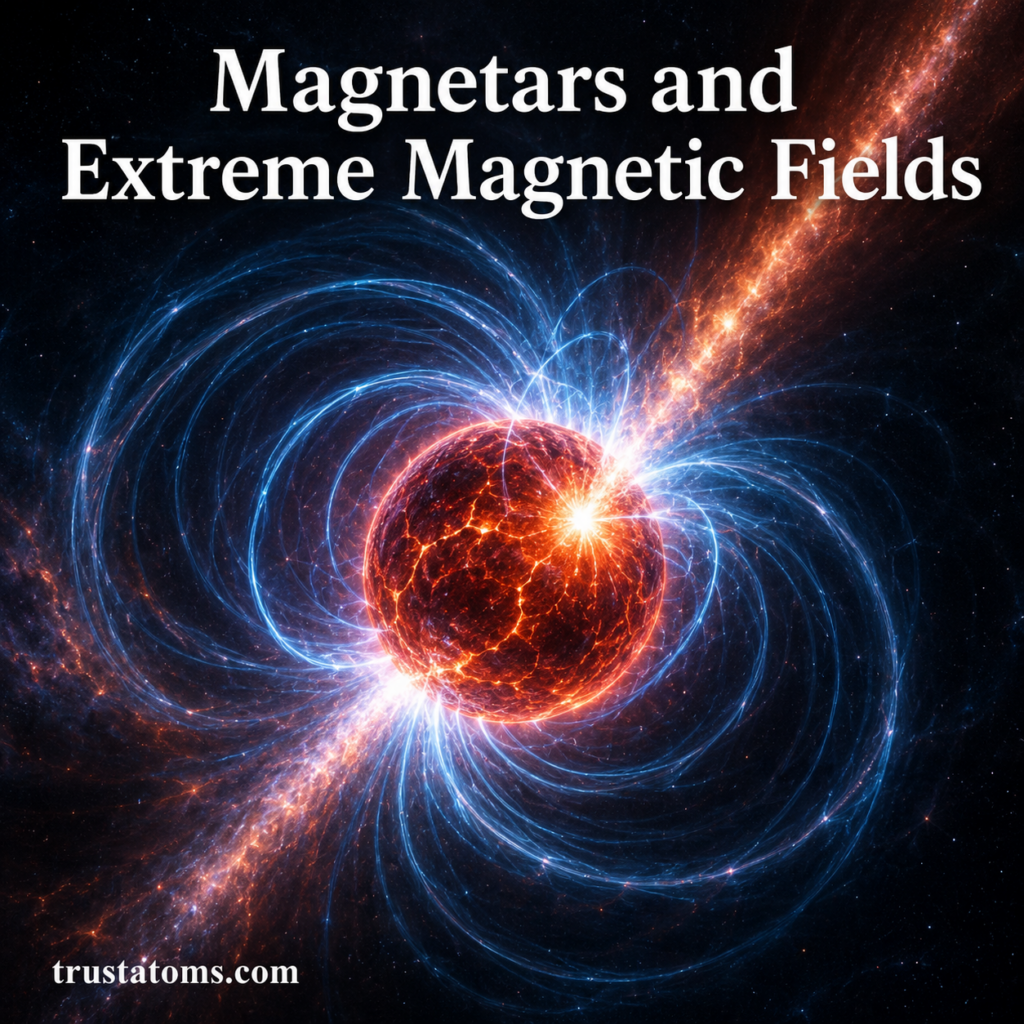
Magnetars are among the most mysterious and powerful objects in the universe. These rare neutron stars possess magnetic fields so intense that they can distort atoms, trigger massive bursts of radiation, and reshape the space around them.
While black holes often capture public attention, magnetars represent a different kind of cosmic extreme — one driven not by gravity alone, but by unimaginable magnetic power.
Scientists study magnetars to better understand stellar evolution, high-energy astrophysics, and the behavior of matter under conditions that cannot be recreated on Earth.
What Is a Magnetar?
A magnetar is a special type of neutron star with an extraordinarily strong magnetic field.
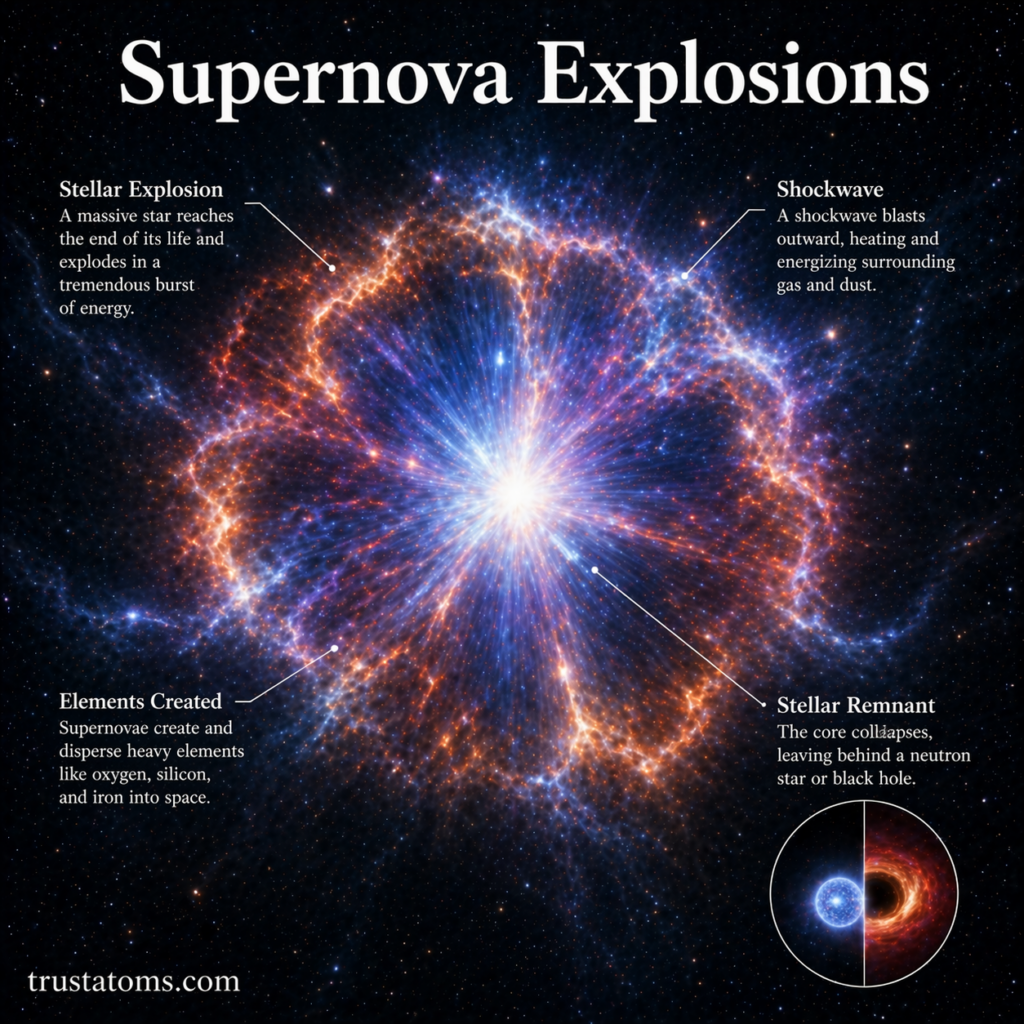
Neutron stars themselves form when massive stars explode in supernova events. After the explosion, the remaining core collapses into an ultra-dense object made mostly of neutrons.
Most neutron stars already possess strong magnetic fields, but magnetars take this to another level.
A typical magnetar may have a magnetic field strength of:
- 100 trillion to 1 quadrillion times stronger than Earth’s magnetic field
- Thousands of times stronger than ordinary neutron stars
- Powerful enough to disrupt electronic systems from enormous distances
Despite being only about 12–20 miles wide, magnetars can contain more mass than the Sun.
How Magnetars Form
Magnetars are believed to form from massive stars that originally contained large amounts of angular momentum and magnetic energy.
The process generally follows these steps:
- A massive star exhausts its nuclear fuel
- The star collapses under gravity
- A supernova explosion occurs
- The core compresses into a neutron star
- Rapid rotation and internal dynamics amplify the magnetic field
Not every neutron star becomes a magnetar. Scientists believe only a small percentage develop the extreme magnetic conditions required.
Why Their Magnetic Fields Are So Extreme
The magnetic field of a magnetar is difficult to fully comprehend because nothing comparable exists naturally on Earth.
Dynamo Effect
One leading explanation involves a process called the dynamo effect.
If a newborn neutron star spins extremely rapidly — potentially hundreds of times per second — the motion of electrically conductive material inside the star can amplify magnetic fields dramatically.
This creates a self-sustaining cycle that intensifies the magnetism.
Compressed Magnetic Flux
When a massive star collapses, its magnetic field becomes compressed into a much smaller volume.
This concentration greatly increases field strength, similar to how squeezing magnetic field lines together intensifies their effect.
What Makes Magnetars Different From Other Neutron Stars?
Magnetars differ from ordinary neutron stars in several important ways.
1. Magnetic Strength
This is their defining characteristic.
Their magnetic fields are the strongest known stable magnetic fields in the universe.
2. Violent Energy Outbursts
Magnetars produce powerful bursts of:
- X-rays
- Gamma rays
- High-energy radiation
These eruptions can release more energy in seconds than the Sun emits in years.
3. Crustal Starquakes
The immense magnetic pressure can crack the magnetar’s crust.
These “starquakes” trigger sudden radiation flares detectable across space.
4. Slower Rotation
Many magnetars rotate more slowly than young neutron stars because their magnetic fields gradually drain rotational energy.
The Power of a Magnetar’s Magnetic Field
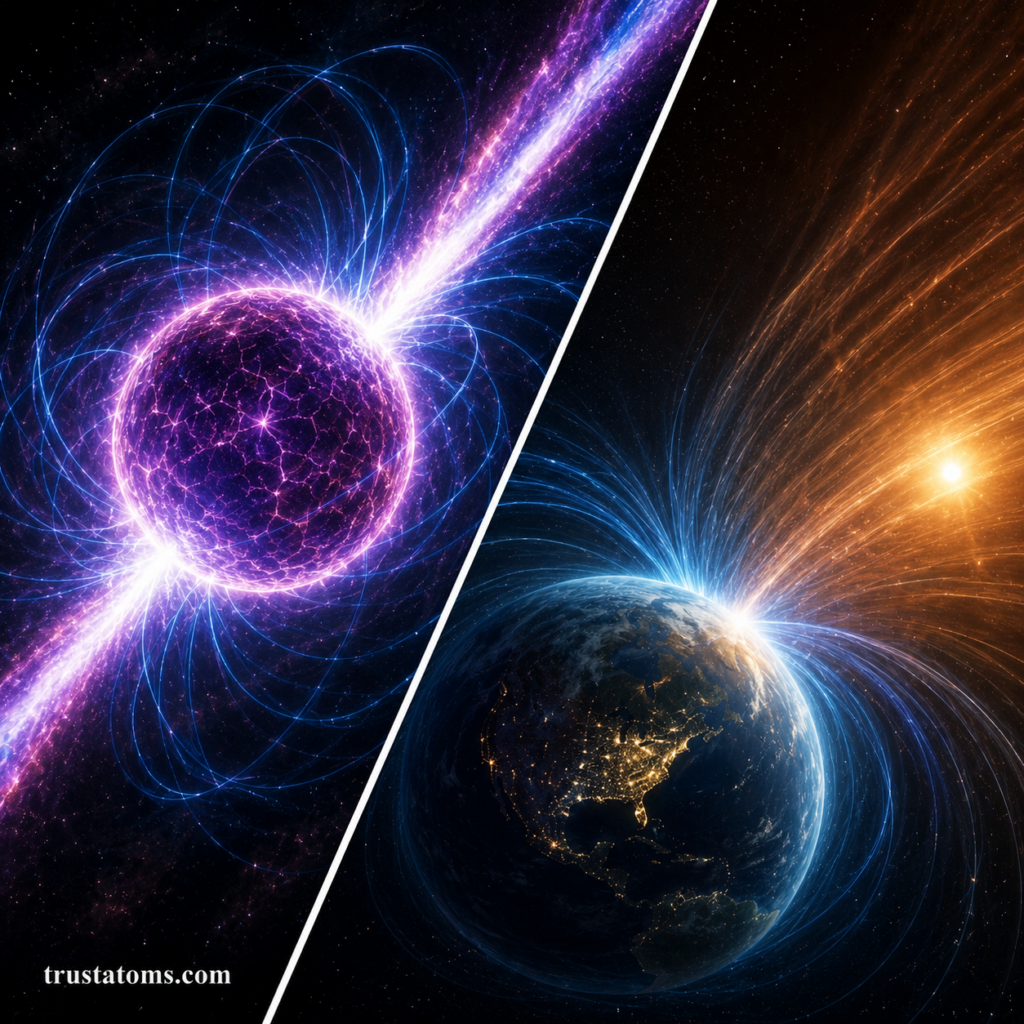
To understand magnetar strength, it helps to compare it with familiar magnetic environments.
| Object | Approximate Magnetic Field |
|---|---|
| Earth | 0.5 gauss |
| Refrigerator magnet | 100 gauss |
| MRI machine | 10,000–70,000 gauss |
| Typical neutron star | 1 trillion gauss |
| Magnetar | Up to 1 quadrillion gauss |
At close distances, a magnetar’s magnetic field could:
- Distort electron clouds in atoms
- Destroy molecular structures
- Induce electric currents in nearby objects
- Potentially erase data from electronics from vast distances
A magnetar passing halfway between Earth and the Moon could theoretically disrupt technology across the planet.
Magnetar Bursts and Flares
Magnetars are famous for sudden high-energy eruptions.
Soft Gamma Repeaters (SGRs)
Some magnetars repeatedly emit bursts of gamma rays and X-rays.
These are known as Soft Gamma Repeaters.
The bursts may last:
- Fractions of a second
- Several minutes
- Rarely, much longer
Giant Flares
The most powerful magnetar eruptions are called giant flares.
These events are extremely rare but incredibly energetic.
In 2004, a giant flare from magnetar SGR 1806-20 briefly affected Earth’s upper atmosphere despite being located about 50,000 light-years away.
Could Magnetars Threaten Earth?
Fortunately, known magnetars are extremely distant from Earth.
However, if a magnetar formed relatively nearby, its radiation could potentially:
- Damage satellites
- Disrupt communication systems
- Affect Earth’s atmosphere
- Increase radiation exposure
Scientists do not consider magnetars an immediate threat to humanity because no dangerous candidates are close enough.
How Scientists Detect Magnetars
Magnetars are primarily observed through high-energy astronomy.
Scientists use:
- X-ray telescopes
- Gamma-ray observatories
- Space-based detectors
- Radio telescopes
Some famous observatories involved in magnetar research include:
- NASA’s Chandra X-ray Observatory
- ESA’s XMM-Newton
- Fermi Gamma-ray Space Telescope
Researchers analyze flare timing, radiation intensity, and rotational changes to study their internal physics.
Magnetars and Fast Radio Bursts
One of the most exciting modern discoveries is the possible connection between magnetars and Fast Radio Bursts (FRBs).
FRBs are extremely brief but intense radio signals arriving from distant galaxies.
In 2020, scientists detected an FRB-like signal from a magnetar within the Milky Way, strengthening the theory that at least some FRBs originate from magnetars.
This discovery connected two major astrophysical mysteries for the first time.
The Strange Physics Around Magnetars
Magnetars create environments where normal physics behaves differently.
Quantum Effects
Their magnetic fields may alter the vacuum of space itself through quantum electrodynamics effects.
In these environments:
- Light polarization changes
- Atomic structures deform
- Radiation behaves unusually
Matter Under Extreme Density
A teaspoon of neutron star material could weigh billions of tons on Earth.
Magnetars combine this extreme density with overwhelming magnetic forces, creating conditions unlike anywhere else in the observable universe.
How Long Do Magnetars Last?
Magnetars are relatively short-lived on cosmic timescales.
Their intense magnetic fields slowly decay over:
- Approximately 10,000 to 100,000 years
As the field weakens, the magnetar may eventually resemble a more typical neutron star.
Because of their short active lifespans, magnetars are considered relatively rare.
Scientists estimate the Milky Way may contain only a few dozen active magnetars at any given time.
Famous Known Magnetars
Several magnetars have become especially important in astronomy research.
SGR 1806-20
Known for producing one of the most powerful giant flares ever observed.
1E 1048.1−5937
Frequently studied due to its changing emission behavior.
XTE J1810−197
One of the first magnetars discovered to emit radio waves.
These objects continue helping researchers test theories about extreme matter and magnetic physics.
Why Magnetars Matter in Astronomy
Magnetars are more than cosmic curiosities.
They help scientists study:
- Extreme magnetic physics
- Stellar death and evolution
- High-energy radiation
- Nuclear matter behavior
- Relativistic effects
- Fast Radio Bursts
- Quantum phenomena in space
Because their environments are so extreme, magnetars serve as natural laboratories for testing physical theories impossible to reproduce on Earth.
Final Thoughts
Magnetars represent one of the universe’s most extreme and fascinating creations.
Their magnetic fields push the limits of known physics, producing violent radiation bursts, strange quantum effects, and enormous cosmic energy releases.
Although rare, magnetars play a major role in helping scientists understand how matter, energy, and magnetic forces behave under extraordinary conditions.
As telescope technology improves and new space observatories launch, researchers will likely uncover even more secrets hidden within these magnetic giants of the cosmos.