
Magnetars are rare neutron stars with extraordinarily powerful magnetic fields, typically reaching around 10¹⁴ to 10¹⁵ gauss at their surfaces. These extreme fields can produce intense X-ray and gamma-ray bursts, alter the behavior of matter, and release enormous amounts of stored magnetic energy.
Among the most extreme objects studied in modern astronomy, magnetars are a special class of neutron stars that allow scientists to investigate magnetic forces under conditions impossible to reproduce in ordinary laboratories.
Although magnetars are only about the size of a city, they contain enormous amounts of matter compressed into an exceptionally small volume. Their unusual combination of density, magnetism, and high-energy radiation makes them valuable targets for astrophysical research.
What Is a Magnetar?
A magnetar is a highly magnetized neutron star, the compact remnant left behind when the core of certain massive stars collapses.
Neutron stars typically measure roughly 20 kilometers across and can contain more mass than the Sun. Their extraordinary density results from matter being compressed far beyond conditions found in ordinary stars.
Magnetars differ from most neutron stars because their magnetic fields are exceptionally strong and can power dramatic episodes of high-energy radiation.
They are one possible outcome of stellar death. Other stars leave behind different compact objects, as explained in White Dwarfs and Stellar Remnants.
How Magnetars Form
Scientists believe many magnetars form during the collapse of massive stellar cores, although the precise conditions that produce their unusually strong magnetic fields remain under investigation.
A possible formation sequence includes:
- A massive star exhausts the nuclear fuel supporting its core against gravitational collapse.
- The core collapses rapidly, compressing matter into an extremely dense state.
- The surrounding stellar layers may be expelled in a core-collapse supernova.
- A neutron star remains, potentially possessing rapid rotation and strong internal magnetic fields.
- Magnetic amplification processes may produce the exceptionally powerful field associated with a magnetar.
Not every neutron star becomes a magnetar. Researchers continue investigating how a progenitor star’s rotation, magnetic properties, and internal structure influence the outcome.
Why Magnetar Magnetic Fields Are So Extreme
Two physical processes help explain how such powerful magnetic fields might develop: magnetic flux compression and dynamo amplification.
Magnetic Flux Compression
When a stellar core collapses, its radius decreases dramatically. If much of its magnetic flux is preserved, the magnetic field becomes concentrated across a much smaller surface area.
This compression can strengthen an existing magnetic field considerably, although additional processes may be needed to explain the strongest magnetars.
Dynamo Amplification
Another proposed mechanism involves powerful fluid motions and rapid rotation inside a newly formed neutron star.
Under suitable conditions, electrically conducting matter can amplify magnetic fields through dynamo action. The effectiveness of this process depends on the star’s internal conditions and rotational behavior.
The relationship between stellar motion and magnetism is explored further in Stellar Rotation and Magnetic Fields.
How Strong Is a Magnetar’s Magnetic Field?
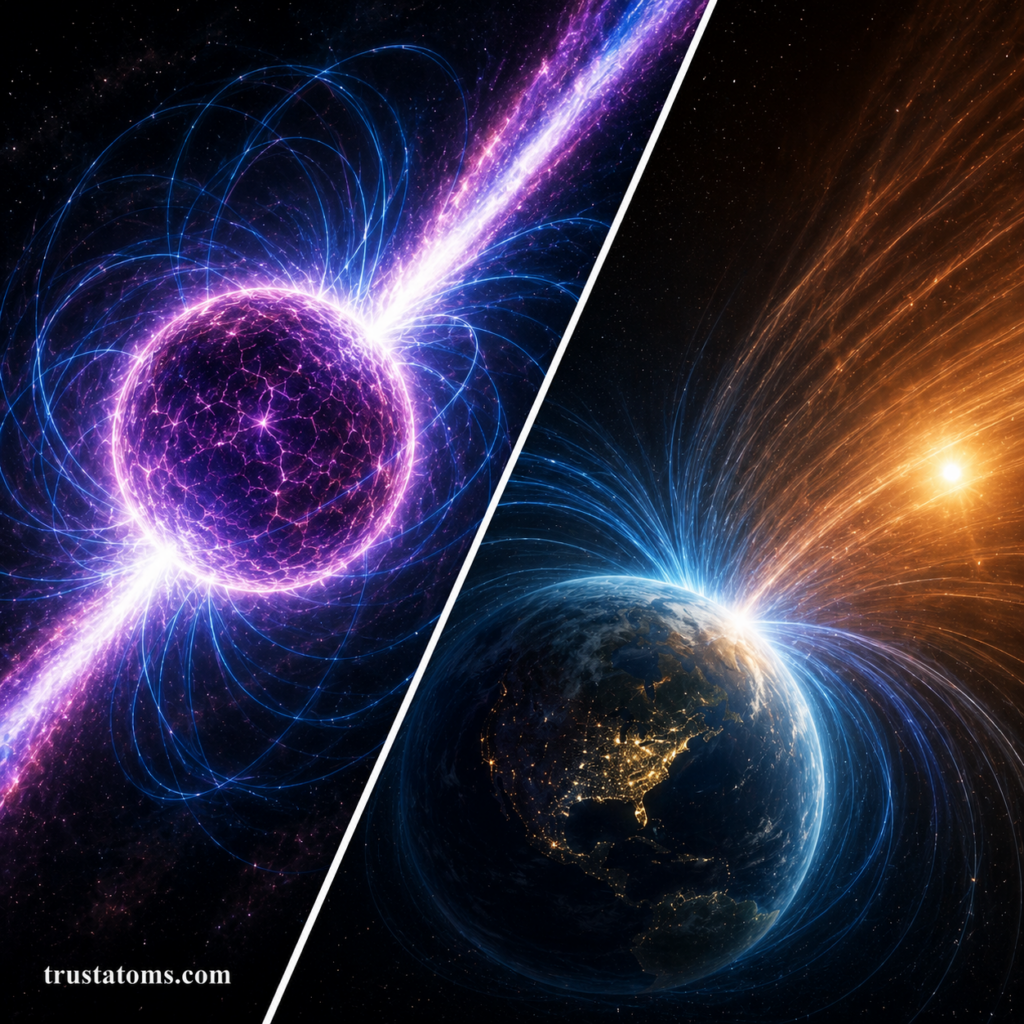
Magnetic field strength is commonly expressed in gauss or tesla. One tesla equals 10,000 gauss.
The following approximate values show the enormous difference between familiar magnetic environments and neutron stars.
| Object or Environment | Approximate Magnetic Field |
|---|---|
| Earth’s surface | 0.25–0.65 gauss |
| Typical refrigerator magnet surface | About 100 gauss |
| Clinical MRI scanner | 15,000–30,000 gauss |
| Ordinary young neutron star | About 10¹² gauss |
| Magnetar | About 10¹⁴–10¹⁵ gauss |
These values refer to different measurement locations, including surfaces and operating fields, so they are intended as comparisons of scale rather than identical experimental conditions.
A Numerical Example of Magnetar Strength
Consider a magnetar with a surface magnetic field of 10¹⁵ gauss. Earth’s surface magnetic field is approximately 0.5 gauss in a representative location.
Dividing 10¹⁵ by 0.5 gives approximately 2 × 10¹⁵. In this example, the magnetar’s surface field is about two quadrillion times stronger than Earth’s local surface field.
That comparison describes magnetic field strength, not the distance over which the field remains dangerous. A magnetar’s field generally weakens rapidly with increasing distance, and its effects depend on the surrounding environment.
What Makes Magnetars Different From Ordinary Neutron Stars?
Both magnetars and ordinary neutron stars are extremely dense stellar remnants, but their observable behavior can differ substantially.
- Magnetic strength: Magnetars typically possess much stronger inferred surface magnetic fields.
- Energy source: Magnetar activity can be powered by the release of stored magnetic energy rather than primarily by rotational energy.
- Radiation bursts: Many magnetars produce sudden X-ray and gamma-ray outbursts.
- Rotation: Many known magnetars rotate once every few seconds, although their rotational properties vary.
- Timing changes: Magnetic stresses and internal processes can produce changes in their observed rotation rates.
These differences are not always absolute. Some neutron stars show overlapping properties, suggesting that the boundaries between observational categories can be more complicated than simple labels imply.
Magnetar Bursts, Starquakes, and Giant Flares
Magnetars can release sudden bursts of high-energy radiation when their magnetic configurations change.
Short X-Ray and Gamma-Ray Bursts
Many magnetar bursts last fractions of a second and are detected by space-based high-energy observatories.
Some repeatedly bursting sources were historically classified as soft gamma repeaters. These objects are now understood to include magnetars.
Magnetic Stress and Starquakes
Strong magnetic stresses can deform a neutron star’s crust and influence its interior. Sudden rearrangements may fracture or shift crustal material, disturb the surrounding magnetic field, and release energy.
Scientists investigate both crustal disturbances and magnetic reconnection as possible contributors to magnetar outbursts.
Rare Giant Flares
Giant flares are exceptionally energetic magnetar eruptions. In December 2004, SGR 1806-20 produced a powerful flare detected by instruments throughout the solar system.
The event briefly affected Earth’s ionosphere, demonstrating that intense high-energy radiation can produce measurable effects across astronomical distances.
Magnetar flares are related to broader questions about high-energy transients, although they are not identical to the long-duration bursts commonly associated with collapsing massive stars. Gamma-Ray Bursts Origins examines the different processes responsible for these powerful events.
Magnetars and Fast Radio Bursts
Fast radio bursts are extremely brief, powerful flashes of radio emission. Many originate outside the Milky Way, and their physical causes remain an active research topic.
In 2020, astronomers detected a bright radio burst associated with the Galactic magnetar SGR 1935+2154. This provided direct evidence that magnetars can generate at least some fast-radio-burst-like events.
The observation strengthened magnetar-based explanations for certain extragalactic fast radio bursts. However, it does not establish that every fast radio burst comes from a magnetar.
How Scientists Detect and Study Magnetars
Magnetars are usually identified through their high-energy emission, unusual rotational behavior, and powerful transient outbursts.
Important observing facilities include NASA’s Chandra X-ray Observatory, ESA’s XMM-Newton, and NASA’s Fermi Gamma-ray Space Telescope.
Researchers examine several measurable properties:
- Rotation period: The time required for one complete rotation.
- Spin-down rate: How quickly the rotation slows over time.
- Radiation spectrum: The distribution of emitted energy across wavelengths.
- Burst behavior: The timing, intensity, and duration of energetic outbursts.
- Radio emission: Signals that may reveal additional activity or magnetic processes.
Magnetic field estimates are often inferred from rotation measurements using simplified models. These estimates are scientifically useful but depend on assumptions about the star’s structure and braking mechanism.
Extreme Physics Near Magnetars
Magnetars provide opportunities to study matter and radiation under extraordinary conditions.
At sufficiently high magnetic field strengths, quantum electrodynamics predicts effects that are negligible in everyday environments. One example is vacuum birefringence, in which the polarization of light can depend on the properties of the surrounding magnetic field.
Extremely strong fields can also alter atomic structures and influence the motion of charged particles.
Meanwhile, the star’s immense density provides a separate challenge: scientists must model how matter behaves when compressed to densities comparable to those inside atomic nuclei.
Observations of magnetars help researchers test theoretical predictions about these conditions, although many details of their internal composition remain uncertain.
How Long Do Magnetars Remain Active?
Magnetars are often associated with relatively young neutron stars because their strongest magnetic activity is expected to diminish as magnetic energy is dissipated.
Models commonly describe active phases lasting thousands to tens of thousands of years, but the timescale depends on magnetic field evolution, internal structure, and the definition of activity.
A magnetar does not necessarily disappear when its strongest bursts cease. It may remain a neutron star whose observable properties change as its magnetic field evolves.
Notable Magnetars Studied by Astronomers
Several magnetars have provided particularly useful observations.
- SGR 1806-20: Produced the extraordinary giant flare observed in December 2004.
- SGR 1935+2154: Associated with the bright radio burst detected in 2020.
- XTE J1810-197: A magnetar known for detectable and variable radio emission.
- 1E 1048.1−5937: Studied for its variable X-ray emission and rotational behavior.
Comparing these objects helps astronomers determine which properties are common among magnetars and which differ between individual sources.
Could a Magnetar Threaten Earth?
A sufficiently powerful high-energy flare from a nearby magnetar could potentially affect satellites, atmospheric ionization, and certain technological systems.
However, the effects would depend on the flare’s energy, distance, radiation spectrum, and direction. Dramatic claims that a magnetar could automatically destroy electronics across enormous distances are not reliable without specifying those conditions.
Known magnetars are distant, and astronomers have not identified one posing an immediate threat to Earth.
Why Magnetars Matter in Astronomy
Magnetars connect several areas of astrophysics, including stellar collapse, nuclear-density matter, magnetic field evolution, and high-energy radiation.
Their bursts also help scientists investigate how energy is transferred to charged particles and radiation. Related processes are explored in Cosmic Rays and High-Energy Particles, which examines energetic particles and their behavior in space.
Because magnetars combine strong gravity, extreme density, and enormous magnetic fields, observations can constrain physical models that cannot be tested directly under laboratory conditions.
Frequently Asked Questions
Are magnetars stronger than ordinary neutron stars?
Magnetars generally have much stronger magnetic fields than ordinary neutron stars. Both are extremely dense stellar remnants, but magnetars can release substantial stored magnetic energy through bursts and flares.
Can magnetars produce fast radio bursts?
Yes. The 2020 radio burst associated with SGR 1935+2154 demonstrated that magnetars can produce powerful, short radio signals. Whether all fast radio bursts share this origin remains uncertain.
What happens when a magnetar loses magnetic energy?
As magnetic energy dissipates, a magnetar may become less active and produce fewer energetic outbursts. It remains a neutron star, although its observable behavior and magnetic properties can change over time.
Magnetars demonstrate how magnetic energy can shape the behavior of an entire stellar remnant, producing radiation bursts, unusual rotational changes, and conditions that challenge existing physical models. Continued observations of their flares, radio signals, and magnetic evolution may reveal more about neutron star interiors and the origin of some of the universe’s most energetic transient events.
Sources: NASA, Chandra X-ray Observatory magnetar research; European Space Agency (ESA), XMM-Newton magnetar observations; Kaspi and Beloborodov, Magnetars, Annual Review of Astronomy and Astrophysics (2017).