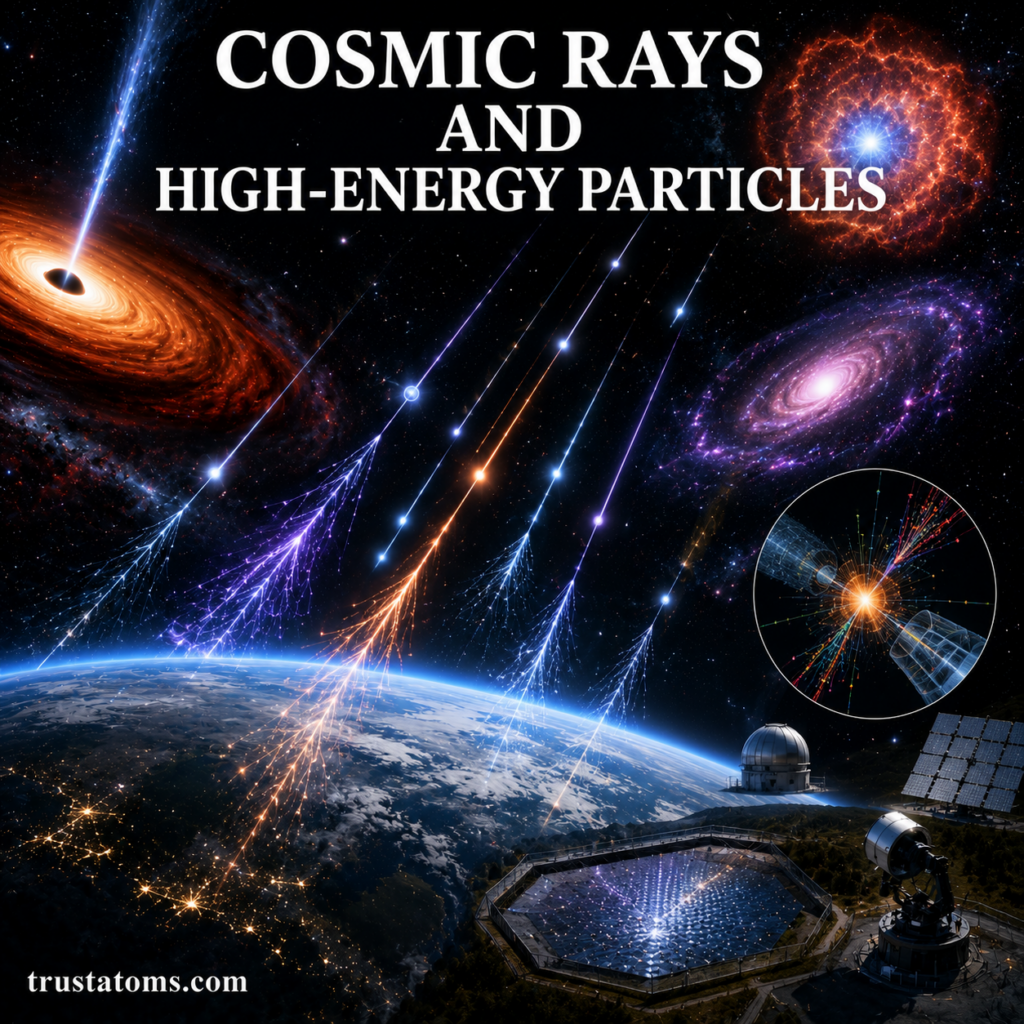
Space is filled with invisible streams of high-energy particles constantly traveling across the universe. Some originate from the Sun, while others come from distant galaxies, exploding stars, black holes, and other extreme cosmic events.
These particles, known as cosmic rays, move at enormous speeds — sometimes approaching the speed of light — and carry immense amounts of energy.
Although cosmic rays were discovered over a century ago, scientists are still investigating many mysteries surrounding their origins, acceleration mechanisms, and effects on Earth and space environments.
Understanding cosmic rays and high-energy particles helps astronomers study some of the universe’s most violent and energetic phenomena.
What Are Cosmic Rays?
Cosmic rays are high-energy particles traveling through space.
Most cosmic rays consist of:
- Protons
- Atomic nuclei
- Electrons
- Other subatomic particles
Despite the name, cosmic rays are not actually rays of light.
They are energetic particles moving through the universe at relativistic speeds.
Where Cosmic Rays Come From
Cosmic rays originate from multiple sources throughout space.
Solar Cosmic Rays
The Sun produces lower-energy cosmic rays during:
- Solar flares
- Coronal mass ejections
- Magnetic storms
These solar particles can affect Earth’s atmosphere and space technology.
Galactic Cosmic Rays
Many cosmic rays come from outside the solar system.
Likely sources include:
- Supernova remnants
- Pulsars
- Neutron stars
- Black holes
These particles often possess far greater energies than solar particles.
Extragalactic Cosmic Rays
Some ultra-high-energy cosmic rays appear to originate beyond the Milky Way galaxy.
Possible sources include:
- Active galactic nuclei
- Quasars
- Gamma-ray bursts
- Supermassive black holes
The exact origins of the most energetic cosmic rays remain uncertain.
How Cosmic Rays Travel Through Space
Cosmic rays move through magnetic fields across the universe.
Because most cosmic rays are electrically charged:
- Magnetic fields alter their paths
- Their directions become difficult to trace
- Identifying exact origins becomes challenging
Interstellar and galactic magnetic fields scatter particles during their journey through space.
The Energy of Cosmic Rays
Cosmic rays can carry enormous amounts of energy.
Some particles possess energies millions of times greater than particles accelerated in Earth-based laboratories.
Ultra-High-Energy Cosmic Rays
The most energetic cosmic rays are called ultra-high-energy cosmic rays.
These particles may contain energies comparable to:
- Fast-moving baseballs concentrated into single atomic particles
Scientists still do not fully understand how nature accelerates particles to such extreme energies.
Particle Acceleration Mechanisms
Extreme astrophysical environments can accelerate particles through powerful electromagnetic processes.
Shock Wave Acceleration
One major theory involves shock waves from supernova explosions.
As shock fronts expand:
- Magnetic fields trap particles
- Particles repeatedly cross shock boundaries
- Energy increases gradually
This process is called Fermi acceleration.
Black Hole Jets
Supermassive black holes can produce relativistic jets containing enormous magnetic fields and high-energy particles.
These environments may accelerate cosmic rays to extreme energies.
Cosmic Rays and Earth’s Atmosphere
When cosmic rays strike Earth’s atmosphere, they collide with atmospheric particles.
Particle Showers
These collisions create cascades of secondary particles called air showers.
Secondary particles may include:
- Muons
- Electrons
- Neutrinos
- Gamma rays
Large cosmic ray events can produce billions of secondary particles.
Atmospheric Effects
Cosmic rays influence:
- Atmospheric ionization
- Cloud formation research
- Radiation levels at high altitude
Scientists continue studying possible long-term climate relationships, although evidence remains debated.
How Scientists Detect Cosmic Rays
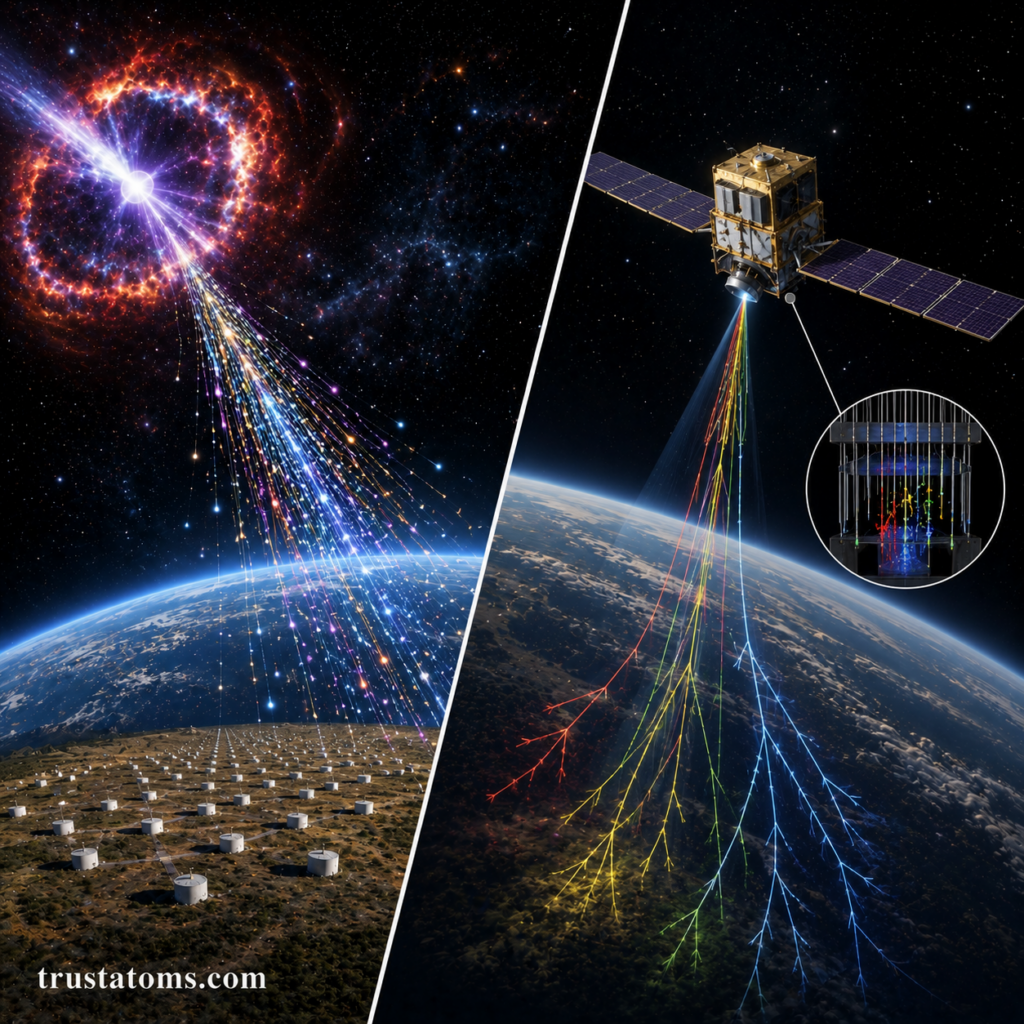
Because Earth’s atmosphere blocks many cosmic rays, scientists use specialized detection methods.
Ground-Based Observatories
Large detector arrays measure secondary particle showers reaching Earth’s surface.
These facilities monitor:
- Particle direction
- Energy
- Arrival timing
Space-Based Detectors
Satellites and spacecraft directly measure cosmic rays before atmospheric interaction.
Space-based instruments provide clearer measurements of primary particles.
Underground Detectors
Some experiments operate deep underground to shield instruments from background radiation.
These detectors help study rare particle interactions.
Cosmic Rays and Relativity
Many cosmic rays travel close to the speed of light.
This makes relativistic physics important.
Relativistic Effects
At near-light speeds:
- Time dilation occurs
- Particle lifetimes increase
- Energy rises dramatically
Relativity helps explain how unstable particles survive long journeys through space.
Cosmic Rays and Quantum Physics
Quantum mechanics governs the behavior of high-energy particles.
Particle interactions involve:
- Quantum tunneling
- Nuclear collisions
- Particle decay
- Radiation emission
Studying cosmic rays allows scientists to investigate quantum physics under extreme conditions.
Cosmic Rays and Neutrinos
High-energy cosmic interactions often produce neutrinos.
What Are Neutrinos?
Neutrinos are extremely light particles that interact very weakly with matter.
They can travel enormous distances through space almost unaffected.
Neutrino Astronomy
Scientists study neutrinos to investigate:
- Supernova explosions
- Black hole systems
- Cosmic ray origins
- High-energy astrophysical events
Neutrino observatories help expand multi-messenger astronomy.
Cosmic Rays and Gamma Rays
High-energy cosmic processes also generate gamma rays.
Gamma-Ray Astronomy
Gamma rays are the highest-energy form of electromagnetic radiation.
They often originate from:
- Pulsars
- Black hole jets
- Supernova remnants
- Gamma-ray bursts
Studying gamma rays helps scientists identify possible cosmic ray acceleration regions.
Effects of Cosmic Rays on Space Exploration
Cosmic rays create significant challenges for human spaceflight.
Radiation Risks
High-energy particles can damage:
- Human tissue
- DNA
- Electronics
- Spacecraft systems
Long-duration missions beyond Earth’s magnetic field face increased radiation exposure.
Spacecraft Shielding
Engineers develop shielding systems to reduce cosmic ray exposure during missions to:
- The Moon
- Mars
- Deep space
Radiation protection remains a major obstacle for long-term human exploration.
Cosmic Rays and Technology
Cosmic rays can affect modern technology even on Earth.
Electronic Interference
High-energy particles sometimes disrupt:
- Satellites
- Computer systems
- Aircraft electronics
- Communication networks
Rare particle strikes may even alter computer memory temporarily.
Aviation Exposure
Airline crews and passengers at high altitude experience slightly increased cosmic radiation exposure compared to ground level.
Cosmic Rays and the Search for New Physics
Cosmic rays provide natural laboratories for studying extreme physics.
Scientists investigate whether cosmic ray observations could reveal:
- Unknown particles
- Dark matter signatures
- New physical laws
- Quantum gravity effects
Some cosmic rays exceed energies achievable in human-built particle accelerators.
Cosmic Ray Observatories
Several major observatories study high-energy particles.
Pierre Auger Observatory
The Pierre Auger Observatory studies ultra-high-energy cosmic rays using large surface detector arrays.
IceCube Neutrino Observatory
The IceCube Neutrino Observatory detects neutrinos deep within Antarctic ice.
Space Telescopes
Space missions monitor cosmic radiation and high-energy particle behavior above Earth’s atmosphere.
Cosmic Rays and the Early Universe
High-energy particles may also provide clues about conditions shortly after the Big Bang.
Studying cosmic rays may help scientists investigate:
- Early-universe physics
- Particle formation
- Extreme energy processes
- Cosmic evolution
Some theories suggest ancient cosmic events still influence high-energy particle behavior today.
Why Cosmic Rays Matter in Astronomy
Cosmic rays connect astronomy, particle physics, and cosmology.
They help scientists study:
- Supernova explosions
- Black hole systems
- Extreme magnetic fields
- Relativistic particle acceleration
- High-energy astrophysics
These particles provide information about environments impossible to reproduce fully on Earth.
Future Research in High-Energy Astrophysics
Scientists continue developing advanced observatories and detectors.
Future goals include:
- Identifying ultra-high-energy cosmic ray origins
- Understanding particle acceleration mechanisms
- Improving neutrino astronomy
- Searching for new particles
- Investigating dark matter connections
Future discoveries may reshape understanding of both astrophysics and fundamental physics.
Final Thoughts
Cosmic rays and high-energy particles represent some of the most energetic and mysterious phenomena in the universe.
Originating from exploding stars, black holes, and distant galaxies, these particles travel across space at extraordinary speeds while carrying immense energy.
By studying cosmic rays, scientists gain valuable insights into extreme astrophysical environments, relativistic physics, quantum interactions, and the structure of the universe itself.
As detector technology improves and multi-messenger astronomy expands, future research may uncover even deeper answers about the powerful cosmic accelerators shaping the high-energy universe.