Interstellar travel has fascinated scientists, writers, and dreamers for generations. The idea of traveling beyond our solar system to distant stars captures humanity’s curiosity about exploration, survival, and the possibility of discovering extraterrestrial life.
However, while science fiction often portrays starships crossing galaxies with ease, the real physics behind interstellar travel presents enormous challenges. The distances involved are almost unimaginable, and the laws of physics place serious limits on speed, energy, and survival.
Understanding these physics challenges helps explain why interstellar travel remains one of the most difficult technological goals humanity has ever considered.
What Is Interstellar Travel?
Interstellar travel refers to travel between star systems rather than travel within a single solar system.
For example:
- Traveling from Earth to Mars is interplanetary travel
- Traveling from Earth to Alpha Centauri is interstellar travel
Alpha Centauri, the closest star system to Earth, is approximately 4.37 light-years away.
That may not sound far astronomically, but in practical terms it is incredibly distant.
The Scale of Interstellar Distances
Space distances are so large that ordinary units quickly become impractical.
What Is a Light-Year?
A light-year is the distance light travels in one year.
Light moves at about 186,000 miles per second (300,000 kilometers per second).
Even at that speed:
- Sunlight takes about 8 minutes to reach Earth
- Light takes over 4 years to reach Alpha Centauri
- Light may take thousands of years to cross parts of the Milky Way
Modern spacecraft are far slower than light.
For comparison:
- Voyager 1 travels around 38,000 miles per hour
- At that speed, reaching Alpha Centauri would take tens of thousands of years
The Speed Limit of the Universe
One of the biggest physics barriers to interstellar travel is the universal speed limit established by Einstein’s theory of relativity.
Why Nothing Can Exceed Light Speed
According to modern physics, objects with mass cannot accelerate to the speed of light because doing so would require infinite energy.
As velocity increases:
- Mass-energy requirements grow dramatically
- Acceleration becomes increasingly difficult
- Energy consumption rises enormously
This creates a hard limit for spacecraft travel.
Relativity and Time Dilation
Einstein’s relativity also introduces time dilation.
At speeds approaching light speed:
- Time slows for travelers relative to observers on Earth
- Journeys could feel shorter for astronauts
- Decades or centuries might pass on Earth during the mission
While time dilation may help travelers personally, it does not eliminate the enormous energy requirements.
The Energy Problem
Accelerating a spacecraft to significant fractions of light speed would require staggering amounts of energy.
Kinetic Energy Requirements
Even a relatively small spacecraft traveling near light speed would contain enormous kinetic energy.
m1
m2
vm1m2
As velocity increases, required propulsion energy grows rapidly.
This creates several major engineering problems:
- Fuel mass becomes enormous
- Heat management becomes difficult
- Energy generation systems become impractical
Rocket Equation Challenges
Traditional chemical rockets are not suitable for interstellar travel.
They suffer from a major limitation:
- Carrying more fuel increases spacecraft mass
- More mass requires more fuel
- This creates diminishing returns
Even advanced nuclear rockets may struggle to achieve meaningful interstellar speeds.
Propulsion Technologies Under Consideration
Scientists have proposed several theoretical propulsion systems to address interstellar travel challenges.
Nuclear Fusion Propulsion
Fusion engines would combine light atomic nuclei to release energy.
Potential advantages include:
- Much higher efficiency than chemical rockets
- Greater thrust potential
- Long-duration energy production
However, controlled fusion remains technologically difficult even on Earth.
Antimatter Engines
Antimatter releases tremendous energy when it contacts normal matter.
Advantages:
- Extremely high energy density
- Potential for near-relativistic speeds
Challenges:
- Antimatter is difficult to produce
- Storage is extremely dangerous
- Current production costs are astronomical
Solar Sails and Laser Propulsion
Some concepts involve using powerful Earth-based lasers to push lightweight spacecraft using reflective sails.
Benefits include:
- No onboard fuel required
- Lower spacecraft mass
- Potential acceleration over long distances
Projects like Breakthrough Starshot explore this concept for tiny probes.
Warp Drives and Wormholes
Science fiction often uses faster-than-light concepts like warp drives or wormholes.
Theoretical physics has explored these ideas mathematically, but major obstacles remain:
- Exotic matter may be required
- Stability problems exist
- No experimental evidence confirms practicality
Currently, these ideas remain speculative.
Radiation Hazards in Deep Space
Interstellar space contains dangerous radiation environments.
Astronauts traveling long distances would face exposure from:
- Cosmic rays
- High-energy particles
- Solar radiation
- Interstellar radiation fields
Why Radiation Is Dangerous
Long-term radiation exposure can cause:
- DNA damage
- Cancer risk
- Nervous system effects
- Equipment failures
Protecting crews would require heavy shielding, which increases spacecraft mass even further.
Micrometeoroids and Interstellar Dust
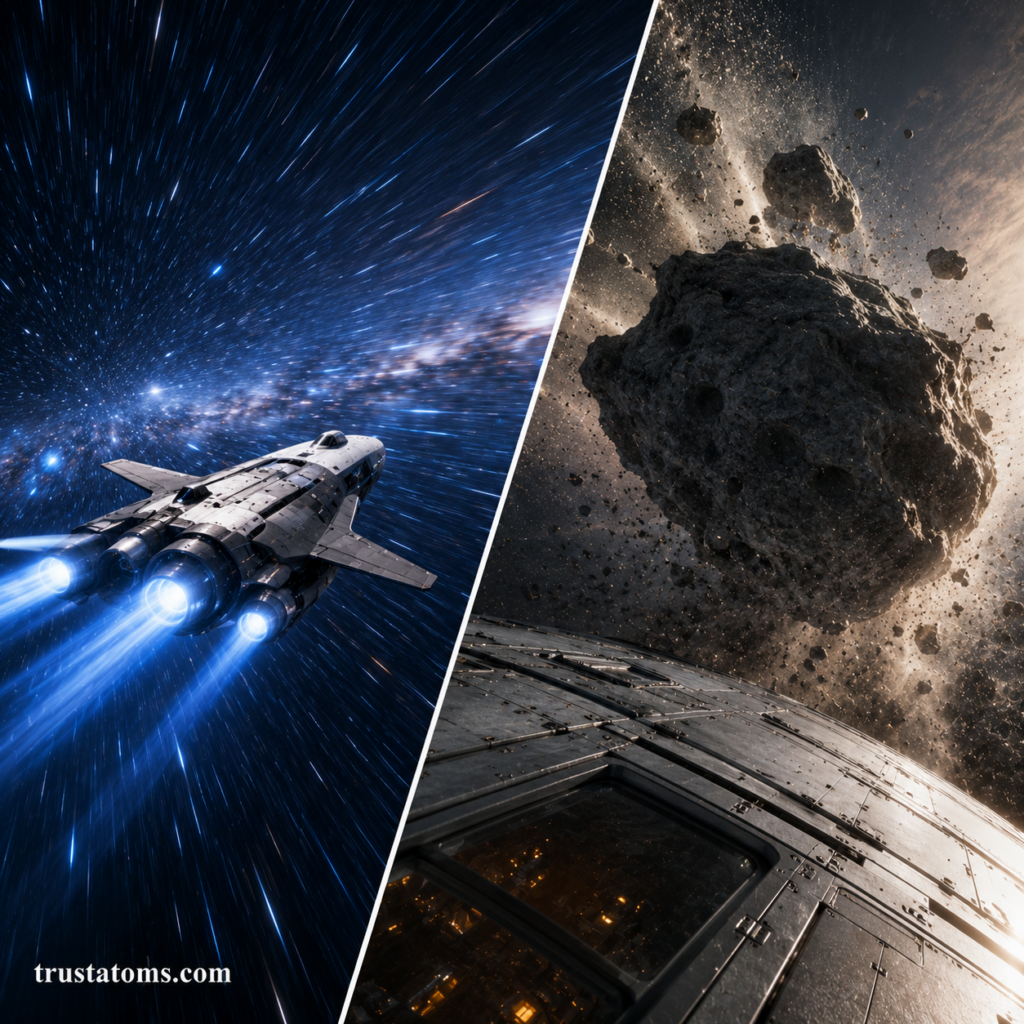
At extremely high speeds, even tiny particles become dangerous.
A microscopic dust grain impacting a spacecraft traveling near light speed could release explosive amounts of energy.
Potential risks include:
- Hull penetration
- Equipment destruction
- Radiation bursts
- Structural failure
Designing protective shielding for relativistic travel is one of the most difficult engineering challenges.
Human Survival Challenges
Interstellar travel involves more than propulsion and physics.
Humans would need to survive extremely long missions.
Life Support Systems
Spacecraft would require closed-loop systems capable of recycling:
- Air
- Water
- Food
- Waste
These systems would need near-perfect reliability over decades or centuries.
Psychological Challenges
Long-duration isolation may produce:
- Mental health problems
- Social conflicts
- Stress and depression
- Cognitive decline
Maintaining stable human communities during multigenerational missions would be difficult.
Generation Ships
One proposed solution involves generation ships.
These massive spacecraft would allow multiple generations of humans to live and die during the journey.
Future descendants would eventually arrive at the destination star system.
However, generation ship concepts create challenges involving:
- Population stability
- Resource sustainability
- Social organization
- Long-term governance
Cryogenic Sleep and Suspended Animation
Another proposed approach involves placing travelers into suspended states during transit.
Potential benefits include:
- Reduced resource consumption
- Lower psychological stress
- Shorter perceived travel time
However, no current technology allows safe long-term suspended animation for humans.
Communication Delays
Communication across interstellar distances would be extremely slow.
Because signals cannot exceed light speed:
- Messages to Alpha Centauri take over 4 years one way
- Conversations become impossible in real time
- Emergency assistance cannot arrive quickly
Interstellar crews would likely operate independently from Earth.
The Problem of Deceleration
Accelerating a spacecraft is only half the challenge.
A spacecraft must also slow down upon arrival.
Without proper deceleration:
- The craft would simply pass through the target system
- Landing or orbital insertion becomes impossible
This requires additional propulsion systems and energy reserves.
Could Artificial Intelligence Help?
Advanced AI systems may reduce some interstellar travel problems.
Potential AI roles include:
- Autonomous spacecraft control
- Maintenance and repairs
- Crew assistance
- Navigation
- Scientific analysis
Robotic missions may ultimately prove more realistic than crewed interstellar travel.
Are Interstellar Missions Possible?
Most scientists believe interstellar travel is physically possible in principle.
However, major barriers remain:
- Energy limitations
- Engineering challenges
- Human survival concerns
- Economic costs
- Technological maturity
The issue is not necessarily whether interstellar travel violates physics, but whether civilization can realistically overcome the required technological hurdles.
Why Scientists Still Study Interstellar Travel
Even if practical star travel remains distant, studying these concepts improves scientific understanding.
Research into interstellar travel contributes to:
- Advanced propulsion physics
- Energy systems
- Radiation protection
- Artificial intelligence
- Space medicine
- Materials science
Many technologies originally developed for ambitious space research eventually benefit life on Earth.
Final Thoughts
Interstellar travel represents one of humanity’s greatest scientific and engineering challenges.
The immense distances between stars force scientists to confront the limits of physics, energy production, propulsion systems, and human survival.
Although current technology falls far short of practical starflight, ongoing research continues expanding our understanding of what may someday become possible.
For now, interstellar travel remains a fascinating blend of astrophysics, engineering, and imagination — a reminder of both the vastness of the universe and humanity’s enduring desire to explore it.