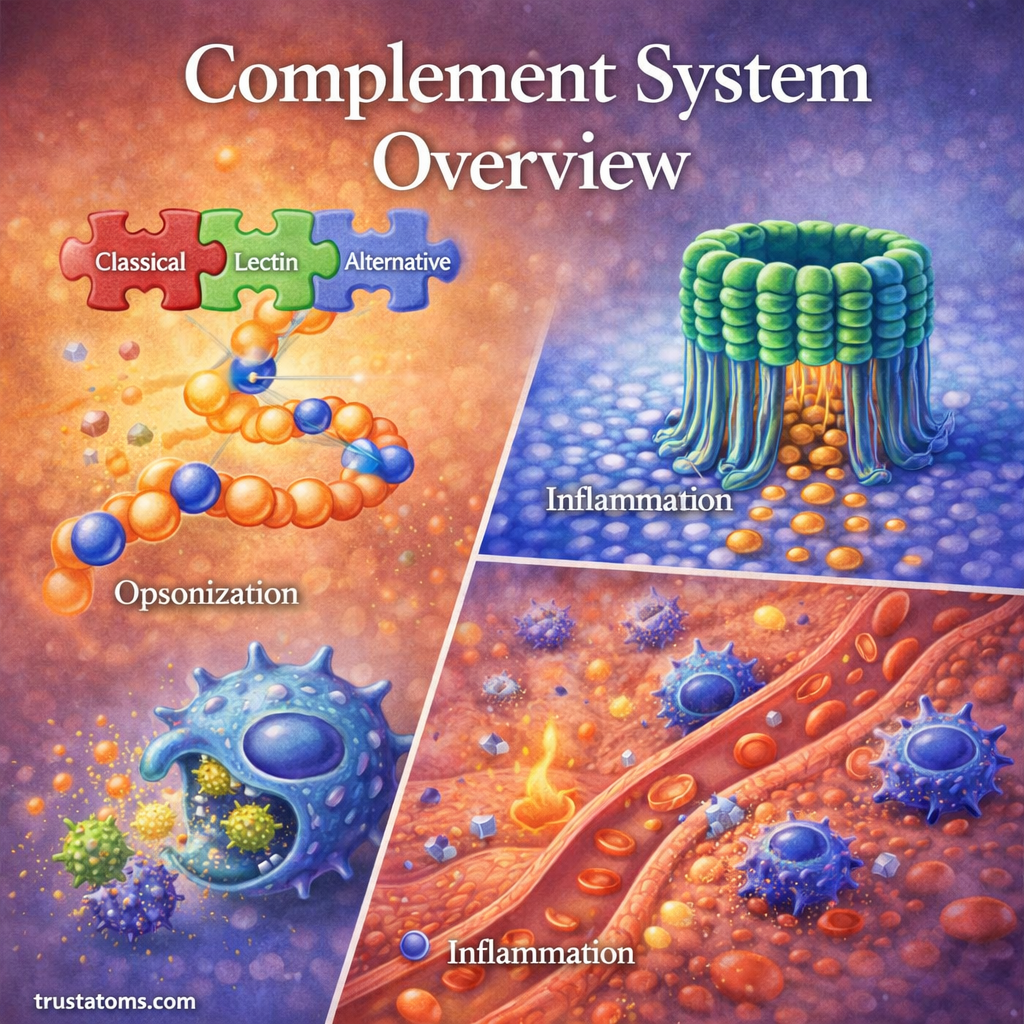
The complement system is a network of immune proteins that helps defend the body against infection by marking microbes for removal, promoting inflammation, and damaging certain microbial membranes. It amplifies immune responses through a series of controlled protein reactions that connect the body’s immediate defenses with antibody-mediated immunity.
Many complement proteins circulate in the blood, while others operate on cell surfaces and within tissues. Their activity connects immune cells, blood vessels, and organs studied in human anatomy, helping the body respond to invading microorganisms while protecting its own cells.
What Is the Complement System?
The complement system consists of more than 30 interacting proteins, including circulating components, receptors, and regulatory proteins. Many are produced by the liver and released into blood plasma, although other cells can also produce complement proteins locally.
Several complement components circulate in inactive forms. When activation begins, enzymes cleave specific proteins, creating fragments that trigger additional reactions. This sequence is called the complement cascade.
Complement works alongside antimicrobial barriers, phagocytes, and other defenses. Its contribution to bacterial protection can be understood alongside antibacterial defense mechanisms, which include several ways the immune system recognizes and eliminates bacteria.
The system has three major protective outcomes:
- Opsonization: Coating microbes with proteins that make them easier for immune cells to engulf.
- Inflammation: Producing signaling fragments that recruit and activate immune cells.
- Membrane damage: Forming protein complexes that can disrupt certain microbial membranes.
The Three Pathways of Complement Activation
Complement activation begins through three major pathways: classical, lectin, and alternative. They recognize different molecular signals but converge on the activation of complement protein C3.
Although complement belongs mainly to innate immunity, the classical pathway provides an important connection with adaptive immune responses. The development of targeted immune recognition is explained in adaptive response activation pathways.
1. Classical Pathway
Triggered by antibodies bound to pathogens, the classical pathway commonly begins when the C1 complex recognizes suitable antibody-antigen complexes. Certain other molecules can also initiate this pathway without antibodies.
Activated C1 initiates reactions involving C4 and C2, producing a C3-converting enzyme called C4b2a. This enzyme cleaves C3 and helps amplify the response.
2. Lectin Pathway
The lectin pathway begins when recognition proteins, such as mannose-binding lectin or ficolins, bind characteristic molecular patterns on microbial surfaces.
Associated enzymes activate C4 and C2, producing the same type of C3 convertase used by the classical pathway. Unlike the antibody-dependent form of classical activation, this process does not require previously produced pathogen-specific antibodies.
3. Alternative Pathway
The alternative pathway takes advantage of low-level spontaneous C3 activation. On surfaces that lack sufficient protective regulators, deposited C3b can combine with factor B and factor D to form the alternative pathway C3 convertase, C3bBb.
This pathway can initiate complement activity and amplify C3 activation started by the other pathways. Healthy human cells generally possess regulatory mechanisms that limit inappropriate complement deposition.
How the Three Pathways Compare
| Pathway | Typical Trigger | Main Feature |
|---|---|---|
| Classical | Antibody-antigen complexes or certain other recognition molecules | Connects complement with antibody responses |
| Lectin | Recognition of microbial carbohydrate patterns | Detects microbial surfaces without requiring antibodies |
| Alternative | C3 activation and amplification on susceptible surfaces | Provides continuous surveillance and strong amplification |
What Happens After Complement Activation?
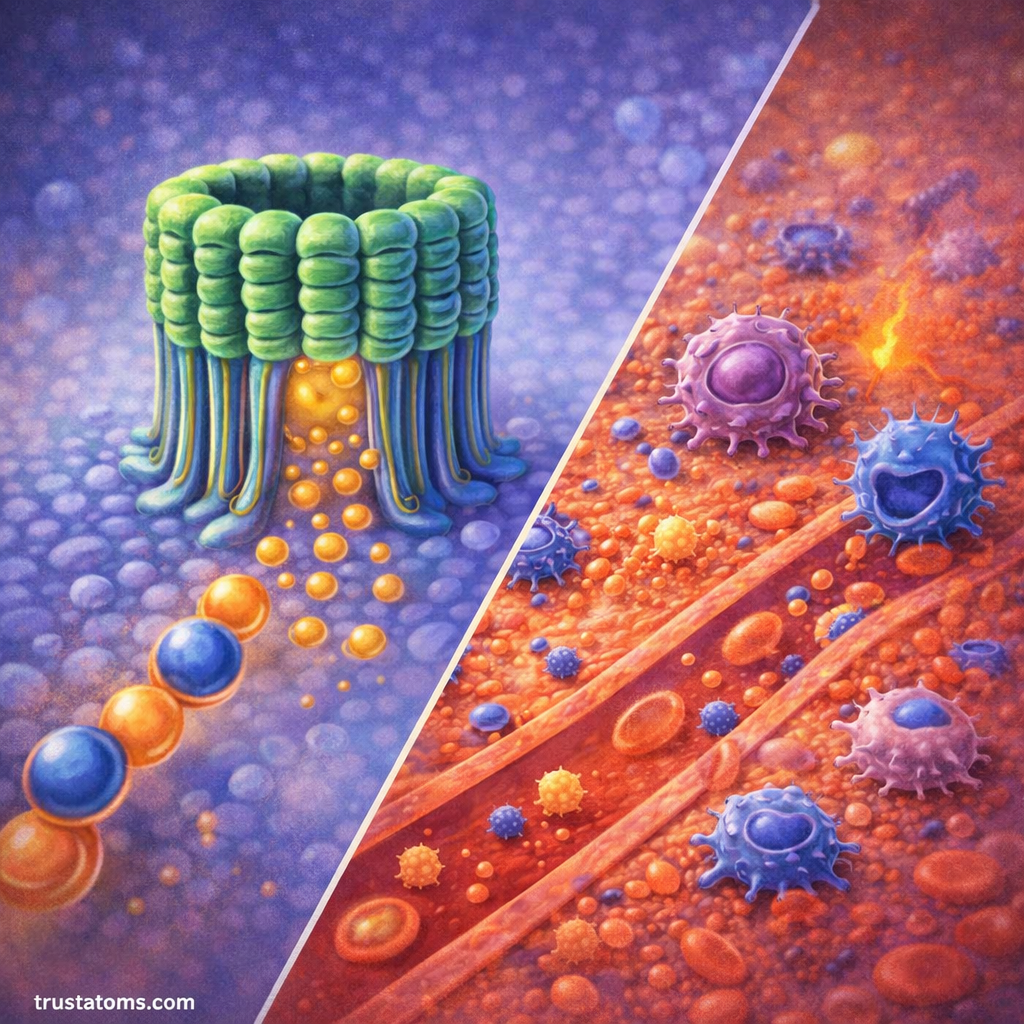
All three pathways generate enzymes that cleave C3 into C3a and C3b. These fragments perform different functions, allowing complement activation to produce several defensive effects simultaneously.
C3b Marks Microbes for Removal
C3b can attach to microbial surfaces, creating a recognizable coating for immune cells. This process, called opsonization, makes it easier for phagocytes to bind and engulf targeted material.
C3a and C5a Promote Inflammation
Complement fragments C3a and C5a contribute to inflammatory signaling. C5a is particularly effective at attracting and activating certain white blood cells, including neutrophils.
These signals help concentrate immune activity where microorganisms or damaged tissues have triggered complement activation.
C5b Initiates Membrane Attack Complex Formation
Further activation produces C5b, which begins assembling the terminal complement components C6, C7, C8, and C9. Together, they form the membrane attack complex.
How the Membrane Attack Complex Destroys Microbes
The membrane attack complex, often abbreviated MAC, forms a pore-like structure in susceptible cell membranes. This disrupts the membrane’s ability to maintain normal conditions and can cause microbial cell death.
MAC activity is especially important in defense against certain Gram-negative bacteria, including Neisseria species. Not every microorganism is equally vulnerable, and many pathogens possess mechanisms that reduce complement-mediated damage.
Complement therefore does not eliminate all infections by directly puncturing microbial membranes. Opsonization and inflammatory signaling are often equally important outcomes.
Complement System and Phagocytosis
Phagocytosis is the process by which specialized immune cells engulf and digest particles, including microorganisms. Complement improves this process by depositing recognizable fragments such as C3b and iC3b on microbial surfaces.
Neutrophils and macrophages possess complement receptors that recognize these fragments. Receptor binding helps the cells attach to coated microbes and promotes their removal.
The cellular steps involved are described in phagocytosis in innate immunity, including how immune cells internalize and break down foreign material.
For example, imagine bacteria entering a small cut in the skin. Complement proteins can become activated on susceptible bacterial surfaces, coating them with C3b while inflammatory signals attract neutrophils. The arriving cells recognize the coated bacteria and engulf them, illustrating how complement and cellular immunity cooperate.
How the Body Prevents Complement From Damaging Healthy Cells
Because complement reactions can amplify rapidly, the body uses regulatory proteins to limit activation on its own tissues. These mechanisms interrupt complement enzymes, inactivate deposited fragments, and prevent inappropriate membrane attack complex formation.
Important regulators include factor H, factor I, CD55, and CD59. Factor H and factor I help control C3b activity, CD55 accelerates the breakdown of certain complement convertases, and CD59 inhibits terminal complex formation on protected cells.
Regulation is essential because excessive or misplaced complement activity can contribute to inflammation and tissue injury.
What Happens When Complement Function Is Abnormal?
Inherited deficiencies and acquired disorders can affect complement activity. Their consequences depend on which proteins or regulatory mechanisms are involved.
- C3 deficiency: Can cause increased susceptibility to serious bacterial infections because C3 is central to multiple complement functions.
- Terminal complement deficiencies: Defects involving C5 through C9 are associated with increased susceptibility to Neisseria infections.
- Early classical pathway deficiencies: Certain deficiencies can increase the risk of autoimmune conditions, including lupus-like disease.
- Regulatory abnormalities: Defective control of complement may contribute to disorders involving abnormal inflammation or damage to blood cells and small vessels.
These examples show that both insufficient complement activity and excessive activation can create health problems.
Complement System vs Other Immune Responses
Complement is part of innate immunity because it can respond without prior exposure to a particular pathogen. However, its interaction with antibodies also connects it to adaptive immunity, which develops targeted responses through B and T lymphocytes.
Unlike antibodies, complement proteins do not individually develop highly specific recognition through immune memory. Instead, they amplify existing recognition signals and help immune cells eliminate targeted material.
Many complement proteins circulate through the bloodstream and reach tissues during immune responses. The relationship between blood transport and immune surveillance is explored in immune system integration with circulation.
Supporting Normal Immune Function
The complement system operates automatically and is regulated by complex molecular interactions. No ordinary food, supplement, or lifestyle habit has been established as a way to selectively strengthen complement activity in otherwise healthy people.
General measures such as adequate nutrition, sufficient sleep, regular physical activity, and recommended vaccinations support overall health and immune protection. People with diagnosed complement deficiencies may require specialized medical care and infection-prevention measures.
Frequently Asked Questions
Is the complement system part of innate or adaptive immunity?
Complement is primarily part of innate immunity because it can respond without prior exposure. It also interacts with adaptive immunity when antibodies activate the classical pathway.
What is the most important complement protein?
C3 is a central component because all three activation pathways converge on its cleavage. Its fragments contribute to opsonization, inflammation, and further complement activation.
Can the complement system attack healthy cells?
Yes. Complement can damage healthy tissues when regulation fails or activation becomes inappropriate. Protective proteins normally limit these reactions on the body’s own cells.
The complement system strengthens immune defense by linking microbial recognition to opsonization, inflammatory signaling, and membrane attack complex formation. Its three activation pathways converge on C3, allowing different threats to trigger overlapping protective responses. Regulatory proteins keep this powerful system under control so that immune activity is directed toward appropriate targets.
This article is for general education and is not medical advice. Talk to a qualified health professional about any medical concern.
Sources: Abbas, Lichtman, and Pillai, Cellular and Molecular Immunology; Murphy and Weaver, Janeway’s Immunobiology; Merck Manual Professional Edition.