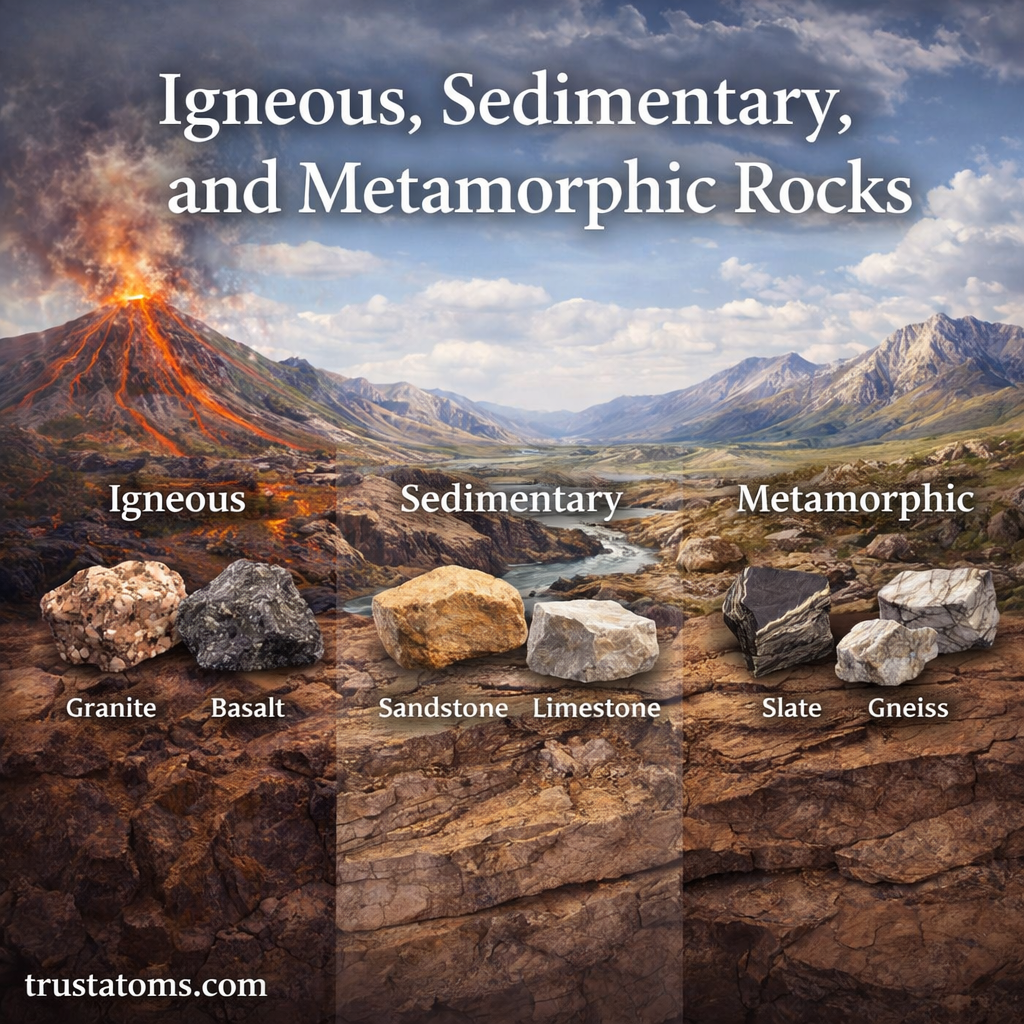
Igneous, sedimentary, and metamorphic rocks are the three main rock types, classified according to how they form. Igneous rocks solidify from molten material, sedimentary rocks form through sediment accumulation or mineral precipitation, and metamorphic rocks develop when existing rocks change under heat, pressure, or chemically active fluids without melting.
Each rock type preserves evidence of different geological processes, from volcanic eruptions to ancient oceans and mountain building. Understanding these materials is a basic part of Earth science because rocks provide clues about the formation of landscapes, the movement of tectonic plates, and the conditions that existed in past environments.
What Are the Three Types of Rocks?
Geologists classify rocks primarily by their origin rather than their color, hardness, or location. The three major groups are:
- Igneous rocks: Form when magma or lava cools and solidifies.
- Sedimentary rocks: Form when sediments become rock or dissolved minerals precipitate and accumulate.
- Metamorphic rocks: Form when existing rocks undergo changes in mineral composition or texture without completely melting.
Most rocks contain one or more minerals, although some, such as obsidian, consist largely of natural glass. The relationship between rock formation and economically useful deposits is explored in Mineral Resources and Geological Distribution.
To understand igneous rocks more closely, Volcanic Rocks and Magma Formation explains how molten rock develops and reaches Earth’s surface.
Sedimentary rocks are particularly useful for preserving traces of ancient organisms, as explained in Fossil Formation in Geological Context.
Igneous Rocks: Formed from Cooling Magma or Lava
Igneous rocks originate when molten rock cools and solidifies. Magma refers to molten rock beneath Earth’s surface, while lava is molten rock that has erupted onto the surface.
Intrusive and Extrusive Igneous Rocks
Intrusive igneous rocks form underground, where magma generally cools slowly enough for relatively large mineral crystals to grow. Extrusive igneous rocks form at or near the surface, where faster cooling usually produces smaller crystals or volcanic glass.
For example, granite commonly contains visible crystals of quartz, feldspar, and mica because it cooled slowly underground. Basalt typically has much smaller crystals because it forms from lava that cools relatively quickly.
Common Examples of Igneous Rocks
- Granite: A coarse-grained intrusive rock commonly used in buildings and countertops.
- Basalt: A fine-grained volcanic rock abundant in oceanic crust.
- Obsidian: Volcanic glass produced when certain lava compositions cool rapidly.
- Pumice: A lightweight volcanic rock containing numerous gas-bubble cavities.
Igneous rocks provide evidence of magma composition, cooling conditions, and volcanic or underground geological activity.
Sedimentary Rocks: Built from Sediments and Mineral Deposits
Sedimentary rocks form through the accumulation of material at Earth’s surface or within bodies of water. Weathering breaks down existing rocks, erosion transports fragments, and deposition allows sediments to settle. Burial, compaction, and cementation can then turn loose sediment into solid rock.
Three Main Sedimentary Rock Groups
- Clastic: Formed from fragments of preexisting rocks, such as sandstone and shale.
- Chemical: Formed when dissolved minerals precipitate from water, such as rock salt.
- Biochemical or organic: Formed through the accumulation of biological material, including many limestones and coal.
Sedimentary rocks frequently occur in recognizable layers called strata. Their thickness, composition, and fossil content help geologists reconstruct ancient rivers, lakes, deserts, and oceans. Sedimentary Basins and Stratigraphy examines how these layers accumulate and how scientists interpret their sequence.
Common Examples of Sedimentary Rocks
Sandstone consists mainly of sand-sized grains, often cemented by silica, calcite, or iron minerals. Shale forms from compacted fine-grained sediment, while limestone consists primarily of calcium carbonate and commonly contains material derived from marine organisms.
Metamorphic Rocks: Changed by Heat and Pressure
Metamorphic rocks form when existing igneous, sedimentary, or metamorphic rocks experience conditions that change their minerals or textures without completely melting them. Heat, pressure, deformation, and chemically active fluids can all contribute to metamorphism.
Foliated and Non-Foliated Metamorphic Rocks
Foliated metamorphic rocks contain aligned minerals or visible bands, often produced under directed pressure. Slate, schist, and gneiss are common examples.
Non-foliated metamorphic rocks lack a prominent layered texture. Marble, which develops from limestone or dolostone, and quartzite, which develops from quartz-rich sandstone, are typical examples.
Metamorphism occurs in several settings, including mountain-building regions and areas surrounding hot magma intrusions. The resulting rocks help scientists interpret past temperatures, pressures, and tectonic activity.
Comparing Igneous, Sedimentary, and Metamorphic Rocks
| Rock Type | Formation Process | Common Examples |
|---|---|---|
| Igneous | Cooling and solidification of molten rock | Granite, basalt, obsidian |
| Sedimentary | Sediment lithification or mineral precipitation | Sandstone, shale, limestone |
| Metamorphic | Transformation of existing rock without melting | Slate, marble, gneiss |
Texture can provide useful clues when identifying rocks. Visible interlocking crystals may suggest an igneous origin, sedimentary layers may indicate deposition, and aligned mineral bands may indicate metamorphism. However, appearance alone is not always conclusive, so geologists also examine mineral composition and geological context.
How Rocks Transform Through the Rock Cycle
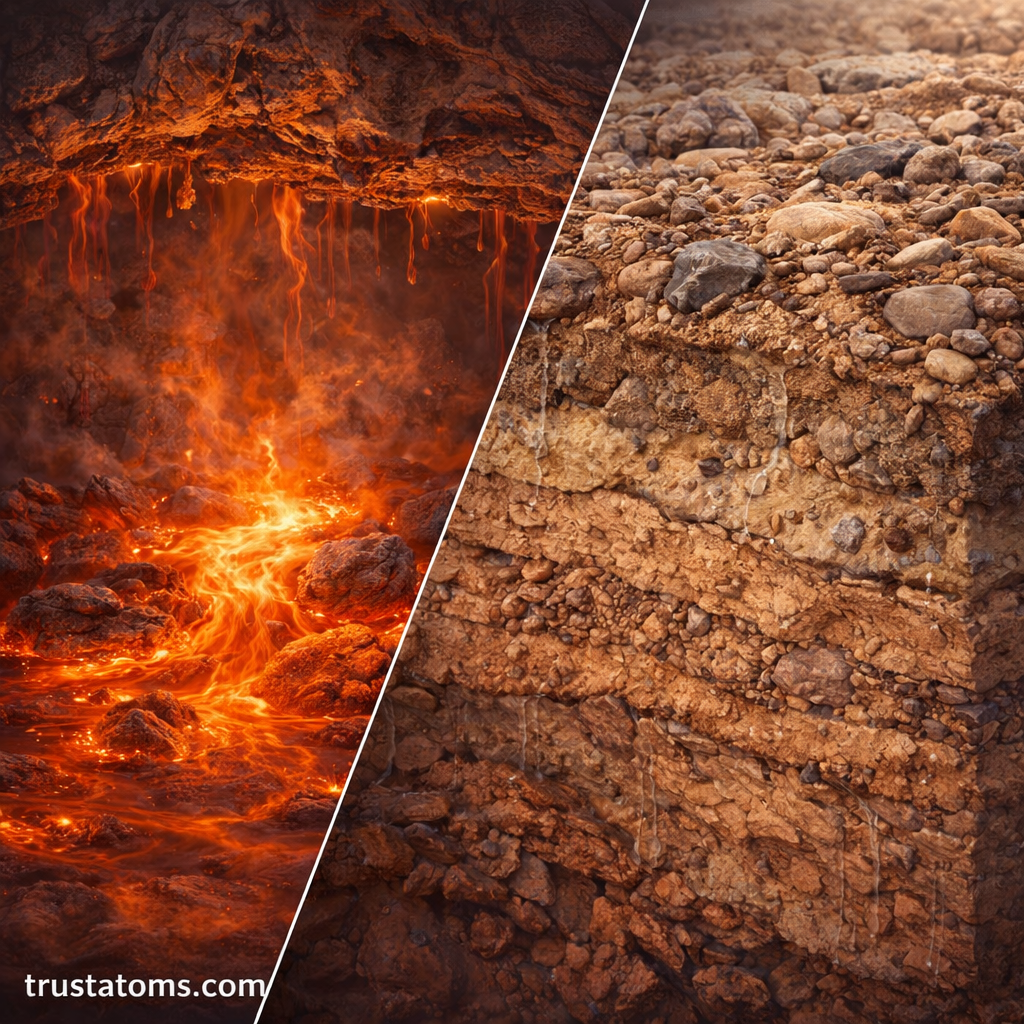
Rocks are not permanent—they continuously change through the rock cycle.
For example, granite exposed at the surface can weather into sand-sized particles. After transportation, deposition, burial, and cementation, those particles may become sandstone. If that sandstone later experiences sufficient heat and pressure, it can transform into quartzite.
If a rock melts, its molten material can eventually cool to form another igneous rock. These processes do not follow a fixed sequence: any rock type may be weathered, buried, metamorphosed, or melted when conditions permit.
How Different Rock Types Are Used
Rock properties influence their practical uses. Granite is valued for its durability in construction, limestone supplies raw material for cement, and marble is used for architectural surfaces and sculpture.
Sedimentary formations can also contain groundwater, petroleum, and natural gas, while some igneous and metamorphic environments host economically valuable mineral deposits. Understanding rock composition and structure helps engineers evaluate construction sites and locate geological resources.
Frequently Asked Questions
What Is the Easiest Way to Tell the Three Rock Types Apart?
Look for clues about formation. Igneous rocks may contain interlocking crystals or volcanic glass, sedimentary rocks may show grains or deposited layers, and metamorphic rocks may display aligned minerals or banding. Some specimens require closer examination to identify accurately.
Can One Rock Change Into Another Type?
Yes. Weathering, deposition, burial, metamorphism, melting, and cooling can transform rocks between the three categories. The changes depend on environmental conditions rather than a required sequence.
Which Rock Type Is Most Likely to Contain Fossils?
Sedimentary rocks are most likely to preserve recognizable fossils because organisms or their traces can become buried in accumulating sediment. High temperatures and pressures during igneous or metamorphic formation commonly destroy or alter fossil evidence.
Igneous, sedimentary, and metamorphic rocks record different stages of Earth’s geological processes, from cooling magma to sediment deposition and deep crustal transformation. Recognizing their formation processes and identifying features allows scientists to reconstruct past environments, investigate tectonic activity, and understand how familiar landscapes developed.
Sources: U.S. Geological Survey (USGS), geology and rock classification educational resources; British Geological Survey (BGS), rock classification resources; Tarbuck, Lutgens, and Tasa, Earth: An Introduction to Physical Geology.