Continental Drift Theory is one of the most important ideas in Earth science, explaining how continents have moved across the planet over millions of years. What began as a controversial hypothesis eventually became the foundation for modern plate tectonics, reshaping how scientists understand Earth’s structure, geology, and natural processes.
What Is Continental Drift?
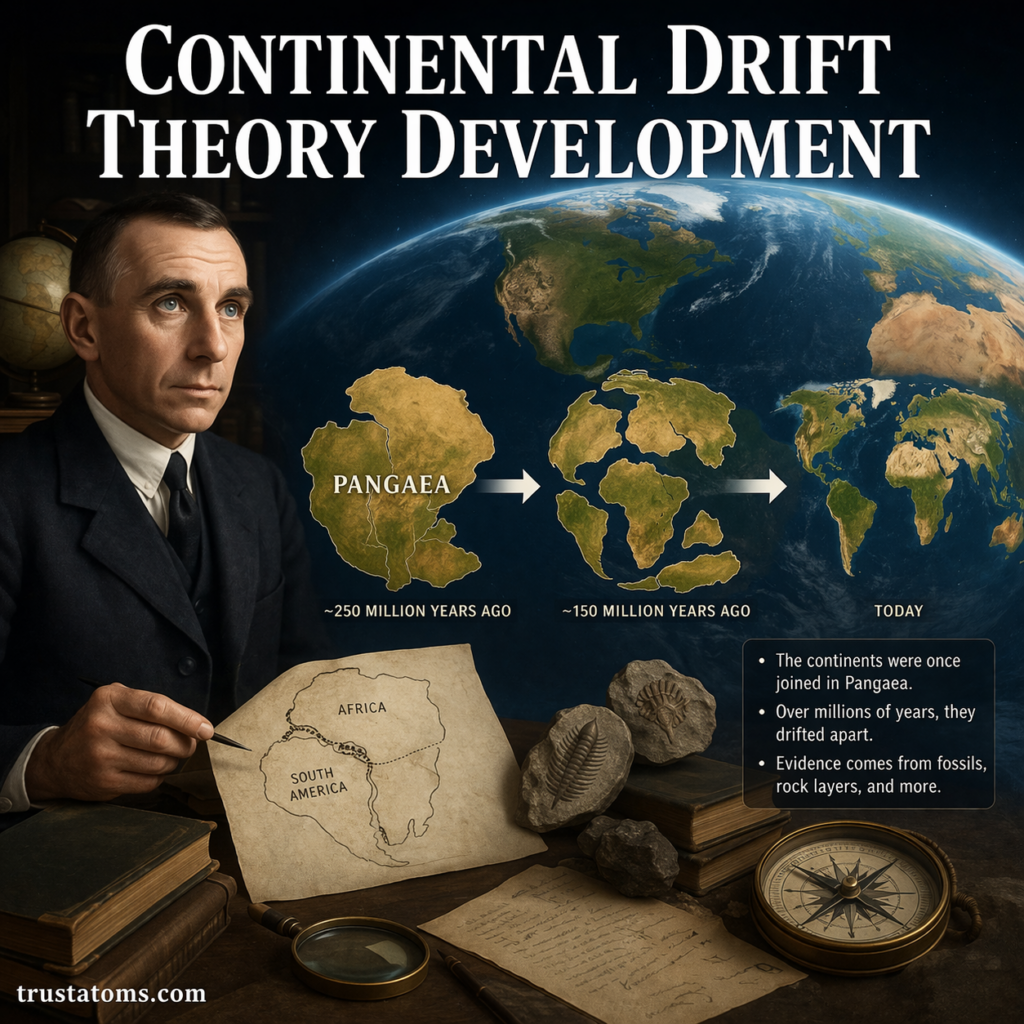
Continental drift is the idea that Earth’s continents were once joined together in a single massive landform and have slowly drifted apart over time.
The concept was first formally proposed by Alfred Wegener in the early 20th century. He suggested that all continents were once part of a supercontinent called Pangaea.
According to this theory:
- Continents are not fixed in place
- They move gradually over millions of years
- Earth’s surface is dynamic, not static
Early Observations That Sparked the Idea
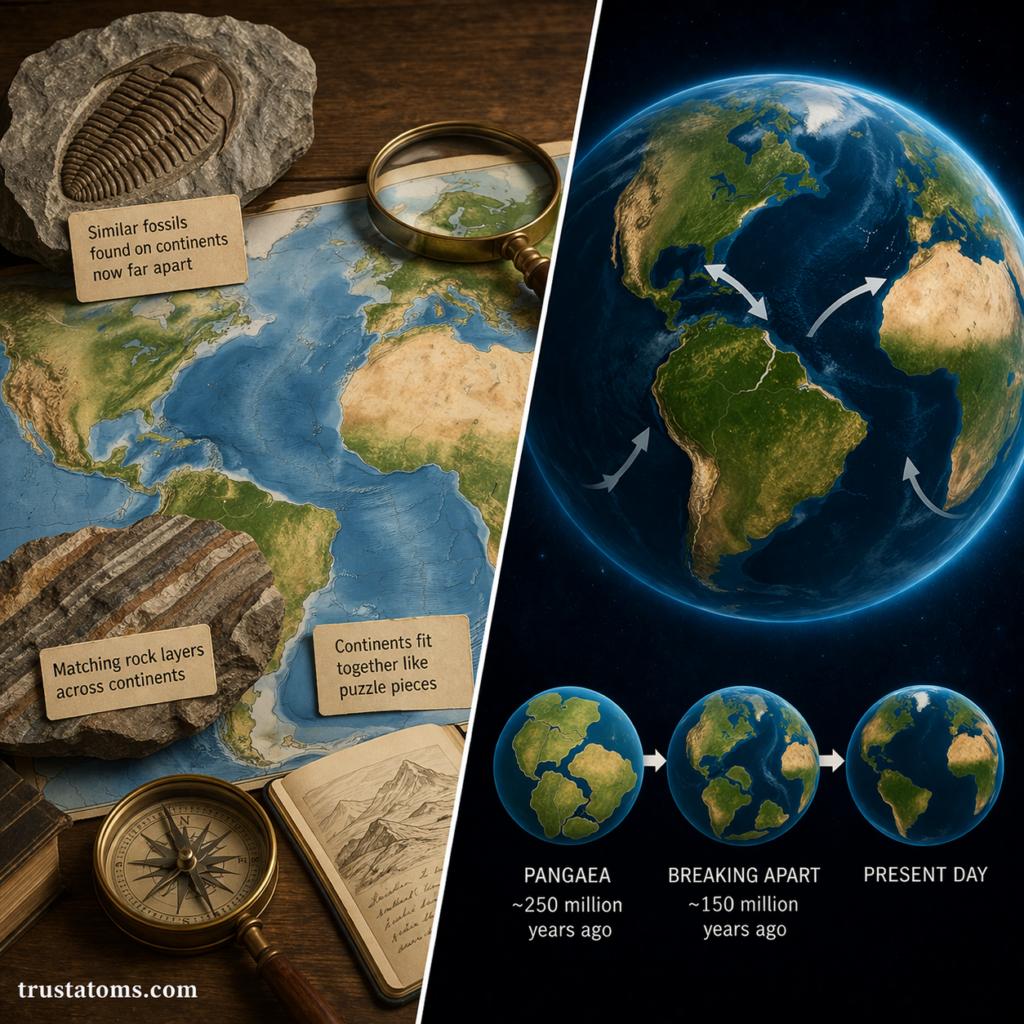
Before continental drift was formally proposed, scientists noticed patterns that suggested continents were once connected.
1. The Puzzle-Like Fit of Continents
- Coastlines—especially between South America and Africa—appear to fit together like pieces of a puzzle
- This alignment is most noticeable when looking at continental shelves rather than modern shorelines
2. Fossil Evidence Across Continents
- Similar types of fossils have been found on continents now separated by oceans
- These organisms would not have been able to cross vast oceans, suggesting the land was once connected
3. Matching Rock Layers and Geological Structures
- Rock formations of the same age and composition appear on different continents
- Mountain ranges also align when continents are repositioned together
These early observations laid the groundwork for the development of continental drift theory.
Continents did not just appear to fit together—they also showed consistent geological and fossil patterns. These combined clues made it increasingly difficult to explain Earth’s surface as static.
Alfred Wegener’s Continental Drift Hypothesis
In 1912, Alfred Wegener introduced his continental drift hypothesis.
He proposed that:
- All continents were once joined in Pangaea
- Over time, they broke apart and drifted to their current positions
Evidence Wegener Used
Wegener supported his theory with multiple lines of evidence:
- Fossil similarities across continents
- Matching geological formations
- Paleoclimate evidence (such as glacial deposits in now-warm regions)
Why the Theory Was Initially Rejected
Despite strong observational evidence, continental drift was widely rejected by scientists at the time.
The main issue was simple:
- Wegener could not explain how continents moved
Many scientists believed Earth’s crust was too rigid for continents to drift. Without a convincing mechanism, the theory remained controversial for decades.
Breakthrough Discoveries in the Mid-20th Century
Continental drift gained acceptance only after new discoveries provided the missing mechanism.
1. Seafloor Spreading
Scientists discovered that new ocean crust forms at mid-ocean ridges and spreads outward.
This process, known as Seafloor Spreading, showed that the ocean floor itself moves—carrying continents with it.
2. Magnetic Evidence
- Rocks on the ocean floor showed symmetrical magnetic patterns
- These patterns recorded reversals in Earth’s magnetic field
- The symmetry supported the idea of spreading seafloor
3. Plate Tectonics Theory
These discoveries led to the development of Plate Tectonics in the 1960s.
Plate tectonics explained that:
- Earth’s outer layer is divided into plates
- These plates move over the semi-fluid mantle
- Continents are carried along with these plates
From Continental Drift to Plate Tectonics
Continental drift became fully accepted once it was integrated into plate tectonics.
Key differences:
- Continental drift: Focused on moving continents
- Plate tectonics: Explains movement of entire lithospheric plates
This broader theory provided the mechanism Wegener lacked.
Evidence Supporting Continental Drift Today
Modern science strongly supports continental drift through advanced technology and data.
Key Supporting Evidence
- GPS measurements show continents moving centimeters per year
- Earthquake patterns outline plate boundaries
- Volcanic activity occurs along moving plate edges
- Ocean floor mapping reveals spreading ridges and trenches
Impact on Earth Science
The development of continental drift theory transformed geology and Earth science.
It helped scientists understand:
- The formation of mountains
- Earthquakes and volcanic activity
- Distribution of fossils and species
- The history of Earth’s climate
Why Continental Drift Still Matters
Continental drift is not just a historical idea—it remains essential to understanding Earth today.
It plays a role in:
- Predicting geological hazards
- Studying climate change over geological time
- Exploring natural resources
- Understanding biodiversity and global patterns
Final Thoughts
The development of continental drift theory shows how scientific ideas evolve over time. What began as a controversial hypothesis by Alfred Wegener eventually became a cornerstone of modern Earth science.
By combining evidence from fossils, geology, and ocean studies, scientists uncovered the dynamic nature of our planet—proving that Earth is constantly changing, even if those changes occur over millions of years.