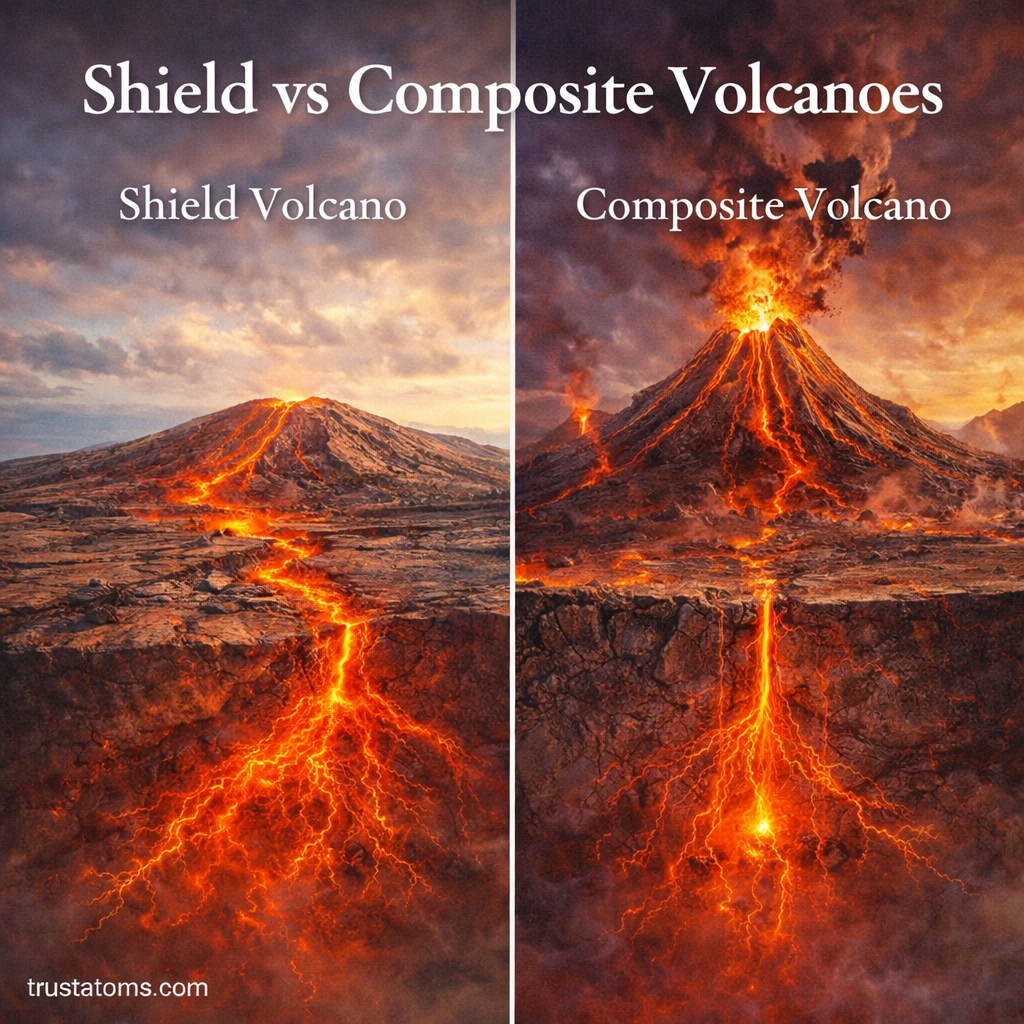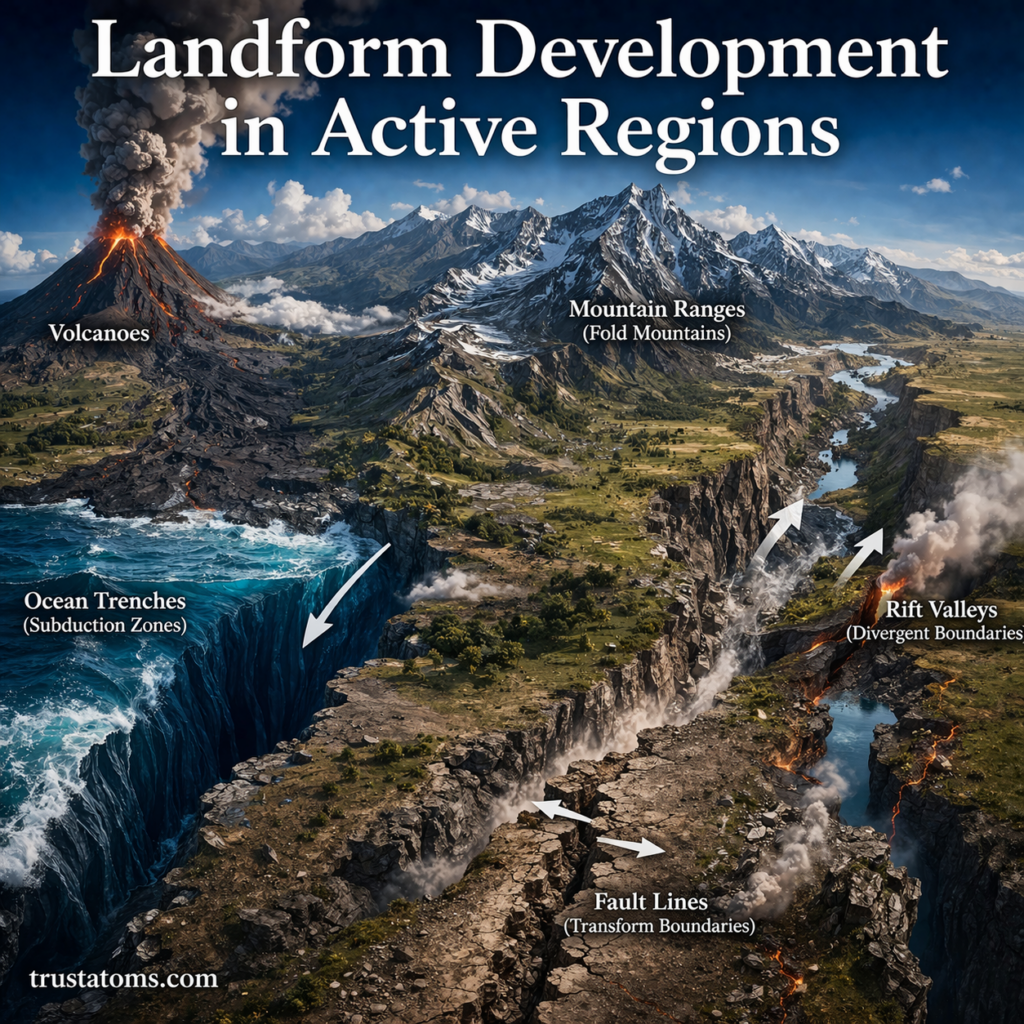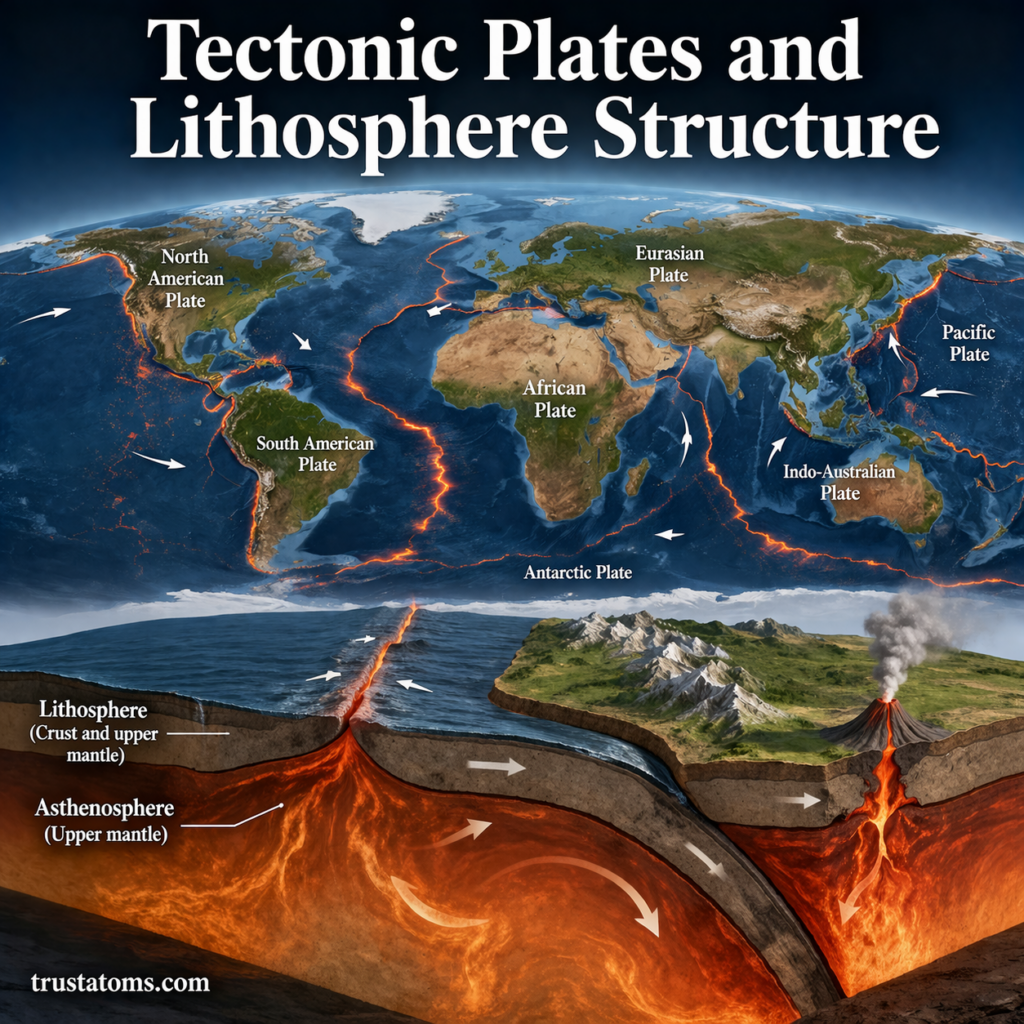
Tectonic plates are enormous moving sections of Earth’s lithosphere, the rigid outer shell made of the crust and uppermost mantle. Their slow movement and interactions at plate boundaries produce earthquakes, volcanoes, mountain ranges, ocean trenches, and new oceanic crust.
Although the ground appears stationary, Earth’s outer shell is continually shifting at rates usually measured in centimeters per year. Understanding the relationship between tectonic plates and the lithosphere is a central part of Earth science because it explains how geological forces reshape the planet’s surface.
What Is the Lithosphere?
The lithosphere is Earth’s rigid outermost mechanical layer. It includes the entire crust and the cool, strong uppermost portion of the mantle beneath it.
Unlike the crust, which is defined by its chemical composition, the lithosphere is defined by how rock behaves under stress. Lithospheric rock is relatively strong and can fracture, while hotter mantle rock beneath it deforms more readily over long periods.
Lithosphere thickness varies considerably. Young oceanic lithosphere near spreading ridges is relatively thin, while older oceanic lithosphere may exceed 100 kilometers in thickness. Continental lithosphere commonly extends beyond 100 kilometers and can exceed 200 kilometers beneath ancient continental interiors.
What Are Tectonic Plates?
Tectonic plates are large, connected sections of lithosphere that move relative to one another. A single plate can contain both oceanic and continental crust, so plate boundaries do not necessarily follow coastlines.
Some of the largest plates are the Pacific, North American, South American, Eurasian, African, Antarctic, and Indo-Australian plate systems. The Indian and Australian plates are also often distinguished because their relative motion and boundary structure are complex.
Their geographic distribution and interactions are examined in Earth’s Major Tectonic Plates.
How Fast Do Tectonic Plates Move?
Most tectonic plates move at rates of approximately 1 to 10 centimeters per year relative to other plates. Scientists measure these movements using satellite-based positioning systems and geological evidence.
For a concrete example, a plate moving 5 centimeters per year would travel approximately 50 kilometers over one million years if its speed and direction remained constant. That is enough movement to reshape coastlines and contribute to the opening or closing of ocean basins over geological time.
The Asthenosphere Beneath the Lithosphere
Beneath the lithosphere lies the asthenosphere, a relatively weak and ductile region of the upper mantle. Its rock is predominantly solid, but high temperatures and long timescales allow it to deform and flow slowly.
The asthenosphere is sometimes described as partially molten, but this does not mean it is a continuous underground ocean of magma. Limited partial melting may occur in certain regions, while most of its material remains solid.
The mechanical contrast between the strong lithosphere and weaker underlying mantle allows tectonic plates to move and deform. Their movement is influenced by gravity, mantle flow, and forces acting at plate boundaries.
Types of Plate Boundaries
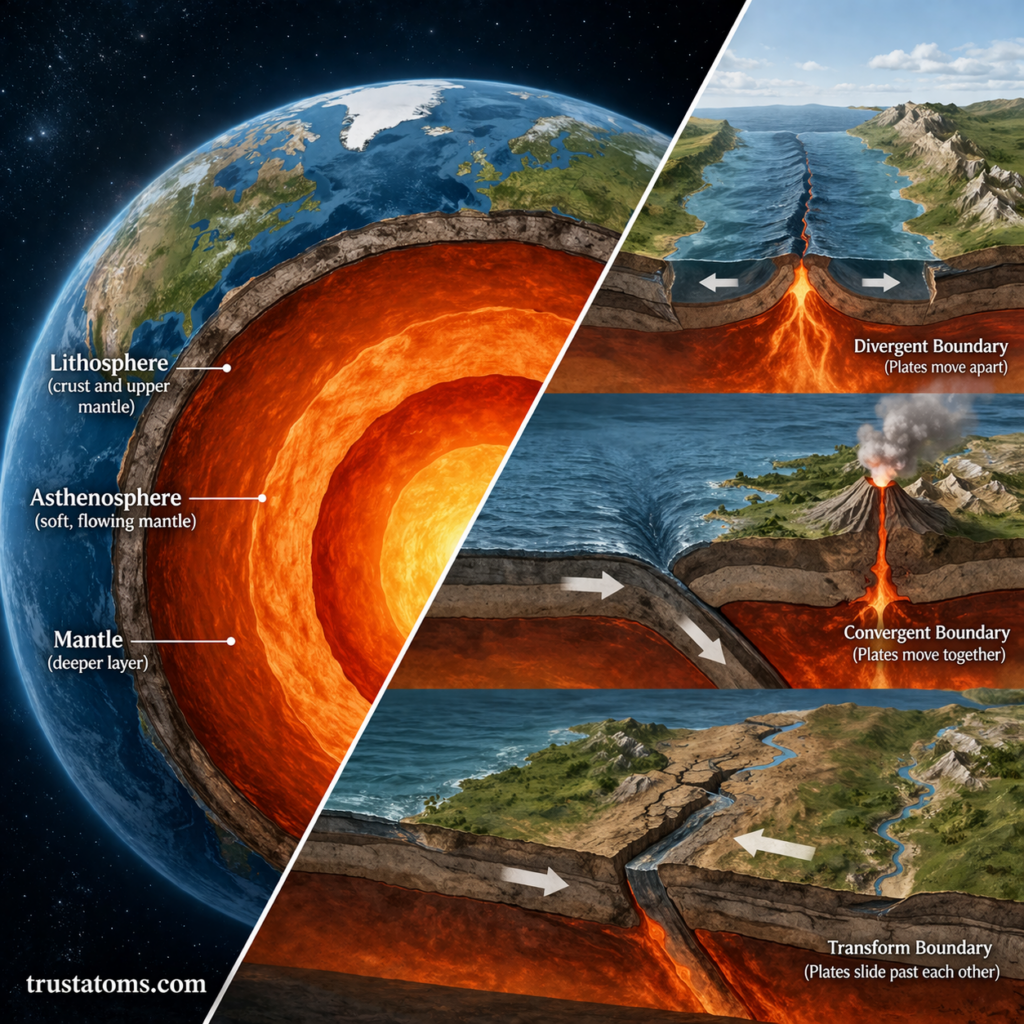
Plate boundaries are regions where neighboring plates interact. Their relative motion determines whether crust is created, consumed, compressed, or displaced sideways.
The three principal categories are explained further in Plate Boundaries and Crustal Movement, while Transform, Convergent, and Divergent Boundaries examines their geological characteristics.
Divergent Boundaries: Plates Move Apart
At divergent boundaries, tectonic plates separate. Mantle material rises beneath the opening, and decompression melting can generate magma that solidifies into new oceanic crust.
The Mid-Atlantic Ridge is a major example of an oceanic divergent boundary. Continental divergence can also produce rift valleys, such as those within the East African Rift system.
Convergent Boundaries: Plates Move Together
Convergent boundaries form where plates move toward each other. When dense oceanic lithosphere descends beneath another plate, the process is called subduction.
Subduction can produce deep ocean trenches, volcanic arcs, and powerful earthquakes. When two buoyant continental masses collide, their crust can thicken and form extensive mountain ranges, as seen in the Himalayas.
Transform Boundaries: Plates Slide Past
At transform boundaries, neighboring plates move horizontally past each other. Friction may temporarily lock sections of a fault, allowing stress to accumulate until sudden slipping produces an earthquake.
The San Andreas Fault in California is a well-known transform boundary between the Pacific and North American plates. Transform boundaries generally do not create or destroy substantial amounts of lithosphere.
What Forces Move Tectonic Plates?
Plate motion results from interacting forces associated with Earth’s internal heat, mantle dynamics, and gravity. Scientists identify several major contributors rather than a single mechanism that drives every plate equally.
- Slab pull: Cold, dense oceanic lithosphere sinks into the mantle at subduction zones, pulling connected plate material toward the boundary.
- Ridge push: Gravity pushes plates away from mid-ocean ridges as lithosphere moves down the elevated ridge flanks.
- Mantle flow: Slow deformation and circulation within the mantle exchange forces with the lithosphere and influence plate movement.
Slab pull is considered particularly significant for many plates connected to active subduction zones. However, the relative contribution of each force depends on plate geometry and surrounding mantle conditions.
Oceanic and Continental Lithosphere Compared
Oceanic and continental lithosphere differ in thickness, composition, density, and geological history. The distinction is important because these properties influence how plates behave during collisions.
| Feature | Oceanic lithosphere | Continental lithosphere |
|---|---|---|
| Crust composition | Primarily basalt and gabbro | Varied, commonly more silica-rich |
| Crust thickness | Typically 5–10 km | Typically 30–70 km |
| Lithosphere thickness | Increases as it cools and ages | Often thick beneath ancient continental regions |
| Density | Generally denser | Generally more buoyant |
| Tectonic behavior | Frequently recycled by subduction | More resistant to deep subduction |
Crust thickness and lithosphere thickness are not interchangeable measurements. The lithosphere includes both crust and rigid uppermost mantle, making it substantially thicker than the crust alone.
Geological Features Created by Plate Tectonics
Plate interactions explain the geographic distribution of many major geological features. Mountain ranges form through compression and collision, ocean trenches develop at subduction zones, and volcanic systems commonly occur near convergent or divergent boundaries.
Earthquakes frequently cluster along plate boundaries because relative movement concentrates stress in faults. The broader scientific framework connecting these observations is explained in the Theory of Plate Tectonics.
Not all geological activity occurs at plate boundaries. Some volcanoes form within plates above mantle hotspots, demonstrating that Earth’s interior can influence surface geology away from major boundaries.
How Scientists Study Plate Movement
Modern satellite positioning measurements detect changes in plate positions over time. Seismometers reveal earthquake locations and fault movement, while ocean-floor magnetic patterns record the creation and spreading of oceanic crust.
Scientists also use seismic waves to investigate Earth’s internal structure. Differences in wave speeds provide evidence about the mechanical properties of the lithosphere, asthenosphere, and deeper mantle.
Frequently Asked Questions
Are tectonic plates the same as Earth’s crust?
No. Tectonic plates consist of lithosphere, which includes both the crust and the rigid uppermost mantle. The crust is only the outermost compositional layer of a plate.
Is the asthenosphere liquid magma?
No. The asthenosphere consists predominantly of solid mantle rock that can deform slowly under high temperatures and pressure. Small amounts of partial melting may occur in certain locations.
Why do earthquakes occur near plate boundaries?
Relative plate movement builds stress in rocks along faults. When the accumulated stress overcomes frictional resistance, sudden fault movement releases energy as seismic waves, producing an earthquake.
The lithosphere forms Earth’s rigid outer shell, while tectonic plates are its moving sections. Their interactions with the underlying mantle and neighboring plates explain how ocean basins expand, mountain ranges rise, and earthquakes occur, connecting the structure of Earth’s interior to changes visible at its surface.
Sources: U.S. Geological Survey, This Dynamic Earth: The Story of Plate Tectonics; National Park Service, Plate Tectonics and Our National Parks; Kearey, Klepeis, and Vine, Global Tectonics.