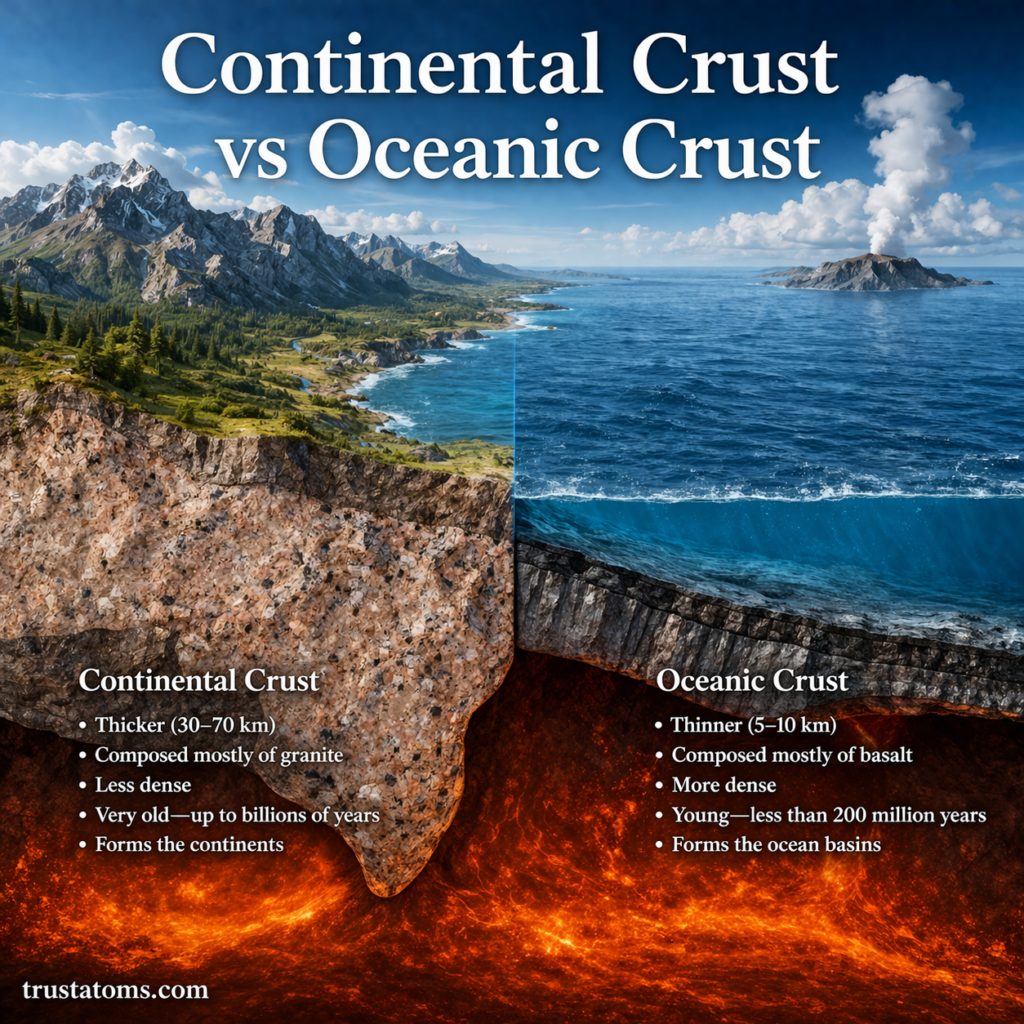
Continental crust and oceanic crust are the two main types of Earth’s outermost solid layer, and they differ in thickness, density, composition, and age. Continental crust is generally thicker, less dense, and older, while oceanic crust is thinner, denser, and continually created and recycled through tectonic activity.
These differences help explain why continents stand relatively high, why deep ocean basins exist, and how mountains, earthquakes, and volcanoes develop. Comparing these crust types is part of Earth science, which examines the planet’s structure, materials, history, and changing natural processes.
What Is Earth’s Crust?
Earth’s crust is the outermost solid compositional layer of the planet. It lies above the mantle and forms the upper portion of the lithosphere, a rigid shell that also includes the uppermost mantle. The lithosphere is divided into tectonic plates that move slowly relative to one another.
The crust is extremely thin compared with Earth’s overall radius of approximately 6,371 kilometers. Its thickness varies between continental and oceanic regions, but even the thickest crust represents only a small fraction of the planet’s interior. The relationship between these structures is explained in the layers of Earth.
Continental crust forms the foundation of continents and their submerged margins. Oceanic crust forms the rocky foundation of most deep ocean basins. Both contain silicate minerals, but differences in their chemical composition influence their density and tectonic behavior.
The crust is continually modified by plate movement. New oceanic crust develops through seafloor spreading mechanisms, while older oceanic lithosphere can descend into the mantle. This process, explored in crustal recycling through subduction, helps explain why oceanic crust generally preserves a shorter geological history than continental crust.
What Is Continental Crust?
Continental crust forms the continents and extends beneath continental shelves along many coastlines. It is commonly about 30 to 70 kilometers thick beneath continental interiors and major mountain belts, although some regions are thinner. Its average composition is broadly granitic, containing relatively high proportions of silica and aluminum compared with oceanic crust.
Continental crust has an average density of approximately 2.7 grams per cubic centimeter. Its relatively low density makes it buoyant compared with the underlying mantle. This contributes to the elevated position of continental landmasses through a gravitational balance known as isostasy.
Some continental rocks preserve geological evidence from billions of years ago. Continental crust can survive repeated tectonic events because its lower density makes it difficult to subduct deeply into the mantle. However, it can still be stretched, fractured, metamorphosed, eroded, and partially recycled.
When continental masses converge, their buoyant crust commonly thickens and deforms rather than descending easily into the mantle. These continental collision processes can produce extensive mountain ranges. The Himalayas, for example, developed through the continuing convergence of the Indian and Eurasian plates.
What Is Oceanic Crust?
Oceanic crust forms beneath most deep ocean basins. It is typically about 5 to 10 kilometers thick, commonly averaging approximately 7 kilometers. Its composition is predominantly basaltic, containing relatively high proportions of iron- and magnesium-bearing minerals.
Basalt commonly forms near the seafloor as lava cools, while gabbro, a chemically similar but coarse-grained rock, develops deeper within the crust. Oceanic crust has an average density of approximately 3.0 grams per cubic centimeter, making it denser than typical continental crust.
Most oceanic crust is geologically young because it forms at spreading centers and is eventually recycled at subduction zones. Nearly all surviving oceanic crust beneath modern ocean basins is younger than approximately 200 million years, although rare older remnants exist in unusual geological settings.
Oceanic crust forms at mid-ocean ridges, where plates move apart and magma rises to create new crust. As the newly formed crust moves away from the ridge, the underlying lithosphere cools, thickens, and generally becomes denser.
Continental Crust vs Oceanic Crust: Comparison Table
The main differences involve thickness, density, composition, geological age, and behavior at tectonic boundaries. The values below represent approximate textbook ranges rather than measurements that apply to every location.
| Characteristic | Continental Crust | Oceanic Crust |
|---|---|---|
| Typical thickness | 30–70 km | 5–10 km |
| Average density | About 2.7 g/cm³ | About 3.0 g/cm³ |
| Typical composition | Broadly granitic | Basaltic and gabbroic |
| Rock chemistry | Relatively silica-rich | Relatively iron- and magnesium-rich |
| Geological age | Some rocks billions of years old | Mostly younger than 200 million years |
| Primary location | Continents and continental shelves | Deep ocean basins |
| Relative buoyancy | Greater | Lower |
| Tectonic behavior | Resists deep subduction | Commonly recycled by subduction |
These characteristics are connected. Composition influences density, while crustal thickness and the temperature of the underlying lithosphere affect surface elevation. Together, these factors help produce Earth’s contrasting continental elevations and deep ocean basins.
How Continental and Oceanic Crust Interact at Plate Boundaries
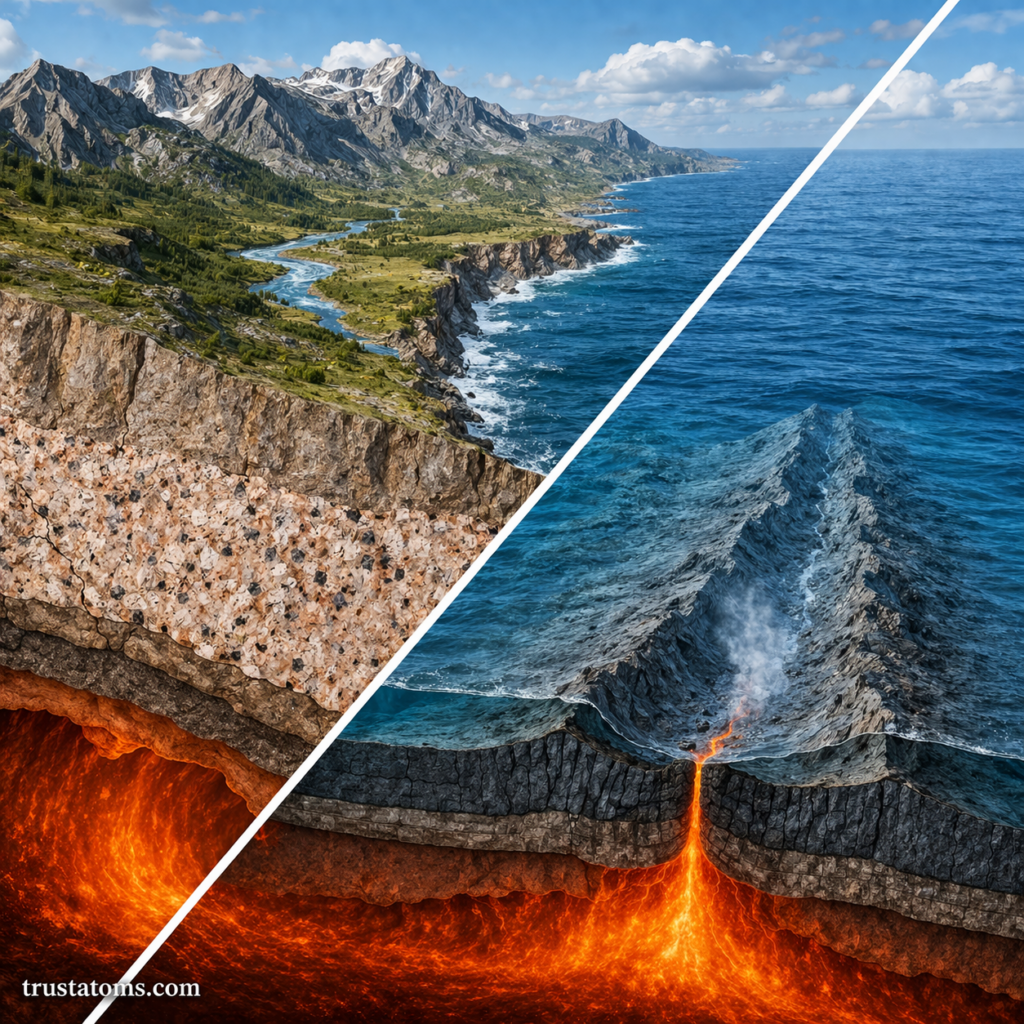
Continental and oceanic crust interact through the movement of lithospheric plates. Their contrasting properties influence what happens when plates converge, separate, or slide past one another.
Convergent Boundaries and Subduction
At some convergent boundaries, an oceanic plate descends beneath a continental plate. As the descending oceanic lithosphere releases water into the overlying mantle, melting can occur and generate magma. Some of this magma rises toward the surface, contributing to volcanic mountain chains.
The Andes provide an example. The Nazca Plate descends beneath the South American Plate, producing earthquakes, volcanic activity, and crustal deformation. Subduction involves oceanic lithosphere, including its crust and uppermost mantle, rather than a detached crustal layer alone.
Divergent Boundaries and New Oceanic Crust
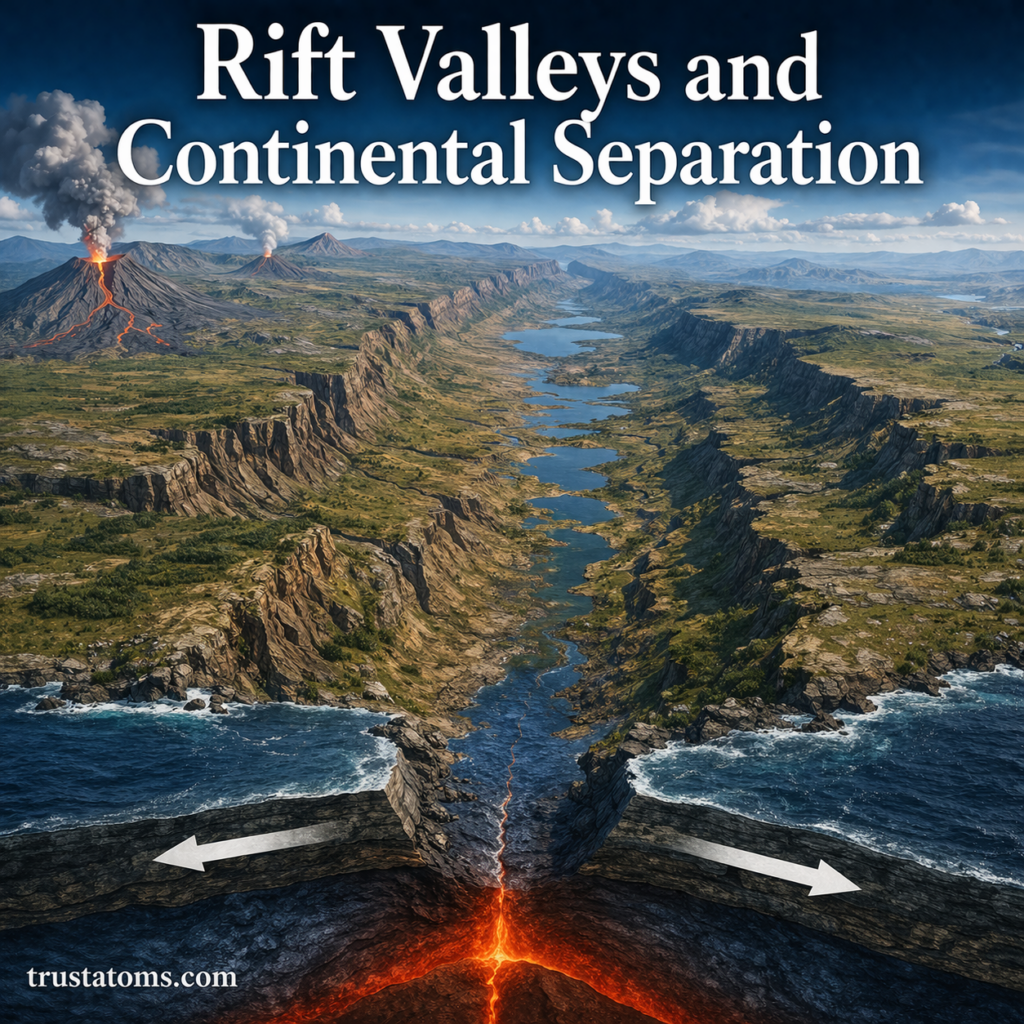
At divergent boundaries, tectonic plates move apart. Hot mantle rises and undergoes partial melting as pressure decreases, producing basaltic magma. When magma cools and solidifies, it forms new oceanic crust along spreading ridges. Older crust gradually moves away on both sides.
Transform Boundaries and Earthquakes
At transform boundaries, tectonic plates slide horizontally past one another. Crust is generally neither created nor destroyed, but friction can cause stress to accumulate. Sudden movement along a fault releases energy as seismic waves, producing earthquakes.
Worked Example: Comparing Crust Thickness and Density
Consider two simplified crustal sections. The continental section is 40 kilometers thick with an average density of 2.7 g/cm³. The oceanic section is 7 kilometers thick with an average density of 3.0 g/cm³.
- Compare thickness: 40 divided by 7 equals approximately 5.7. The continental crust is about 5.7 times thicker in this example.
- Compare density: 3.0 minus 2.7 equals 0.3 g/cm³. The oceanic crust has a higher average density by 0.3 g/cm³.
- Calculate the percentage difference: 0.3 divided by 2.7, multiplied by 100, equals approximately 11%. The oceanic crust is about 11% denser than the continental crust.
- Interpret the comparison: continental crust is considerably thicker but consists of less-dense material, while oceanic crust is thinner and denser.
These numbers are representative examples rather than observations from a particular location. They show why thickness and density must be considered together. Actual elevation also depends on mantle density, lithospheric temperature, and tectonic forces.
Why Oceanic Crust Is Younger Than Continental Crust
Oceanic crust undergoes a continuing cycle of formation, movement, and recycling. New crust forms at spreading ridges, moves outward with tectonic plates, and may eventually enter a subduction zone. Over geological time, this process removes much of the older oceanic crust from Earth’s surface.
Continental crust follows a different history. Its relatively low density allows large portions to survive tectonic collisions and repeated mountain-building events. Ancient, stable continental interiors called cratons preserve evidence of geological processes from the distant past.
This difference explains why continents contain rocks that scientists have dated to billions of years old, while most modern ocean basins are underlain by much younger crust. Continental crust is not permanent, however, and can be modified or recycled through geological processes.
Common Misconceptions
Oceanic Crust Is Simply Continental Crust Covered by Water
Crust type depends on geological composition and structure, not whether water covers it. Continental crust extends beneath continental shelves, while oceanic crust forms most deep ocean basins.
All Continental Crust Is Made of Granite
Continental crust contains igneous, sedimentary, and metamorphic rocks. Describing its average composition as granitic does not mean every continental rock is granite.
Oceanic Crust Is Always Sinking Into the Mantle
Oceanic crust forms at spreading centers and moves with tectonic plates. Subduction occurs only at appropriate convergent boundaries, and oceanic crust can remain at the surface for millions of years before being recycled.
Continents Cannot Move Because Their Crust Is Thick
Continental crust moves as part of tectonic plates. Its thickness and buoyancy influence deformation and collision processes, but they do not prevent continental movement.
Frequently Asked Questions
Which is thicker, continental crust or oceanic crust?
Continental crust is generally thicker, commonly measuring about 30 to 70 kilometers. Oceanic crust typically measures about 5 to 10 kilometers. Thickness varies according to location and geological history.
Why is oceanic crust denser than continental crust?
Oceanic crust contains a greater proportion of iron- and magnesium-rich minerals, resulting in a higher average density. Continental crust is generally more silica-rich and contains more relatively low-density minerals.
Which type of crust is older?
Continental crust preserves much older geological material, including rocks billions of years old. Most oceanic crust is younger than approximately 200 million years because it is continually formed and recycled through tectonic activity.
Why does oceanic crust subduct beneath continental crust?
Oceanic lithosphere becomes denser as it cools and can descend into the mantle at convergent boundaries. Continental lithosphere is generally more buoyant because of its thick, relatively low-density crust, making deep subduction of large continental masses more difficult.
Can continental crust exist underwater?
Yes. Continental shelves and many submerged continental margins consist of continental crust. Crust type is determined by geological composition and structure rather than whether it lies above or below sea level.
Continental and oceanic crust differ in physical properties and geological history. Their contrasting thicknesses, densities, and tectonic behavior help explain Earth’s surface features, from elevated continents and deep ocean basins to volcanic arcs and mountain ranges. Together, they reveal how the planet’s outer layers continually change through plate tectonics.
Sources: U.S. Geological Survey (USGS), This Dynamic Earth: The Story of Plate Tectonics; OpenStax, Physical Geology; Encyclopaedia Britannica, Earth’s Crust; National Oceanic and Atmospheric Administration (NOAA), Ocean Exploration.