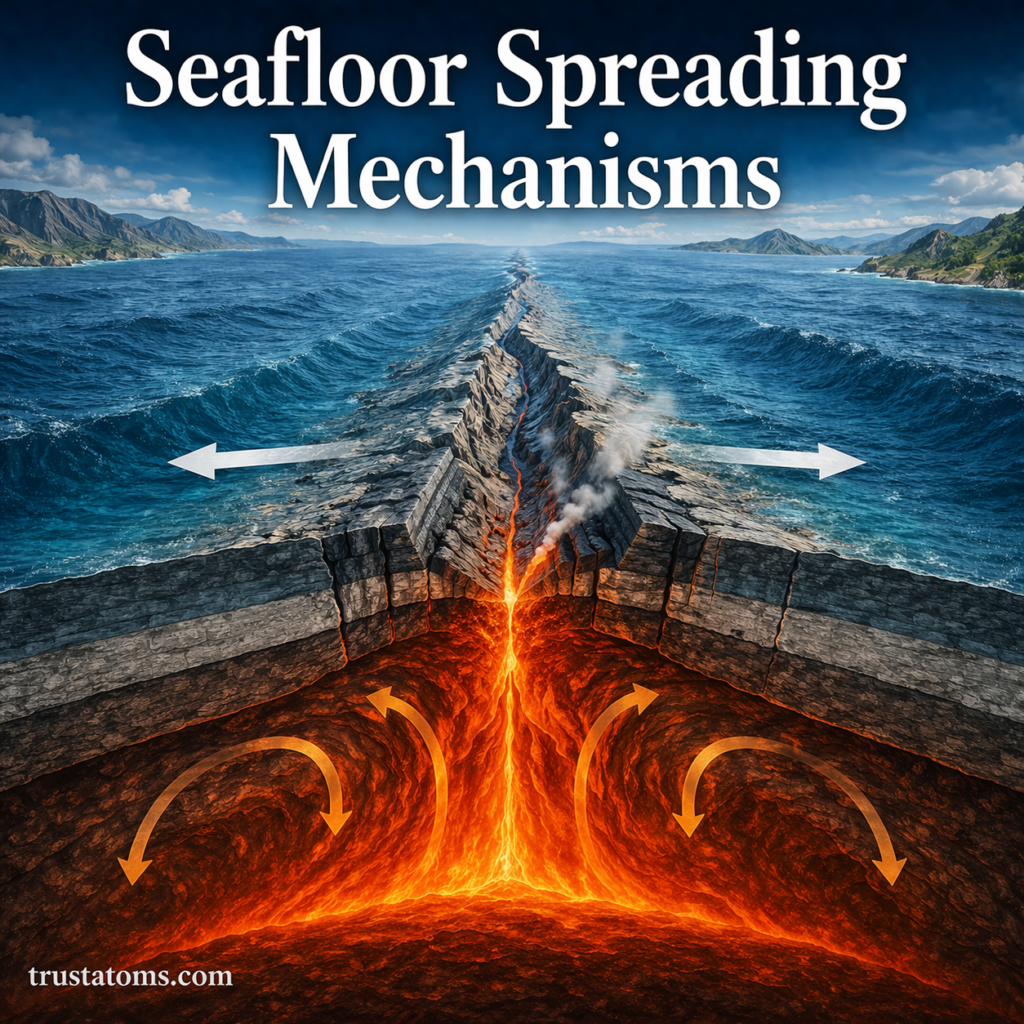
Seafloor spreading occurs when tectonic plates move apart at underwater ridges, allowing magma to rise, cool, and form new oceanic crust. The new crust moves outward as spreading continues, gradually changing the size and shape of ocean basins.
This process is a central part of Earth science because it connects the movement of tectonic plates with underwater volcanism, earthquakes, and the changing positions of continents. Scientists study ocean-floor rocks and magnetic patterns to reconstruct how spreading has occurred over geological time.
What Is Seafloor Spreading?
Seafloor spreading is the process by which new oceanic crust forms at mid-ocean ridges and gradually moves away from them.
It occurs at divergent plate boundaries, where two tectonic plates separate. Hot mantle material rises beneath the opening, partially melts as pressure decreases, and supplies magma that solidifies into new rock. The spreading plates carry this rock away from the ridge.
The discovery of seafloor spreading helped explain how continents could change position, building on ideas explored in continental drift theory development. Continental separation can also begin with stretching and faulting on land, as described in rift valleys and continental separation.
How Mid-Ocean Ridges Create New Crust
Mid-ocean ridges are connected underwater mountain systems that mark places where oceanic plates diverge. They rise above the surrounding seafloor because the underlying rocks are relatively hot and buoyant.
New oceanic crust forms through a sequence of physical processes:
- Plate separation: Tectonic plates move away from one another at a divergent boundary.
- Mantle upwelling: Hot, mostly solid mantle rock rises beneath the ridge.
- Partial melting: Falling pressure allows some mantle minerals to melt, producing basaltic magma.
- Magma movement: Magma travels upward through fractures and may erupt onto the ocean floor.
- Crust formation: Magma cools into igneous rock, including basalt near the surface and gabbro deeper below.
- Outward movement: Continued plate divergence carries newly formed crust away from the ridge axis.
Underwater lava can cool rapidly into rounded structures called pillow basalts. Together with deeper intrusive rocks, these volcanic deposits build the oceanic crust.
What Drives Seafloor Spreading?
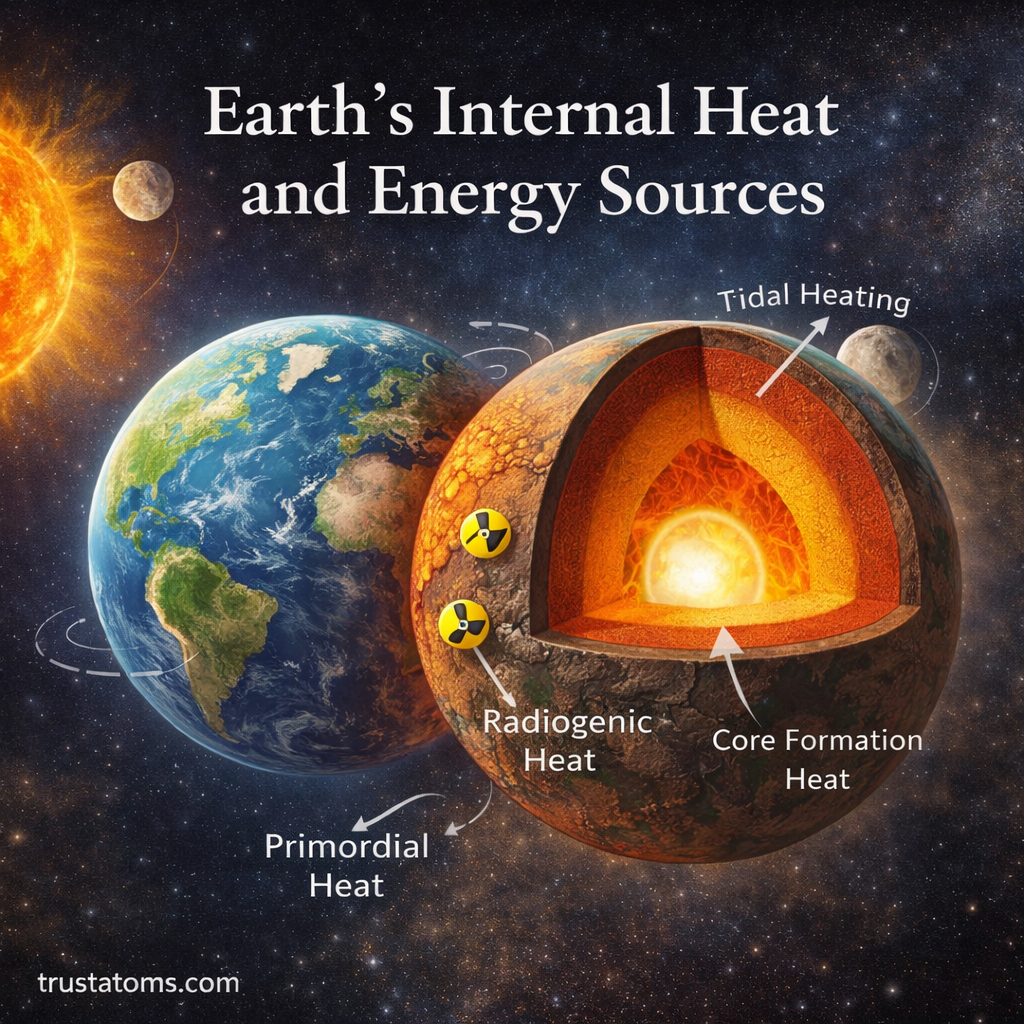
Seafloor spreading is part of the larger movement of Earth’s lithospheric plates. Heat escaping from Earth’s interior drives slow mantle circulation, but mantle convection alone does not fully explain plate motion.
Two important forces contribute to the movement:
- Slab pull: Cold, dense oceanic lithosphere sinking at a subduction zone pulls the attached plate toward the trench.
- Ridge push: Gravity helps plates slide away from the elevated mid-ocean ridge toward lower surrounding seafloor.
Slab pull is considered a major contributor to plate movement, although the relative importance of different forces varies among tectonic plates. Magma generally fills the space created by divergence rather than independently pushing entire plates apart.
Evidence That the Ocean Floor Is Spreading
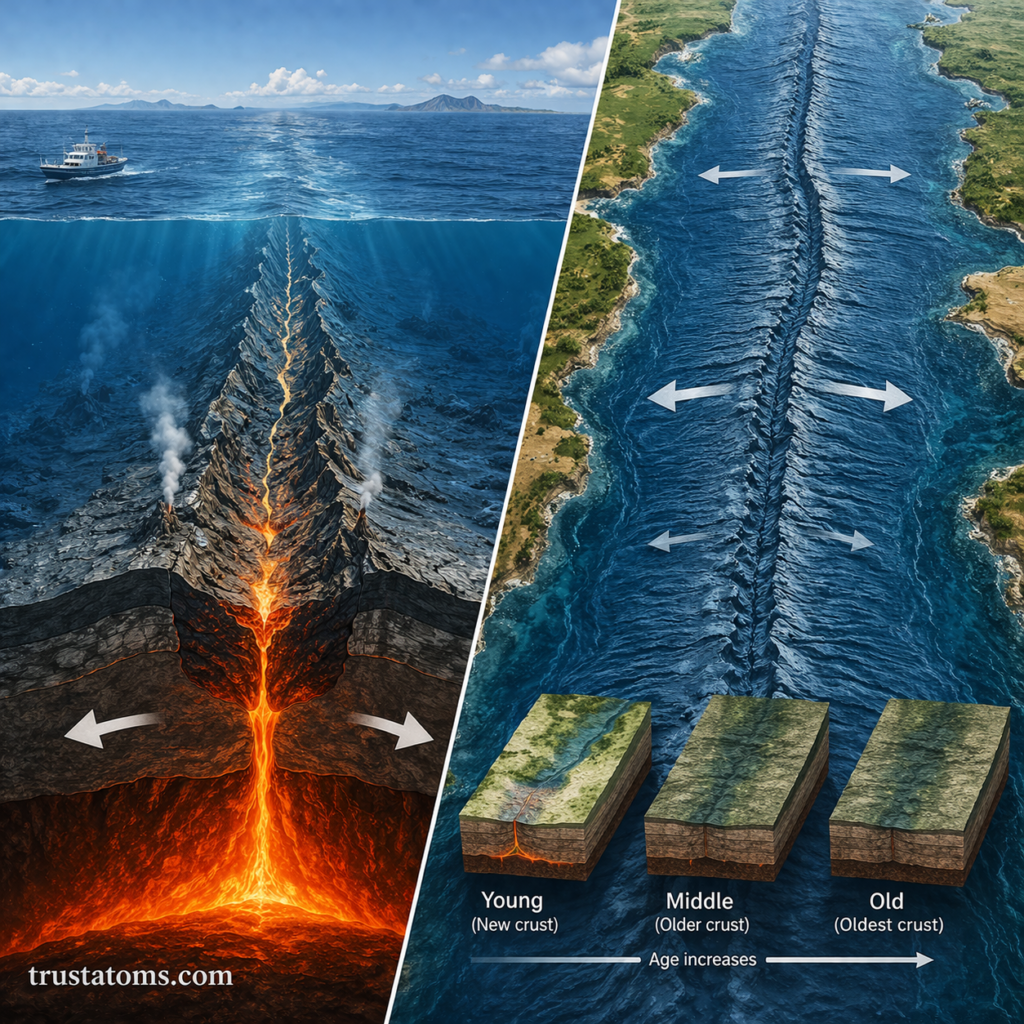
Scientists have identified several independent patterns that support seafloor spreading.
Symmetrical Magnetic Stripes
As basalt cools, magnetic minerals can preserve the direction of Earth’s magnetic field. Because the field has reversed many times, successive bands of oceanic crust record alternating magnetic polarities.
These bands commonly form matching patterns on opposite sides of a spreading ridge. Their symmetry provides evidence that crust has formed at the ridge and moved outward in both directions.
Oceanic Crust Ages and Sediment
Rock dating shows that oceanic crust is generally youngest near spreading ridges and becomes older with increasing distance. Sediment layers also tend to thicken away from ridges because older crust has had more time to accumulate deposits.
Measurements of plate motion using satellite-based geodesy provide additional confirmation that plates are separating today.
Fast and Slow Seafloor Spreading
Different ridge systems spread at different speeds. Spreading rates are commonly measured in centimeters per year, often using the combined separation rate of both plates.
| Feature | Fast-Spreading Ridge | Slow-Spreading Ridge |
|---|---|---|
| Example | East Pacific Rise | Mid-Atlantic Ridge |
| Typical full spreading rate | Often over 8 cm/year | Often around 2–4 cm/year |
| Seafloor shape | Broad, relatively smooth ridge crest | Rugged terrain with a prominent axial valley |
| Magma supply | Generally more continuous | Often more variable |
For a simple example, imagine two plates separating at a combined rate of 4 centimeters per year. Over one million years, their total separation would reach approximately 40 kilometers, assuming the rate remained constant. Each plate would move about 20 kilometers away from the ridge if spreading were symmetrical.
Actual spreading rates can change, and movement may be unequal on the two sides of a ridge. Even so, this calculation shows how a few centimeters of annual motion can produce major geographical changes.
Seafloor Spreading, Earthquakes, and Volcanism
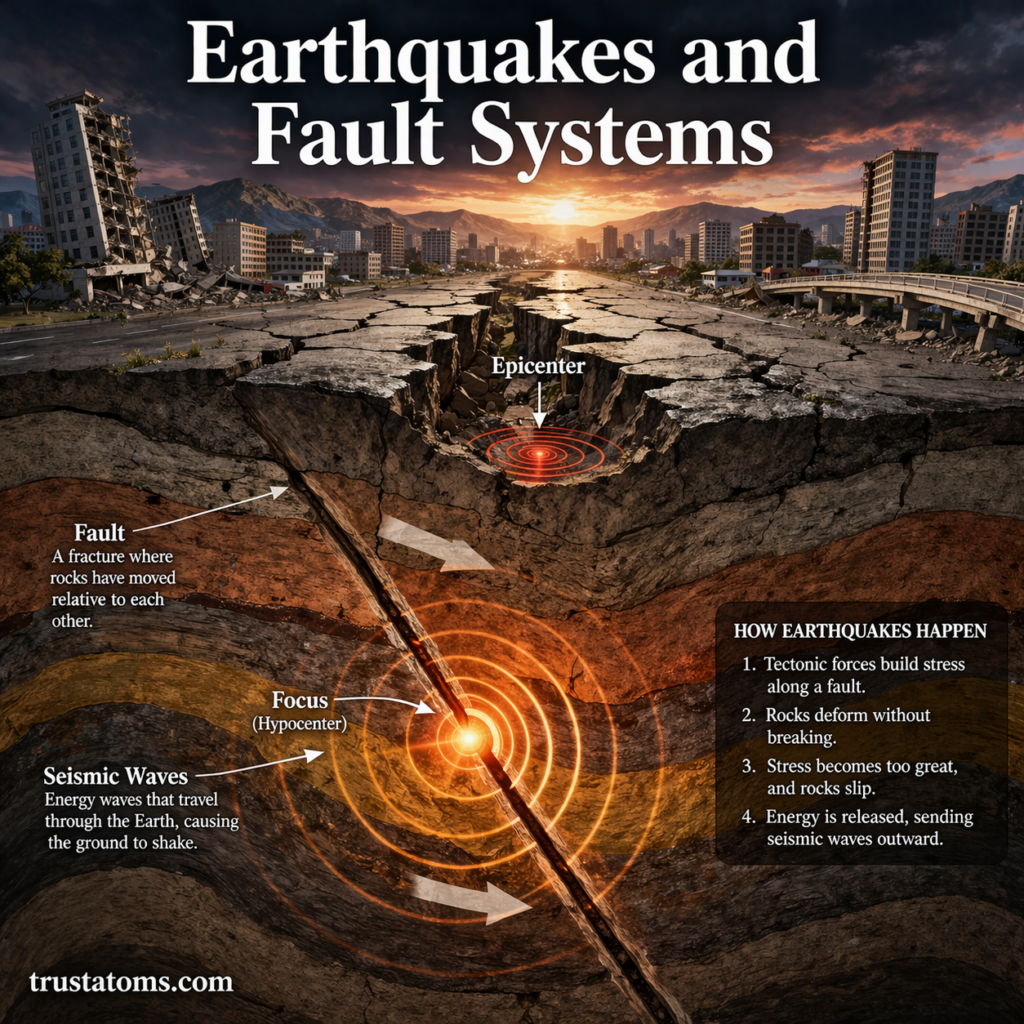
Spreading ridges are active geological environments. As plates separate, rocks fracture and magma moves through the crust, producing shallow earthquakes and volcanic eruptions.
Movement along plate boundaries causes seismic activity. At mid-ocean ridges, earthquakes are generally shallow, while transform faults connecting ridge segments accommodate sideways plate movement.
Seawater can also circulate through fractured, hot rock and emerge from hydrothermal vents. These vents release mineral-rich fluids and support ecosystems whose food webs begin with chemical energy rather than sunlight.
The Life Cycle of Oceanic Crust
Oceanic crust begins at a spreading ridge, cools as it moves away, and may eventually reach a subduction zone. As the underlying mantle lithosphere cools and thickens, the ocean floor becomes denser and generally subsides to greater depths.
Oceanic crust is typically thinner and denser than continental crust, a distinction explained in continental crust vs oceanic crust. These differences help explain why oceanic lithosphere can sink beneath another plate at convergent boundaries.
Not all newly formed oceanic crust is immediately recycled. Its eventual fate depends on plate movement and the location of subduction zones. Scientists use the ages and distribution of surviving oceanic rocks to reconstruct the opening and closing of past ocean basins.
Frequently Asked Questions
Does seafloor spreading make Earth bigger?
No. New crust forms at divergent boundaries, while older oceanic lithosphere is consumed at subduction zones. These processes redistribute Earth’s surface without causing continuous planetary expansion.
Why is the youngest oceanic crust near a mid-ocean ridge?
New rock forms as magma cools at the ridge axis. Continued plate separation moves earlier-formed crust outward, leaving the youngest rocks closest to the spreading center.
Can seafloor spreading create a new ocean?
Yes. If continental rifting progresses until the landmass separates and oceanic crust begins forming between the fragments, a new ocean basin can develop. The Atlantic Ocean is an example of an ocean basin that expanded through sustained seafloor spreading.
Seafloor spreading explains how new oceanic crust forms while tectonic plates move apart. Matching magnetic stripes, increasing crust ages, and measured plate movements provide evidence for this process, while differences between fast and slow ridges reveal how spreading shapes the ocean floor.
Sources: U.S. Geological Survey, This Dynamic Earth: The Story of Plate Tectonics; National Oceanic and Atmospheric Administration, Ocean Exploration educational resources; OpenStax, Physical Geology.