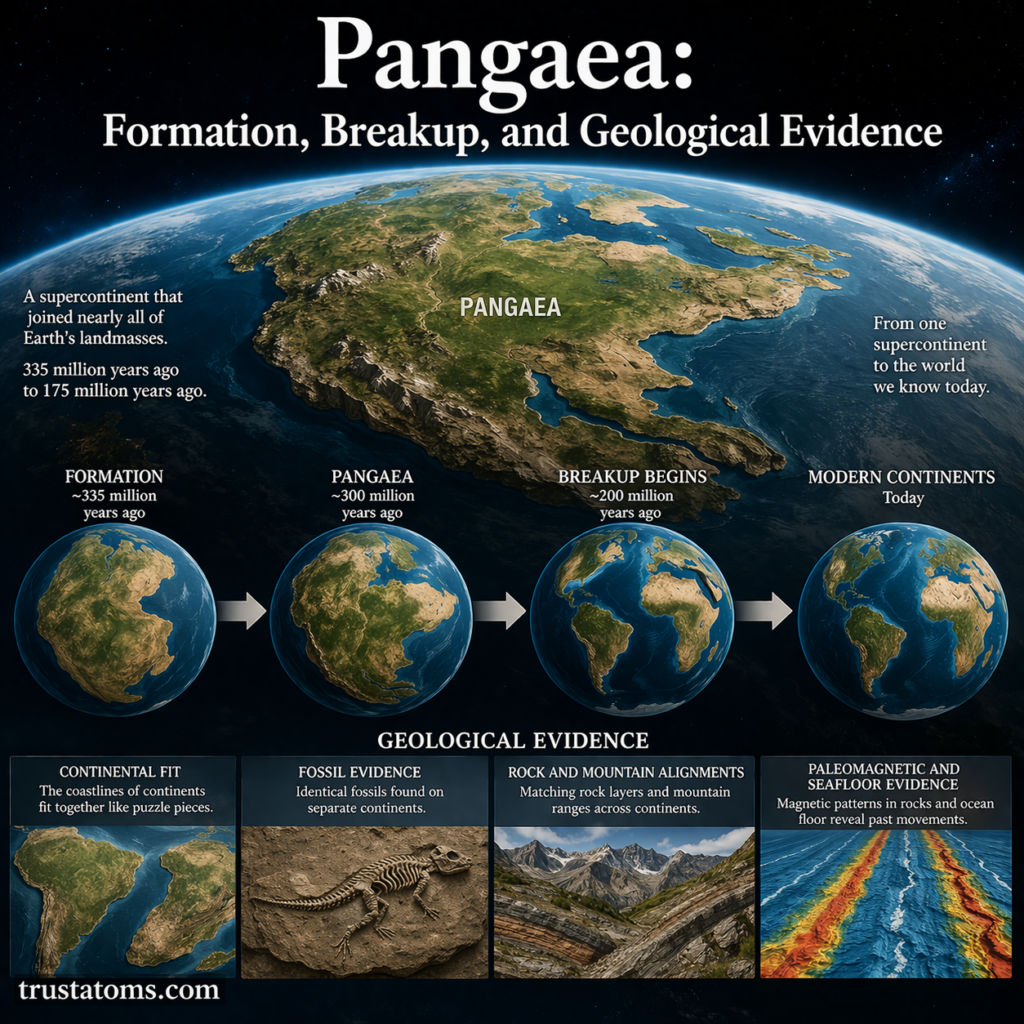
Pangaea was a massive supercontinent that existed hundreds of millions of years ago, bringing together nearly all of Earth’s landmasses into one connected body. Its formation and eventual breakup played a major role in shaping today’s continents, oceans, and ecosystems.
Understanding Pangaea helps explain how Earth’s surface evolved—and why continents appear the way they do today.
What Was Pangaea?
Pangaea (meaning “all Earth”) was a supercontinent that formed during the late Paleozoic Era and began breaking apart in the early Mesozoic Era.
Key Facts About Pangaea
- Formed around 335 million years ago
- Began breaking apart about 175 million years ago
- Surrounded by a vast ocean called Panthalassa
- Included nearly all modern continents
Pangaea represents one of the most important stages in Earth’s geological history.
How Did Pangaea Form?
Pangaea formed through the gradual movement and collision of tectonic plates over millions of years.
The Formation Process
- Continental Drift
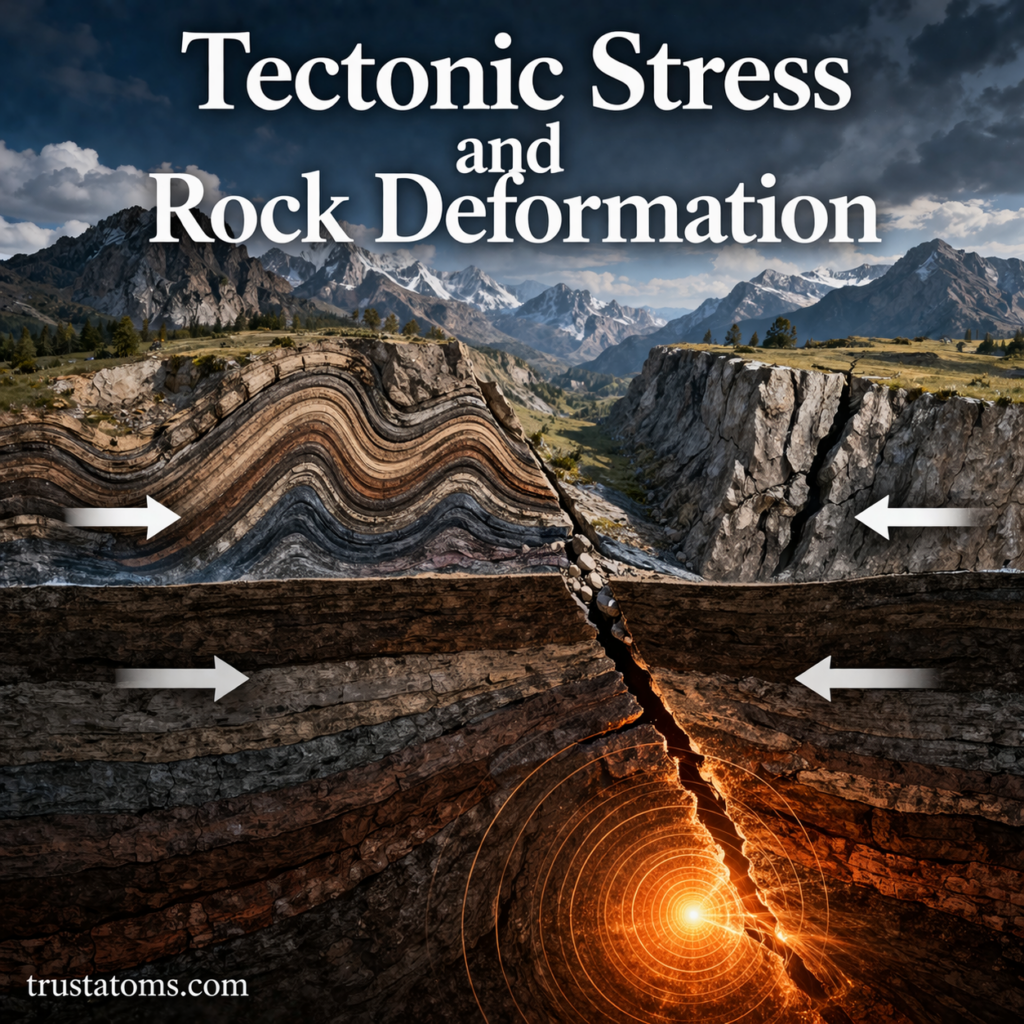
Continents slowly moved across Earth’s surface due to plate tectonics. - Plate Convergence
Plates collided, compressing the crust and forming mountain ranges. - Continental Assembly
Smaller landmasses merged into larger ones, eventually forming a single supercontinent.
Major Collisions
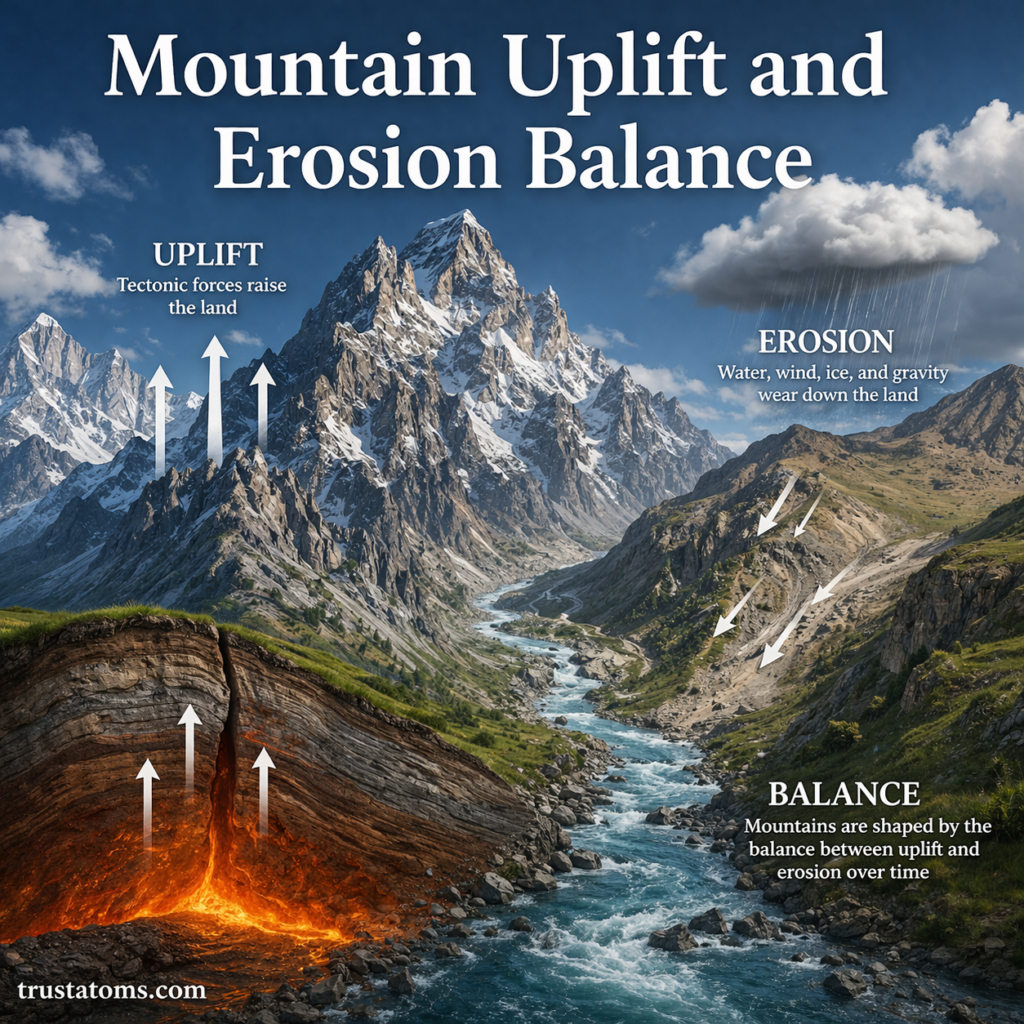
- The collision of North America and Europe helped form the Appalachian Mountains
- Gondwana (southern continents) merged with Laurasia (northern continents)
These large-scale collisions were driven by forces deep within Earth’s mantle.
What Was Life Like on Pangaea?
Pangaea’s unique structure influenced both climate and life.
Climate Conditions
- Interior regions were dry due to distance from oceans
- Coastal areas experienced more moderate climates
- Seasonal temperature extremes were common inland
Impact on Life
- Animals and plants could migrate freely across vast areas
- Early reptiles and plants spread widely
- Ecosystems were less isolated compared to today
This connected landmass allowed species to expand across regions that are now separated by oceans.
Why Did Pangaea Break Apart?
Pangaea did not remain intact. Internal Earth processes eventually caused it to split.
Causes of Breakup
- Heat buildup beneath the supercontinent
- Rising mantle material weakened the crust
- Formation of rift zones (cracks in the crust)
- Development of new ocean basins
The Breakup Process
- Rifting Begins
Cracks formed within Pangaea due to internal pressure. - Continental Separation
Landmasses began drifting apart. - Ocean Formation
New oceans formed between separating continents. - Continued Drift
Continents moved into their current positions over millions of years.
From Pangaea to Modern Continents
After Pangaea began to break apart, it split into two major landmasses:
Laurasia
- Included North America, Europe, and Asia
- Located in the northern hemisphere
Gondwana
- Included South America, Africa, Antarctica, Australia, and India
- Located in the southern hemisphere
Over time, these landmasses continued to fragment and shift into today’s continental arrangement.
Geological Evidence for Pangaea
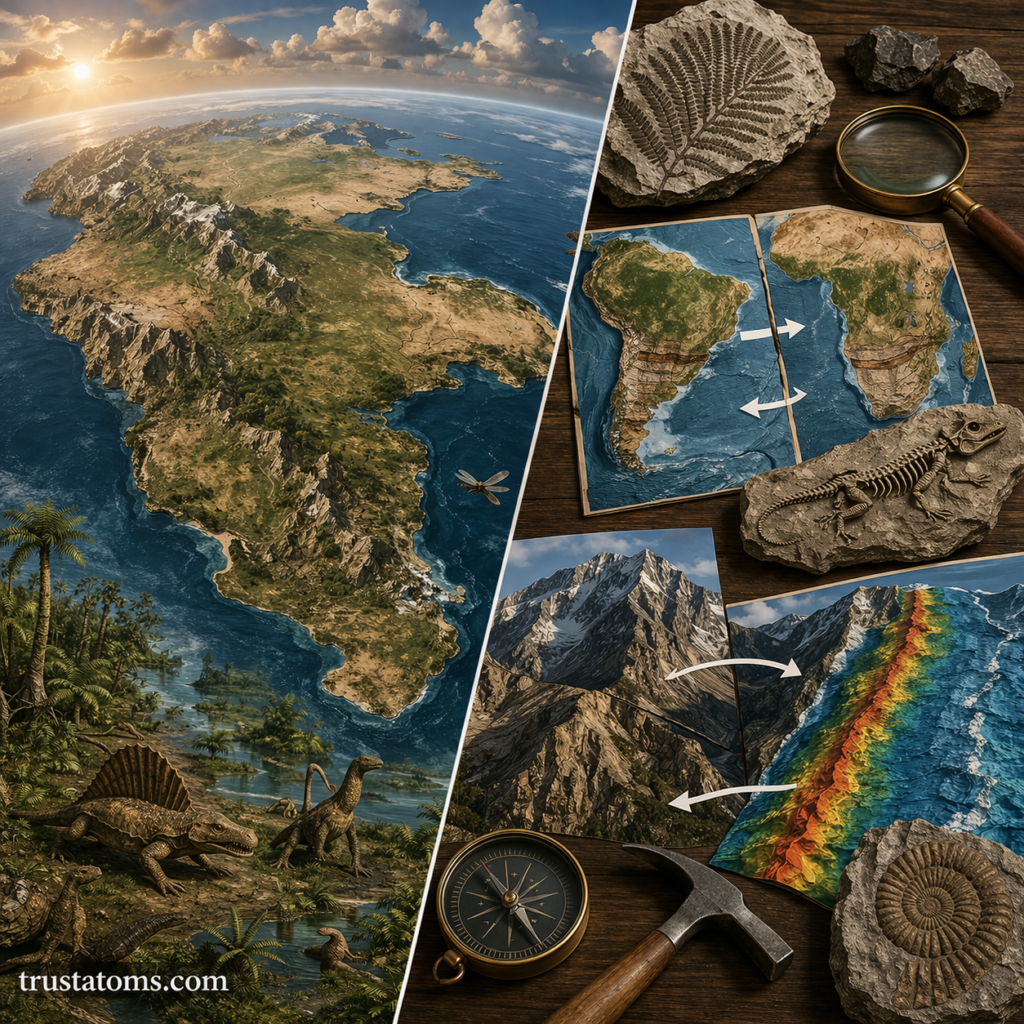
Scientists have gathered strong evidence supporting the existence of Pangaea.
Continental Fit
- Coastlines of continents like South America and Africa fit together like puzzle pieces
Fossil Evidence
- Identical fossils found on widely separated continents
- Example: Mesosaurus fossils in both South America and Africa
Rock and Mountain Alignments
- Matching rock layers across continents
- Mountain ranges that continue across now-separated landmasses
Paleomagnetism
- Magnetic signatures in rocks reveal past positions of continents
- Confirms movement over time
Seafloor Spreading
- New ocean crust forms at mid-ocean ridges
- Magnetic patterns show continents moving apart
Why Pangaea Matters Today
Studying Pangaea provides important insights into Earth’s processes.
Geological Understanding
- Explains the formation of mountain ranges
- Helps identify past tectonic activity
Climate Insights
- Reveals how continent positioning affects climate patterns
Evolutionary Connections
- Explains similarities in fossils across continents
- Shows how species spread and evolved
Natural Hazard Awareness
- Helps scientists understand earthquake and volcanic zones
Key Takeaways
- Pangaea was a supercontinent that existed from about 335 to 175 million years ago
- It formed through tectonic plate collisions and continental drift
- Its breakup was caused by internal Earth processes like mantle convection
- Evidence includes fossil records, rock formations, and magnetic data
- Pangaea’s history explains modern continental positions and geological patterns
Final Thoughts
Pangaea is one of the most powerful examples of Earth’s dynamic nature. What now appears as separate continents was once a single, connected landmass shaped by deep geological forces.
By studying its formation and breakup, scientists gain a clearer understanding of how Earth has evolved—and how it will continue to change in the future.