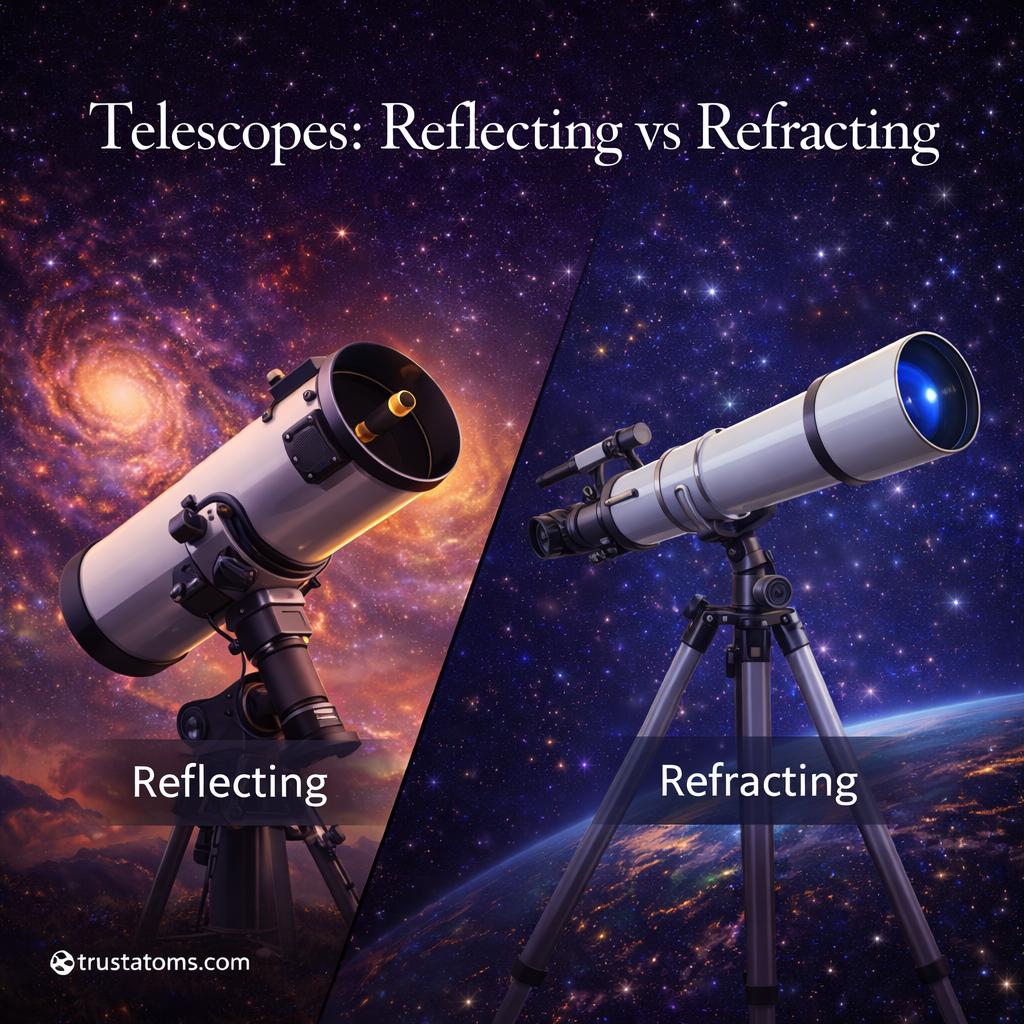
Telescopes have transformed how we explore the universe, allowing us to observe distant planets, stars, and galaxies. But not all telescopes are built the same. The two main types—reflecting and refracting telescopes—use different methods to gather and focus light.
Understanding how each works will help you choose the right telescope and better appreciate how astronomers study space.
What Is a Telescope?
A telescope is an optical instrument designed to collect and magnify light from distant objects.
Main purpose:
- Gather more light than the human eye
- Focus that light to form a clear image
- Magnify distant objects for observation
There are two primary designs:
- Refracting telescopes (use lenses)
- Reflecting telescopes (use mirrors)
Refracting Telescopes
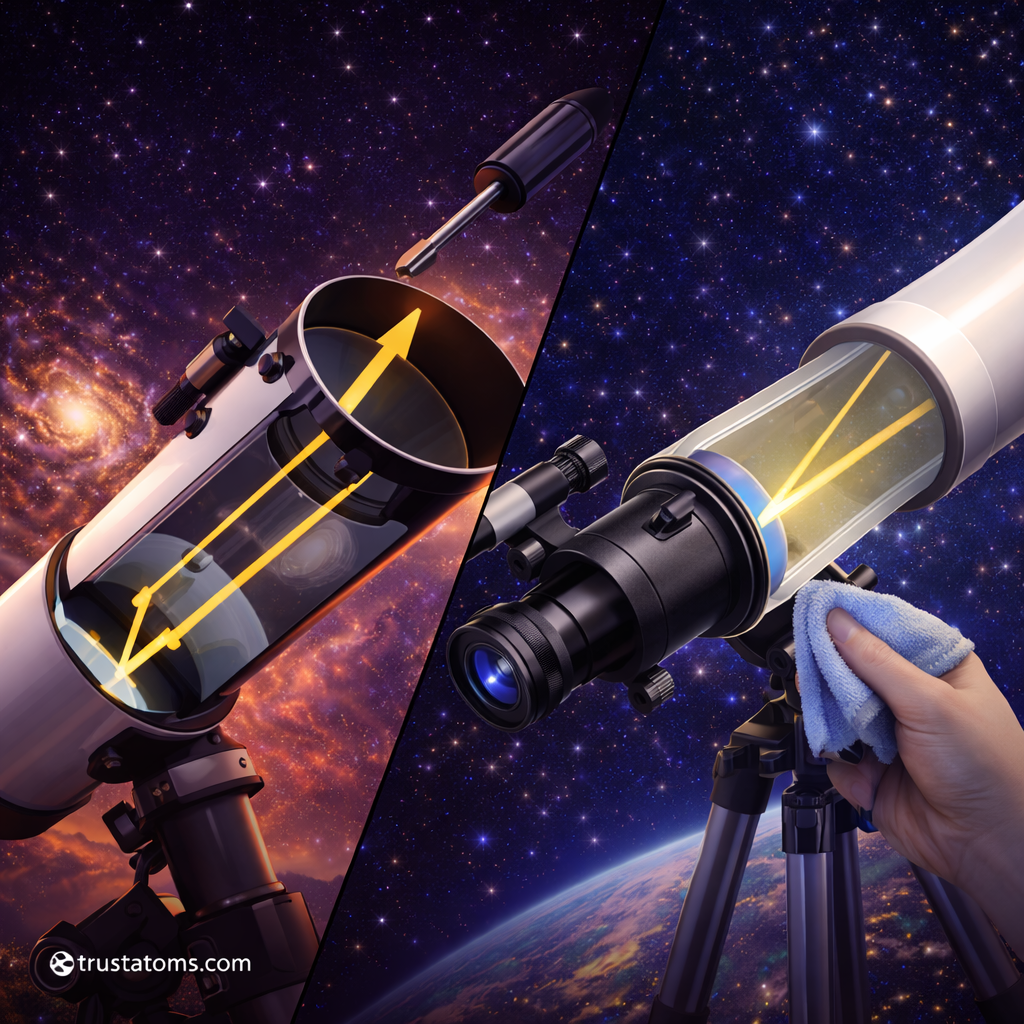
Refracting telescopes use lenses to bend (refract) light and bring it into focus.
How They Work:
- Light enters through a large front lens (objective lens)
- The lens bends the light toward a focal point
- An eyepiece magnifies the image
Key Features:
- Long, narrow tube design
- Sealed system (low maintenance)
- Typically lightweight and portable
Advantages of Refracting Telescopes
- Sharp, high-contrast images
- Excellent for viewing planets and the Moon
- Minimal maintenance (no mirror alignment needed)
- Durable and stable design
Disadvantages of Refracting Telescopes
- More expensive for larger sizes
- Can suffer from chromatic aberration (color distortion)
- Heavier lenses become harder to manufacture at large scales
Reflecting Telescopes
Reflecting telescopes use mirrors instead of lenses to gather and focus light.
How They Work:
- Light enters the telescope and hits a curved primary mirror
- The mirror reflects light to a focal point
- A secondary mirror redirects the light to the eyepiece
Key Features:
- Shorter and wider tube design
- Uses mirrors instead of glass lenses
- Common in both amateur and professional astronomy
Advantages of Reflecting Telescopes
- No chromatic aberration
- More affordable for large apertures
- Better for observing faint, deep-sky objects
- Widely used in modern astronomy
Disadvantages of Reflecting Telescopes
- Requires regular alignment (collimation)
- Open design can collect dust
- Slightly more maintenance than refractors
Reflecting vs Refracting: Key Differences
Light Handling
- Refractors: Bend light using lenses
- Reflectors: Reflect light using mirrors
Image Quality
- Refractors: High contrast, ideal for planets
- Reflectors: Better for faint objects like galaxies
Cost
- Refractors: More expensive at larger sizes
- Reflectors: More cost-effective for big telescopes
Maintenance
- Refractors: Low maintenance
- Reflectors: Requires occasional adjustments
Which Telescope Should You Choose?
The best telescope depends on your goals and experience level.
Choose a Refracting Telescope If You:
- Want clear views of planets and the Moon
- Prefer low maintenance
- Are a beginner looking for simplicity
Choose a Reflecting Telescope If You:
- Want to observe galaxies and nebulae
- Need a larger aperture at a lower cost
- Don’t mind occasional maintenance
Real-World Use in Astronomy
Professional astronomers primarily use reflecting telescopes.
Why?
- Mirrors can be made much larger than lenses
- Large mirrors collect more light
- Essential for observing distant and faint objects
Some of the world’s largest telescopes, including space-based observatories, use mirror-based designs.
Common Mistakes to Avoid
When choosing or using a telescope, avoid these common errors:
- Focusing only on magnification instead of aperture
- Assuming more expensive always means better
- Ignoring maintenance needs of reflectors
- Choosing the wrong type for your viewing goals
Understanding your needs is more important than picking the “most powerful” option.
Final Thoughts
Both reflecting and refracting telescopes play an important role in astronomy. Each has strengths that make it ideal for specific types of observations.
Key takeaway:
- Refractors = clarity and simplicity
- Reflectors = power and versatility
By understanding the differences, you can make better decisions and enjoy a more rewarding stargazing experience.