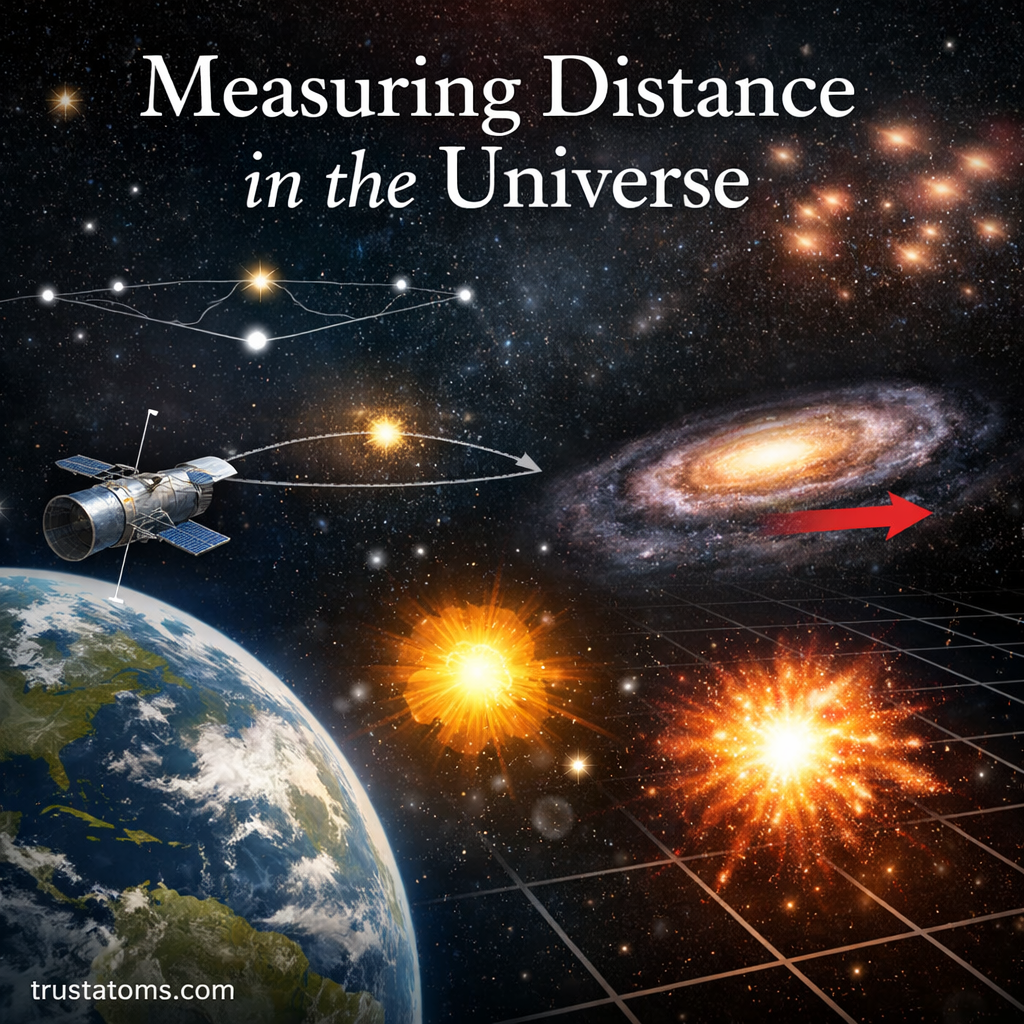
Understanding distance in the universe is one of the biggest challenges in astronomy. Unlike measuring distances on Earth, we can’t stretch a tape measure between stars or galaxies. Instead, scientists rely on a series of clever methods—often called the cosmic distance ladder—to estimate how far away objects are.
Each method works best for a specific range of distances, and together they allow astronomers to map the vast scale of the cosmos.
Why Measuring Cosmic Distance Is Difficult
Distances in space are unimaginably large. Even the nearest star system beyond our Sun is over 4 light-years away. Because of this, astronomers must rely on indirect measurements based on light, motion, and geometry.
Some key challenges include:
- No physical reference points like we have on Earth
- Light can be affected by dust, gravity, and expansion of space
- Objects are constantly moving
- The universe itself is expanding
To overcome these challenges, astronomers use multiple techniques that build on each other.
Units Used to Measure Distance in Space
Before diving into methods, it’s important to understand the units astronomers use:
Astronomical Unit (AU)
- The average distance between Earth and the Sun
- About 93 million miles (150 million kilometers)
- Used mainly within our solar system
Light-Year
- The distance light travels in one year
- About 5.88 trillion miles (9.46 trillion kilometers)
- Common for measuring distances between stars
Parsec
- Short for “parallax second”
- Equal to about 3.26 light-years
- Widely used in professional astronomy
The Cosmic Distance Ladder
Astronomers use different methods depending on how far away an object is. Each step in the “ladder” builds on the previous one.
Parallax: Measuring Nearby Stars
Parallax is the most direct and reliable method for measuring nearby stars.
How It Works
As Earth orbits the Sun, nearby stars appear to shift slightly against distant background stars. By measuring this tiny shift, astronomers can calculate distance using geometry.
Key Points
- Works best for stars within a few thousand light-years
- Highly accurate with modern space telescopes
- Foundation for other distance methods
Standard Candles: Measuring Brightness
For more distant objects, astronomers use standard candles—objects with known brightness.
The Idea
If you know how bright something truly is and compare it to how bright it appears from Earth, you can calculate its distance.
Common Standard Candles
Cepheid Variable Stars
- Stars that pulse in brightness at regular intervals
- The period of pulsation tells us their true brightness
- Useful for measuring distances to nearby galaxies
Type Ia Supernovae
- Exploding stars with nearly identical peak brightness
- Visible across vast distances
- Help measure distances between galaxies
Redshift: Measuring the Expanding Universe
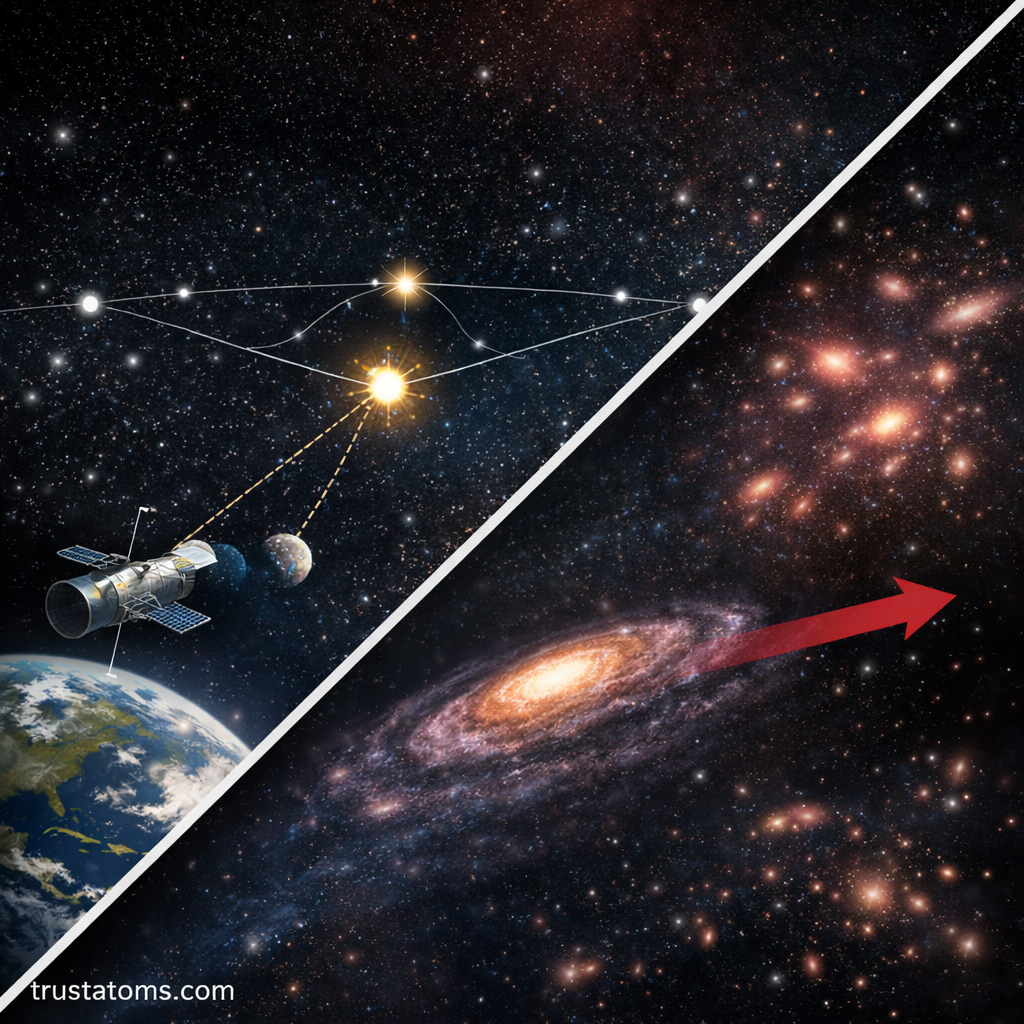
For extremely distant galaxies, astronomers rely on redshift.
What Is Redshift?
Light from distant galaxies is stretched to longer (redder) wavelengths as the universe expands.
What It Tells Us
- The greater the redshift, the farther away the galaxy
- Also indicates how fast the object is moving away from us
This method is essential for studying the large-scale structure of the universe.
Hubble’s Law and Cosmic Expansion
Redshift is closely tied to Hubble’s Law, which states that galaxies move away from us at speeds proportional to their distance.
Why It Matters
- Helps estimate distances to very far galaxies
- Provides evidence that the universe is expanding
- Supports modern cosmological models
Other Distance Measurement Techniques
Astronomers also use additional methods for specific situations:
Main Sequence Fitting
- Compares star clusters to known brightness patterns
- Useful for star groups within our galaxy
Tully-Fisher Relation
- Links a galaxy’s rotation speed to its brightness
- Helps estimate distances to spiral galaxies
Surface Brightness Fluctuations
- Measures variations in brightness across a galaxy
- Useful for relatively nearby galaxies
Why Accurate Distance Matters
Measuring distance isn’t just about mapping space—it’s critical for understanding how the universe works.
Accurate distances help scientists:
- Determine the size and age of the universe
- Study galaxy formation and evolution
- Measure the rate of cosmic expansion
- Understand dark energy and dark matter
Without reliable distance measurements, much of modern astronomy wouldn’t be possible.
Common Challenges and Sources of Error
Even with advanced methods, measuring cosmic distance isn’t perfect.
Some common issues include:
- Dust blocking or dimming light
- Variations in “standard” candle brightness
- Instrument limitations
- Uncertainty in calibration between methods
Astronomers constantly refine these techniques to improve accuracy.
The Future of Distance Measurement
New technologies are making distance measurements more precise than ever.
Advancements include:
- Space telescopes with higher resolution
- Improved parallax measurements for distant stars
- Better calibration of standard candles
- Large-scale surveys mapping billions of galaxies
These innovations will help answer some of the biggest questions in science, including the true expansion rate of the universe.
Final Thoughts
Measuring distance in the universe is a complex but fascinating challenge. From parallax to redshift, each method reveals a piece of the cosmic puzzle.
By combining these techniques, astronomers have built a detailed map of the universe—one that continues to grow as technology advances and our understanding deepens.