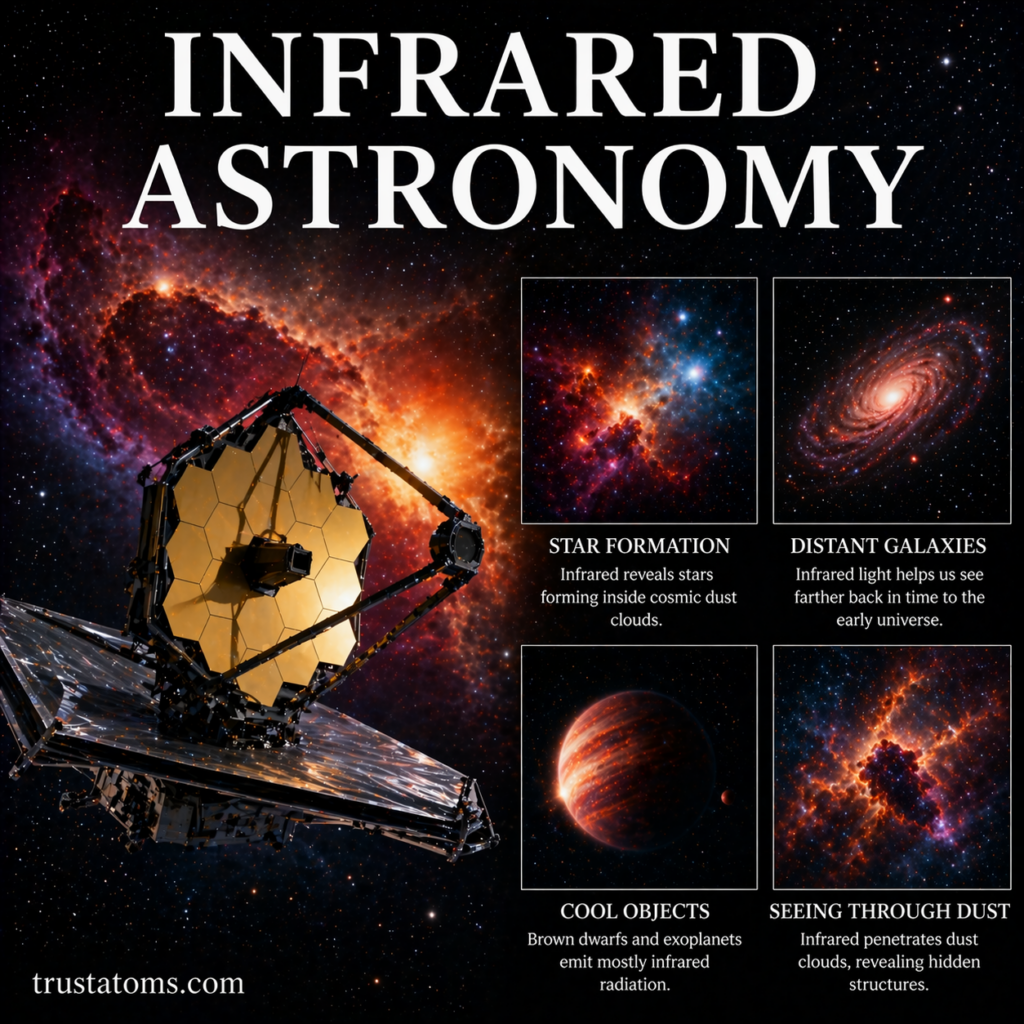
Infrared astronomy allows scientists to observe parts of the universe that are invisible to the human eye. By detecting heat rather than visible light, this method reveals hidden regions of space—such as star-forming clouds, distant galaxies, and cool celestial objects.
It has become one of the most powerful tools for exploring the universe, especially in areas where dust and gas block traditional observations.
What Is Infrared Astronomy?
Infrared astronomy is the study of celestial objects using infrared radiation, a type of electromagnetic energy with wavelengths longer than visible light.
Unlike visible light:
- Infrared radiation is associated with heat
- It can pass through dust clouds
- It reveals cooler objects not visible in optical light
This makes it ideal for observing regions that would otherwise remain hidden.
Why Infrared Observations Are Important
Many areas of space are obscured by dust and gas that block visible light.
Infrared astronomy allows scientists to:
- See through dense cosmic dust
- Detect newly forming stars
- Study distant galaxies
- Observe cool objects like brown dwarfs
Without infrared observations, large portions of the universe would remain unseen.
How Infrared Astronomy Works
Infrared telescopes detect heat emitted by objects rather than reflected light.
Basic process:
- Collection
- Telescopes gather infrared radiation
- Detection
- Specialized sensors convert heat signals into data
- Cooling systems
- Instruments are kept extremely cold to avoid interference from their own heat
- Data processing
- Signals are converted into images and measurements
Because everything emits some heat, detecting faint infrared signals requires highly sensitive equipment.
Challenges of Infrared Astronomy
Infrared observations face unique difficulties.
Major challenges include:
- Earth’s atmosphere absorbs much infrared radiation
- Heat from the telescope itself can interfere with readings
- Water vapor in the air reduces signal clarity
To overcome these issues, astronomers use:
- High-altitude observatories
- Dry, remote locations
- Space-based telescopes
Space-Based Infrared Telescopes
Many of the most important infrared observations come from space.
Examples include:
- James Webb Space Telescope
- Spitzer Space Telescope
These telescopes operate above Earth’s atmosphere, allowing them to capture clearer infrared signals.
What Infrared Astronomy Reveals
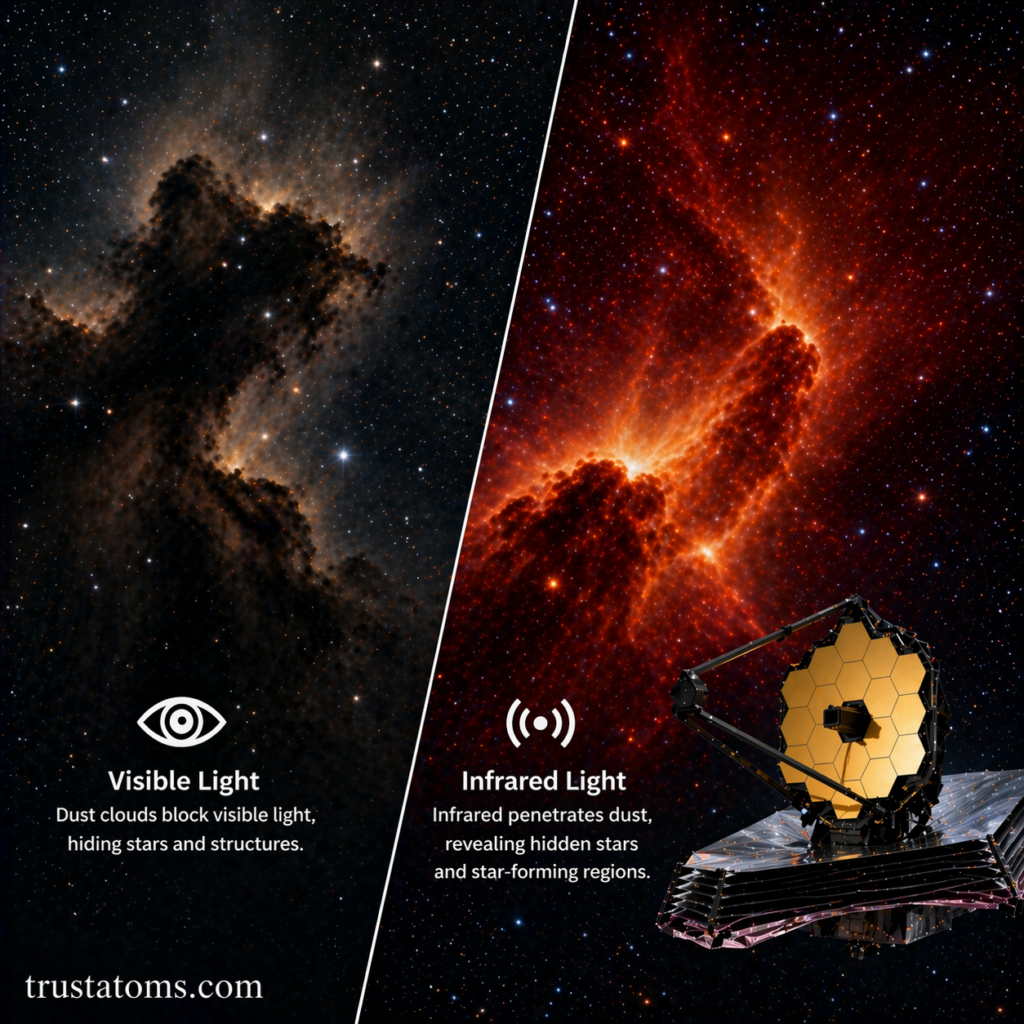
Infrared imaging uncovers details that cannot be seen with visible light.
Star Formation
- Stars form inside dense clouds of gas and dust
- Infrared can penetrate these clouds
- Reveals early stages of stellar development
Distant Galaxies
- Light from distant galaxies is stretched into infrared wavelengths
- Allows astronomers to study the early universe
Cool Objects
- Brown dwarfs and planets emit mostly infrared radiation
- Often invisible in optical observations
Galactic Structure
- Helps map the structure of the Milky Way
- Reveals stars hidden behind dust clouds
Infrared vs Visible Light Astronomy
Understanding the difference highlights why infrared is so valuable.
Visible Light Astronomy:
- Shows bright, hot objects
- Blocked by dust
- Limited view of hidden regions
Infrared Astronomy:
- Detects heat and cooler objects
- Penetrates dust clouds
- Reveals hidden structures
Both methods are complementary and often used together.
Everyday Example of Infrared Detection
Infrared technology isn’t limited to space.
Examples include:
- Night vision cameras
- Thermal imaging devices
- Remote controls
These everyday tools use the same basic principle—detecting heat instead of visible light.
The Future of Infrared Astronomy
Infrared astronomy continues to evolve with new technologies.
Future advancements include:
- More sensitive detectors
- Larger space telescopes
- Improved cooling systems
- Deeper observations into early cosmic history
These developments will help scientists:
- Study the first galaxies
- Understand star and planet formation
- Search for habitable worlds
Final Thoughts
Infrared astronomy opens a window into the hidden universe. By detecting heat instead of visible light, it reveals structures and objects that would otherwise remain invisible.
From star-forming regions to the earliest galaxies, infrared observations continue to expand our understanding of the cosmos and uncover the universe’s most elusive secrets.