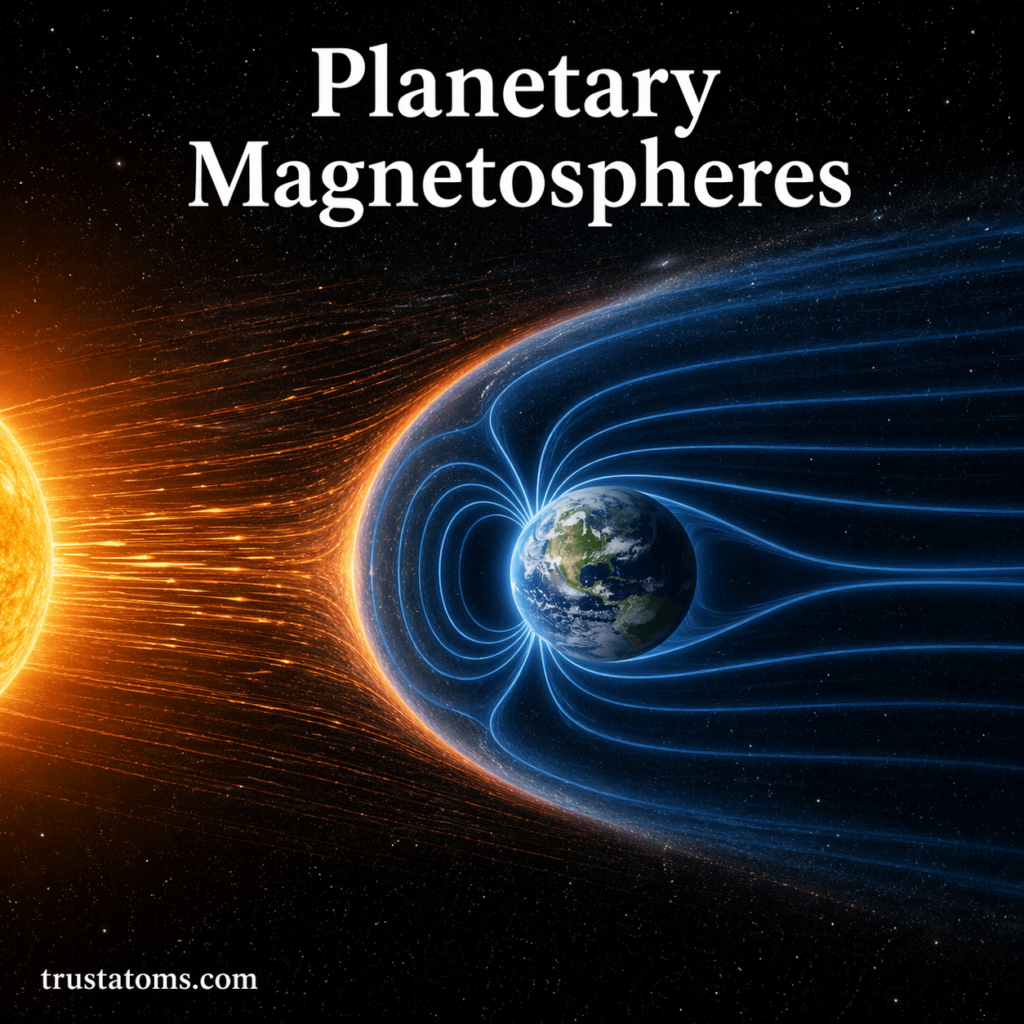
Planetary magnetospheres are one of the most important yet invisible features of planets. These vast magnetic “bubbles” surround certain planets, protecting them from harmful solar radiation and shaping their space environments.
From the powerful magnetic field of Jupiter to the nearly absent one on Mars, magnetospheres play a major role in determining whether a planet can hold an atmosphere—and potentially support life.
What Is a Magnetosphere?
A magnetosphere is a region of space around a planet where the planet’s magnetic field dominates over the solar wind.
The solar wind is a constant stream of charged particles flowing outward from the Sun. Without protection, this radiation can strip away atmospheres and damage planetary surfaces.
A magnetosphere acts like a shield by:
- Deflecting charged particles
- Trapping radiation in specific regions
- Reducing atmospheric loss over time
How Magnetospheres Form
Magnetospheres are created by a process called the dynamo effect.
Key Requirements
For a planet to have a strong magnetosphere, it typically needs:
- A rotating core
- Electrically conductive material (like molten iron)
- Internal heat to keep the core active
As the molten core moves and rotates, it generates electric currents, which in turn create a magnetic field.
Structure of a Magnetosphere
Magnetospheres are not perfect spheres. They are shaped by the solar wind.
Main Regions
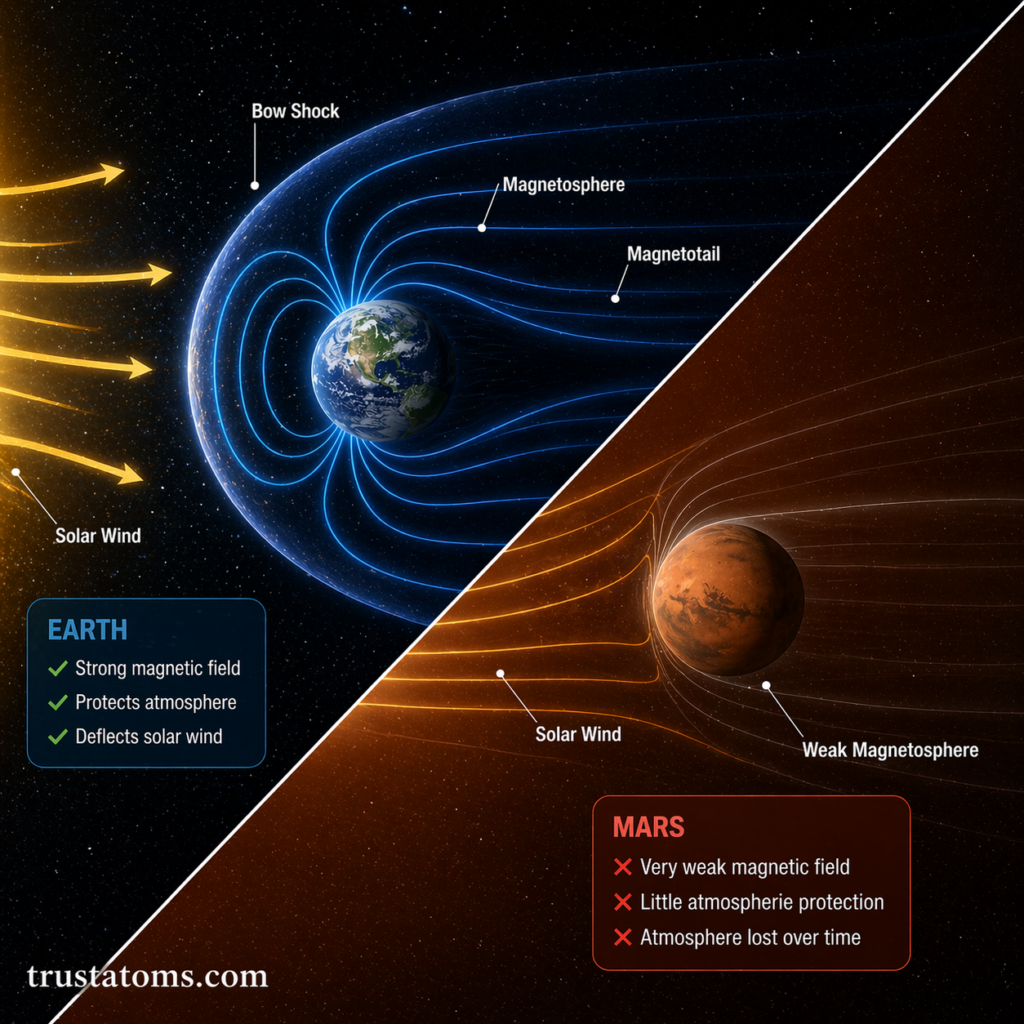
- Bow Shock
The outer boundary where the solar wind first slows down - Magnetopause
The boundary where solar wind pressure balances the planet’s magnetic field - Magnetotail
A long extension stretching away from the Sun - Radiation Belts
Zones where charged particles are trapped (like Earth’s Van Allen belts)
Magnetospheres in the Solar System
Not all planets have magnetospheres, and their strength varies greatly.
Strong Magnetospheres
- Earth
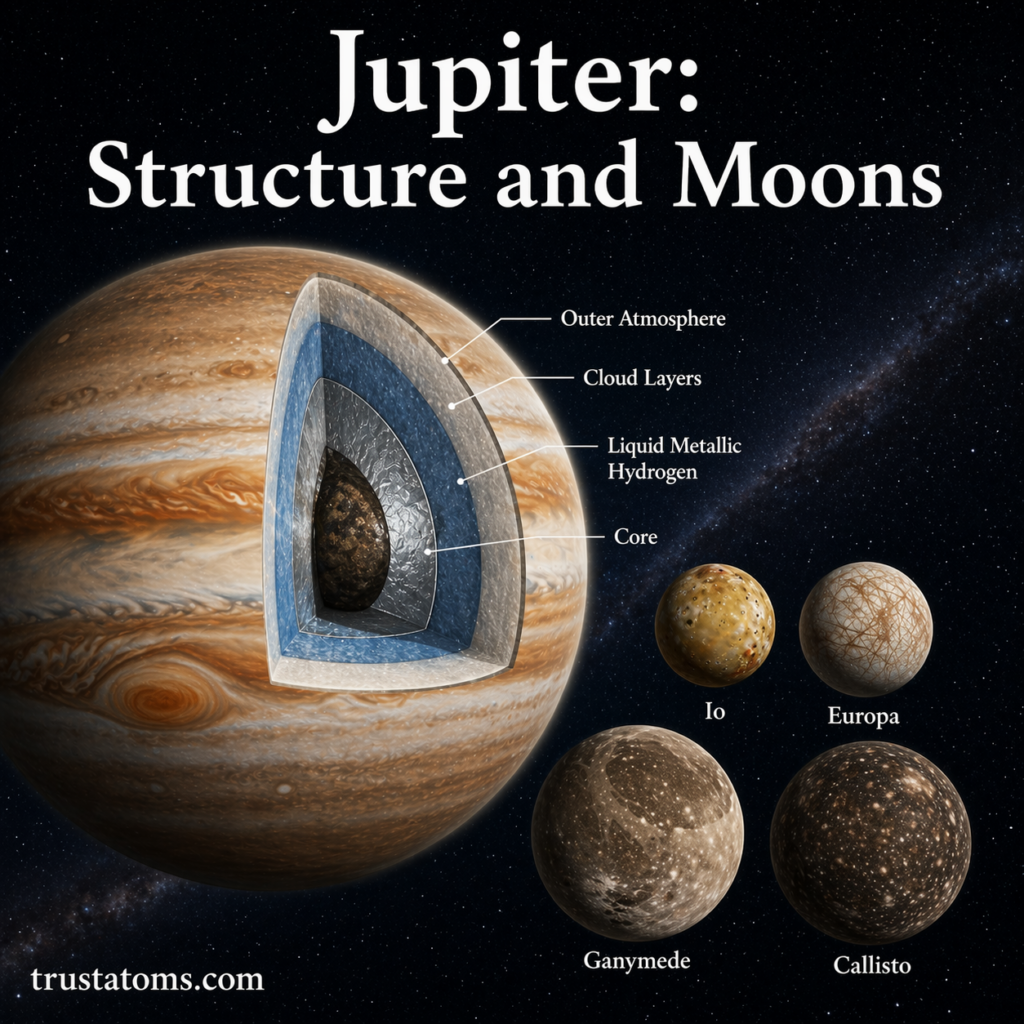
Protects the atmosphere and enables life to thrive - Jupiter
The largest and most powerful magnetosphere in the solar system - Saturn
Strong but less intense than Jupiter’s
Weak or Partial Magnetospheres
- Mercury
Has a weak magnetic field due to its small size - Uranus and Neptune
Have unusual, tilted magnetic fields
No Global Magnetosphere
- Mars
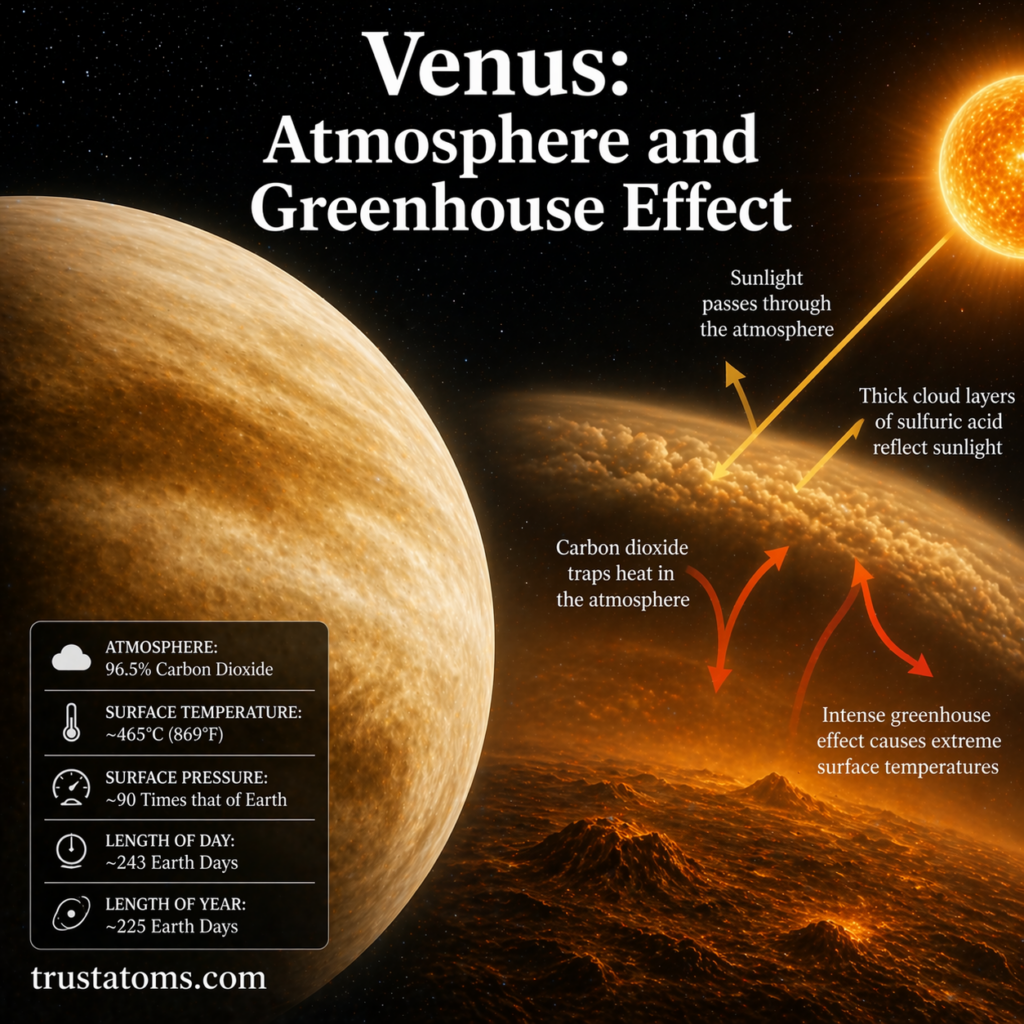
Lost most of its magnetic field long ago, leading to atmospheric loss - Venus
No intrinsic magnetic field, but has an induced magnetosphere from solar wind interaction
Why Magnetospheres Matter
Magnetospheres are critical for planetary evolution and habitability.
Atmospheric Protection
Without a magnetosphere, solar wind can gradually strip away a planet’s atmosphere. This is believed to have happened on Mars.
Radiation Shielding
Magnetospheres reduce the amount of harmful radiation reaching the surface, which is important for:
- Biological processes
- Long-term climate stability
- Human exploration safety
Space Weather Effects
Magnetospheres interact with solar storms, causing:
- Auroras (northern and southern lights)
- Satellite disruptions
- Power grid issues (on Earth)
Earth’s Magnetosphere as a Case Study
Earth’s magnetosphere is one of the most studied and important examples.
Key Features
- Extends tens of thousands of kilometers into space
- Constantly reshaped by solar activity
- Generates auroras near the poles
Why It Matters
Earth’s magnetosphere:
- Prevents rapid atmospheric loss
- Protects living organisms from radiation
- Supports modern technology by moderating space weather effects
What Happens Without a Magnetosphere?
Planets without strong magnetospheres face significant challenges.
Consequences
- Atmospheric erosion over billions of years
- Increased surface radiation
- Reduced chances of supporting life
Mars is a prime example. Evidence suggests it once had a thicker atmosphere and liquid water, but lost much of both after its magnetic field weakened.
Magnetospheres and the Search for Life
Magnetospheres are an important factor when scientists search for habitable exoplanets.
Key Considerations
- Planets with strong magnetic fields are more likely to retain atmospheres
- Protection from stellar radiation improves habitability
- Magnetic activity may indicate an active interior
While not the only requirement for life, a magnetosphere significantly increases the chances of long-term stability.
Future Research and Exploration
Scientists continue to study magnetospheres using spacecraft and simulations.
Ongoing Missions and Goals
- Measuring magnetic fields of distant planets
- Understanding solar wind interactions
- Exploring how magnetospheres evolve over time
These studies help us better understand both our own planet and others across the universe.
Final Thoughts
Planetary magnetospheres are invisible but powerful forces that shape the destiny of planets. They influence atmosphere retention, surface conditions, and even the possibility of life.
By studying magnetospheres, scientists gain insight into how planets form, evolve, and survive in the harsh environment of space.