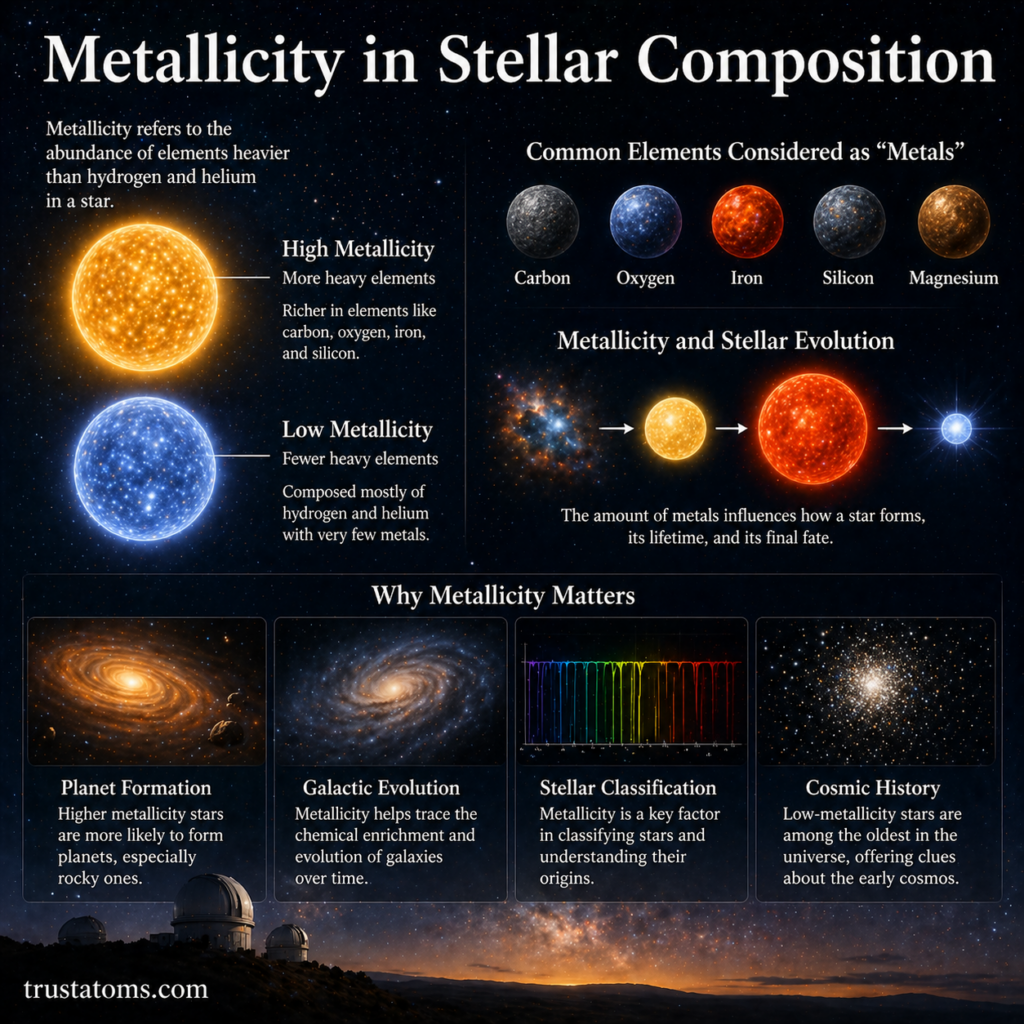
In astronomy, the term metallicity has a very different meaning than it does in everyday language. While metals on Earth refer to elements like iron or copper, astronomers define “metals” as all elements heavier than hydrogen and helium.
Understanding metallicity is essential for studying how stars form, evolve, and contribute to the chemical history of the universe.
What Is Metallicity?
Metallicity describes the proportion of a star’s mass made up of elements heavier than hydrogen and helium.
Key Points
- Hydrogen and helium make up most of a star
- All other elements (carbon, oxygen, iron, etc.) are considered “metals”
- Metallicity indicates how chemically enriched a star is
Astronomers often compare a star’s metallicity to that of the Sun.
How Metallicity Is Measured
Metallicity is typically expressed using a logarithmic scale based on iron content.
Common Notation
- [Fe/H] represents the ratio of iron to hydrogen compared to the Sun
- A value of 0 means the same metallicity as the Sun
- Negative values mean fewer heavy elements
- Positive values mean more heavy elements
Examples
- [Fe/H] = -1 → 10 times less iron than the Sun
- [Fe/H] = +1 → 10 times more iron than the Sun
This system helps astronomers compare stars across different regions and ages.
Why Metallicity Matters
Metallicity plays a major role in how stars behave and evolve.
Key Impacts
- Influences star formation processes
- Affects temperature and color
- Impacts stellar lifespan
- Determines likelihood of planet formation
Stars with higher metallicity are more likely to host planets, especially rocky ones.
Population Types of Stars
Stars are often grouped into populations based on their metallicity.
Population I Stars
- High metallicity
- Younger stars
- Found in the galactic disk
- Often contain planetary systems
Example: The Sun
Population II Stars
- Low metallicity
- Older stars
- Found in the galactic halo and globular clusters
These stars formed earlier in the universe when fewer heavy elements existed.
Population III Stars (Theoretical)
- Extremely low or zero metallicity
- First generation of stars
- Formed from primordial hydrogen and helium
These stars have not yet been directly observed but are important in cosmological models.
Metallicity and Stellar Evolution
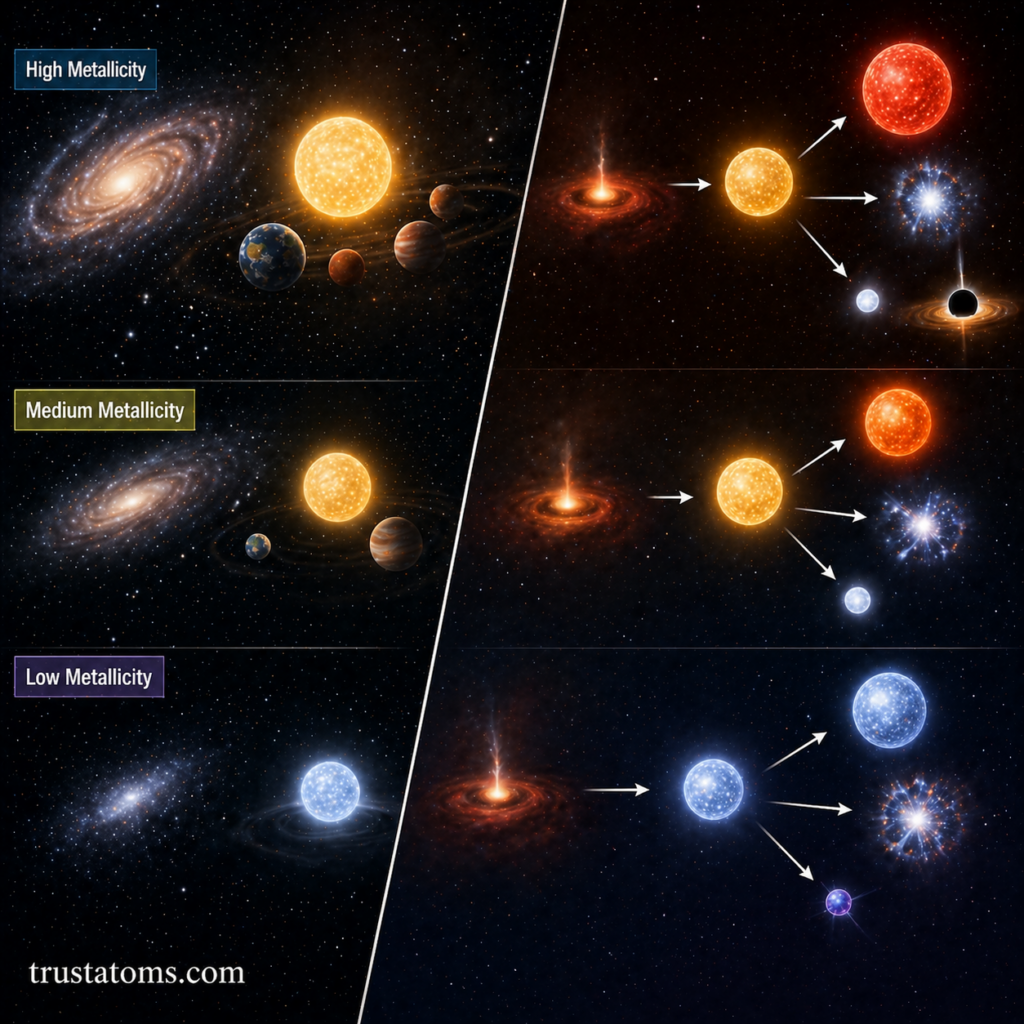
The amount of heavy elements in a star affects its entire life cycle.
High Metallicity Stars
- Cooler outer layers
- More efficient radiation absorption
- Greater likelihood of forming complex systems
Low Metallicity Stars
- Hotter and more compact
- Burn fuel differently
- Often found in older regions of the galaxy
Metallicity influences how stars age and what they become at the end of their lives.
Metallicity and Planet Formation
Metallicity is closely linked to the formation of planets.
Why It Matters
- Heavy elements are needed to build solid planetary cores
- Higher metallicity increases chances of forming rocky planets
- Gas giants also form more easily in metal-rich environments
This is why many known exoplanet systems are found around stars with higher metallicity.
The Chemical Evolution of the Universe
Metallicity also tells the story of how the universe has changed over time.
How Elements Are Created
- Stars fuse hydrogen into helium
- Heavier elements form in later stages of stellar evolution
- Supernova explosions spread these elements into space
- New stars form from enriched material
Each generation of stars increases the metallicity of the universe.
Metallicity in the Milky Way
Different regions of our galaxy have different metallicity levels.
Galactic Trends
- Galactic center: higher metallicity
- Galactic disk: moderate metallicity
- Galactic halo: low metallicity
This variation helps astronomers map the history and structure of the Milky Way.
Observing Metallicity
Astronomers determine metallicity by analyzing a star’s light.
Methods
- Spectroscopy reveals absorption lines of different elements
- The strength of these lines indicates abundance
- Advanced telescopes provide precise chemical data
This allows scientists to study stars even at great distances.
Final Thoughts
Metallicity is a key concept in understanding stars and the evolution of the universe. By examining the chemical composition of stars, astronomers can trace cosmic history, predict stellar behavior, and even assess the likelihood of planetary systems.
From the earliest stars made of pure hydrogen and helium to modern stars rich in heavy elements, metallicity connects the past, present, and future of the cosmos.