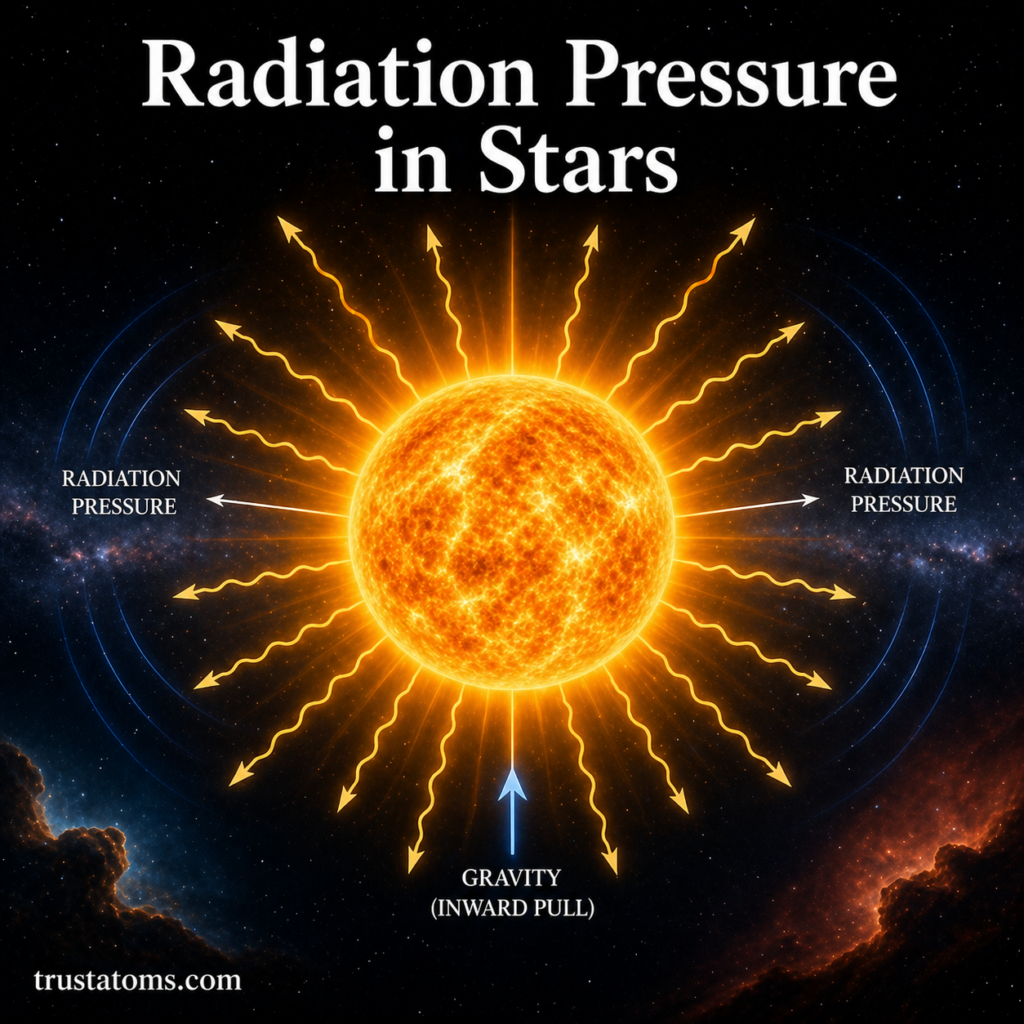
Stars shine because of powerful processes happening deep within their cores. While gravity constantly pulls matter inward, another force pushes outward—radiation pressure. This balance between inward gravity and outward pressure is what keeps stars stable for millions or even billions of years.
Radiation pressure plays a crucial role in how stars form, evolve, and eventually die. In the most massive stars, it can even dominate over gravity and shape their ultimate fate.
What Is Radiation Pressure?
Radiation pressure is the force exerted by light (photons) when it interacts with matter. Even though photons have no mass, they carry momentum. When they collide with particles, they transfer energy and push outward.
Key points about radiation pressure:
- Produced by photons emitted during nuclear fusion
- Acts outward from the star’s core
- Opposes the inward pull of gravity
- Stronger in hotter and more luminous stars
Inside a star, trillions of photons are constantly being generated and scattered, creating a steady outward push.
The Balance Between Gravity and Pressure
Stars exist in a state called hydrostatic equilibrium, where two main forces balance each other:
Inward force:
- Gravity pulling gas toward the center
Outward forces:
- Gas pressure from hot plasma
- Radiation pressure from photons
This balance determines a star’s size, temperature, and stability. If radiation pressure becomes too strong, the star can expand. If gravity dominates, the star can contract.
How Radiation Pressure Is Generated
Radiation pressure originates in the core of a star, where nuclear fusion takes place.
In stars like the Sun, hydrogen atoms fuse into helium, releasing enormous amounts of energy in the form of photons.
The process step-by-step:
- Nuclear fusion releases high-energy photons
- Photons scatter through dense stellar material
- Each interaction transfers momentum outward
- This creates a continuous outward force
Although photons take thousands to millions of years to reach the surface, their cumulative effect sustains radiation pressure throughout the star.
Radiation Pressure in Different Types of Stars
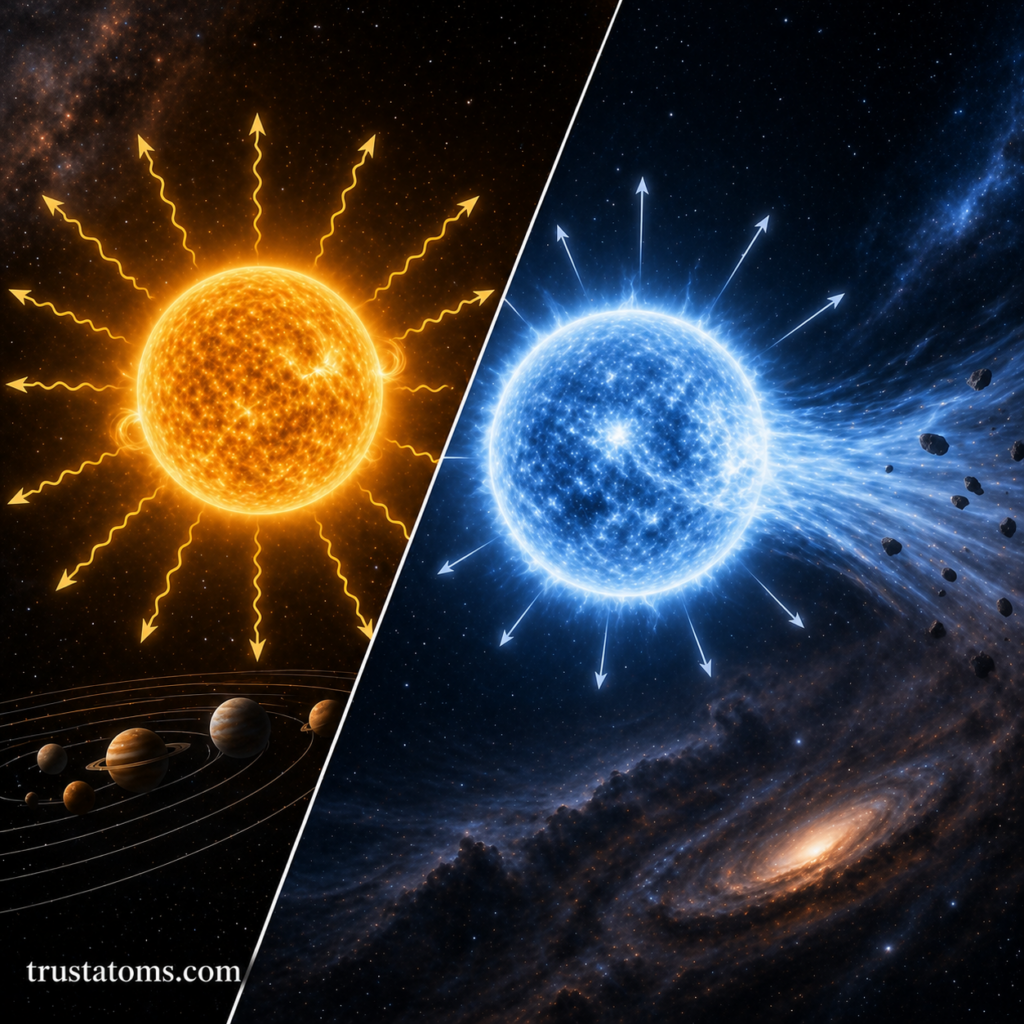
Radiation pressure doesn’t affect all stars equally. Its importance depends largely on a star’s mass and luminosity.
Low-mass stars (like the Sun):
- Gas pressure dominates
- Radiation pressure plays a smaller role
- Stable and long-lived
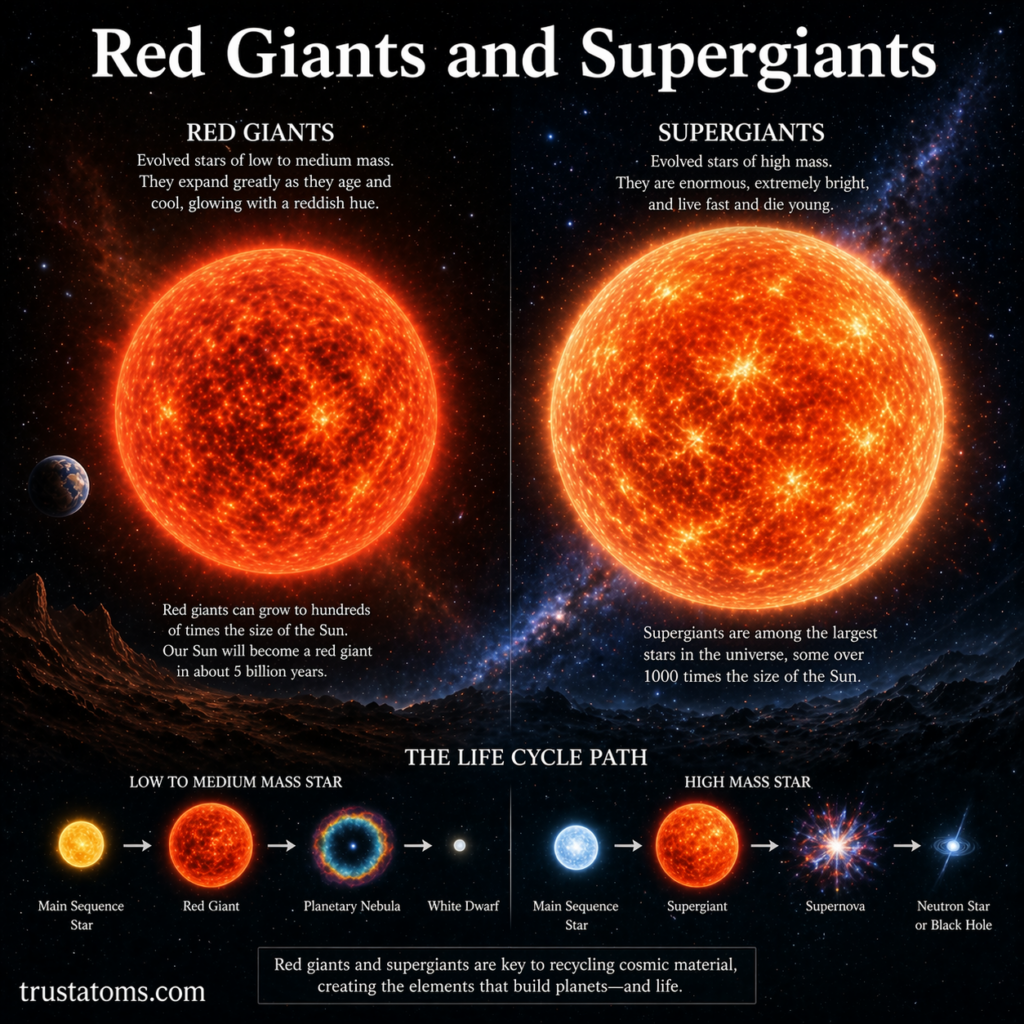
Massive stars:
- Radiation pressure becomes significant or dominant
- Can counteract gravity more strongly
- More prone to instability and mass loss
In extremely massive stars, radiation pressure can be so strong that it drives material away from the surface in powerful stellar winds.
The Eddington Limit
There is a theoretical maximum brightness a star can reach before radiation pressure overcomes gravity. This is known as the Eddington limit.
What happens at this limit:
- Outward radiation force equals inward gravitational force
- The star cannot hold onto its outer layers
- Material begins to escape into space
The concept is widely studied by institutions like NASA and the European Space Agency to better understand massive stars and luminous objects.
Radiation Pressure and Stellar Winds
Radiation pressure plays a major role in driving stellar winds, especially in massive stars.
Effects of stellar winds:
- Continuous loss of mass over time
- Enrichment of surrounding space with heavy elements
- Formation of nebulae and interstellar clouds
These winds can significantly alter a star’s evolution and contribute to the formation of new stars and planetary systems.
Role in Star Formation
Radiation pressure also influences how stars are born.
During the collapse of a gas cloud:
- Gravity pulls material inward
- Fusion begins in the core
- Radiation pressure builds and pushes outward
If radiation pressure becomes strong enough, it can slow or even halt further accumulation of mass. This limits how large a star can grow.
Radiation Pressure in Extreme Objects
Radiation pressure becomes especially important in extreme cosmic environments.
Examples include:
- Massive stars nearing the Eddington limit
- Accretion disks around black holes
- Quasars emitting enormous energy
In these systems, radiation pressure can shape matter on a galactic scale and drive powerful outflows.
Why Radiation Pressure Matters
Understanding radiation pressure helps astronomers:
- Explain how stars maintain stability
- Predict how massive stars evolve and lose mass
- Understand limits on stellar brightness
- Study interactions between stars and their environments
Research from centers like the Harvard-Smithsonian Center for Astrophysics continues to uncover how radiation influences the life cycle of stars.
Final Thoughts
Radiation pressure is one of the key forces that governs the life of a star. Working alongside gravity and gas pressure, it helps maintain balance, drive stellar winds, and shape the evolution of stars across the universe.
From steady stars like our Sun to the most luminous giants, radiation pressure is a powerful reminder that even light itself can shape the cosmos.