The Cosmic Inflation Theory is a widely accepted scientific explanation for how the universe expanded in its earliest moments. It proposes that just after the Big Bang, the universe underwent an extremely rapid expansion.
This idea helps explain why the universe appears smooth, evenly distributed, and structured on large scales today.
Different philosophical and religious perspectives interpret these findings in various ways. In science, inflation is studied as a physical process based on observation and mathematical models.
What Is Cosmic Inflation?
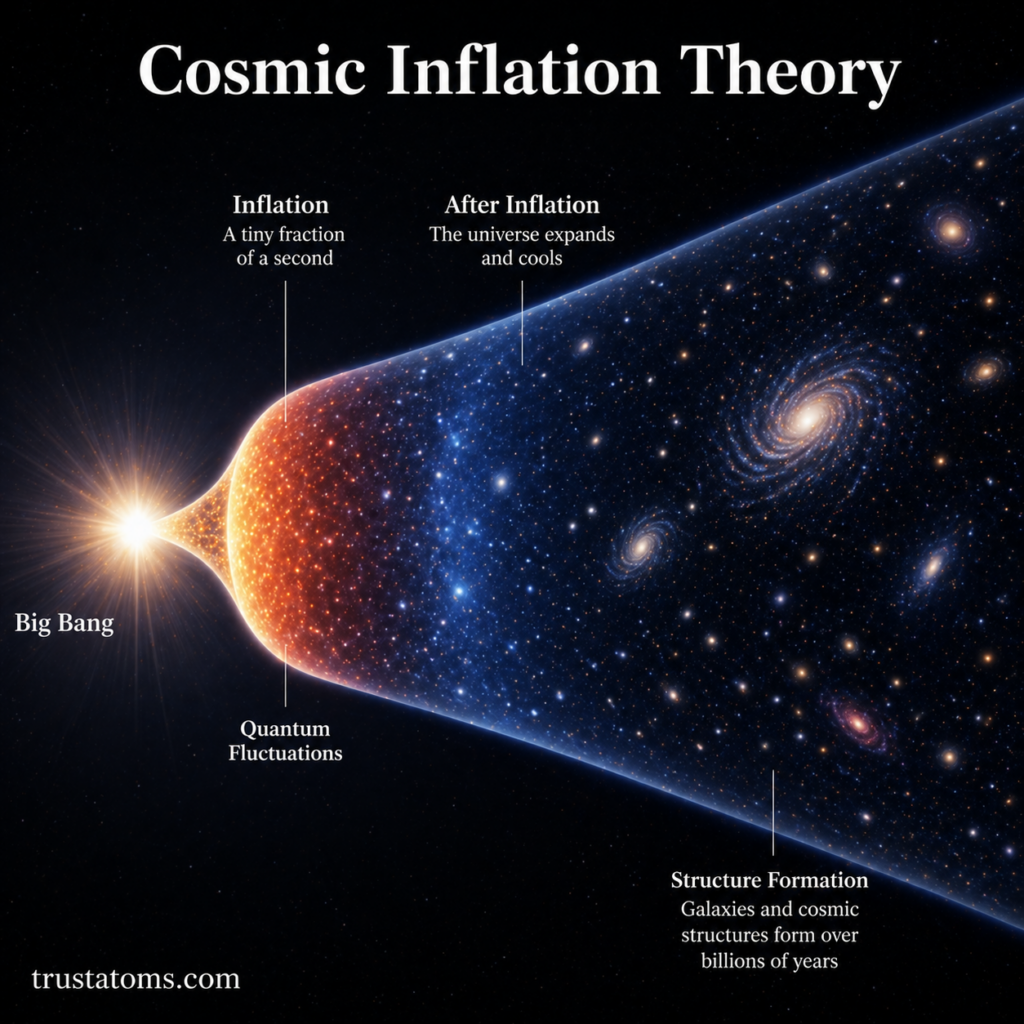
Cosmic inflation suggests that the universe expanded exponentially within a tiny fraction of a second after the Big Bang.
During this brief period:
- Space expanded faster than the speed of light
- Tiny regions were stretched to enormous sizes
- Small fluctuations became the seeds of galaxies
The theory was first proposed by physicist Alan Guth in the 1980s.
Why Was Inflation Proposed?
Before inflation, scientists struggled to explain several puzzling observations about the universe.
Key Problems Inflation Addresses
The Horizon Problem
Distant parts of the universe look very similar, even though they seem too far apart to have interacted.
Inflation suggests these regions were once close together before being rapidly stretched apart.
The Flatness Problem
The universe appears geometrically flat rather than curved.
Inflation helps explain this by smoothing out any initial curvature.
The Monopole Problem
Some theories predict particles that we don’t observe.
Inflation would have spread these particles so thinly that they are extremely difficult to detect.
How Inflation Works
Inflation is thought to be driven by a theoretical energy field.
The Process
- The early universe existed in a high-energy state
- This energy caused rapid expansion of space
- The expansion slowed as energy transformed into particles
- The universe continued expanding at a slower rate
This marks the transition from the earliest moments into the more familiar evolution of the universe.
Quantum Fluctuations and Structure Formation
Inflation connects very small-scale physics with large cosmic structures.
What Happened
- Tiny variations existed at the quantum level
- Inflation stretched these variations across vast distances
- Over time, gravity turned them into galaxies and clusters
These small differences are still visible today in patterns across the universe.
Evidence Supporting Cosmic Inflation
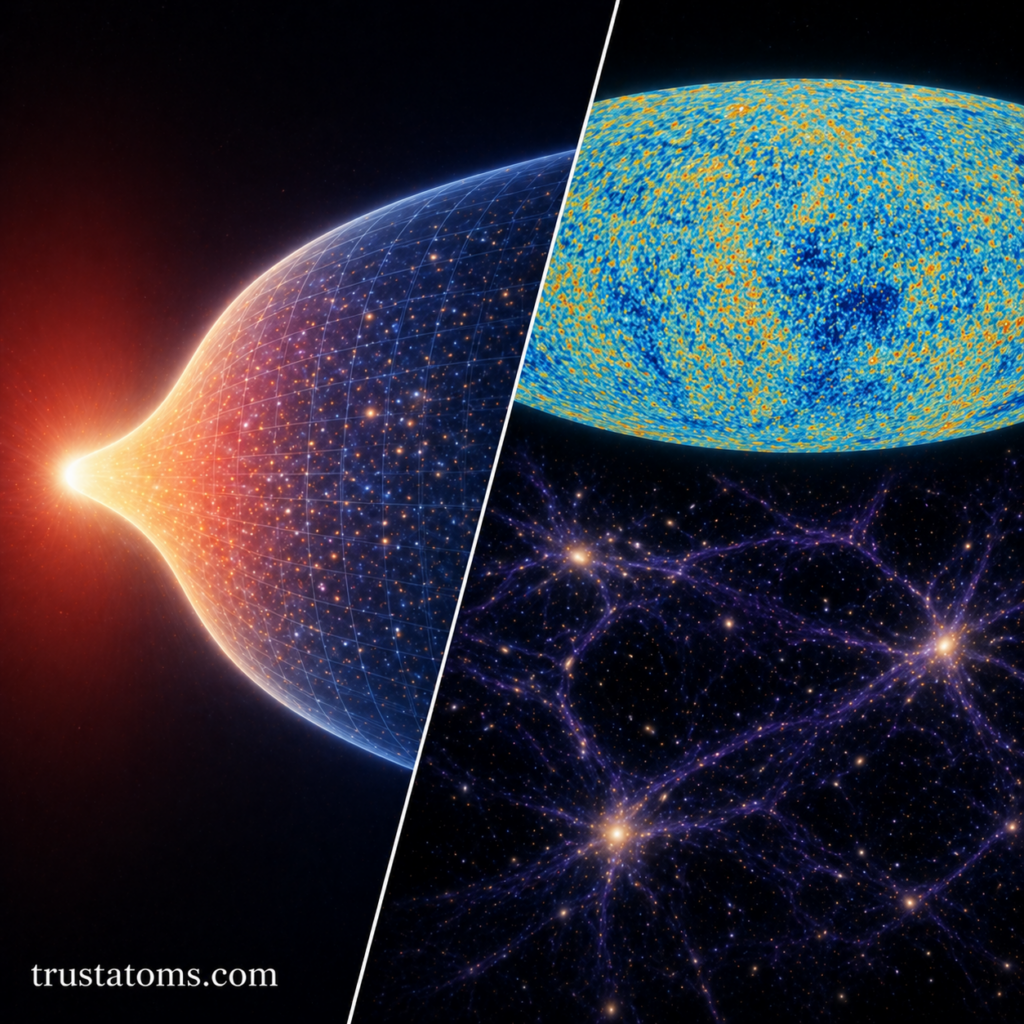
While inflation cannot be directly observed, several observations support it.
Cosmic Microwave Background
The Cosmic Microwave Background shows:
- A nearly uniform temperature across the universe
- Small fluctuations that match inflation predictions
Large-Scale Structure
The distribution of galaxies aligns with what inflation models predict.
Flat Geometry
Measurements suggest the universe is very close to flat, consistent with inflation theory.
Scientific Perspective vs. Personal Beliefs
Science focuses on explaining natural processes using observation and evidence.
Cosmic inflation is part of this effort—it describes how the universe expanded in its earliest moments.
People may interpret these findings differently depending on their worldview:
- Some see inflation as a purely natural process
- Others see it as part of a larger purposeful design
- Some perspectives do not accept inflation or the Big Bang model
These interpretations fall outside the scope of scientific testing but are important in broader philosophical or religious discussions.
Why Cosmic Inflation Matters
Understanding inflation helps scientists explain key features of the universe.
Key Takeaways
- Explains the universe’s uniform appearance
- Connects early quantum physics to galaxy formation
- Supports modern cosmology models
- Helps refine our understanding of the universe’s origins
Final Thoughts
The Cosmic Inflation Theory provides a powerful framework for understanding the early expansion of the universe. While it is grounded in scientific observation and modeling, its broader meaning is interpreted differently depending on individual perspectives.
By separating scientific explanations from philosophical or religious interpretations, we can better understand both the evidence and the diversity of viewpoints surrounding the origins of the universe.