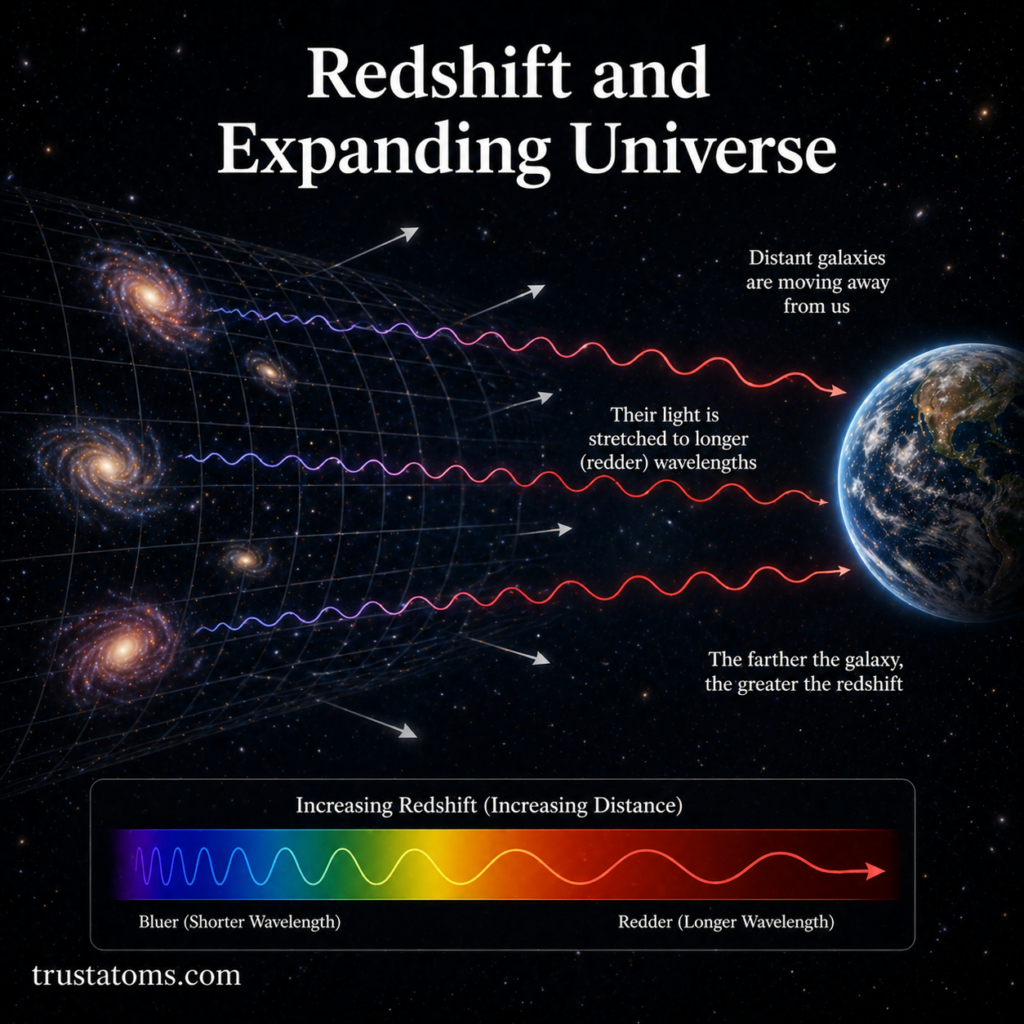
The universe is not static—it is constantly expanding. One of the strongest pieces of evidence for this comes from a phenomenon known as redshift, which shows that distant galaxies are moving away from us.
By studying redshift, astronomers have uncovered how the universe is growing, how fast it’s expanding, and even clues about its origin and future.
What Is Redshift?
Redshift occurs when light from an object is stretched to longer wavelengths as it travels through space. This shift moves the light toward the red end of the visible spectrum.
In simple terms:
- Objects moving away from us appear “redder”
- Objects moving toward us appear “bluer” (called blueshift)
This effect is similar to how sound changes pitch when a moving vehicle passes by, known as the Doppler effect.
Types of Redshift
There are three main types of redshift, each with a different cause.
Doppler Redshift
This occurs when an object moves away from the observer through space.
- Common in nearby galaxies
- Based on relative motion
- Similar to sound wave stretching
Cosmological Redshift
This is the most important type for understanding the universe.
- Caused by the expansion of space itself
- Light stretches as space expands
- Applies to distant galaxies
Gravitational Redshift
This happens when light escapes a strong gravitational field.
- Predicted by General Relativity
- Light loses energy as it climbs out of gravity
- Seen near massive objects like black holes
How Redshift Shows the Universe Is Expanding
In the 1920s, astronomer Edwin Hubble made a groundbreaking discovery: almost all galaxies show redshift.
This means:
- Most galaxies are moving away from us
- The farther away a galaxy is, the faster it appears to move
This relationship is described by Hubble’s Law.
Hubble’s Law Explained
Hubble’s Law connects a galaxy’s distance to how fast it is moving away.
Key Idea
- Greater distance = higher redshift = faster recession speed
This suggests that space itself is expanding, carrying galaxies along with it.
It’s important to note:
- Galaxies are not moving through space in the usual sense
- Instead, the space between galaxies is expanding
The Expanding Universe Concept
The idea of an expanding universe changed our understanding of cosmology.
What Expansion Means
- The universe was smaller and denser in the past
- Space continues to stretch over time
- Galaxies become more spread out
This discovery strongly supports the Big Bang model, which describes the universe beginning from a hot, dense state.
Redshift and the Cosmic Timeline
Redshift doesn’t just show motion—it also acts like a time machine.
Looking Back in Time
- Light from distant galaxies takes billions of years to reach us
- Higher redshift means we see objects as they were long ago
- Astronomers can study the early universe
This allows scientists to trace how galaxies formed and evolved.
Measuring Redshift
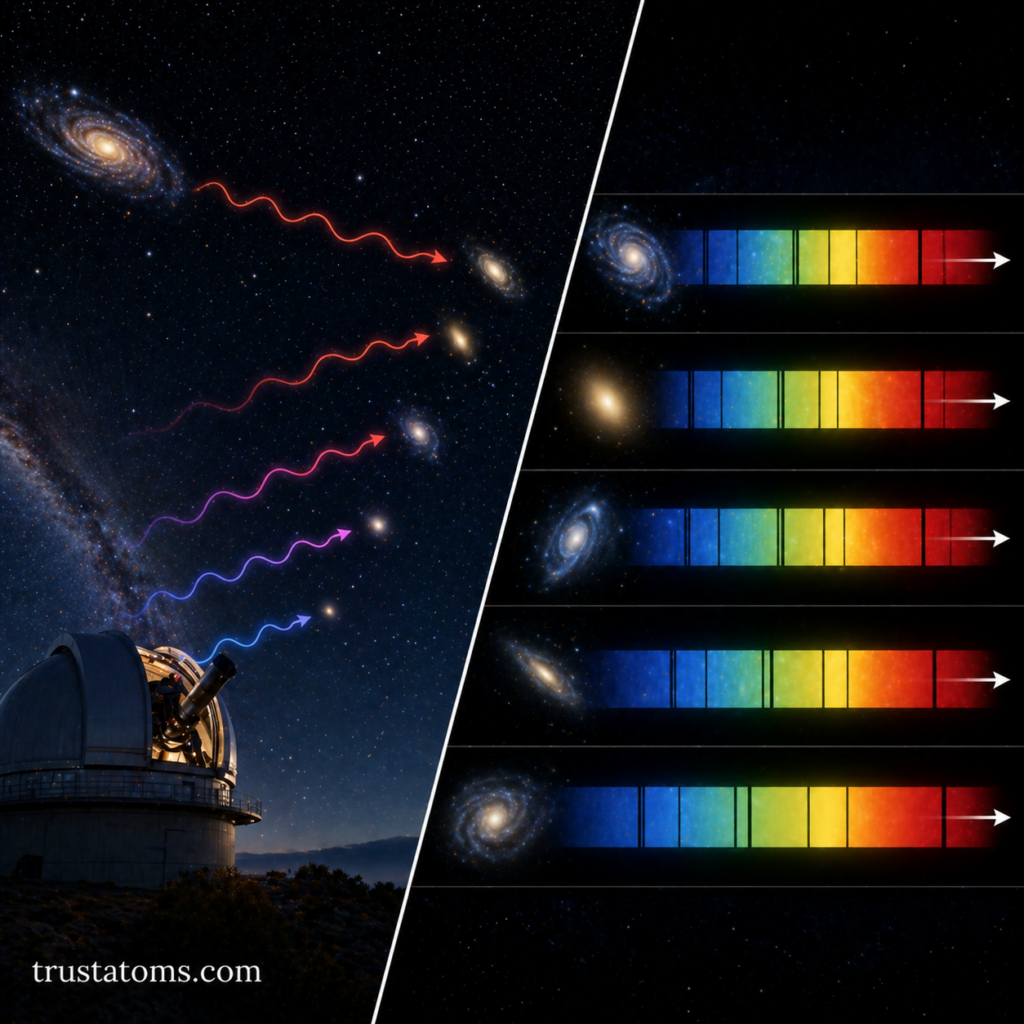
Astronomers measure redshift by analyzing the light spectrum from distant objects.
How It Works
- Light from a galaxy is collected using telescopes
- The spectrum is analyzed for known patterns (spectral lines)
- These lines appear shifted toward red wavelengths
- The amount of shift reveals velocity and distance
This method is one of the most powerful tools in observational astronomy.
Redshift and Dark Energy
In the late 1990s, scientists discovered something surprising: the expansion of the universe is accelerating.
This is attributed to a mysterious force known as Dark Energy.
What This Means
- The universe is expanding faster over time
- Gravity is not slowing expansion as expected
- Dark energy may make up most of the universe
Redshift measurements played a key role in discovering this acceleration.
Why Redshift Matters
Redshift is essential for understanding the universe.
Key Takeaways
- Confirms that the universe is expanding
- Helps measure distances to galaxies
- Provides insight into the universe’s history
- Supports major cosmological theories
Without redshift, modern astronomy would look very different.
Final Thoughts
Redshift is one of the most important tools in cosmology, revealing that the universe is dynamic and constantly evolving. By studying how light stretches across space, scientists have uncovered the expansion of the universe and gained insight into its past and future.
As technology improves, redshift observations will continue to refine our understanding of the cosmos and the forces shaping it.