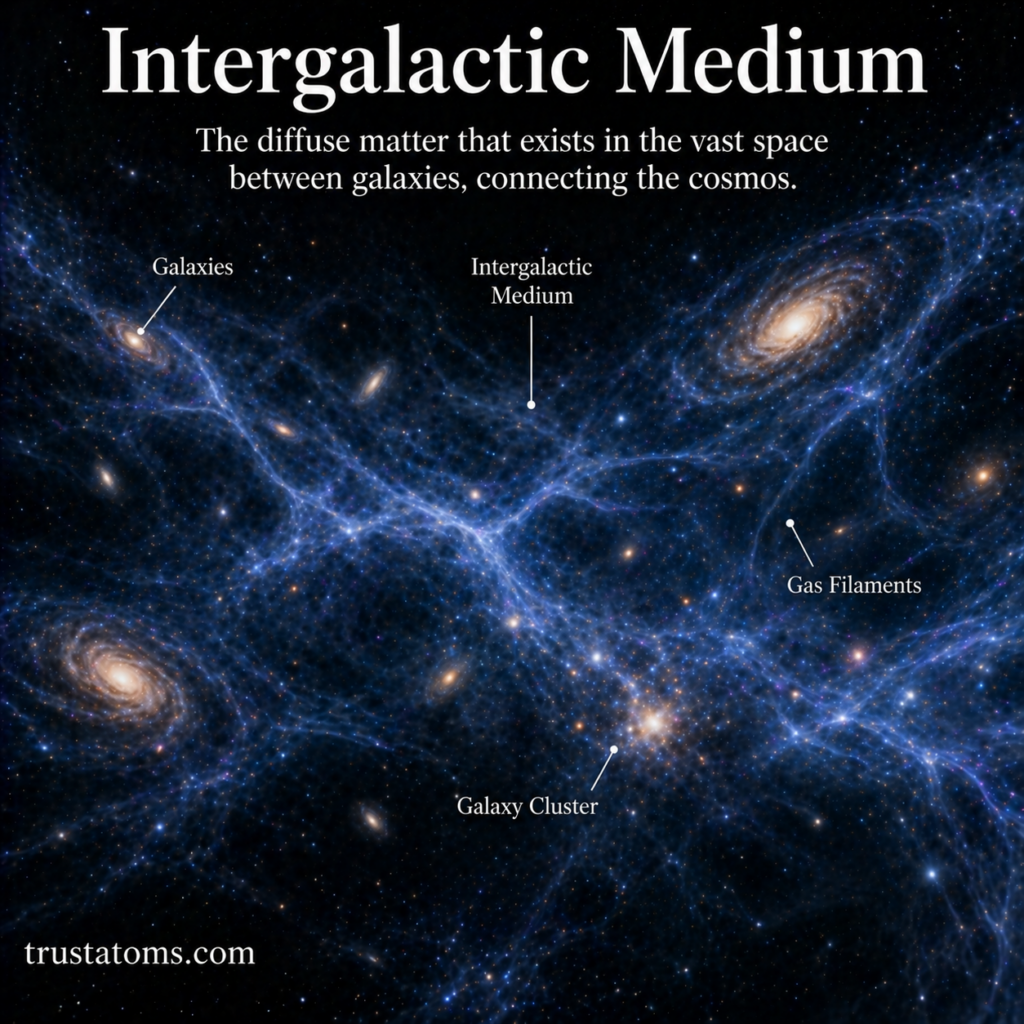
The intergalactic medium (IGM) is the vast, diffuse matter that exists in the space between galaxies. While galaxies, stars, and planets get most of the attention, the IGM actually contains a significant portion of the universe’s ordinary matter.
Far from being empty, this space is filled with thin gas, mostly hydrogen, that plays a crucial role in the evolution of the universe.
What Is the Intergalactic Medium?
The intergalactic medium is the matter that lies between galaxies across cosmic space.
It is primarily made up of:
- Hydrogen (the most abundant element in the universe)
- Helium
- Trace amounts of heavier elements
Unlike matter inside galaxies, the IGM is extremely diffuse—often just a few atoms per cubic meter.
How the Intergalactic Medium Formed
The IGM formed shortly after the Big Bang as the universe expanded and cooled.
Key Stages
- Early universe plasma – Hot, dense state
- Recombination – Atoms form (~380,000 years later)
- Cosmic dark ages – Neutral gas fills space
- Reionization – First stars and galaxies ionize the gas
After these stages, the IGM became a mixture of ionized and neutral gas spread throughout the universe.
The Cosmic Web Connection
The IGM is not evenly distributed—it follows the structure of the cosmic web.
What This Means
- Gas flows along filaments connecting galaxies
- Denser regions form near galaxy clusters
- Large voids contain very little matter
The IGM acts as the “bridge” between galaxies, linking them across vast distances.
Types of Intergalactic Medium
The IGM is not uniform. It exists in different states depending on temperature and density.
1. Warm-Hot Intergalactic Medium (WHIM)
- Temperature: 100,000 to 10 million Kelvin
- Found in filaments between galaxies
- Thought to contain a large fraction of missing matter
2. Diffuse Ionized Gas
- Very low density
- Ionized by radiation from galaxies and quasars
- Common throughout intergalactic space
3. Neutral Hydrogen Clouds
- Cooler and less ionized
- Detected through absorption lines
- Important for studying early cosmic history
How Scientists Study the IGM
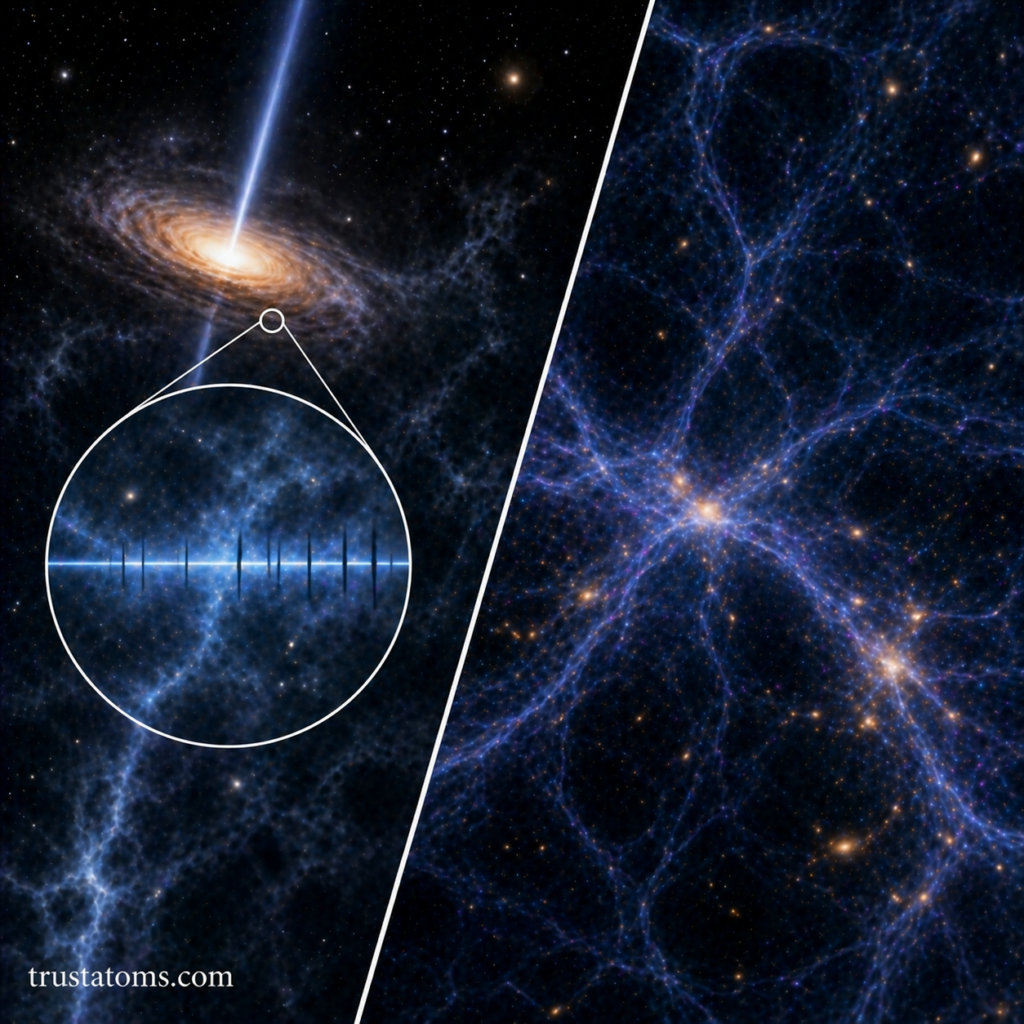
Because the IGM is so faint, astronomers cannot observe it directly in most cases.
Instead, they study it using indirect methods.
Key Techniques
- Absorption lines: Light from distant quasars passes through the IGM, revealing its composition
- Spectroscopy: Identifies elements and ionization states
- Simulations: Models how gas behaves over cosmic time
One important observational feature is the Lyman-alpha forest, a series of absorption lines that map hydrogen in the IGM.
The Role of the Intergalactic Medium
The IGM plays a major role in cosmic evolution.
Key Functions
- Supplies gas for galaxy formation
- Regulates star formation rates
- Transports energy and matter across the universe
- Records the history of cosmic events
Galaxies continuously exchange matter with the IGM through inflows and outflows.
Intergalactic Medium and Galaxy Formation
Galaxies do not form in isolation—they depend on the IGM.
How They Interact
- Gas from the IGM flows into galaxies, fueling star formation
- Supernovae and black holes push material back into the IGM
- This cycle shapes galaxy growth over time
This process is often called the cosmic baryon cycle.
The Missing Matter Problem
Astronomers have long known that some normal matter (not dark matter) is “missing.”
The Mystery
- Observations show less visible matter than expected
- Simulations predict more matter should exist
The Solution
Much of this missing matter is believed to be in the warm-hot intergalactic medium (WHIM), which is difficult to detect.
Why the Intergalactic Medium Matters
The IGM is essential for understanding the universe as a whole.
Key Takeaways
- Contains a large portion of the universe’s ordinary matter
- Connects galaxies through the cosmic web
- Influences galaxy formation and evolution
- Provides insight into early cosmic history
It is a hidden but fundamental component of the cosmos.
Final Thoughts
The intergalactic medium may seem like empty space, but it is actually a dynamic and essential part of the universe. By studying this diffuse matter, scientists gain insight into how galaxies form, evolve, and interact across cosmic time.
As observational technology improves, the IGM continues to reveal new details about the structure and history of the universe.