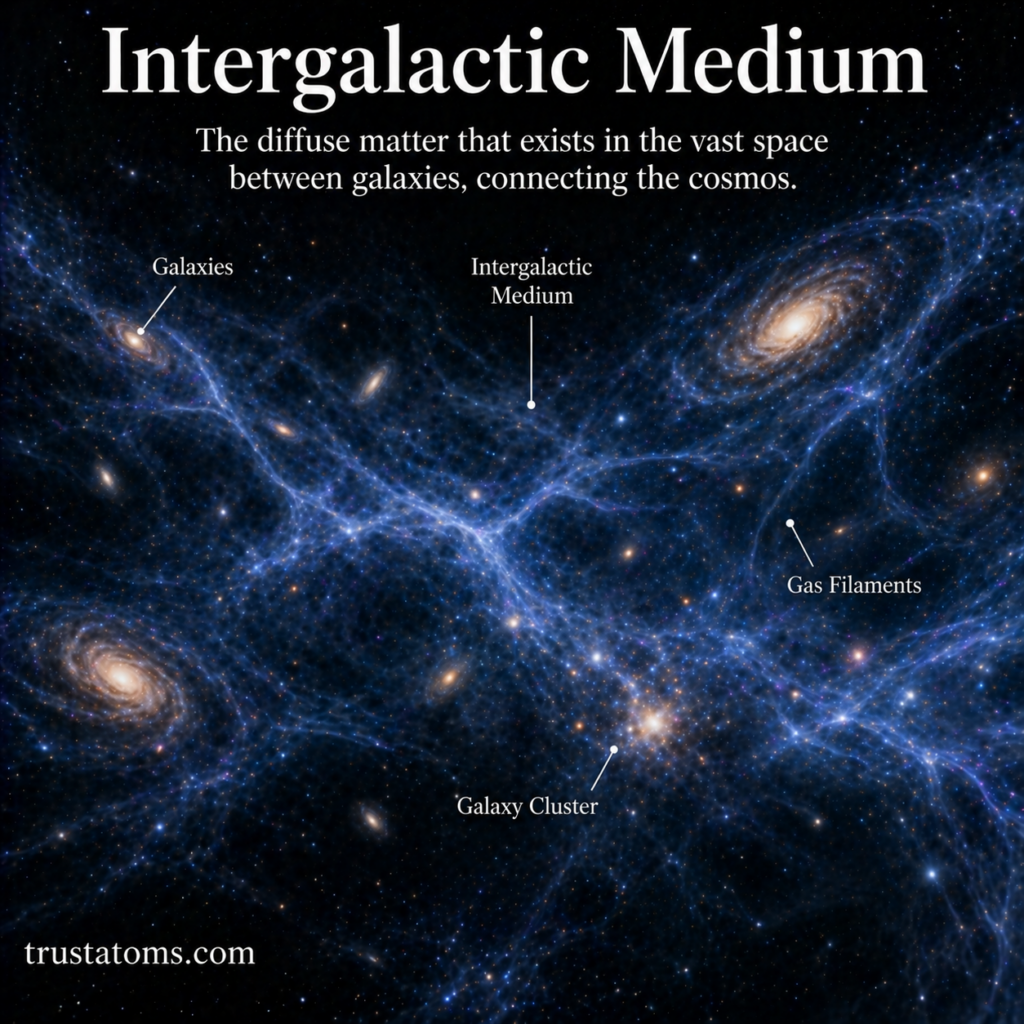
The intergalactic medium (IGM) is the extremely diffuse gas that occupies the space between galaxies, consisting primarily of hydrogen and helium. Although this gas is difficult to observe, it contains a substantial portion of the universe’s ordinary matter and helps regulate how galaxies form and evolve.
Intergalactic space is therefore not completely empty. Understanding this widespread material is an important part of modern astronomy, connecting observations of individual galaxies with the large-scale structure and history of the universe.
What Is the Intergalactic Medium?
The intergalactic medium consists of gas and plasma spread throughout the regions separating galaxies. Most of its ordinary matter is hydrogen, followed by helium, with smaller quantities of heavier elements produced by earlier generations of stars.
Much of this material is ionized, meaning electrons have been separated from atoms by energetic radiation or collisions. Other regions contain neutral hydrogen, particularly where gas is sufficiently dense or shielded from ionizing radiation.
The IGM differs from the gas found inside galaxies. Interstellar Medium and Gas Clouds examines the material between stars within galaxies, where densities and environmental conditions can be considerably different.
Intergalactic gas is extraordinarily thin. In some diffuse regions, its average density can be comparable to only a few hydrogen atoms per cubic meter, although denser filaments and gas surrounding galaxies contain substantially more particles.
How the Intergalactic Medium Formed
According to the Big Bang model, the early universe began in an extremely hot, dense state and expanded and cooled over time. The gas that eventually became the intergalactic medium developed through several important stages.
- Early plasma: During the universe’s early development, matter existed largely as free electrons and atomic nuclei within a hot plasma.
- Recombination: Approximately 380,000 years after the Big Bang, according to cosmological measurements, cooling allowed electrons and nuclei to combine into neutral atoms.
- Cosmic dark ages: Neutral hydrogen filled much of intergalactic space before the first luminous stars and galaxies developed.
- Reionization: Radiation from early luminous sources ionized much of the hydrogen between galaxies.
As cosmic structures developed, gravity drew gas toward growing concentrations of matter. Some gas accumulated in galaxies, while substantial quantities remained distributed throughout intergalactic space.
How the IGM Follows the Cosmic Web
The IGM is not evenly distributed—it follows the structure of the cosmic web.
This enormous network consists of filaments, sheets, dense nodes, and comparatively empty regions called cosmic voids. Galaxies and galaxy clusters tend to occupy the denser parts of the network.
Gravity draws gas toward filaments and clusters, while cosmic expansion influences how matter is distributed over large distances. The resulting pattern connects galaxies through structures extending across millions of light-years.
Although cosmic voids contain less matter than filaments, they are not entirely empty. Extremely diffuse gas can still occupy these enormous regions.
Different Types of Intergalactic Gas
Intergalactic matter exists at different temperatures, densities, and ionization levels. Scientists often distinguish several broad components.
Warm-Hot Intergalactic Medium
The warm-hot intergalactic medium (WHIM) consists of gas with temperatures ranging approximately from 100,000 to 10 million kelvins.
This material is commonly associated with cosmic filaments, where gravitational compression and shock waves heat the gas. Its high temperature and low density make it difficult to detect using ordinary observations.
Diffuse Photoionized Gas
Much of the lower-density IGM contains hydrogen ionized by ultraviolet radiation from galaxies and quasars. This gas is often much cooler than the WHIM, with characteristic temperatures around ten thousand kelvins.
Neutral Hydrogen Regions
Some intergalactic regions contain measurable neutral hydrogen. Astronomers study this material through its absorption of light from distant background sources.
Neutral hydrogen was especially widespread before cosmic reionization, making it useful for investigating conditions in the early universe.
How Scientists Study the Intergalactic Medium
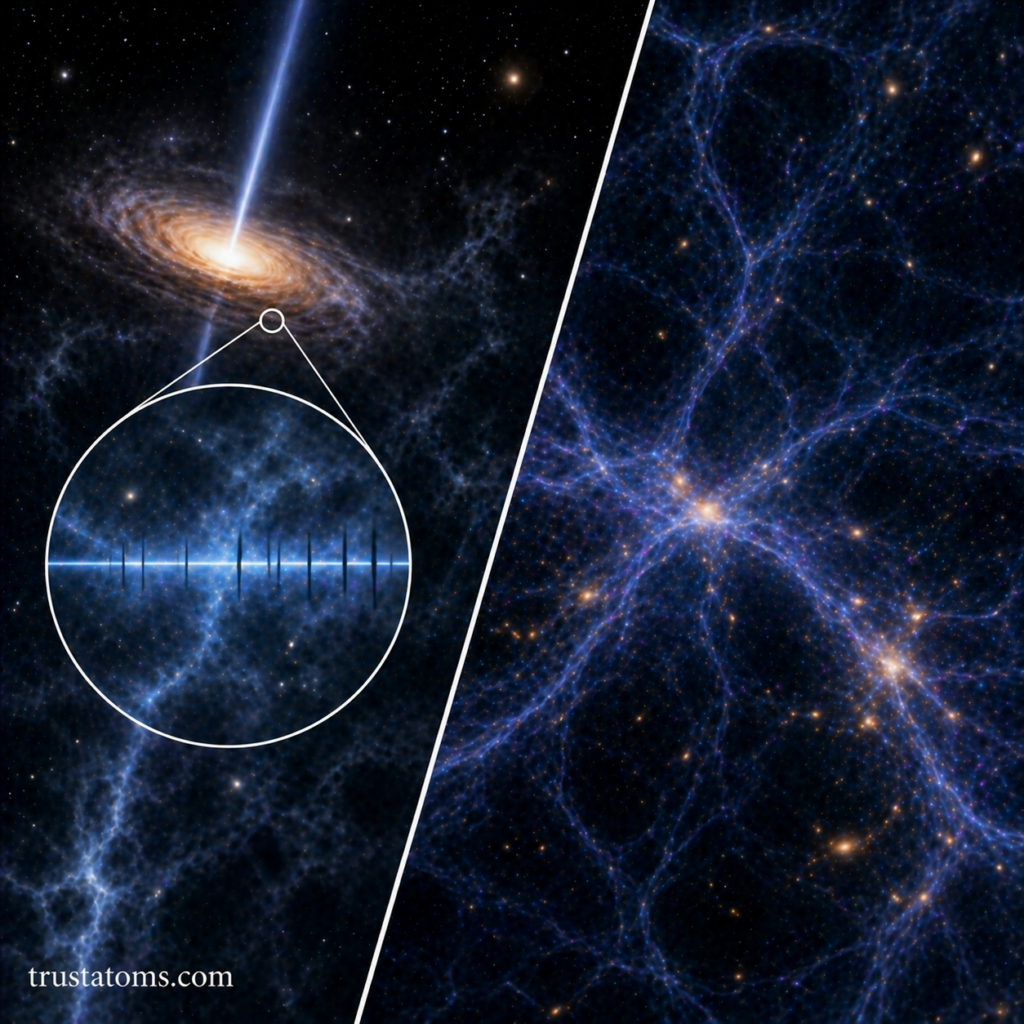
Because intergalactic gas is so diffuse, its radiation is often too faint for direct imaging. Astronomers instead use several complementary techniques to investigate its composition, temperature, and distribution.
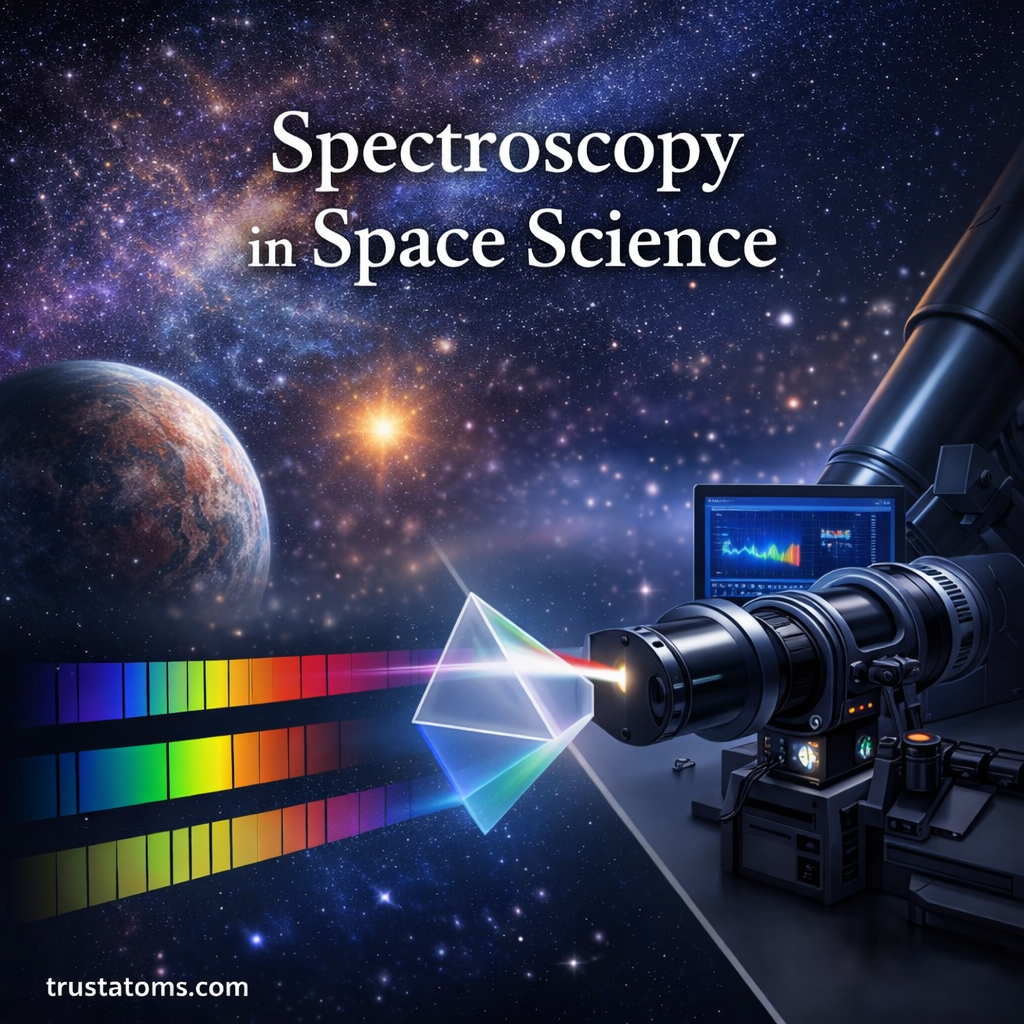
- Quasar absorption spectroscopy: Light from distant quasars passes through intervening gas, producing absorption features at specific wavelengths.
- Ultraviolet observations: Spectral measurements reveal hydrogen and certain heavier elements in diffuse gas.
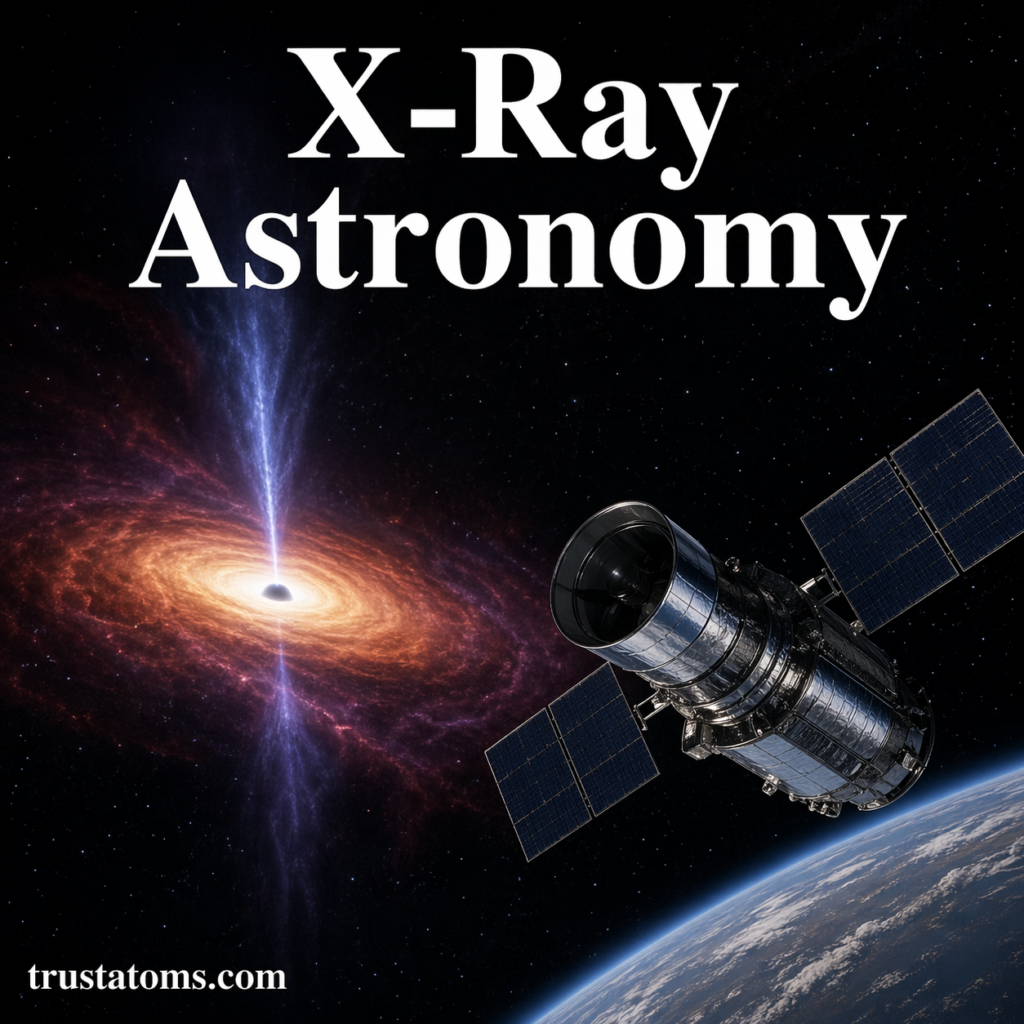
- X-ray observations: Highly ionized elements can provide evidence of extremely hot intergalactic material.
- Computer simulations: Cosmological models predict how gravity, gas heating, and galaxy activity influence intergalactic matter.
These observations also complement measurements of the universe’s gravitational structure. Dark Matter Evidence explains why astronomers infer an additional, nonluminous form of matter that influences the distribution of galaxies and intergalactic gas.
The Lyman-Alpha Forest: Reading Gas Through Light
One of the most useful methods for investigating the IGM involves the Lyman-alpha forest, a collection of absorption features visible in the spectra of distant quasars.
Neutral hydrogen absorbs ultraviolet light at a rest wavelength of approximately 121.6 nanometers. As quasar light travels toward Earth, it passes through multiple hydrogen-rich regions at different distances.
Because cosmic expansion shifts the absorption features by different amounts, each region can leave a separate signature in the observed spectrum.
For example, hydrogen at a redshift of 3 produces Lyman-alpha absorption at approximately 486 nanometers, within the visible spectrum. Astronomers can therefore use optical observations of distant quasars to study ultraviolet absorption produced by intergalactic hydrogen.
By analyzing many absorption features, researchers reconstruct how gas is distributed across different distances and periods of cosmic history.
How Intergalactic Gas Influences Galaxy Formation
Galaxies depend on supplies of gas to continue producing new stars. Intergalactic matter provides an important reservoir from which galaxies can acquire additional material.
Gas from the IGM flows into galaxies, fueling star formation in developing galaxies and helping sustain star formation in established systems.
Material also moves in the opposite direction. Supernova explosions and activity around supermassive black holes can drive powerful outflows that carry gas and heavier elements beyond galaxies.
Some expelled material later returns, while other gas remains outside galaxies for extended periods. These exchanges form part of the cosmic baryon cycle.
The balance between inflowing gas, star formation, and outflows influences how quickly galaxies grow and how much gas remains available for future stars.
The Missing Matter Problem
Cosmological measurements allow scientists to estimate how much ordinary matter should exist in the universe. However, surveys of stars, galaxies, and readily detectable gas historically accounted for less matter than these measurements predicted.
This discrepancy became known as the missing baryons problem. It concerns ordinary matter made of particles such as protons and neutrons, not the separate problem of identifying dark matter.
The distinction is explained in Baryonic Matter in the Universe, which describes the matter composing stars, planets, gas, and familiar physical objects.
Observations and simulations indicate that substantial amounts of previously difficult-to-detect baryonic matter reside in diffuse intergalactic gas, including the WHIM.
Measurements using ultraviolet and X-ray absorption, along with other techniques, have strengthened this explanation. Determining precisely how the gas is distributed remains an active area of research.
What the IGM Reveals About Cosmic History
Intergalactic gas preserves evidence of events that shaped the universe over billions of years, according to cosmological observations and models.
Its ionization state helps researchers investigate when early luminous objects transformed surrounding neutral hydrogen. Its temperature and chemical composition provide clues about heating, galaxy outflows, and the spread of heavier elements.
Comparing observations with simulations also tests predictions about the growth of cosmic structure. Because the IGM extends far beyond individual galaxies, it provides a broad view of how matter responds to gravity and cosmic expansion.
Frequently Asked Questions
Is the space between galaxies completely empty?
No. Intergalactic space contains extremely diffuse gas, primarily hydrogen and helium, along with radiation and other components. The density is very low compared with conditions inside galaxies, but the enormous volume means the total amount of gas is substantial.
What is the difference between the IGM and dark matter?
The intergalactic medium consists of ordinary gas that can absorb and emit electromagnetic radiation. Dark matter is inferred mainly through its gravitational effects and does not interact with light in the same detectable way as ordinary gas.
How can scientists detect gas that is almost invisible?
Astronomers examine how intergalactic gas absorbs light from distant quasars and other bright sources. Specific absorption features reveal the presence of hydrogen and other elements, even when the gas itself is too faint to image directly.
The intergalactic medium connects galaxies through a vast network of diffuse gas and supplies material that can influence their growth. Measurements of hydrogen absorption, hot gas, and cosmic structure show that much of the universe’s ordinary matter exists outside visible galaxies. Continued observations will help scientists refine estimates of this material and reconstruct how it changed throughout cosmic history.
Sources: NASA, cosmic structure and intergalactic matter resources; European Space Agency, cosmology and large-scale structure resources; Mo, van den Bosch, and White, Galaxy Formation and Evolution.