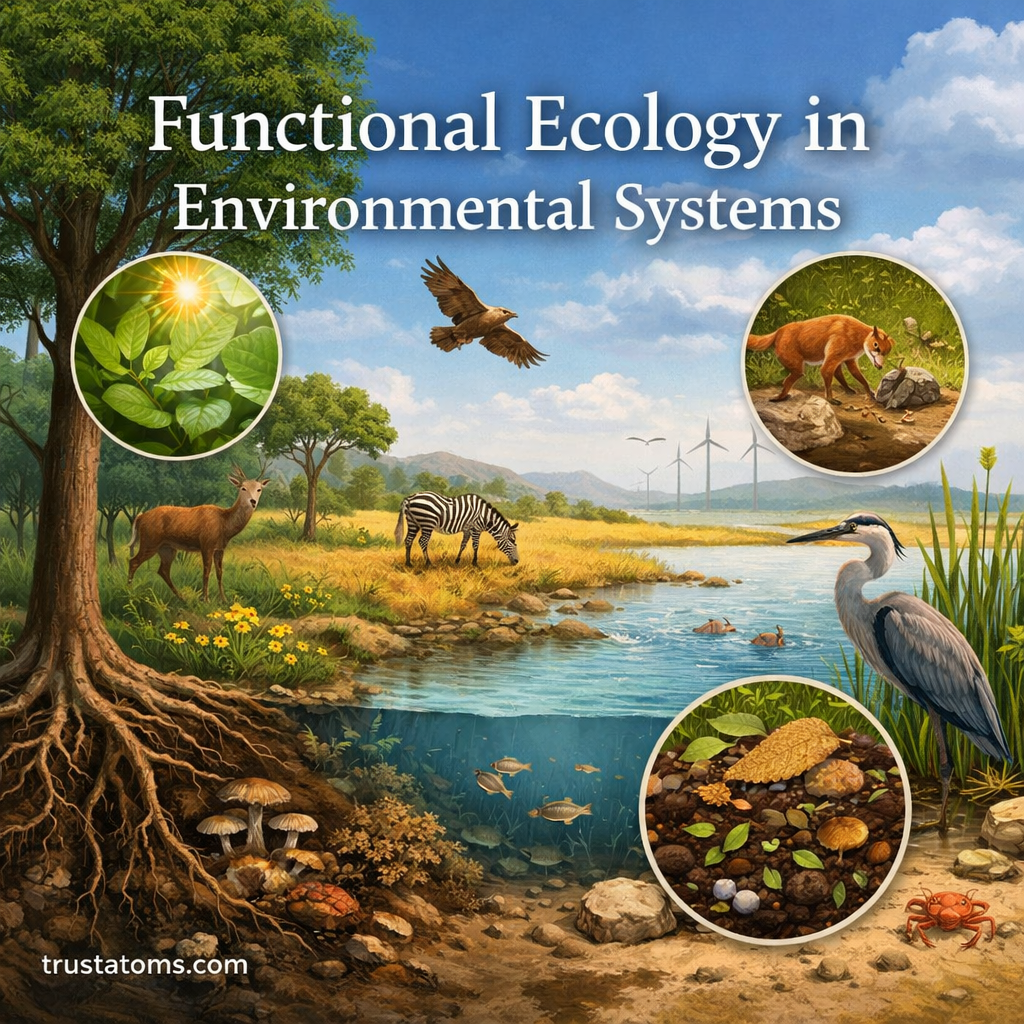
Functional Ecology in Environmental Systems

Illustration showing functional ecology across environmental systems with plants, animals, decomposers, and nutrient cycling in forest, grassland, and water ecosystems.
Illustration showing how organisms such as plants, animals, and decomposers interact across ecosystems to drive ecological functions and environmental processes. trustatoms.com.

Functional ecology is a branch of biology that focuses on how organisms interact with their environment through their biological traits and functions. Rather than simply identifying species, functional ecology examines what organisms do in ecosystems—how they acquire energy, recycle nutrients, respond to environmental stress, and influence ecological processes.

Understanding functional ecology is essential for explaining how ecosystems operate, how they respond to environmental change, and how biodiversity supports ecosystem stability.

Continue reading “Functional Ecology in Environmental Systems”
Systems Ecology in Complex Environments

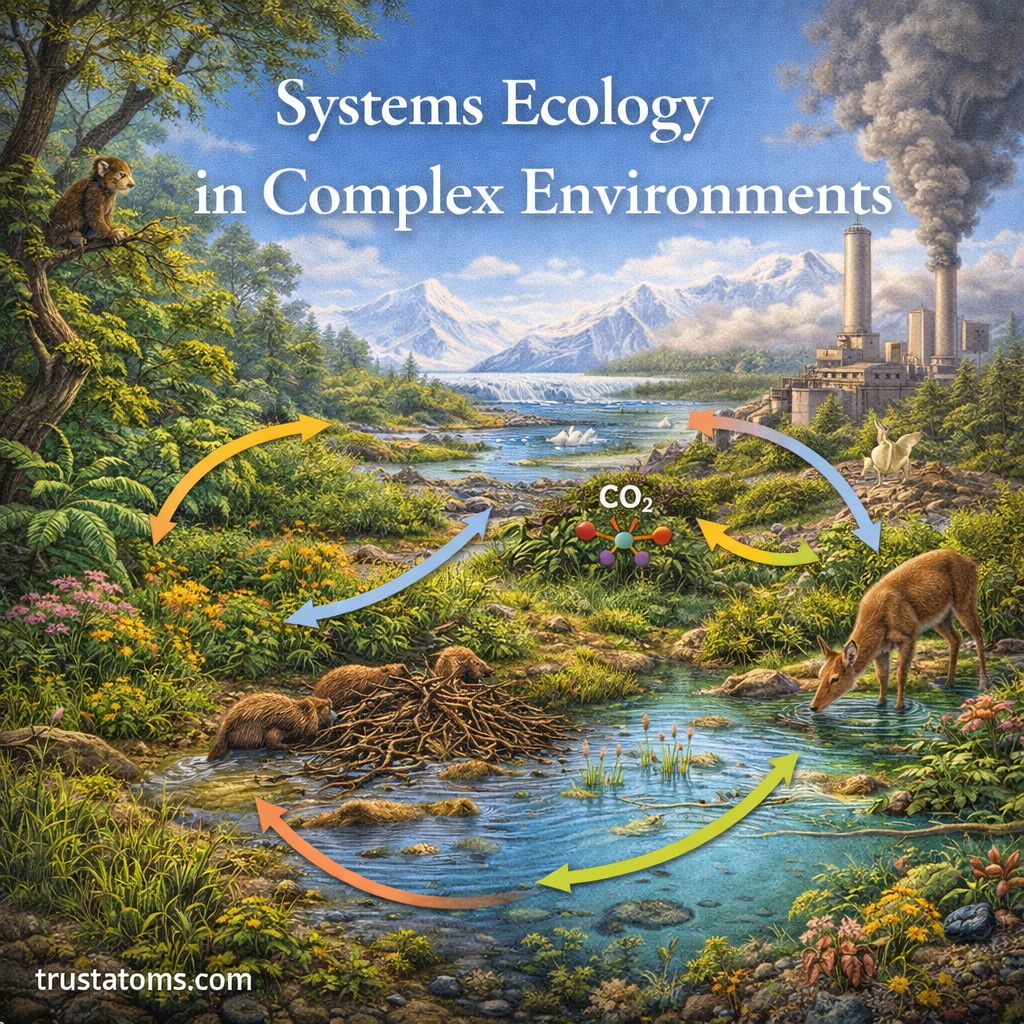
Educational ecosystem diagram showing interconnected environments such as forests, rivers, mountains, wildlife, and human industry representing systems ecology interactions.
Illustrated ecosystem showing interconnected natural environments and energy flows representing systems ecology in complex ecosystems. trustatoms.com.

Ecosystems are made up of many interconnected parts, including living organisms, physical environments, and the energy and nutrients that move between them. Systems ecology is the scientific approach that studies ecosystems as integrated systems rather than isolated components.

By analyzing how organisms interact with each other and with their environment, systems ecology helps scientists understand how ecosystems function, adapt, and respond to environmental change. This field is especially important when studying complex environments where many biological and environmental processes occur simultaneously.

Continue reading “Systems Ecology in Complex Environments”

Ecological Interactions in Community Systems

Educational ecosystem diagram showing ecological interactions such as predation, mutualism, competition, and decomposition within a forest community.
Illustrated ecosystem scene showing multiple ecological interactions including predation, pollination, and nutrient recycling within a community system. trustatoms.com.

Ecosystems are built on countless interactions between organisms. Within ecological communities, species influence one another through relationships such as competition, predation, and cooperation. These relationships shape population sizes, species diversity, and the stability of entire ecosystems.

The study of ecological interactions in community systems helps scientists understand how organisms coexist, how ecosystems function, and how environmental changes can affect biodiversity.

By examining how species interact, ecologists can better predict ecosystem responses to disturbances such as climate change, habitat loss, and invasive species.

Continue reading “Ecological Interactions in Community Systems”

Succession in Ecological Communities

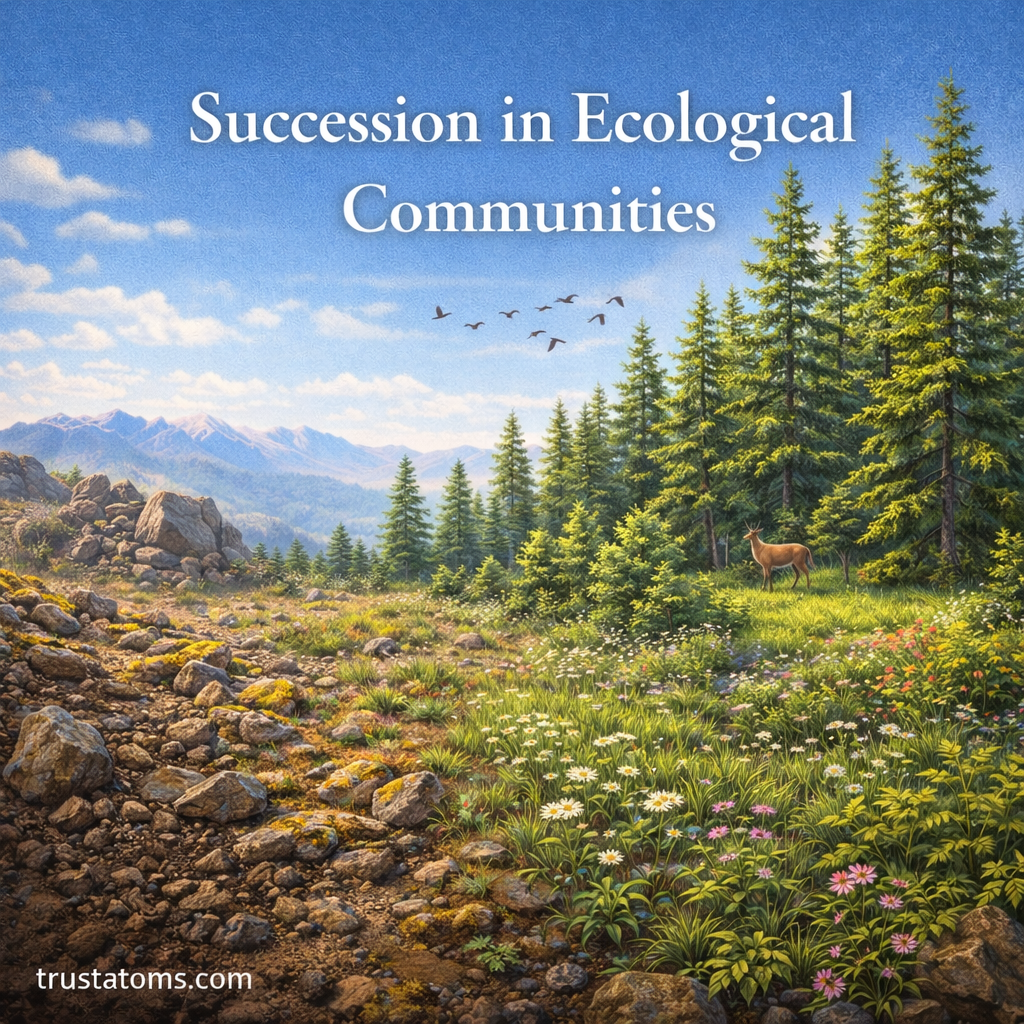
Educational illustration showing stages of ecological succession from bare rock to grasses, shrubs, and a mature forest ecosystem.
Illustrated diagram showing ecological succession as landscapes gradually change from barren ground to mature forest communities. trustatoms.com.

Ecological communities are constantly changing. Over time, plants, animals, and microorganisms gradually replace one another in an area through a natural process known as ecological succession. This process shapes ecosystems after disturbances such as volcanic eruptions, floods, fires, or human activity.

Succession helps ecosystems recover and rebuild, allowing new communities of organisms to develop and adapt to environmental conditions. By studying ecological succession, scientists gain insight into how ecosystems form, evolve, and maintain biodiversity.

Continue reading “Succession in Ecological Communities”

Biogeochemical Cycles in Earth Systems

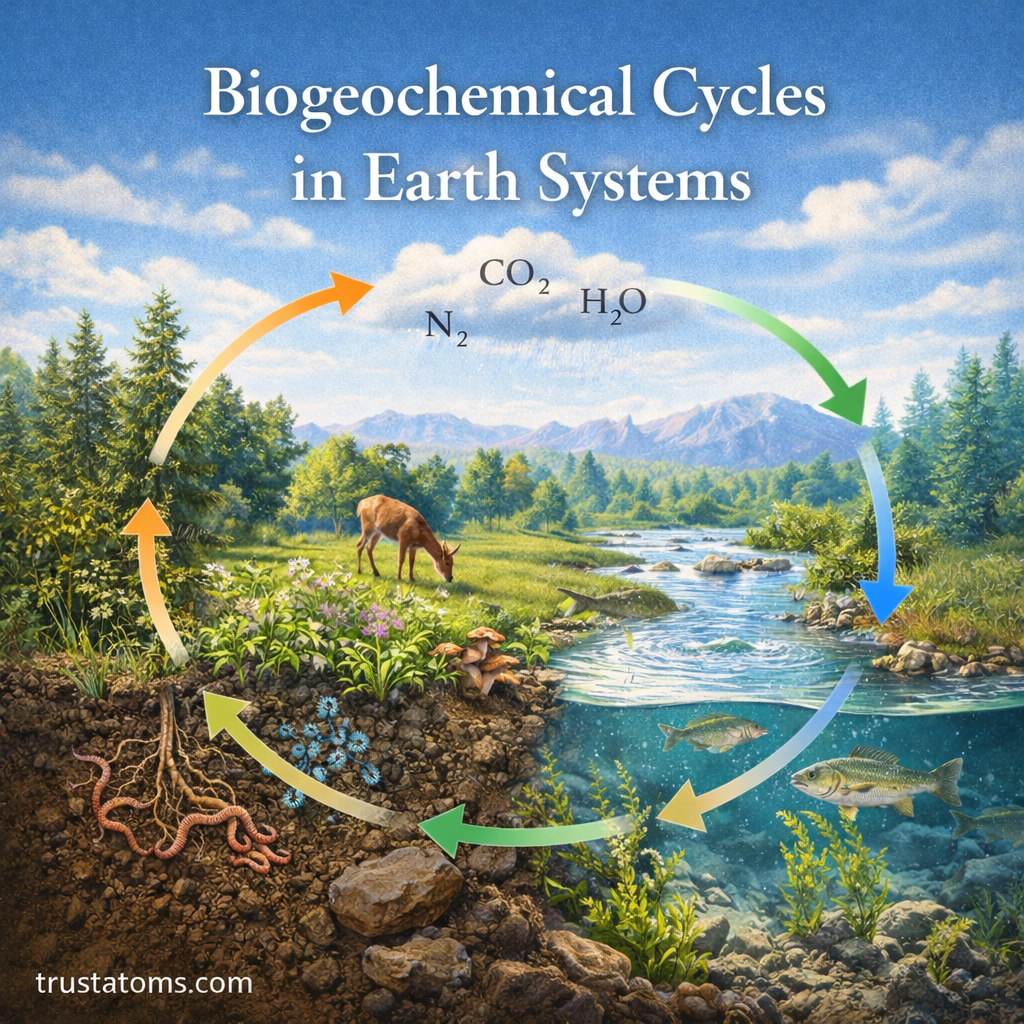
Educational ecosystem diagram illustrating biogeochemical cycles with nutrients moving between atmosphere, land, water, plants, animals, and soil organisms.
Illustrated ecosystem diagram showing how nutrients cycle through Earth systems including the atmosphere, soil, water, plants, and animals. trustatoms.com.

Biogeochemical cycles are fundamental processes that move essential chemical elements through Earth’s living and non-living systems. These cycles connect the biosphere (living organisms) with the atmosphere, hydrosphere, and geosphere, allowing nutrients to circulate through ecosystems and support life.

Without these cycles, critical elements such as carbon, nitrogen, and phosphorus would become locked in one location and unavailable to organisms. Instead, biogeochemical cycles continually redistribute these elements, maintaining ecological balance across the planet.

Understanding these cycles helps scientists study ecosystem productivity, climate change, and environmental sustainability.

Continue reading “Biogeochemical Cycles in Earth Systems”

Nutrient Cycling in Ecosystems

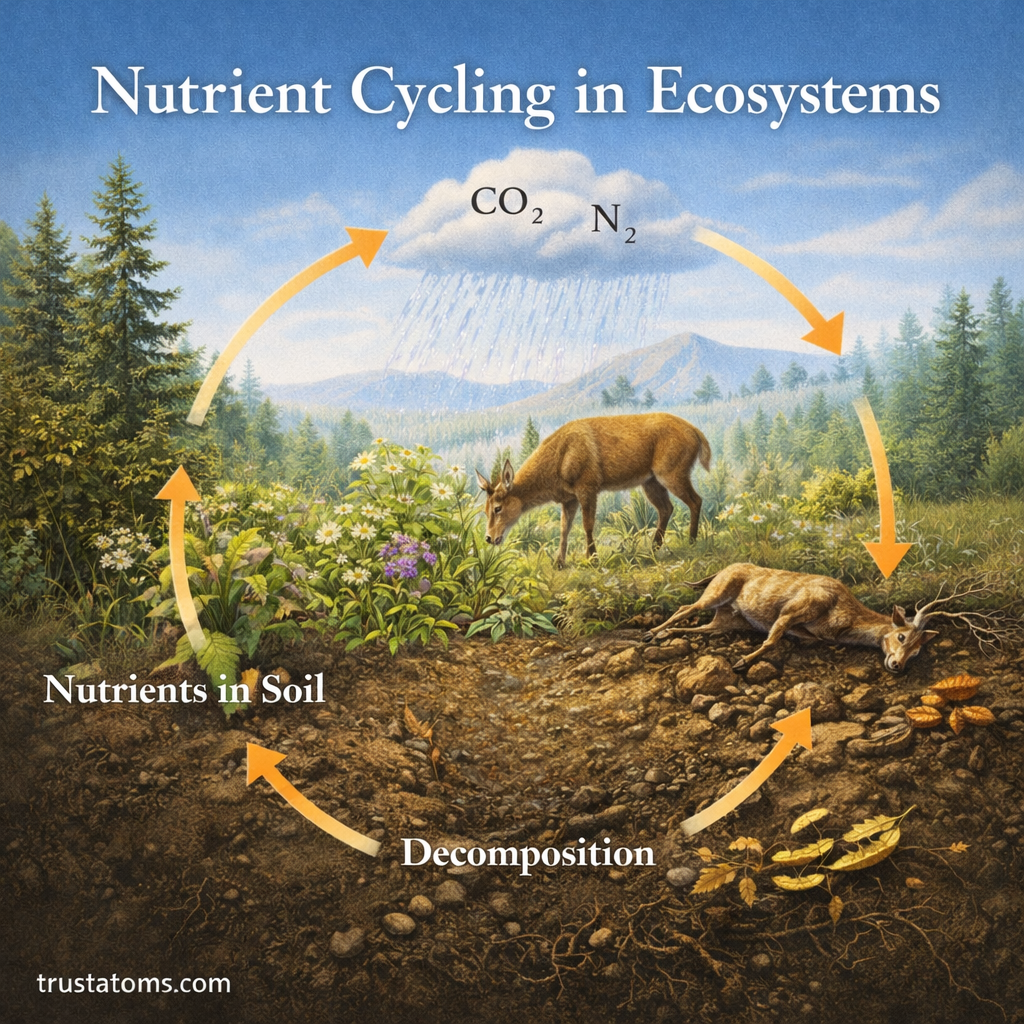
Educational ecosystem diagram illustrating nutrient cycling between plants, animals, soil nutrients, and decomposers in a natural environment.
Illustrated ecosystem diagram showing how nutrients cycle through plants, animals, soil, and decomposers in nature. trustatoms.com.

Nutrient cycling is one of the most essential processes that keeps ecosystems functioning. While energy moves through food chains and is eventually lost as heat, nutrients are continuously recycled through the environment. These nutrients support plant growth, sustain food webs, and help maintain ecological balance.

Every living organism depends on nutrients such as carbon, nitrogen, phosphorus, and water. Through natural biological and chemical processes, these elements move between organisms, soil, water, and the atmosphere. This ongoing movement is known as nutrient cycling.

Understanding nutrient cycling helps scientists explain how ecosystems remain productive and how environmental changes can disrupt ecological stability.

Continue reading “Nutrient Cycling in Ecosystems”

Energy Flow in Trophic Systems

Educational ecosystem diagram showing energy flow through trophic levels from producers and herbivores to carnivores, apex predators, and decomposers.
Illustrated ecosystem diagram showing how energy moves through trophic systems from producers to consumers and decomposers. trustatoms.com.

Energy flow is one of the most important processes in ecology. Every ecosystem depends on the movement of energy through different organisms, from plants that capture sunlight to predators that hunt other animals. This transfer of energy occurs through trophic systems, which organize organisms based on how they obtain energy.

Understanding energy flow helps scientists explain ecosystem stability, food chains, population sizes, and environmental changes. It also shows why ecosystems have many plants but relatively few top predators.

Continue reading “Energy Flow in Trophic Systems”

What Is a Trophic Level?

Educational ecosystem diagram showing trophic levels with plants, herbivores, carnivores, and apex predators connected by arrows representing energy flow.
Illustrated ecosystem diagram showing how energy moves through trophic levels from producers to apex predators. trustatoms.com.

Understanding how energy moves through ecosystems is a fundamental concept in biology. One of the key ideas used to describe this process is the trophic level. Trophic levels help scientists organize living organisms based on how they obtain energy and nutrients.

From plants that capture sunlight to predators at the top of the food chain, every organism occupies a position within a system of energy transfer. By studying trophic levels, biologists can better understand ecosystem balance, food chains, and environmental changes.

Continue reading “What Is a Trophic Level?”

What Is a Food Web?

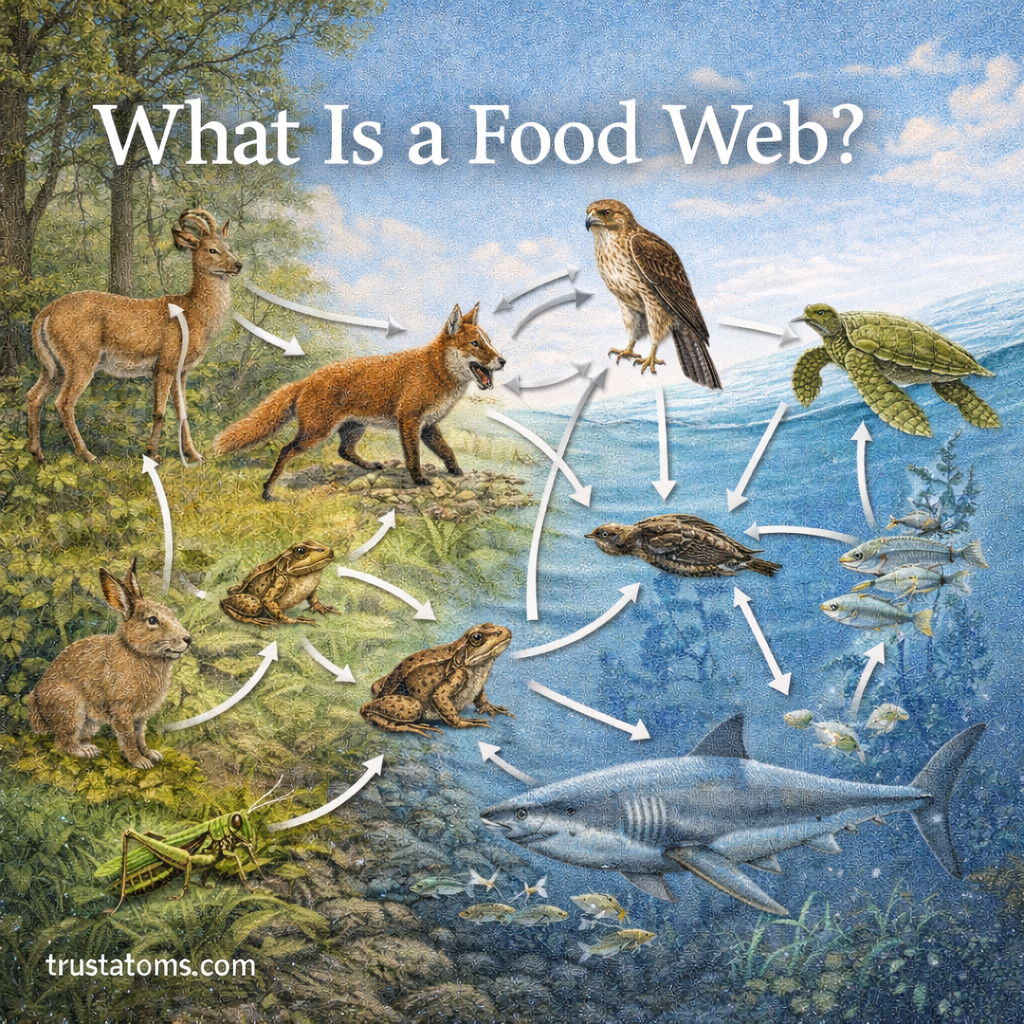
Educational illustration showing a food web with multiple animals connected by arrows representing interconnected feeding relationships in an ecosystem.
Illustration showing a food web with multiple species and feeding relationships demonstrating energy flow in an ecosystem. trustatoms.com.

A food web is a network of interconnected food chains that shows how energy and nutrients move through an ecosystem. Instead of a single pathway of energy flow, a food web illustrates the many feeding relationships that exist between organisms.

In nature, most species eat more than one type of food and are eaten by multiple predators. Because of this complexity, ecosystems function through food webs rather than simple food chains.

Understanding food webs helps scientists study biodiversity, ecosystem stability, and how environmental changes affect the balance of life.

Continue reading “What Is a Food Web?”

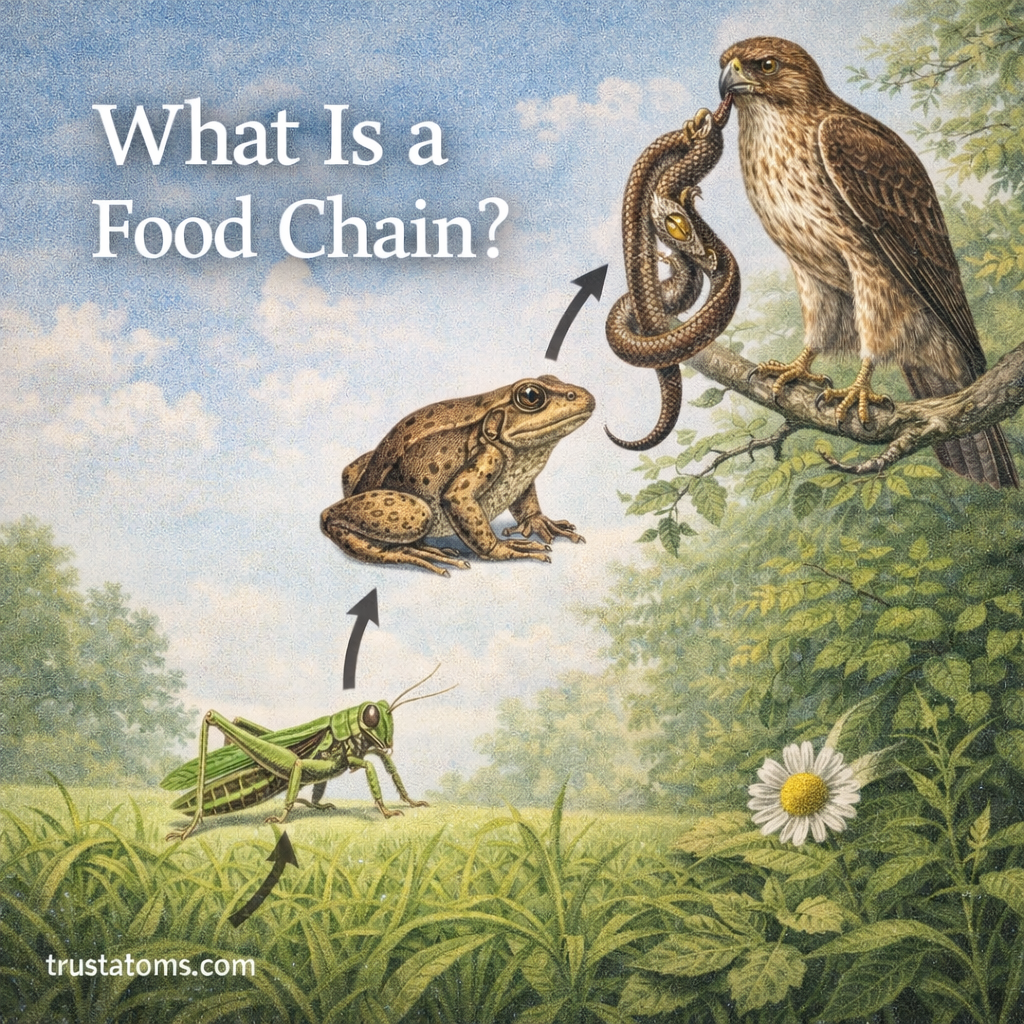
What Is a Food Chain?

Educational illustration showing a food chain with grasshopper, frog, snake, and hawk connected by arrows representing energy flow in an ecosystem.
Illustration showing a simple food chain with grasshopper, frog, snake, and hawk demonstrating energy flow in nature. trustatoms.com.

A food chain is a sequence that shows how energy and nutrients move through living organisms in an ecosystem. It describes who eats whom in nature, starting with producers such as plants and ending with top predators.

Food chains illustrate the flow of energy from one organism to another. Plants capture energy from the sun, herbivores eat plants, and predators consume other animals. This transfer of energy connects all living things within an ecosystem.

Understanding food chains helps scientists study ecosystems, biodiversity, and how environmental changes affect the balance of life on Earth.

Continue reading “What Is a Food Chain?”