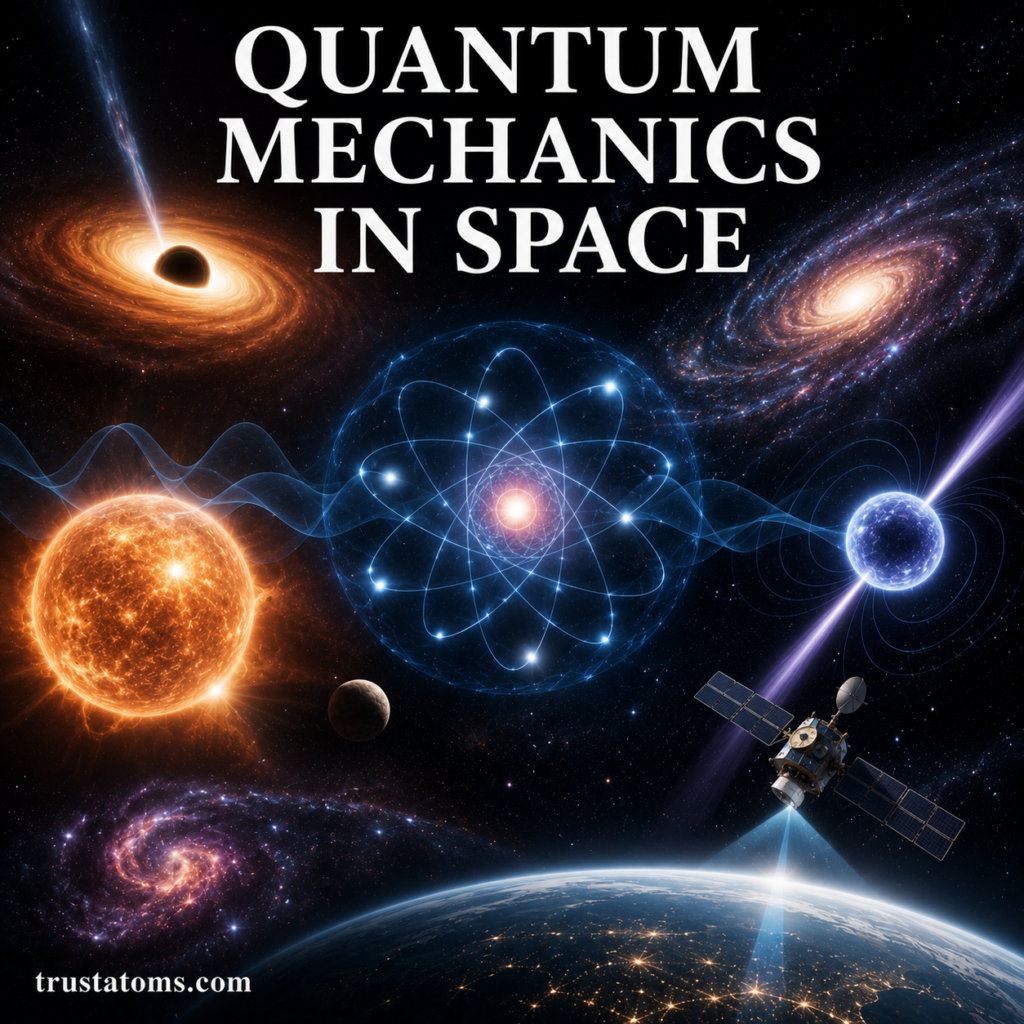
Quantum mechanics is one of the most important and mysterious branches of modern physics. It explains the behavior of matter and energy at extremely small scales, including atoms, electrons, photons, and subatomic particles.
While quantum mechanics is often associated with laboratory experiments and microscopic particles, it also plays a major role in astronomy and space science.
From the formation of stars to black holes, neutron stars, cosmic radiation, and the structure of the early universe, quantum mechanics helps scientists understand some of the most extreme environments in space.
Understanding quantum mechanics in space reveals how the smallest physical laws influence the largest cosmic structures in the universe.
What Is Quantum Mechanics?
Quantum mechanics is the branch of physics that describes how particles behave at atomic and subatomic scales.
Unlike classical physics, quantum systems often behave in surprising and non-intuitive ways.
Key quantum principles include:
- Wave-particle duality
- Quantum uncertainty
- Superposition
- Quantum entanglement
- Probability-based outcomes
- Quantized energy levels
These principles govern matter and energy throughout the universe.
Why Quantum Mechanics Matters in Space
Space contains environments impossible to recreate fully on Earth.
Extreme conditions include:
- Enormous gravity
- Near-light-speed particles
- Ultra-high temperatures
- Intense radiation
- Vacuum conditions
- Superdense matter
Quantum mechanics becomes essential for explaining how matter behaves under these extreme cosmic conditions.
Without quantum physics, modern astronomy would not fully explain:
- Star formation
- Nuclear fusion
- Black hole radiation
- Neutron stars
- Cosmic background radiation
- Particle interactions in space
Wave-Particle Duality in Space
One fundamental quantum principle is wave-particle duality.
Particles such as electrons and photons behave as both:
- Particles
- Waves
This behavior affects many astronomical processes.
Light in Astronomy
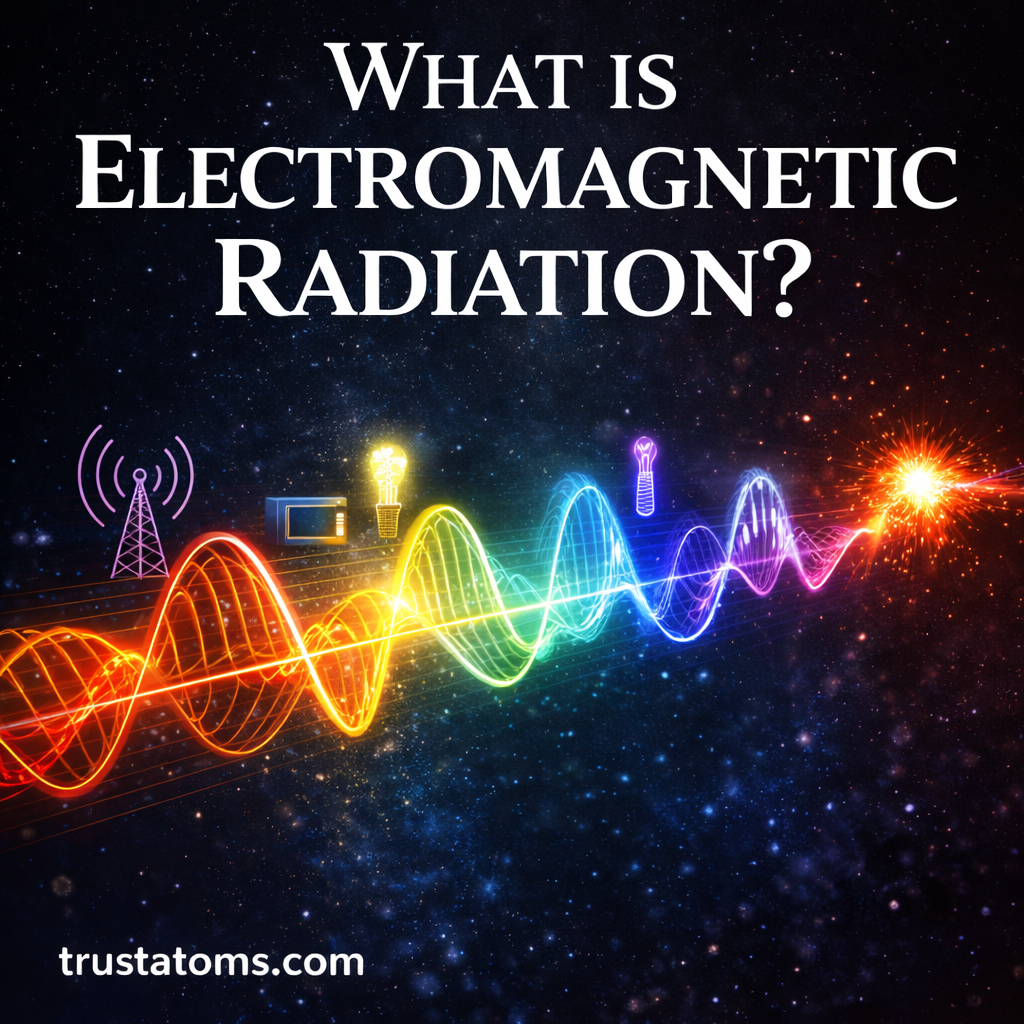
Light behaves as quantized packets called photons.
Astronomers study photons from:
- Stars
- Galaxies
- Pulsars
- Nebulae
- Black holes
Quantum behavior influences how light interacts with matter throughout space.
Quantum Mechanics and Nuclear Fusion
Stars shine because of nuclear fusion powered by quantum processes.
Fusion Inside Stars
Inside stellar cores:
- Hydrogen nuclei collide
- Quantum tunneling allows fusion
- Energy is released
Without quantum tunneling, the Sun’s core would not be hot enough for fusion to occur efficiently.
Quantum Tunneling
Quantum tunneling allows particles to pass through energy barriers that classical physics would forbid.
This process is essential for:
- Stellar energy production
- Element formation
- Long-term star stability
Quantum mechanics therefore directly powers stars throughout the universe.
The Uncertainty Principle
Physicist Werner Heisenberg introduced the uncertainty principle.
It states that certain properties cannot both be measured precisely at the same time.
ΔxΔp≥2ℏ
This principle affects particle behavior throughout space.
Implications in Astronomy
The uncertainty principle contributes to:
- Quantum pressure
- Atomic structure
- Stability of dense stars
- Vacuum fluctuations
Quantum uncertainty influences the structure of matter on both microscopic and cosmic scales.
Quantum Degeneracy Pressure
Quantum mechanics helps prevent certain stars from collapsing completely.
White Dwarfs
White dwarf stars resist gravitational collapse through electron degeneracy pressure.
This pressure results from quantum rules preventing identical electrons from occupying the same quantum state.
Neutron Stars
Neutron stars resist collapse through neutron degeneracy pressure.
These objects contain matter compressed to extraordinary densities.
Quantum mechanics becomes critical for explaining their structure and stability.
Quantum Mechanics and Black Holes
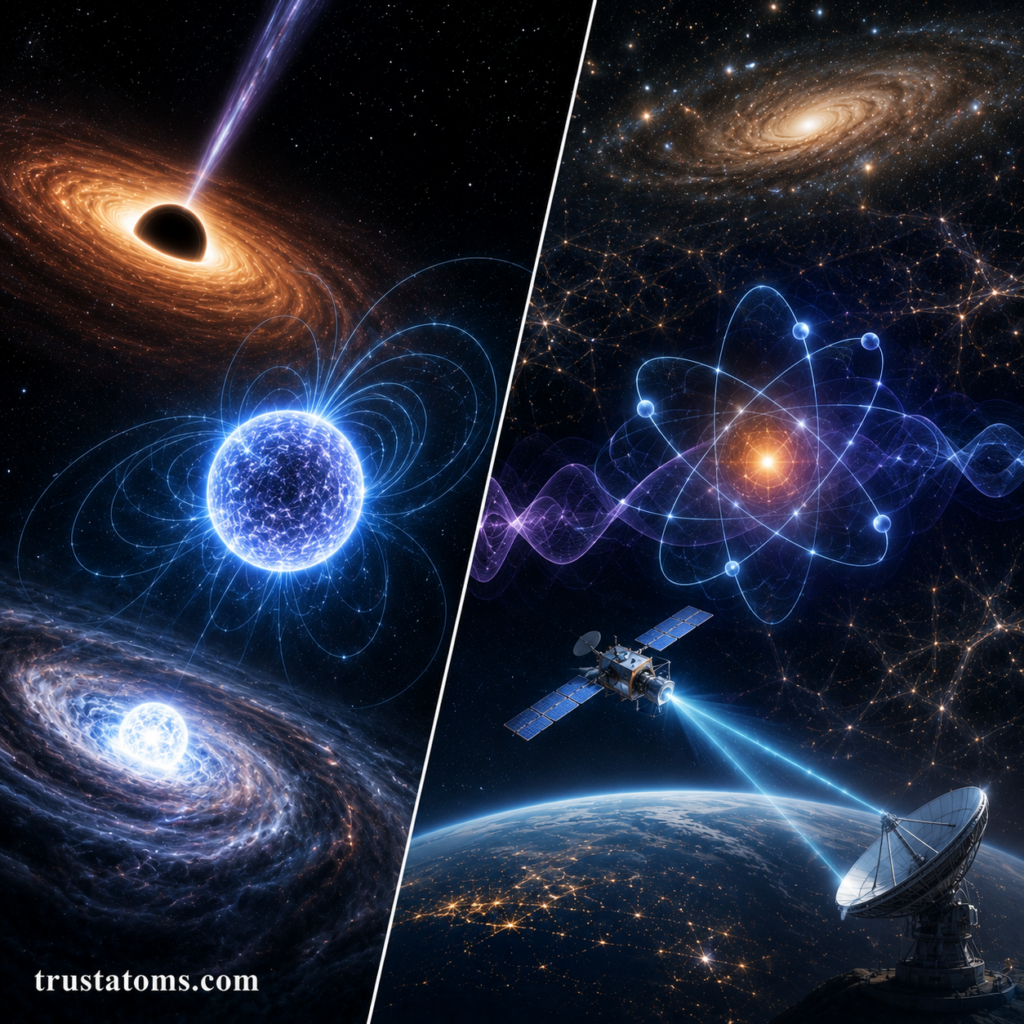
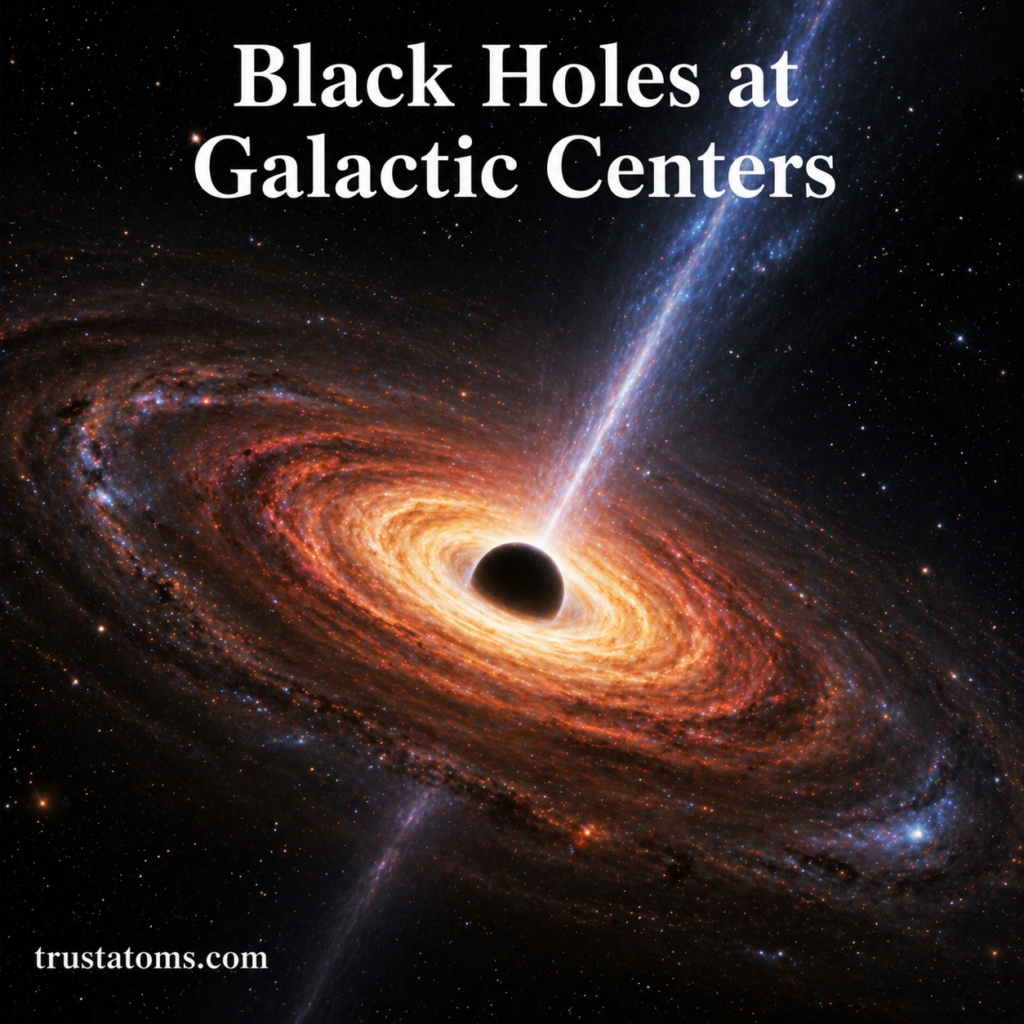
Black holes combine gravity and quantum physics in extreme ways.
Hawking Radiation
Physicist Stephen Hawking proposed that black holes may emit radiation through quantum effects near the event horizon.
This theoretical process is called Hawking radiation.
Hawking radiation suggests black holes could slowly lose mass over time.
Why It Matters
Hawking radiation connects:
- Quantum mechanics
- Thermodynamics
- General relativity
It represents one of the most important attempts to combine gravity and quantum physics.
Quantum Fluctuations in Space
Even empty space contains quantum activity.
Vacuum Fluctuations
Quantum theory predicts that particles can briefly appear and disappear in vacuum space.
These temporary fluctuations may influence:
- Black holes
- Cosmic inflation
- Dark energy
- Early-universe physics
Space is therefore not truly empty at the quantum level.
Quantum Entanglement in Space
Quantum entanglement occurs when particles become linked so their properties remain correlated across large distances.
Entanglement Experiments
Scientists have tested quantum entanglement using satellites and space-based communication systems.
Potential applications include:
- Quantum encryption
- Ultra-secure communication
- Deep-space communication research
Quantum entanglement continues to challenge classical ideas about locality and information transfer.
Quantum Mechanics and the Early Universe
Quantum physics played a major role shortly after the Big Bang.
Quantum Fluctuations After the Big Bang
Tiny quantum fluctuations in the early universe may have eventually grown into:
- Galaxies
- Galaxy clusters
- Cosmic large-scale structure
Modern cosmology studies how quantum effects shaped the universe’s evolution.
Cosmic Inflation
Some theories propose that rapid inflation expanded microscopic quantum fluctuations to cosmic scales.
This may explain patterns observed in the cosmic microwave background radiation.
Cosmic Rays and High-Energy Particles
Space contains extremely energetic particles traveling near light speed.
Quantum Particle Interactions
Cosmic rays interact through quantum processes involving:
- Particle collisions
- Nuclear reactions
- Radiation emission
Studying these particles helps scientists investigate extreme physics beyond Earth laboratories.
Quantum Mechanics and Dark Matter
Dark matter remains one of astronomy’s biggest mysteries.
Some dark matter theories involve hypothetical quantum particles such as:
- WIMPs
- Axions
- Sterile neutrinos
Quantum physics may eventually help identify the true nature of dark matter.
Quantum Gravity and Space
One major challenge in modern physics is combining quantum mechanics with general relativity.
Why It’s Difficult
Quantum mechanics describes small-scale physics extremely well.
General relativity describes gravity and large-scale spacetime extremely well.
However, the two theories become difficult to reconcile under extreme conditions such as:
- Black hole singularities
- The Big Bang
- Planck-scale physics
Quantum Gravity Theories
Researchers investigate possible solutions including:
- String theory
- Loop quantum gravity
- Holographic theories
A complete quantum gravity theory remains undiscovered.
Space-Based Quantum Research
Space provides unique conditions for quantum experiments.
Why Space Is Useful
Advantages include:
- Microgravity
- Long-distance particle testing
- Reduced environmental interference
- Vacuum conditions
Space agencies increasingly explore quantum technologies for future missions.
Quantum Technologies in Space
Potential applications include:
- Quantum navigation
- Secure communication
- Precision sensors
- Improved timing systems
Quantum science may influence future spacecraft systems significantly.
Quantum Mechanics and Time
Quantum physics also raises questions about time itself.
Scientists continue studying:
- Quantum time behavior
- Information paradoxes
- Time symmetry
- Quantum causality
These topics become especially important near black holes and during early-universe conditions.
Why Quantum Mechanics in Space Matters
Quantum mechanics helps explain some of the universe’s most fundamental processes.
It influences:
- Star energy production
- Black hole behavior
- Cosmic structure formation
- Particle interactions
- Early-universe evolution
Modern astronomy depends heavily on quantum physics to interpret observations accurately.
Future Discoveries in Quantum Astronomy
Future observatories and experiments may reveal new quantum phenomena in space.
Scientists hope to learn more about:
- Dark matter particles
- Quantum gravity
- Black hole information
- Cosmic inflation
- High-energy particle physics
Advances in technology may eventually uncover entirely new physics beyond current theories.
Final Thoughts
Quantum mechanics in space connects the smallest scales of physics with the largest structures in the universe.
From powering stars through nuclear fusion to shaping black holes, neutron stars, and cosmic evolution, quantum physics plays a critical role throughout astronomy and cosmology.
Although many quantum mysteries remain unsolved, ongoing research continues expanding our understanding of how the universe behaves under extreme conditions.
Future discoveries in quantum astronomy may ultimately reshape humanity’s understanding of matter, gravity, spacetime, and the origins of the cosmos itself.