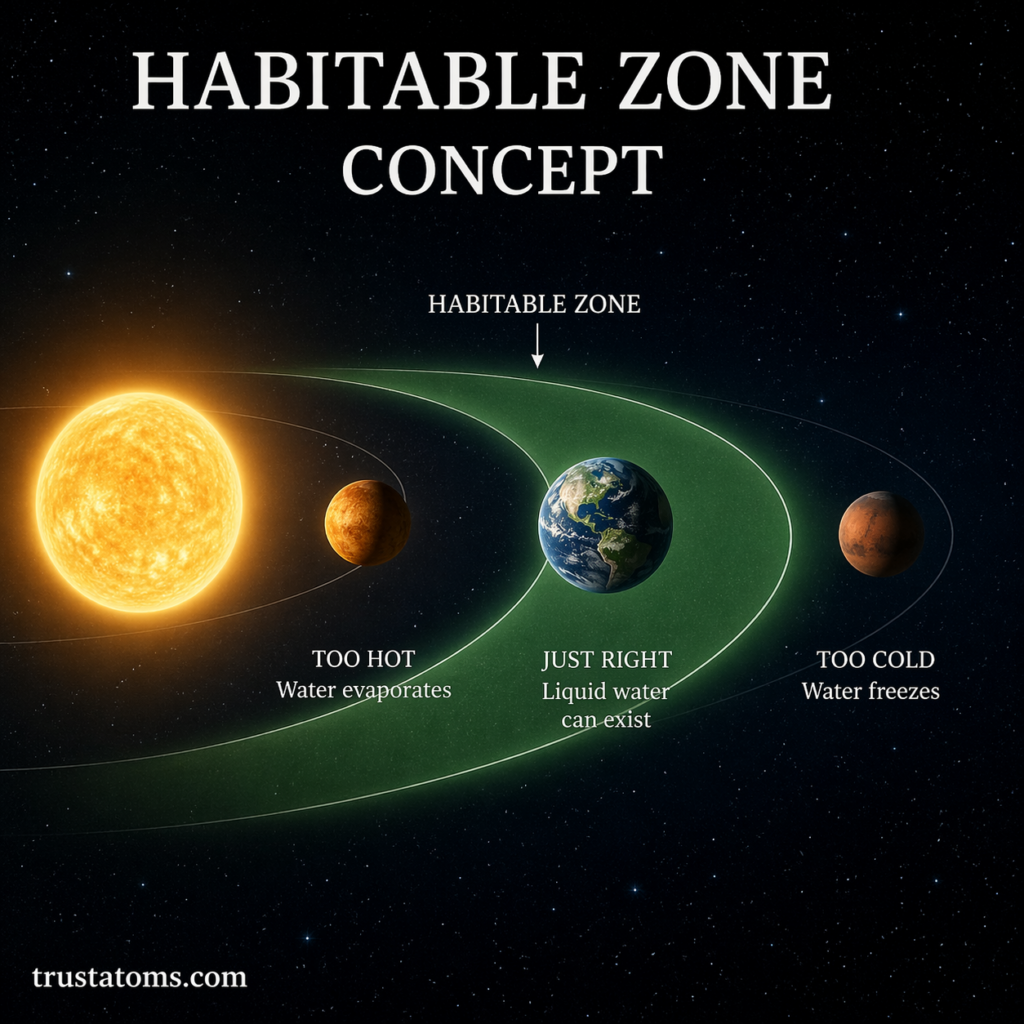
The habitable zone is one of the most important ideas in modern astronomy, especially in the search for life beyond Earth. Often called the “Goldilocks zone,” it refers to the region around a star where conditions may be just right for liquid water to exist on a planet’s surface.
Since liquid water is essential for life as we know it, understanding habitable zones helps scientists identify which distant worlds could potentially support life.
What Is the Habitable Zone?
The habitable zone (HZ) is the range of distances from a star where a planet could maintain temperatures suitable for liquid water.
If a planet is:
- Too close to its star → water evaporates (too hot)
- Too far from its star → water freezes (too cold)
- Just right → water can remain liquid
This balance depends largely on the star’s energy output and the planet’s atmospheric conditions.
Why Liquid Water Matters
Liquid water is considered a key ingredient for life because it:
- Acts as a solvent for chemical reactions
- Helps transport nutrients
- Stabilizes temperature environments
- Supports complex biological processes
On Earth, water is fundamental to every known life form, making it the primary target when scientists search for habitable planets.
Factors That Define a Habitable Zone
The habitable zone is not fixed—it varies based on several factors.
1. Star Type and Size
Hot, large stars:
- Emit more energy
- Have habitable zones farther away
Cool, smaller stars:
- Emit less energy
- Have habitable zones much closer in
For example:
- Our Sun has a moderate habitable zone
- Red dwarf stars have very tight, close-in habitable zones
2. Planetary Atmosphere
A planet’s atmosphere can dramatically affect its temperature through the greenhouse effect.
- Thick atmosphere → traps heat → warmer planet
- Thin or no atmosphere → heat escapes → colder planet
A good example is:
- Venus: too hot due to extreme greenhouse effect
- Mars: too cold due to thin atmosphere
3. Orbital Distance
A planet’s average distance from its star determines how much energy it receives.
- Stable, nearly circular orbits are ideal
- Highly elliptical orbits can cause extreme temperature swings
The Sun’s Habitable Zone
In our solar system, the habitable zone includes:
- Earth (perfectly within the zone)
- Mars (near the outer edge)
- Venus (near the inner edge, but too hot due to atmosphere)
Earth remains the only known planet with stable liquid water on its surface.
Beyond Distance: The “Habitable Zone” Is More Complex
While distance from a star is important, habitability involves more than just location.
Additional factors include:
- Magnetic field (protects from radiation)
- Planet size and gravity (retains atmosphere)
- Geological activity (regulates climate)
- Presence of water sources
- Atmospheric composition
Because of this, some planets in the habitable zone may still be uninhabitable.
Habitable Zones Around Different Stars
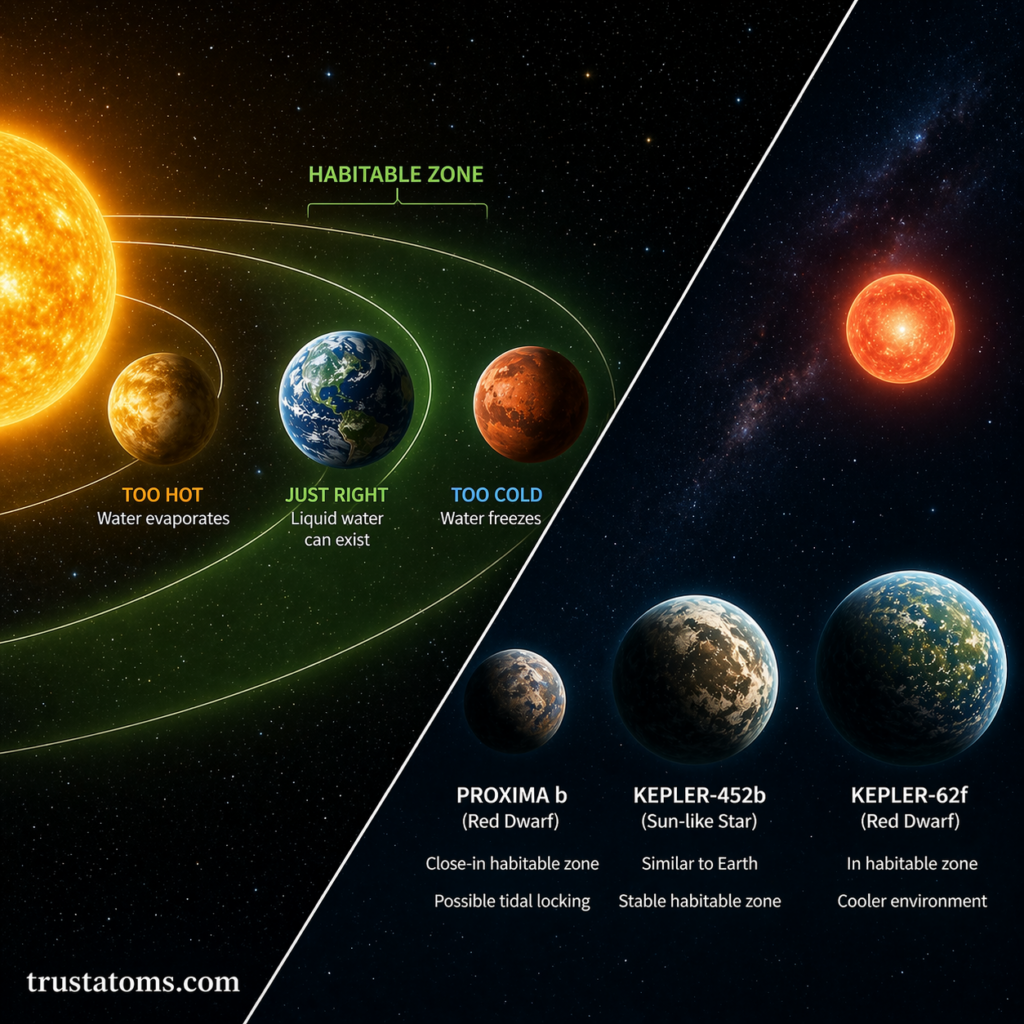
Different types of stars create very different habitable environments.
Red Dwarf Stars
- Most common stars in the galaxy
- Long lifespans
- Planets must orbit very close
Challenges:
- Strong stellar flares
- Tidal locking (one side always facing the star)
Sun-Like Stars
- Stable energy output
- Balanced habitable zones
- Best candidates for Earth-like planets
Giant Stars
- Very wide habitable zones
- Short lifespans
- Less time for life to develop
The Search for Habitable Exoplanets
Astronomers use powerful telescopes and missions to find planets in habitable zones.
Key methods include:
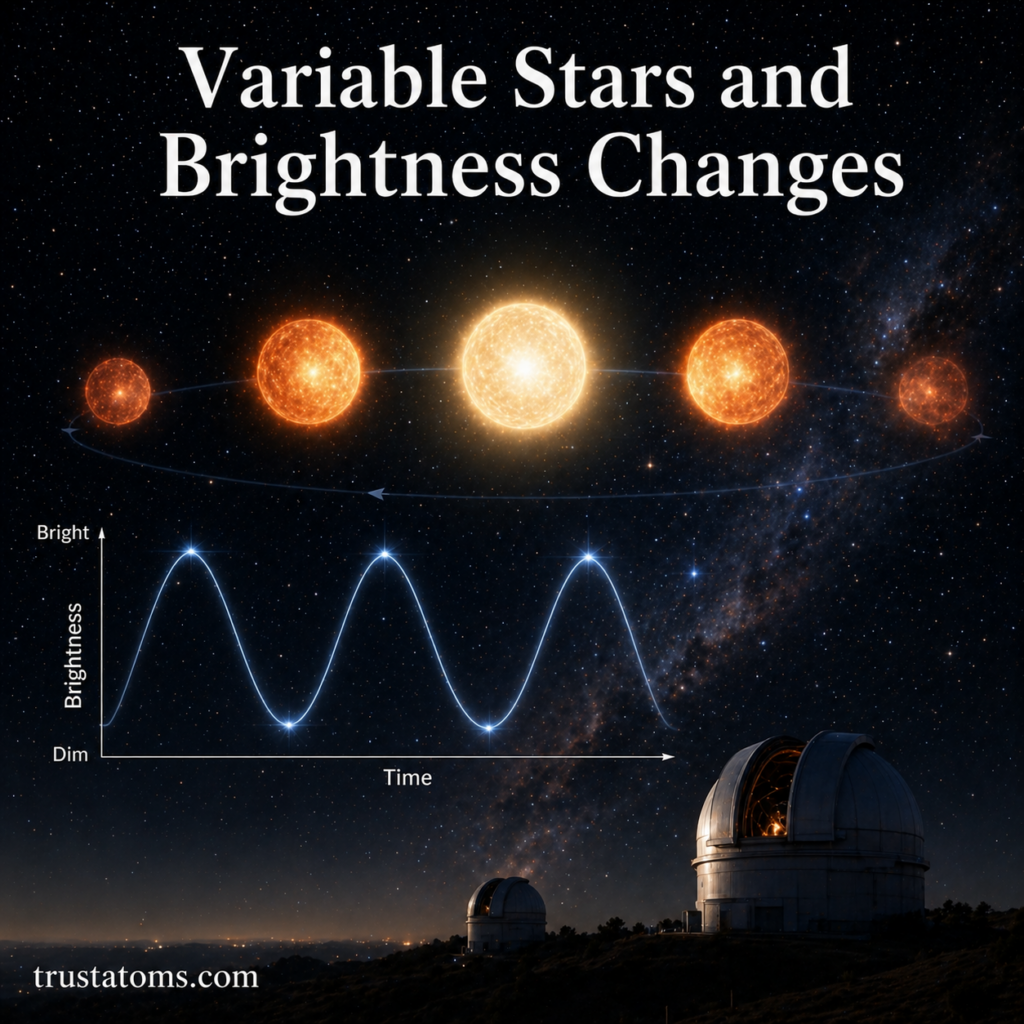
- Transit method (detecting dips in starlight)
- Radial velocity (measuring star wobble)
- Direct imaging (rare but growing)
Notable discoveries include planets in habitable zones of distant stars, known as exoplanets.
Scientists analyze:
- Planet size
- Orbital distance
- Star type
- Atmospheric signals
Can Life Exist Outside the Habitable Zone?
Interestingly, life might exist even outside traditional habitable zones.
Examples include:
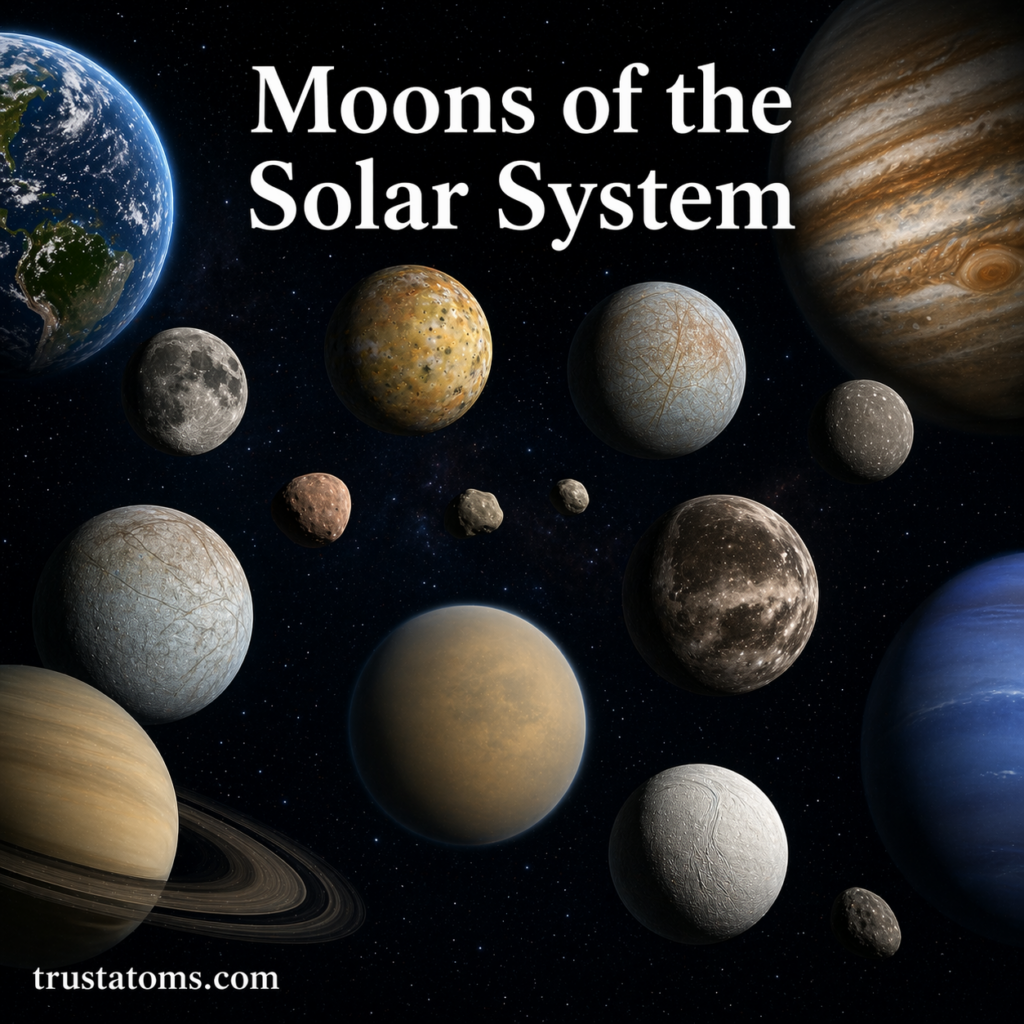
- Moons with subsurface oceans (like Europa or Enceladus)
- Planets with internal heat sources
- Thick atmospheres that trap heat
This expands the idea of habitability beyond just surface liquid water.
Common Misconceptions About the Habitable Zone
“Habitable zone means habitable planet”
Not necessarily. A planet in the zone could still lack:
- Atmosphere
- Water
- Stable climate
“Earth is exactly in the center”
Earth is comfortably within the habitable zone, but not perfectly centered.
“Only Sun-like stars can host life”
Smaller stars may also host habitable planets, though conditions differ.
Why the Habitable Zone Matters
Understanding habitable zones helps scientists:
- Narrow down targets in the search for life
- Study planetary climates and evolution
- Understand Earth’s uniqueness
- Guide future space missions
It is a foundational concept in astrobiology and planetary science.
Final Thoughts
The habitable zone concept provides a powerful framework for exploring the universe and identifying worlds that might support life. While it simplifies a complex reality, it remains one of the most useful tools scientists have in the search for Earth-like planets.
As technology improves, our ability to detect and study these distant worlds continues to grow—bringing us closer to answering one of humanity’s biggest questions: Are we alone?