When an earthquake occurs, energy is released deep within the Earth. This energy travels outward in all directions in the form of seismic waves. These waves are what cause the shaking we feel on the surface.
Understanding seismic wave propagation is essential for studying earthquakes, locating their origin, and designing safer structures.
What Are Seismic Waves?
Seismic waves are vibrations that travel through the Earth after a sudden release of energy, usually caused by fault movement.
They move through:
- Solid rock
- Liquid layers
- The Earth’s surface
Scientists study these waves using instruments called seismographs to understand how earthquakes behave.
Types of Seismic Waves
Seismic waves are divided into two main categories:
- Body waves (travel through the Earth’s interior)
- Surface waves (travel along the Earth’s surface)
Body Waves
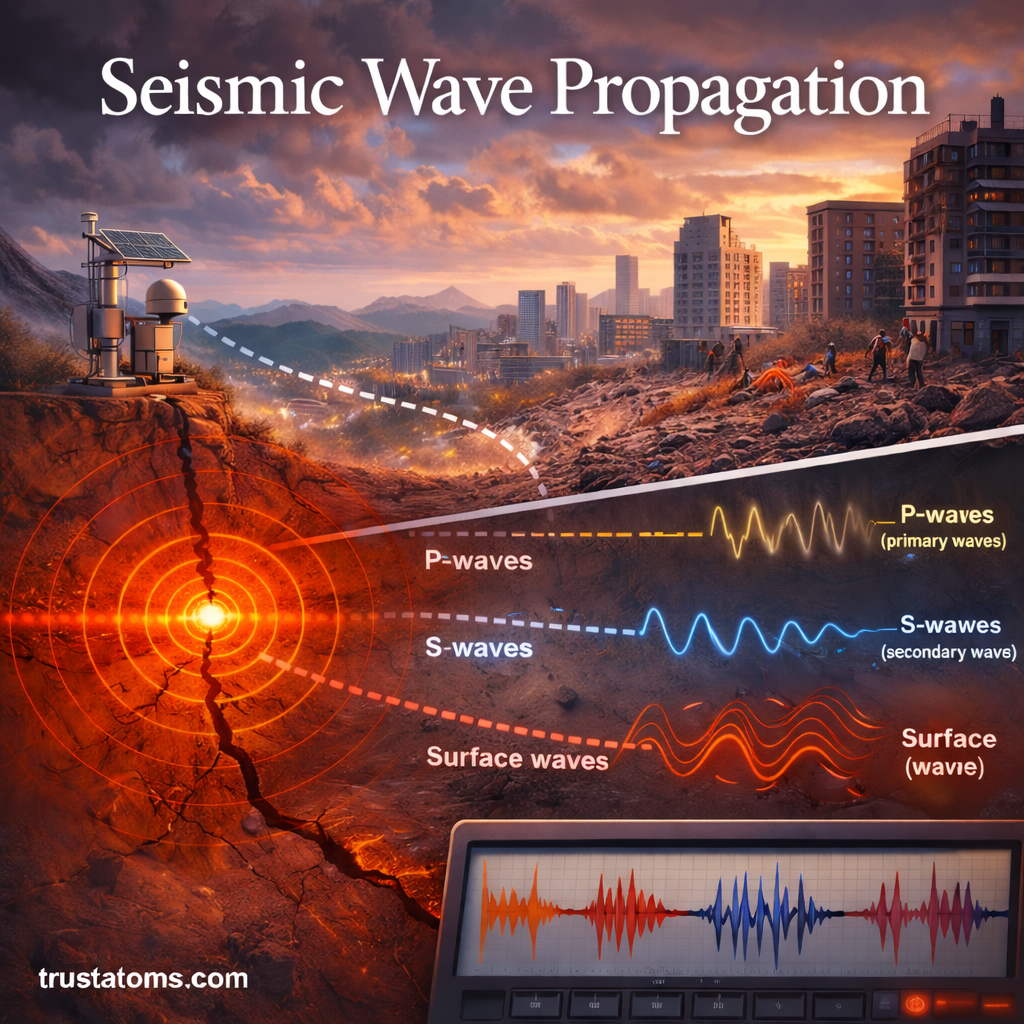
Body waves move through the internal layers of the Earth and are the first to be detected.
1. Primary Waves (P-Waves)
- Fastest seismic waves
- Travel through solids, liquids, and gases
- Compress and expand material in the direction of travel
Key characteristics:
- First to arrive at seismic stations
- Usually cause minimal damage
2. Secondary Waves (S-Waves)
- Slower than P-waves
- Travel only through solids
- Move material perpendicular to the direction of travel
Key characteristics:
- Cannot pass through liquids (like the outer core)
- Responsible for stronger ground shaking
Surface Waves
Surface waves travel along the Earth’s surface and typically cause the most damage.
1. Love Waves
- Move side-to-side horizontally
- Cause buildings to sway
2. Rayleigh Waves
- Produce a rolling motion (like ocean waves)
- Move both vertically and horizontally
How Seismic Waves Propagate
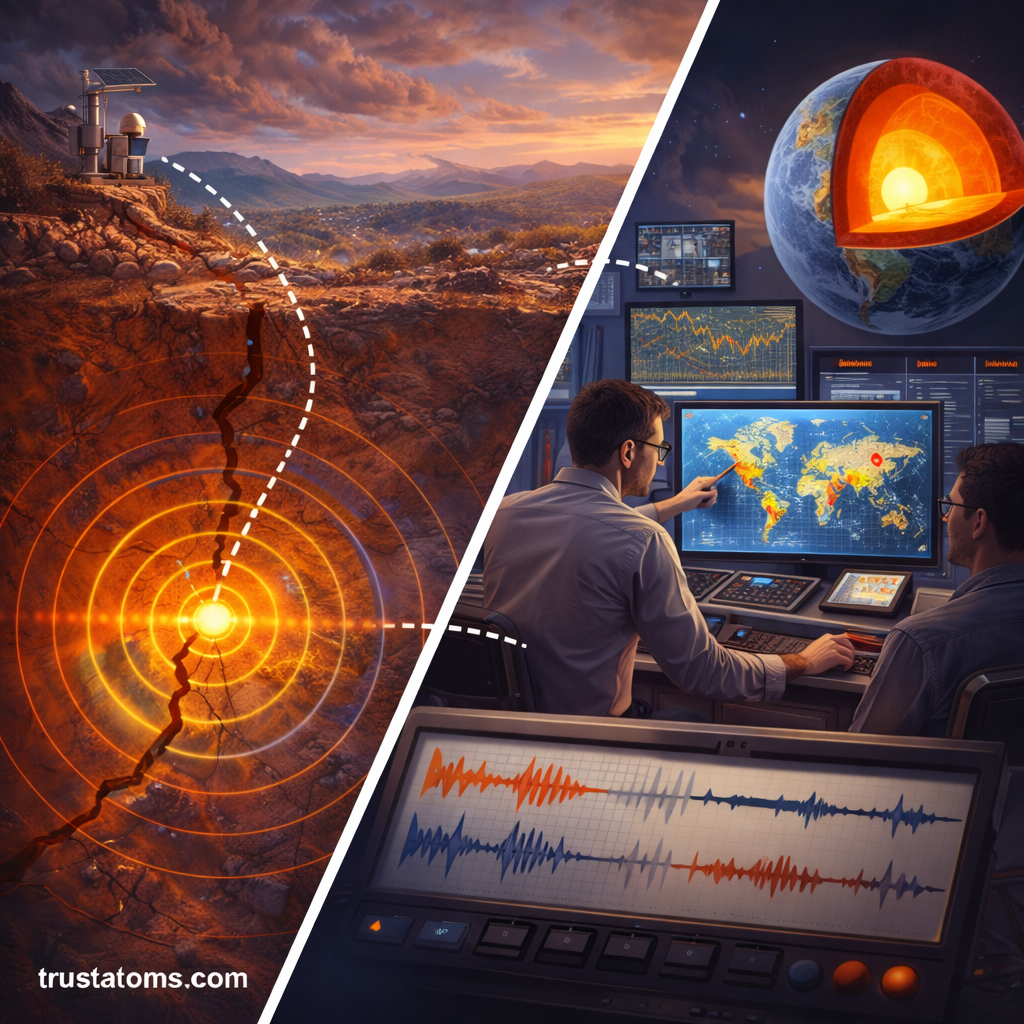
Seismic wave propagation depends on how energy moves through different materials.
Key Factors That Affect Propagation:
- Density of materials
- Elastic properties of rocks
- Temperature and pressure conditions
- Layer boundaries within the Earth
When waves encounter different materials, they can:
- Reflect (bounce back)
- Refract (change direction)
- Slow down or speed up
Why Seismic Waves Matter
Seismic waves provide critical information about the Earth and earthquakes.
Locating Earthquakes
By measuring the arrival times of P-waves and S-waves, scientists can determine:
- The location of the earthquake epicenter
- The depth of the घटना (event)
Understanding Earth’s Interior
Seismic waves reveal details about Earth’s structure:
- Crust
- Mantle
- Core
For example, the fact that S-waves cannot travel through liquids helped scientists discover that the Earth’s outer core is liquid.
Seismic Wave Speed and Behavior
Different waves travel at different speeds:
- P-waves: fastest
- S-waves: slower
- Surface waves: slowest but most destructive
Speed depends on the material:
- Faster in dense, solid rock
- Slower in softer or less rigid materials
This variation is why some regions experience stronger shaking than others.
Real-World Applications
Understanding seismic wave propagation has many practical uses.
Earthquake Early Warning Systems
Systems like ShakeAlert detect fast-moving P-waves to provide warnings before stronger shaking arrives.
Engineering and Construction
Engineers use seismic data to:
- Design earthquake-resistant structures
- Identify high-risk areas
- Improve building materials and techniques
Oil and Gas Exploration
Seismic waves are used to map underground resources by analyzing how waves reflect off different layers.
Seismic Wave Measurement Tools
Scientists rely on specialized equipment to study wave propagation.
Seismographs
- Record ground motion
- Detect even small vibrations
Seismic Networks
- Multiple stations work together
- Provide accurate location and magnitude data
Computer Models
- Simulate how waves move through the Earth
- Help predict ground shaking patterns
Common Misconceptions
“All seismic waves are equally dangerous”
Surface waves usually cause the most damage, not the fastest waves.
“Seismic waves only travel through solid rock”
P-waves can travel through liquids and gases as well.
“Stronger earthquakes always mean worse damage”
Damage depends on many factors, including wave type, depth, and local geology.
Lessons From Seismic Wave Studies
Research into seismic waves has led to major scientific advancements:
- Better earthquake detection and monitoring
- Improved understanding of Earth’s internal structure
- Safer building designs in seismic regions
Final Thoughts
Seismic wave propagation is a key concept in understanding how earthquakes affect the Earth. These waves carry energy across vast distances, revealing important information about both the earthquake itself and the planet’s internal structure.
By studying how seismic waves travel, scientists can improve early warning systems, enhance safety measures, and deepen our understanding of the dynamic Earth.