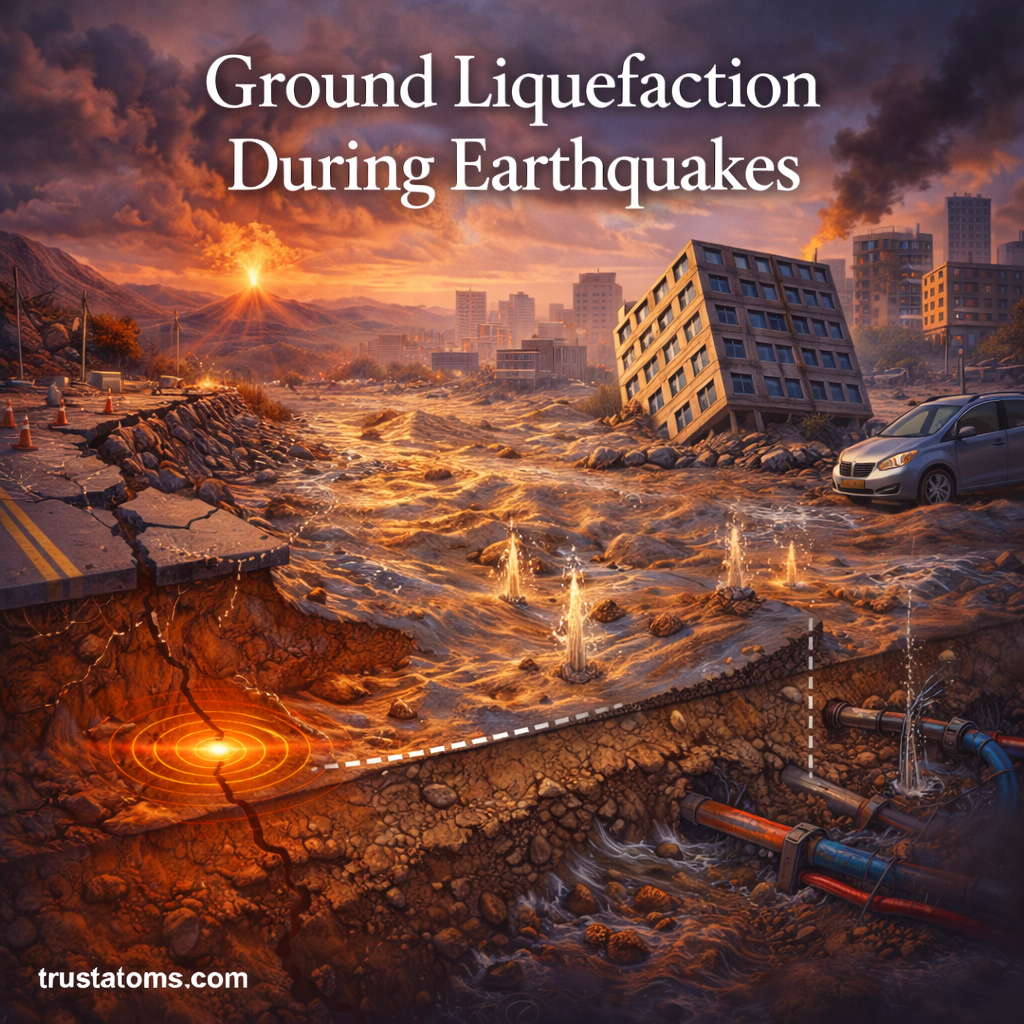
During powerful earthquakes, the ground beneath our feet can suddenly lose its strength and stability. In some cases, solid soil begins to behave like a liquid—a phenomenon known as ground liquefaction.
This process can cause buildings to sink, roads to crack, and infrastructure to fail, even in areas far from the earthquake’s epicenter. Understanding liquefaction is essential for reducing earthquake damage and improving safety.
What Is Ground Liquefaction?
Ground liquefaction occurs when saturated soil temporarily loses its strength due to intense shaking during an earthquake.
In simple terms:
- Soil particles lose contact with each other
- Water pressure between particles increases
- The ground behaves like a fluid instead of a solid
This can lead to dramatic and dangerous ground movement.
How Liquefaction Happens

Liquefaction typically occurs in loose, water-saturated soils such as sand or silt.
Step-by-Step Process:
- An earthquake causes strong ground shaking
- Soil particles are disturbed and compacted
- Water trapped between particles builds pressure
- The pressure reduces friction between particles
- The soil loses strength and begins to flow
Conditions That Increase Liquefaction Risk
Not all areas are equally vulnerable. Several factors increase the likelihood of liquefaction.
1. Soil Type
- Loose, sandy soils are most susceptible
- Silty soils can also liquefy
- Dense or rocky soils are less likely to be affected
2. Water Saturation
- High groundwater levels increase risk
- Coastal regions and riverbanks are especially vulnerable
3. Earthquake Strength
- Stronger and longer-lasting shaking increases the chance of liquefaction
4. Depth of Soil Layers
- Shallow, loose soil layers are more prone to failure
Effects of Ground Liquefaction
Liquefaction can cause severe and widespread damage.
Structural Damage
- Buildings may tilt or sink
- Foundations can crack or collapse
- Bridges and roads may become unstable
Ground Deformation
- Lateral spreading (horizontal ground movement)
- Settlement (ground sinking)
- Surface cracking
Infrastructure Failure
- Broken water and gas lines
- Damaged sewer systems
- Disrupted transportation networks
Real-World Examples
Ground liquefaction has been observed in many major earthquakes.
1964 Niigata Earthquake (Japan)
- Buildings tilted dramatically but remained intact
- Liquefaction caused soil to behave like a fluid
- Became a key case study for engineers
1989 Loma Prieta Earthquake (USA)
- Significant liquefaction in the San Francisco Bay Area
- Damage to roads, bridges, and buildings
2011 Christchurch Earthquake (New Zealand)
- Severe liquefaction across urban areas
- Widespread flooding and ground instability
- Major impact on infrastructure and housing
Why Liquefaction Matters in Earth Science
Liquefaction is a critical factor in understanding earthquake damage.
Key Reasons:
- Explains why some areas suffer more damage than others
- Helps identify high-risk zones
- Guides safer construction practices
Even moderate earthquakes can cause severe damage if liquefaction conditions are present.
How Engineers Reduce Liquefaction Risk
Modern engineering techniques can significantly reduce the impact of liquefaction.
Ground Improvement Methods
- Compacting loose soil
- Adding drainage systems to reduce water pressure
- Mixing soil with stabilizing materials
Foundation Design
- Deep foundations (piles) anchored in stable layers
- Reinforced structures that can withstand movement
Land-Use Planning
- Avoiding construction in high-risk areas
- Using hazard maps to guide development
How Scientists Identify Liquefaction Zones
Experts use a combination of tools and data to assess risk.
Methods Include:
- Soil testing and sampling
- Groundwater level analysis
- Historical earthquake data
- Computer modeling
These assessments help governments and engineers plan safer communities.
Common Misconceptions
“Liquefaction only happens near the ocean”
While common in coastal areas, it can also occur inland near rivers, lakes, or areas with high groundwater.
“Only large earthquakes cause liquefaction”
Even moderate earthquakes can trigger liquefaction if conditions are right.
“Liquefaction destroys all buildings”
Some buildings remain standing but may tilt or become unusable due to foundation damage.
How Individuals Can Stay Safer
While liquefaction is difficult to predict at a local level, awareness can help reduce risk.
Practical Tips:
- Know if you live in a liquefaction-prone area
- Follow local building codes and regulations
- Prepare an emergency plan for earthquakes
- Stay informed about local hazards
Lessons From Past Events
Historic earthquakes have taught us valuable lessons:
- Soil conditions are just as important as earthquake magnitude
- Engineering improvements can reduce damage significantly
- Prepared communities recover faster
Final Thoughts
Ground liquefaction is one of the most surprising and destructive effects of earthquakes. It turns solid ground into an unstable, flowing surface—posing serious risks to buildings and infrastructure.
By understanding how liquefaction works and where it is likely to occur, scientists, engineers, and communities can take steps to reduce its impact and build safer environments.