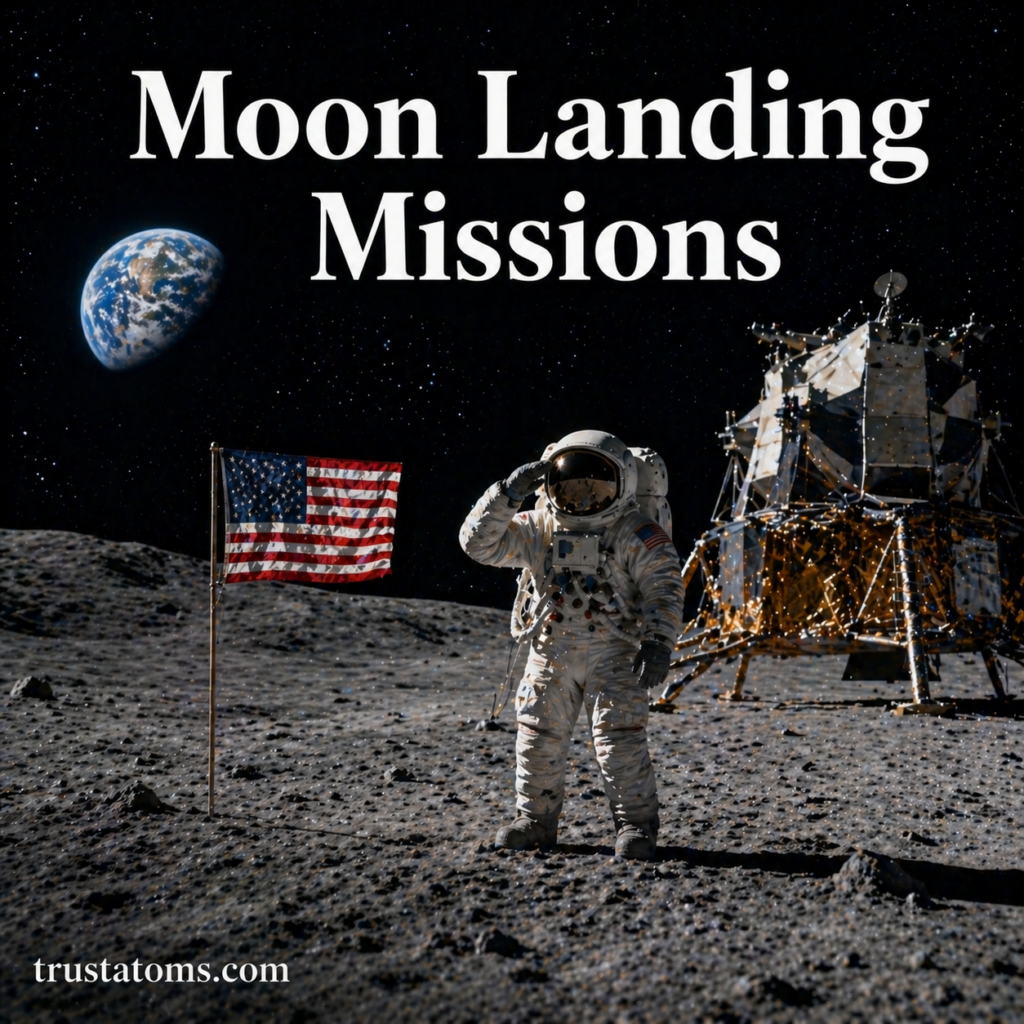
Moon landing missions are space expeditions that deliver robotic spacecraft or human explorers to the lunar surface for scientific investigation and exploration. The first successful robotic soft landing occurred in 1966, followed by the first crewed Moon landing during NASA’s Apollo 11 mission on July 20, 1969.
Moon landing missions represent one of the most extraordinary achievements in human history of space exploration. They required advances in navigation, propulsion, spacecraft engineering, and scientific research, transforming our understanding of the Moon and contributing to the study of astronomy.
From early Soviet probes to American astronauts and modern robotic landers, lunar missions have revealed the Moon’s geology, surface conditions, and resources. Their findings continue to shape plans for future human exploration.
What Are Moon Landing Missions?
Moon landing missions are spacecraft expeditions designed to reach the lunar surface. Some carry scientific instruments that operate automatically, while others transport astronauts who conduct experiments, collect samples, and explore the surrounding terrain.
There are two main categories:
- Robotic missions: Uncrewed spacecraft that land scientific instruments, deploy rovers, or collect samples for analysis.
- Crewed missions: Spacecraft that transport astronauts to the lunar surface and provide systems for their safe return.
Not every mission to the Moon includes a landing. Orbiters study the surface from above, while impact probes deliberately strike the Moon to gather measurements. The development of these spacecraft is explored in Lunar Exploration Probes.
Successful crewed lunar landings are among the achievements covered in Human Spaceflight Milestones, alongside earlier missions that demonstrated humans could survive and work in space.
Early Robotic Missions to the Moon
Before astronauts could attempt a lunar landing, robotic spacecraft helped engineers understand the Moon’s surface and test navigation systems. The Soviet Union’s Luna program achieved several important early milestones.
| Mission | Year | Achievement |
|---|---|---|
| Luna 2 | 1959 | First human-made spacecraft to reach the Moon, impacting its surface. |
| Luna 9 | 1966 | First successful soft landing on the Moon. |
| Surveyor 1 | 1966 | First successful American robotic soft landing. |
| Luna 16 | 1970 | First successful robotic return of lunar soil samples to Earth. |
A soft landing means a spacecraft reaches the surface at a controlled speed rather than crashing into it. Luna 9 demonstrated that a spacecraft could survive touchdown and transmit photographs from the lunar surface.
American Surveyor missions subsequently examined landing conditions and helped prepare for Apollo. Their measurements provided useful evidence about the strength and properties of lunar soil.
The Apollo Program and the First Human Moon Landing
NASA’s Apollo program was developed to land astronauts on the Moon and return them safely to Earth. It followed earlier American spaceflight programs that tested crewed spacecraft, orbital operations, and rendezvous procedures.
Apollo missions progressively tested the spacecraft and procedures needed for lunar exploration. Apollo 8 carried astronauts around the Moon in 1968, while Apollo 10 rehearsed lunar landing operations without touching down.
Later American spaceflight efforts followed a different approach. Space Shuttle Program History explains how reusable spacecraft supported missions in low Earth orbit rather than transporting crews to the lunar surface.
NASA’s subsequent lunar exploration plans are described in Artemis Program Goals, including preparations for renewed human exploration of the Moon.
Apollo 11: The First Crewed Moon Landing
On July 20, 1969, Apollo 11 became the first mission to land humans on the Moon. Neil Armstrong and Buzz Aldrin descended to the lunar surface in the lunar module Eagle, while Michael Collins remained in orbit aboard the command module Columbia.
Armstrong became the first person to step onto the Moon, followed by Aldrin. During their surface activities, the astronauts collected lunar samples, photographed the landing site, and deployed scientific instruments.
The crew returned safely to Earth on July 24, 1969. Their mission demonstrated that astronauts could travel to another celestial body, conduct scientific work, launch from its surface, and return home.
The Six Successful Apollo Moon Landings
Between 1969 and 1972, six Apollo missions successfully landed astronauts on the Moon. Twelve people walked on the lunar surface during these expeditions.
| Mission | Year | Major Achievement |
|---|---|---|
| Apollo 11 | 1969 | First human landing and lunar surface exploration. |
| Apollo 12 | 1969 | Precision landing near the Surveyor 3 spacecraft. |
| Apollo 14 | 1971 | Geological exploration and sample collection at Fra Mauro. |
| Apollo 15 | 1971 | First Apollo mission to use a lunar roving vehicle. |
| Apollo 16 | 1972 | Exploration of the Descartes highlands. |
| Apollo 17 | 1972 | Final Apollo landing and extensive geological fieldwork. |
Apollo 13 was intended to land on the Moon but suffered an oxygen tank explosion during the journey. Its crew returned safely to Earth without attempting a landing.
Later Apollo missions carried more scientific equipment and allowed astronauts to travel farther from their landing sites. Apollo 17 included geologist Harrison Schmitt, the first professional scientist to walk on the Moon.
Technology That Made Moon Landings Possible
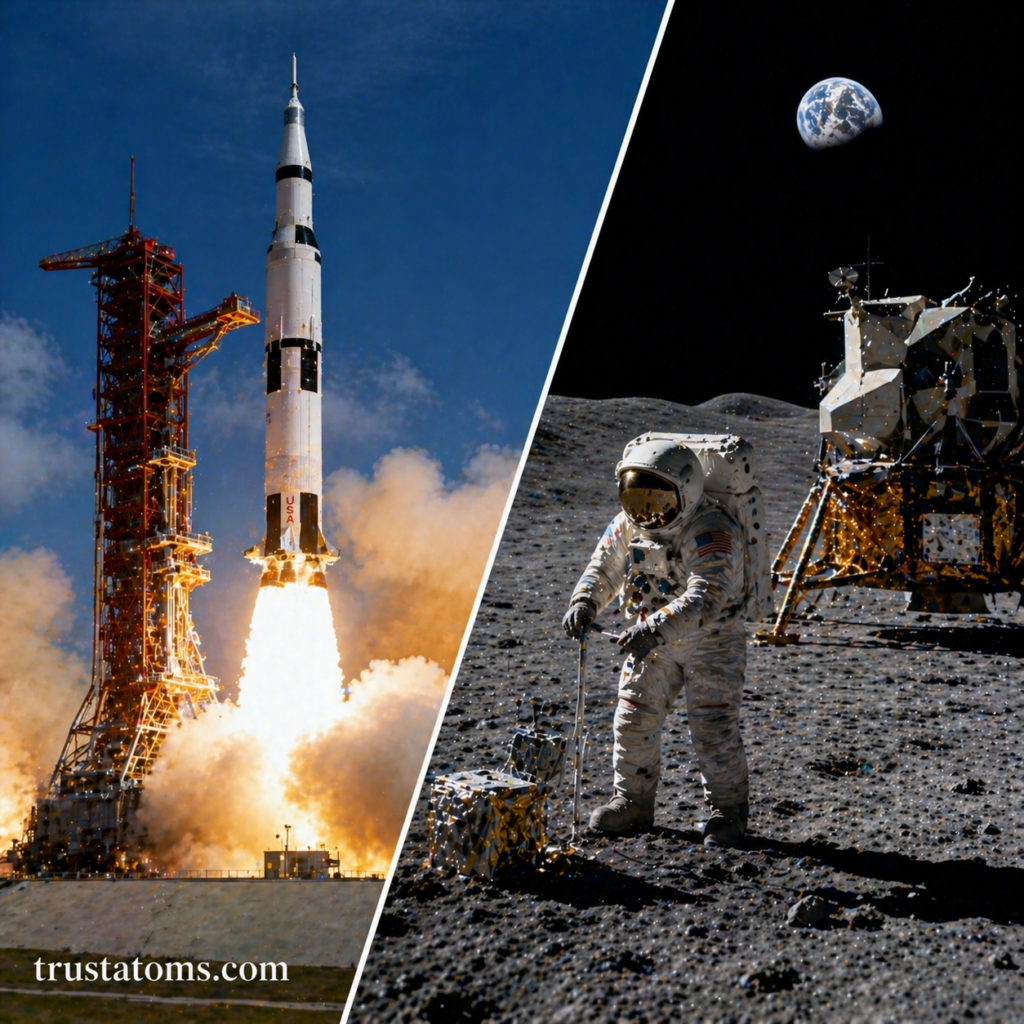
Landing astronauts on the Moon required several spacecraft systems working together. Apollo used the Saturn V rocket, a command and service module, and a separate lunar module.
- Saturn V: Launched the spacecraft from Earth and provided the propulsion needed to begin the journey toward the Moon.
- Command module: Housed the crew during major portions of the mission and returned astronauts through Earth’s atmosphere.
- Service module: Supplied propulsion, electrical power, and other essential spacecraft systems.
- Lunar module: Carried two astronauts from lunar orbit to the surface and launched them back into orbit afterward.
The lunar module’s descent and ascent stages served different purposes. Its descent stage remained on the Moon, while the ascent stage lifted the astronauts back to their orbiting spacecraft.
The Challenges of Landing on the Moon
The Moon has almost no atmosphere, so spacecraft cannot rely on parachutes for their final descent. Landing vehicles must use rocket engines to reduce speed and reach the surface safely.
Navigation is another challenge. The average distance between Earth and the Moon is approximately 384,400 kilometers, and spacecraft must follow carefully calculated trajectories to reach the correct destination.
Apollo missions also required dependable life support, communication, electrical power, and thermal protection. Engineers designed backup procedures because equipment failures could threaten an entire mission.
Lunar dust created additional difficulties. Its fine, abrasive particles could cling to equipment and spacesuits, complicating surface operations and maintenance.
Scientific Discoveries From Lunar Landings
The Apollo missions returned approximately 382 kilograms of lunar rocks and soil to Earth. Scientists have studied these samples for decades, using increasingly advanced laboratory techniques.
Lunar samples revealed evidence of ancient volcanic activity, impact processes, and differences between the Moon’s highlands and darker plains. Radiometric dating of lunar rocks has helped scientists reconstruct the Moon’s geological history.
Evidence from lunar samples and other observations supports the leading scientific model that the Moon formed following a giant impact involving the early Earth. Researchers continue refining this explanation as new measurements become available.
Apollo astronauts also deployed instruments that measured moonquakes and other environmental conditions. These observations helped scientists investigate the Moon’s internal structure.
Modern Robotic Moon Landings and Artemis
After Apollo 17 in 1972, human lunar landings stopped, but robotic exploration continued. Modern missions have examined previously unexplored terrain, tested landing technologies, and investigated resources that may support future exploration.
China’s Chang’e 4 mission achieved the first soft landing on the Moon’s far side in 2019. India’s Chandrayaan-3 successfully landed near the lunar south polar region in 2023, while Japan’s SLIM spacecraft demonstrated precision landing technology in 2024.
NASA’s Artemis program is intended to establish a new phase of human lunar exploration. Its objectives include testing advanced spacecraft, returning astronauts to the lunar surface, and developing capabilities for longer missions beyond Earth.
Scientists are particularly interested in the lunar polar regions, where permanently shadowed areas may contain water ice. Understanding the distribution and accessibility of these deposits could influence future landing sites and resource-use strategies.
Frequently Asked Questions
How Many Times Have Humans Landed on the Moon?
Humans successfully landed on the Moon six times during NASA’s Apollo program, beginning with Apollo 11 in 1969 and ending with Apollo 17 in 1972. Twelve astronauts walked on the lunar surface during those missions.
What Was the First Spacecraft to Land on the Moon?
The Soviet spacecraft Luna 2 became the first human-made object to reach the Moon when it impacted the surface in 1959. Luna 9 achieved the first successful soft landing in 1966, allowing a spacecraft to operate after touchdown.
Why Are Scientists Interested in Returning to the Moon?
Returning to the Moon allows scientists to study unexplored regions, collect new geological samples, investigate potential water ice deposits, and test equipment for extended human missions. Lunar exploration also provides experience that may help prepare for future missions to Mars.
Moon landing missions transformed lunar exploration from distant observation into direct scientific investigation. Robotic landers established that controlled touchdowns were possible, while Apollo astronauts returned samples and measurements that continue to inform research. Modern lunar missions are building on those achievements by exploring new terrain and testing the technologies needed for future surface operations.
Sources: NASA Apollo Lunar Surface Journal; NASA Solar System Exploration; European Space Agency lunar exploration resources.