Time feels constant in everyday life. Seconds pass steadily, clocks tick uniformly, and events appear to unfold at the same rate for everyone around us.
However, modern physics shows that time is not absolute.
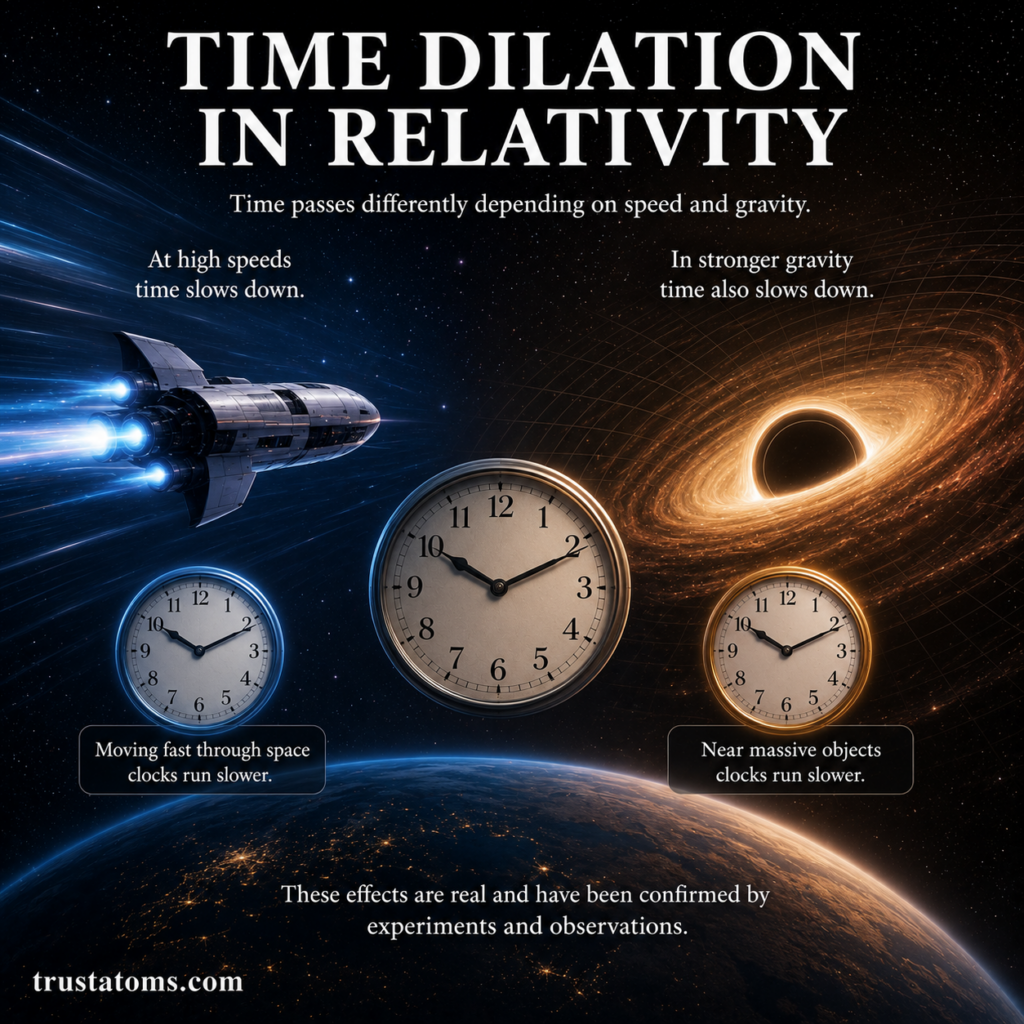
According to Albert Einstein’s theories of relativity, time can slow down depending on speed and gravity. This phenomenon is called time dilation.
Time dilation has been confirmed through experiments involving atomic clocks, satellites, particle physics, and astronomical observations. It plays a major role in modern physics, cosmology, and space exploration.
Understanding time dilation in relativity helps explain how spacetime behaves under extreme conditions and why time itself depends on motion and gravity.
What Is Time Dilation?
Time dilation refers to the difference in elapsed time measured by observers experiencing different conditions of motion or gravity.
In relativity:
- Time does not pass universally at the same rate
- Motion affects the flow of time
- Gravity affects the flow of time
- Different observers may measure different time intervals
Two major types of time dilation exist:
- Velocity time dilation (special relativity)
- Gravitational time dilation (general relativity)
Einstein’s Theory of Special Relativity
Einstein introduced special relativity in 1905.
The theory is based on two main principles:
- The laws of physics are the same in all inertial reference frames
- The speed of light in a vacuum is constant for all observers
These principles lead to surprising consequences involving space and time.
Velocity Time Dilation
Special relativity predicts that moving clocks run slower relative to stationary observers.
The faster an object moves, the more noticeable the effect becomes.
The Time Dilation Formula
Velocity time dilation can be described mathematically.
This relationship shows that as velocity approaches the speed of light, elapsed time slows dramatically.
What the Formula Means
In the equation:
- Δt₀ represents proper time
- v represents velocity
- c represents the speed of light
At everyday speeds, time dilation effects are extremely small.
At relativistic speeds, however, the effects become significant.
Why the Speed of Light Matters
The speed of light acts as a fundamental limit in the universe.
According to relativity:
- Nothing with mass can exceed light speed
- Light speed remains constant for all observers
To preserve this constant speed, spacetime itself adjusts through:
- Time dilation
- Length contraction
- Relativity of simultaneity
These effects are interconnected.
The Twin Paradox
One famous thought experiment illustrating time dilation is the Twin Paradox.
The Scenario
Imagine identical twins:
- One remains on Earth
- The other travels near light speed in a spacecraft
When the traveling twin returns:
- Less time has passed for the traveler
- The space traveler appears younger
This happens because high-speed motion slows time relative to the Earth-bound twin.
Is It a Real Paradox?
The situation is not actually contradictory.
The traveling twin experiences acceleration and changes reference frames, making the situations physically different.
Relativity fully explains the outcome.
Experimental Evidence for Velocity Time Dilation
Time dilation is not just theoretical.
Experiments repeatedly confirm its existence.
Particle Lifetime Experiments
Certain particles called muons form in Earth’s upper atmosphere.
Normally, they decay very quickly.
However:
- Fast-moving muons survive longer than expected
- Time dilation extends their observed lifetimes
This allows many muons to reach Earth’s surface.
Atomic Clock Experiments
Scientists placed highly accurate atomic clocks on aircraft traveling around Earth.
After comparing them with stationary clocks:
- Tiny time differences appeared exactly as relativity predicted
These experiments directly confirmed time dilation.
General Relativity and Gravity
Einstein expanded relativity in 1915 through general relativity.
This theory describes gravity as curvature of spacetime.
Massive objects warp spacetime around them.
Gravity and Time
General relativity predicts that stronger gravity slows time.
This effect is called gravitational time dilation.
Clocks closer to massive objects run slower compared to clocks farther away.
Gravitational Time Dilation Formula
Gravitational time dilation near a spherical mass can be approximated using:
This equation shows how gravity influences the passage of time.
What It Means
Near strong gravitational fields:
- Time slows significantly
- Clocks tick more slowly
- Processes appear delayed to distant observers
The stronger the gravity, the larger the effect.
Time Dilation Near Black Holes
Black holes create some of the strongest gravitational time dilation effects in the universe.
Event Horizon Effects
Near a black hole:
- Gravity becomes extremely intense
- Time slows dramatically relative to distant observers
An observer far away would see objects near the event horizon appear to slow down.
Extreme Time Differences
In theory:
- Minutes near a black hole could equal years elsewhere
Science fiction often explores these concepts, but the physics is based on real relativity principles.
GPS Satellites and Real-World Time Dilation
Time dilation affects modern technology directly.
GPS System Corrections
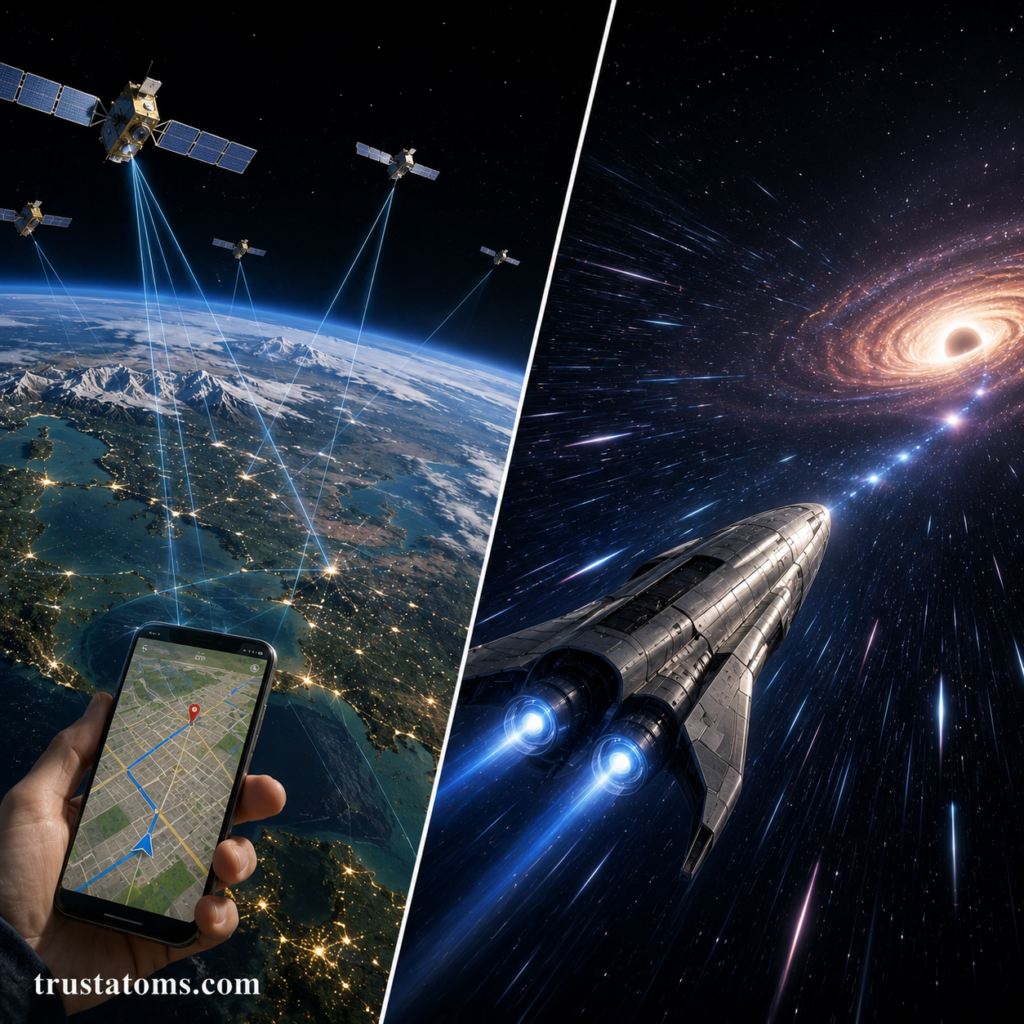
Global Positioning System (GPS) satellites orbit Earth at high speeds and weaker gravitational fields.
Both effects influence onboard clocks:
- Speed causes clocks to run slower
- Reduced gravity causes clocks to run faster
Engineers must correct for relativistic effects continuously.
Without relativity corrections:
- GPS errors would accumulate rapidly
- Navigation systems would become inaccurate
This is one of the clearest practical demonstrations of relativity.
Time Dilation and Space Travel
Time dilation becomes important for future interstellar travel concepts.
Relativistic Spaceflight
If spacecraft approached light speed:
- Travelers would age more slowly
- More time would pass on Earth
This creates fascinating possibilities for long-duration missions.
Interstellar Implications
Relativity theoretically allows travelers to reach distant stars within their lifetimes while centuries pass elsewhere.
However, enormous energy requirements make such travel extremely difficult with current technology.
Relativity of Simultaneity
Relativity also changes how observers perceive simultaneous events.
Different Observers, Different Timing
Events appearing simultaneous to one observer may occur at different times for another moving observer.
This demonstrates that:
- Time is not universal
- Observations depend on reference frames
Time and space combine into a unified structure called spacetime.
Spacetime and Minkowski Space
Physicist Hermann Minkowski helped reformulate relativity mathematically.
He described spacetime as a four-dimensional structure combining:
- Three spatial dimensions
- One time dimension
In relativity:
- Space and time are interconnected
- Motion through space affects motion through time
This framework became central to modern physics.
Time Dilation in Astronomy
Astronomers observe relativistic effects throughout the universe.
Fast-Moving Cosmic Objects
Relativistic jets near black holes and neutron stars involve matter moving close to light speed.
These systems exhibit measurable relativistic effects.
Gravitational Lensing and Redshift
Massive cosmic structures affect both light and time through spacetime curvature.
Relativity helps explain:
- Galaxy behavior
- Black hole observations
- Cosmic expansion
Common Misconceptions About Time Dilation
Time dilation often creates confusion.
Does Time “Feel” Slower?
No.
An observer experiencing time dilation perceives their own clock normally.
The difference appears only when comparing observers in different conditions.
Is Time Travel Possible?
Time dilation technically allows travel into the future through relativistic effects.
However:
- Traveling backward in time remains speculative
- No proven mechanism currently exists
Relativity does not provide practical backward time travel methods.
Why Time Dilation Matters
Time dilation is fundamental to modern physics because it reveals that:
- Time is flexible
- Space and time are connected
- Gravity alters spacetime
- Motion changes temporal experience
It supports both special and general relativity while influencing:
- Cosmology
- GPS technology
- Particle physics
- Black hole research
- Space exploration
Future Research and Relativity
Scientists continue studying relativity under extreme conditions.
Research areas include:
- Quantum gravity
- Black hole physics
- Gravitational waves
- High-energy particle collisions
- Early-universe cosmology
Understanding time dilation more deeply may help unify general relativity and quantum mechanics.
Final Thoughts
Time dilation in relativity transformed humanity’s understanding of time itself.
Einstein’s theories revealed that time is not absolute, but influenced by speed, gravity, and spacetime geometry.
Experiments involving atomic clocks, particle physics, GPS satellites, and astronomical observations continue confirming these predictions with remarkable accuracy.
From black holes to interstellar travel concepts, time dilation remains one of the most fascinating and important consequences of modern physics.
As research advances, relativity continues shaping our understanding of the universe and the true nature of space and time.