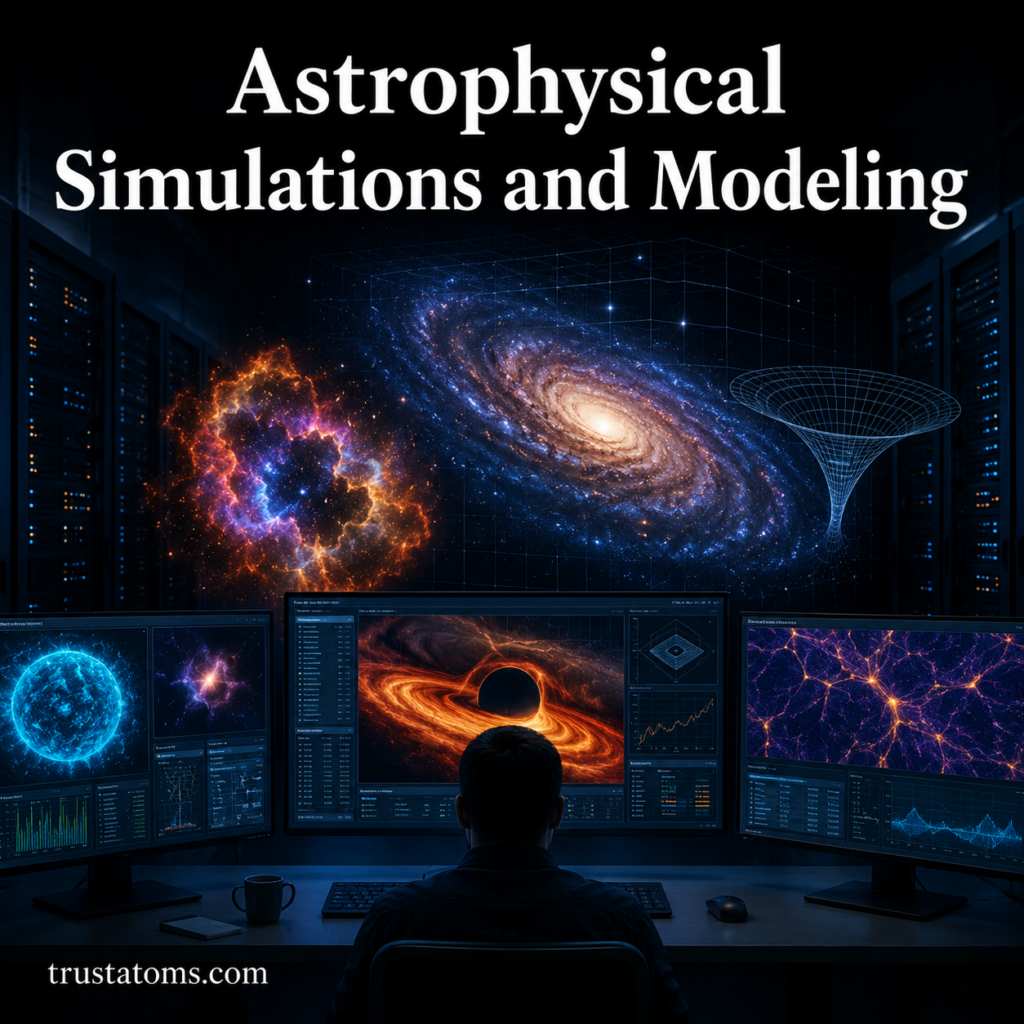
Astrophysical simulations and modeling use mathematical equations and computers to recreate the behavior of objects and physical processes in space. Scientists use these models to test theories, predict how astronomical systems change, and compare possible explanations with telescope observations.
In astronomy and astrophysics, many processes cannot be reproduced in laboratories or observed from beginning to end. Computer simulations make it possible to investigate events such as galaxy formation, stellar explosions, planetary interactions, and black hole mergers under controlled mathematical conditions.
Unlike a telescope image, a simulation is not a direct observation. It is a calculated representation of what should happen if its physical assumptions and starting conditions are correct.
What Are Astrophysical Simulations?
Astrophysical simulations are numerical models that calculate how matter, energy, gravity, and radiation interact in astronomical environments. Researchers translate physical laws into equations that computers can solve approximately.
Different simulations emphasize different processes. Models of Plasma Physics in Space investigate electrically charged gases and magnetic fields, while studies involving Cosmic Dust and Interstellar Particles examine how small particles interact with gas and radiation.
Other models calculate signals from colliding compact objects. Research into Gravitational Waves Detection depends partly on simulated waveforms that scientists compare with measurements from gravitational-wave observatories.
How Computer Simulations Recreate Cosmic Processes
A simulation begins with a physical question, such as whether a cloud of gas will collapse into stars or whether a planetary orbit will remain stable.
Researchers then construct a mathematical model using relevant physical laws. These may include Newtonian gravity, fluid dynamics, electromagnetism, thermodynamics, or Einstein’s general relativity.
The basic workflow follows several steps:
- Define the system: Identify the objects, physical processes, and scientific question.
- Set initial conditions: Specify starting positions, velocities, temperatures, densities, or magnetic fields.
- Choose numerical methods: Divide the system into particles, grid cells, or other computational elements.
- Calculate changes: Advance the model through successive time steps while solving the relevant equations.
- Evaluate results: Compare predictions with observations and test whether different assumptions change the outcome.
For example, a simplified simulation of the Sun and Earth can calculate Earth’s position and velocity at regular intervals using gravitational equations. A more complex planetary model might include eight planets and examine how their gravitational interactions influence orbital stability over time.
Smaller time steps can improve numerical accuracy, but they also increase computational cost. Researchers must balance precision, simulation duration, and available computing resources.
Types of Astrophysical Simulations
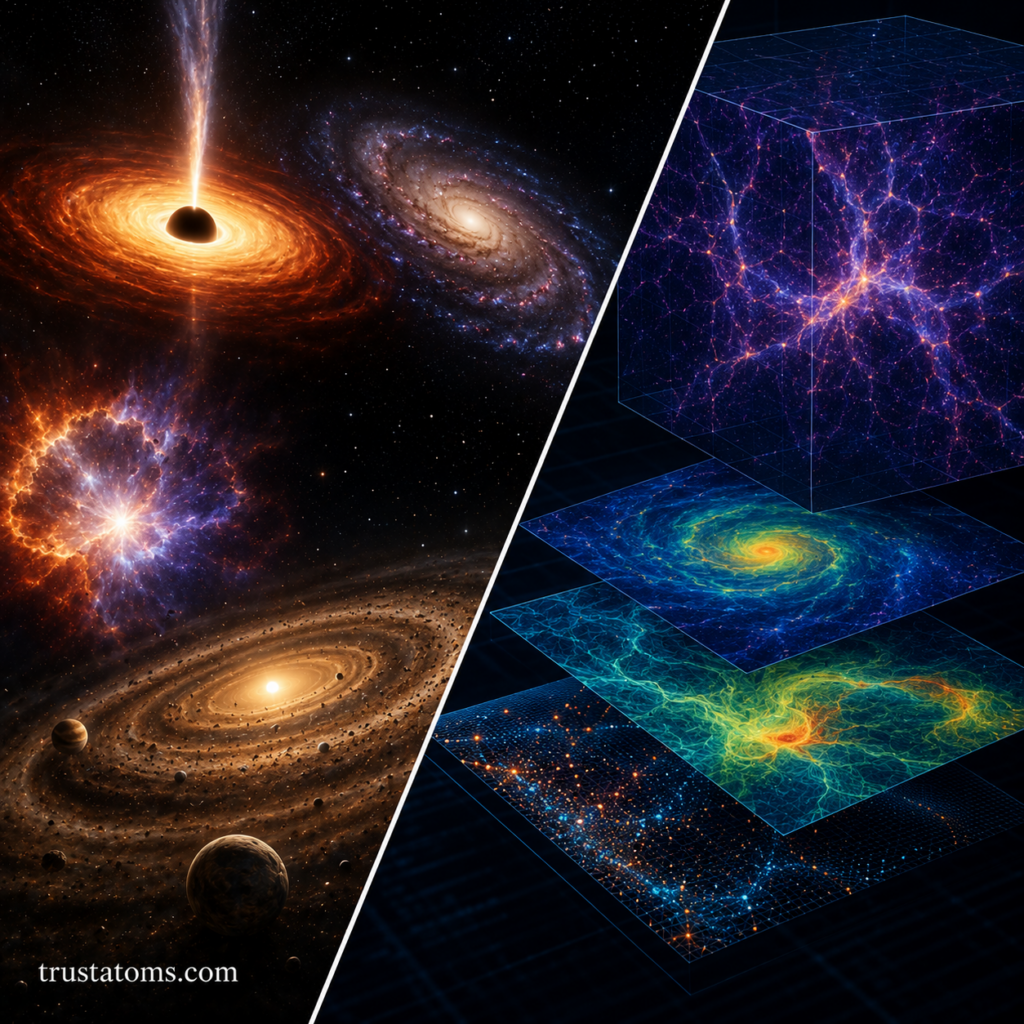
Astrophysicists select numerical methods according to the processes being investigated. Some models track individual particles, while others calculate changes across a grid representing a continuous material.
N-Body Simulations
N-body simulations calculate gravitational interactions among multiple objects or computational particles. They are used to study planetary systems, star clusters, galaxy interactions, and dark matter distributions.
Each simulated particle responds to the gravitational influence of surrounding matter. Large cosmological models may represent enormous numbers of particles, although each particle can stand for a substantial quantity of matter rather than an individual physical object.
Hydrodynamic Simulations
Hydrodynamic simulations model the motion of gases and other fluids. They calculate changes in density, pressure, temperature, and velocity as material moves through space.
These methods help researchers investigate interstellar gas clouds, accretion disks, stellar winds, and expanding supernova remnants. Some simulations combine fluid motion with gravity and radiation to represent more complicated environments.
Magnetohydrodynamic Simulations
Magnetohydrodynamics, or MHD, describes how electrically conducting fluids interact with magnetic fields. It is particularly useful for modeling ionized gases found throughout space.
MHD simulations investigate solar activity, stellar atmospheres, interstellar plasma, and some processes associated with black hole accretion. Magnetic fields can influence how gas moves, becomes compressed, and transfers energy.
Cosmological Simulations and Galaxy Formation
Cosmological simulations investigate how matter becomes distributed across enormous regions of space. Researchers use models based on cosmological theory and observational evidence to study the formation of galaxies, galaxy clusters, and the cosmic web.
Many simulations begin with small density variations consistent with measurements of the cosmic microwave background. Gravity gradually amplifies these variations, producing concentrations of matter and large-scale structures.
Projects such as the Millennium Simulation, Illustris, and EAGLE have modeled different aspects of cosmic structure and galaxy development.
Some models include dark matter alone, while others incorporate ordinary gas, star formation, and energy released by stars or active galactic nuclei. Researchers compare the resulting galaxy populations with astronomical surveys.
Modeling Star Formation and Stellar Explosions
Star formation simulations investigate how dense regions of molecular clouds collapse under gravity. These models often include gas turbulence, magnetic fields, heating, cooling, and radiation.
As material becomes denser, some regions may fragment into smaller collapsing structures. Simulations help scientists examine which conditions favor the formation of individual stars or groups of stars.
Supernova simulations address a different problem: how stellar explosions develop and spread energy into surrounding space. Core-collapse models may include fluid dynamics, neutrino transport, nuclear reactions, and extreme gravitational conditions.
These calculations help researchers investigate neutron star formation, shock-wave behavior, and the distribution of elements produced or dispersed during stellar explosions.
Planetary System and Exoplanet Modeling
Planetary simulations examine how objects move and interact within gravitational systems. N-body models can investigate orbital stability, resonances, and close encounters between planets or smaller bodies.
Other simulations represent disks of gas and dust surrounding young stars. Researchers use them to test explanations for planet formation, migration, and the development of planetary systems.
Climate models extend computational astrophysics into planetary environments. They estimate how atmospheric composition, incoming stellar radiation, clouds, and circulation might affect a planet’s temperature.
Such models help assess possible surface conditions on exoplanets, but they cannot establish habitability without sufficient information about the planet and its environment.
Black Hole Simulations and Relativistic Physics
Black hole simulations often require general relativity because gravity strongly affects matter and light near these objects.
Researchers model accretion disks, magnetic fields, energetic jets, and the paths of light traveling through curved spacetime. These calculations help interpret observations of Black Holes at Galactic Centers, where surrounding gas can produce intense radiation.
Numerical relativity also allows scientists to calculate the behavior of merging black holes. The resulting gravitational-wave predictions can be compared with signals measured by detectors such as LIGO and Virgo.
By comparing simulations with observations, researchers can test whether measured signals agree with predictions from general relativity.
Dark Matter and Large-Scale Structure Models
Dark matter is inferred from gravitational effects rather than directly observed through ordinary electromagnetic radiation. Simulations investigate how hypothetical dark matter particles behave gravitationally and form structures.
In widely used cosmological models, dark matter collects into halos that influence the formation and distribution of galaxies.
Researchers compare simulated structures with observations of galaxy clustering, gravitational lensing, and other measurements. Differences between predictions and observations may reveal limitations in the model, uncertainties in ordinary-matter physics, or questions requiring further investigation.
How Simulations Are Tested Against Observations
A simulation becomes scientifically useful when its predictions can be evaluated against independent evidence. Researchers compare simulated outputs with telescope images, spectra, orbital measurements, or gravitational-wave signals.
For example, a galaxy simulation might predict the number and distribution of galaxies in a particular environment. Astronomers can compare those predictions with survey measurements to assess how well the model reproduces observed patterns.
Scientists also create synthetic observations from simulations. These calculations account for effects such as viewing angle, wavelength, and instrument resolution, making comparisons with real telescope data more meaningful.
Agreement supports a model’s usefulness under the tested conditions, but does not prove every assumption is correct. Different models can sometimes produce similar observable results.
Computational Challenges and Supercomputers
Detailed simulations require substantial computing resources because many physical processes interact across different distances and timescales.
Major challenges include:
- Resolution: Small structures may be impossible to represent accurately in a model covering an enormous region.
- Computational cost: More particles, grid cells, and physical processes require additional calculations.
- Numerical stability: Inappropriate algorithms or time steps can produce inaccurate results.
- Incomplete physics: Some processes are not fully understood or cannot be calculated directly at the required scale.
- Data management: Large simulations generate outputs that require storage, analysis, and verification.
Supercomputers address some of these challenges by distributing calculations across many processors. Researchers also use adaptive meshes and specialized algorithms to concentrate computational effort where greater detail is needed.
Artificial Intelligence in Astrophysical Modeling
Machine learning can help researchers analyze simulation outputs, identify patterns, and approximate selected calculations that would otherwise require substantial computing time.
For example, a trained model may estimate certain simulation outcomes across a range of input parameters. Researchers can use these estimates to explore possible scenarios before running more detailed calculations.
However, machine-learning predictions depend on their training data. They may become unreliable when applied to conditions outside the range represented during training.
Limitations of Astrophysical Simulations
Every simulation simplifies reality. A model may omit small-scale processes, approximate uncertain physical relationships, or rely on starting conditions that are not precisely known.
Numerical resolution also limits what a simulation can represent. A model of an entire galaxy cannot necessarily resolve the detailed physics occurring near an individual star.
Researchers address these limitations by comparing different numerical methods, testing sensitivity to assumptions, and checking predictions against observations.
How Simulations Support Different Fields of Astronomy
Computational modeling connects many of the Branches of Astronomy, from planetary science and stellar astrophysics to cosmology and high-energy astronomy.
Simulations help scientists investigate processes that are difficult to observe directly, explore how different physical assumptions affect outcomes, and identify measurements that could distinguish competing explanations.
As computing methods improve, researchers can represent more interacting processes and compare models with increasingly detailed observations. The scientific value of these advances depends on careful testing, not simply producing more realistic-looking visualizations.
Frequently Asked Questions
What is an astrophysical simulation?
An astrophysical simulation is a computer-based calculation of how an astronomical system behaves under specified physical laws and starting conditions. Scientists use simulations to investigate processes such as orbital motion, galaxy formation, and stellar explosions.
Are astrophysical simulations accurate?
Their accuracy depends on the physical equations, numerical methods, assumptions, and quality of the input information. Scientists evaluate reliability by testing numerical behavior and comparing predictions with observations.
Why do astrophysicists use supercomputers?
Many simulations involve enormous numbers of calculations across interacting physical systems. Supercomputers allow researchers to distribute these calculations across processors and study models that would be impractical on ordinary computers.
Astrophysical simulations allow scientists to test how physical laws might produce the structures and events observed in space. Their greatest strength comes from combining numerical predictions with independent measurements, allowing researchers to refine explanations of everything from planetary orbits to galaxy formation.
Sources: OpenStax, Astronomy 2e; Max Planck Institute for Astrophysics, Computational Astrophysics research resources; LIGO Scientific Collaboration, Numerical Relativity and Gravitational Waves educational resources.