Genome editing allows scientists to make targeted changes to DNA, with applications in medicine, agriculture, and biological research. Its main ethical challenges involve safety, inherited genetic changes, fair access to treatments, and the possible consequences of modifying living organisms.
In modern biology, genome editing helps researchers investigate how genes function and develop treatments for certain genetic diseases. However, the ability to change DNA does not guarantee that every modification will be safe, effective, or ethically acceptable.
What Is Genome Editing?
Genome editing refers to techniques that modify DNA at selected locations within an organism’s genome. Depending on the method, scientists can disrupt genes, remove DNA segments, replace sequences, or change how genes are regulated.
Genome editing is one form of Genetic Engineering, a broader field involving the deliberate modification of genetic material.
Many editing systems recognize a particular DNA sequence and create a break that the cell must repair. Scientists can use these repair processes to introduce changes, although the resulting modifications are not always perfectly predictable.
Newer approaches, including base editing and prime editing, can make certain DNA changes without requiring the same type of double-strand break used by traditional editing systems.
Major Genome Editing Technologies
Several technologies allow researchers to target DNA. They differ in how they recognize genetic sequences, produce changes, and deliver editing components into cells.
CRISPR-Cas Systems
CRISPR-based technologies are currently the most widely used genome editing tools. Many CRISPR systems use a guide RNA to direct a Cas enzyme toward a complementary DNA sequence.
In conventional CRISPR-Cas9 editing, the enzyme cuts DNA at the targeted location. Cellular repair mechanisms then reconnect the DNA, sometimes creating small changes or incorporating a supplied repair template.
CRISPR technology has rapidly accelerated research across genetics and biotechnology. Its relatively accessible design allows researchers to investigate many genetic targets, although editing efficiency and accuracy vary.
Zinc Finger Nucleases and TALENs
Zinc finger nucleases use engineered DNA-binding proteins connected to enzymes that cut DNA. TALENs operate similarly but use a different type of protein-based DNA recognition system.
Both technologies can produce targeted modifications, but designing their DNA-binding proteins generally requires more specialized engineering than designing CRISPR guide RNAs.
Gene Editing Technologies in Modern Biology provides a broader comparison of these methods, including newer editing approaches.
Genome editing can also be incorporated into medical treatments. Gene Therapy Technologies explains how genetic material and modified cells are used to address specific diseases.
Medical Applications of Genome Editing
One major application of genome editing is treating diseases associated with genetic mutations or abnormal gene activity. Researchers can modify selected cells to restore a biological function or compensate for a harmful genetic change.
Medical applications include:
- Inherited blood disorders: Editing blood-forming stem cells to improve the production or function of hemoglobin.
- Cancer research: Modifying immune cells to investigate ways of improving their ability to recognize tumors.
- Rare genetic diseases: Developing treatments that target specific mutations or regulatory pathways.
- Drug development: Creating laboratory cell models that reproduce disease-associated genetic changes.
A Real-World Example: CRISPR and Sickle Cell Disease
Sickle cell disease is an inherited blood disorder involving abnormal hemoglobin. The condition can cause red blood cells to become rigid and sickle-shaped, leading to painful episodes, anemia, and organ damage.
Casgevy, a CRISPR-based treatment approved by the U.S. Food and Drug Administration, demonstrates a medical application of genome editing. The treatment modifies a patient’s blood-forming stem cells outside the body to increase fetal hemoglobin production.
Rather than directly correcting the original sickle cell mutation, the treatment edits a regulatory region associated with the BCL11A gene. This allows the modified cells to produce more fetal hemoglobin, which helps reduce red blood cell sickling.
The patient must undergo preparative chemotherapy before receiving the edited cells. Although this approach can substantially reduce severe disease complications, it also illustrates why genome editing requires careful medical evaluation and long-term monitoring.
Agricultural Applications of Genome Editing
Genome editing allows agricultural researchers to modify traits associated with crop performance, food quality, and resistance to environmental stress.
Potential applications include developing plants with improved resistance to particular diseases, greater tolerance of drought conditions, or altered nutritional characteristics.
Unlike conventional breeding, which combines many genetic differences through reproduction, genome editing can target selected sequences. However, the resulting agricultural traits still require testing under realistic growing conditions.
A successful laboratory modification does not automatically produce higher yields or improved resilience in the field. Soil conditions, climate, pests, and interactions among genes can influence the final outcome.
Genome Editing in Biological and Disease Research
Researchers frequently use genome editing to determine what individual genes do. By disrupting or modifying a gene, scientists can observe changes in cellular behavior and investigate its biological function.
These experiments support research into cancer, inherited disorders, immune responses, and developmental biology.
For example, scientists can introduce a disease-associated mutation into cultured cells and compare those cells with an otherwise similar unmodified group. Differences in protein production, growth, or cellular activity may help reveal how the mutation contributes to disease.
Such experiments require appropriate controls because unexpected editing effects or differences between cells can complicate interpretation.
Environmental Applications and Ecological Risks
Genome editing is also being investigated for environmental applications, including modifying disease-carrying insects and studying traits associated with species conservation.
One particularly controversial approach involves gene drives, which are genetic systems designed to increase the inheritance of particular traits beyond ordinary Mendelian expectations.
Researchers have investigated gene drives as a possible way to reduce populations of mosquitoes that transmit diseases. However, releasing organisms carrying such systems could produce ecological consequences that are difficult to predict or reverse.
Environmental applications therefore require assessments of ecological interactions, unintended spread, and possible effects on other species.
Ethical Concerns Surrounding Genome Editing
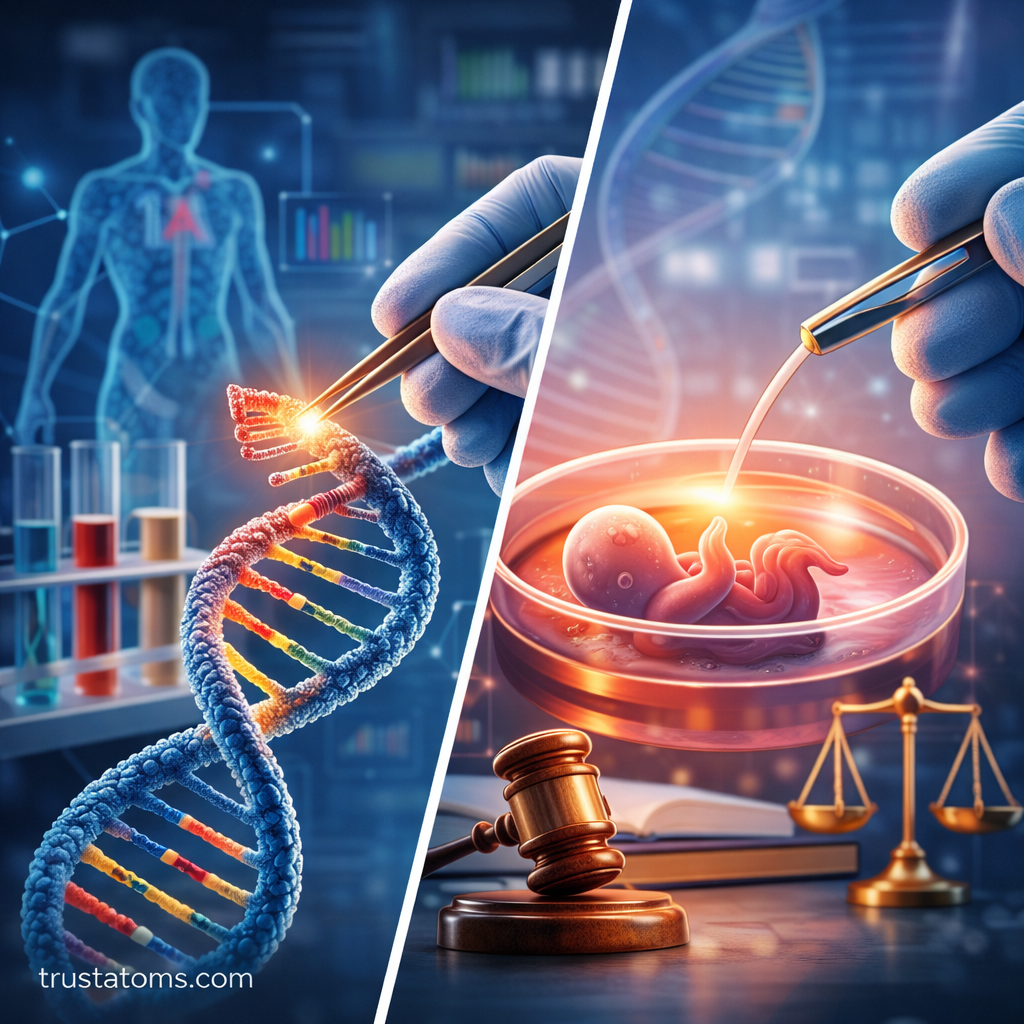
The ethical implications of genome editing depend partly on which cells are modified, the intended purpose, and whether the changes could affect future generations.
Somatic Editing Versus Germline Editing
Somatic genome editing modifies non-reproductive cells. These changes are generally limited to the treated person and are not intended to be inherited by their children.
Germline editing involves changes to reproductive cells or early embryos that could potentially be inherited by future generations. This creates additional concerns because descendants cannot consent to changes that may affect their health.
Heritable human genome editing also raises questions about uncertain long-term consequences and whether existing scientific knowledge is sufficient to justify reproductive applications.
Treating Disease Versus Enhancing Human Traits
Using genome editing to treat a serious genetic disorder differs ethically from attempting to enhance characteristics such as intelligence, appearance, or physical performance.
Most complex human traits are influenced by numerous genes and environmental factors. Consequently, editing one gene would not reliably produce many proposed enhancements.
Critics also warn that enhancement applications could reinforce discrimination or create pressure to favor particular inherited characteristics.
Safety and Unintended Genetic Changes
Genome editing is not perfectly predictable. Off-target effects occur when an editing system changes DNA outside the intended location.
Unexpected changes can also occur at the intended target, including larger deletions or rearrangements. Even a correctly edited sequence may affect gene activity differently than researchers anticipated.
Safety evaluation therefore involves examining editing accuracy, cellular function, possible immune responses, and long-term outcomes.
Fair Access and Healthcare Inequality
Advanced genome editing treatments may require specialized laboratories, extensive medical procedures, and prolonged monitoring. These requirements can make treatment expensive and difficult to access.
Ethical discussions include whether patients with similar medical needs will have comparable opportunities to receive treatment, regardless of income or geographic location.
How Genome Editing Is Regulated
Regulation varies among countries and depends on the application. Human clinical treatments, agricultural products, and environmental interventions may fall under different legal frameworks.
Common oversight mechanisms include:
- Ethics review of proposed research involving human participants.
- Clinical trials evaluating treatment safety and effectiveness.
- Restrictions on reproductive uses of human germline editing.
- Environmental risk assessments for genetically modified organisms.
- Long-term monitoring of patients receiving certain genetic treatments.
The World Health Organization has published recommendations addressing governance and oversight of human genome editing. Such guidance emphasizes transparency, scientific accountability, and public engagement.
Future Developments in Genome Editing
Researchers continue to improve editing accuracy, delivery methods, and control over genetic changes. Base editing and prime editing are being studied as alternatives for certain modifications that conventional DNA-cutting approaches cannot easily achieve.
Improved delivery systems may help editing components reach tissues that are currently difficult to treat. Scientists are also developing methods to evaluate unintended changes more thoroughly.
These advances could expand medical and agricultural applications, but technical progress does not eliminate the need for independent safety testing and ethical oversight.
Frequently Asked Questions
Is genome editing the same as genetic engineering?
Genome editing is a type of genetic engineering focused on targeted DNA modifications. Genetic engineering also includes broader techniques, such as introducing genetic material without directly editing an existing sequence.
Why is human embryo genome editing controversial?
Editing embryos for reproductive purposes could introduce genetic changes inherited by future generations. Concerns include uncertain long-term effects, consent from future descendants, and possible uses unrelated to treating serious disease.
Can genome editing completely eliminate genetic diseases?
Genome editing can treat certain genetic conditions, but it cannot currently eliminate all genetic diseases. Many disorders involve multiple genes, difficult-to-reach tissues, or biological processes that cannot be corrected through a single DNA modification.
Genome editing provides increasingly useful methods for studying genes, developing selected medical treatments, and modifying agricultural traits. Its risks differ substantially between editing a patient’s blood cells, modifying crops, and making potentially inherited changes to human embryos. Responsible applications require reliable evidence of safety and effectiveness, appropriate oversight, and careful consideration of who receives the benefits and bears the risks.
Sources: World Health Organization, Human Genome Editing: Recommendations; National Academies of Sciences, Engineering, and Medicine, Human Genome Editing: Science, Ethics, and Governance; National Human Genome Research Institute, Genome Editing.