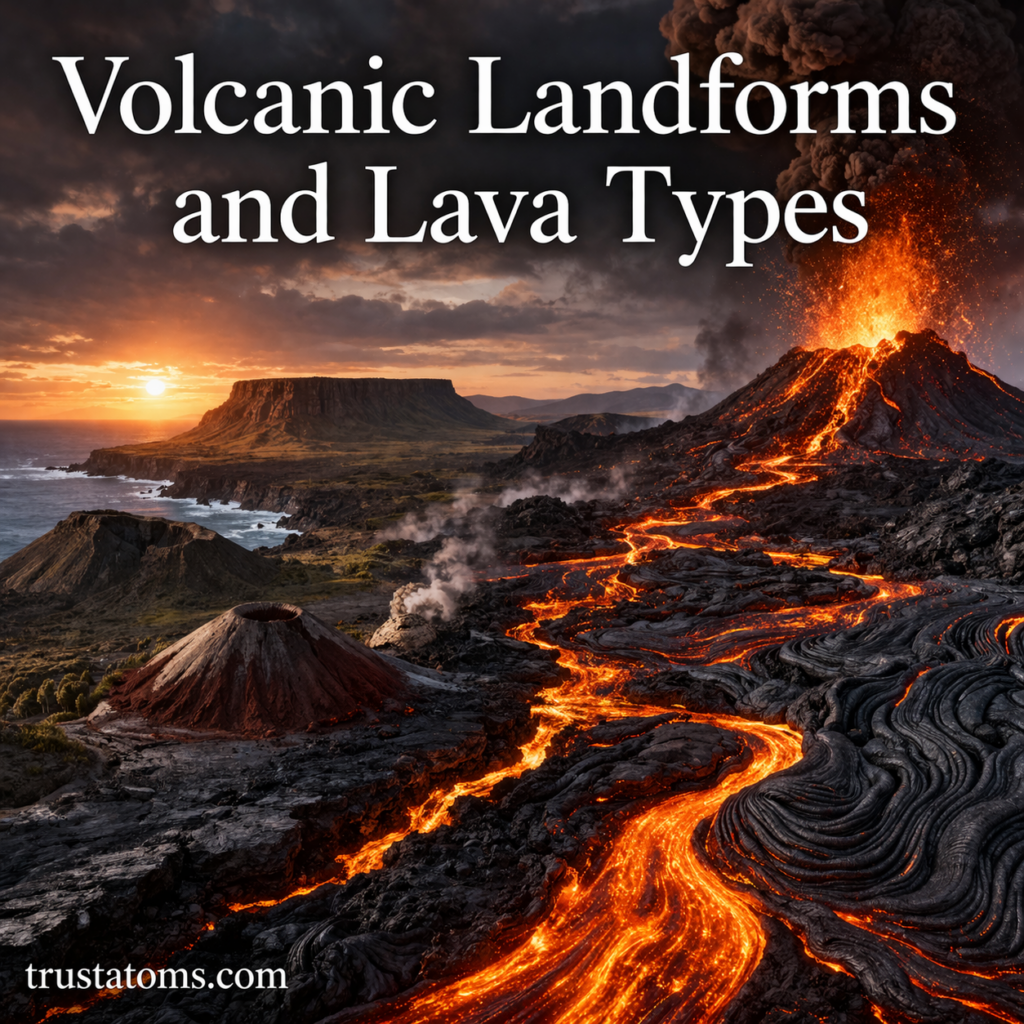
Volcanic landforms are features such as shield volcanoes, composite volcanoes, lava domes, and lava plateaus created by eruptions and the accumulation of volcanic material. Their shapes depend on lava composition, viscosity, eruption style, and how molten rock and volcanic fragments spread across the landscape.
Fluid lava can build broad, gently sloping volcanoes, while thicker lava often accumulates near vents or contributes to steeper formations. Understanding these relationships is part of Earth science, which examines the processes that continually reshape Earth’s surface.
What Is Lava and What Controls Its Movement?
Lava is molten rock that reaches Earth’s surface during a volcanic eruption. Before reaching the surface, it is called magma. As lava moves and cools, it solidifies into volcanic rock.
The distance lava travels and the shapes it creates depend on several interacting properties.
- Silica content: Generally influences how easily molten rock flows, with silica-rich lava tending to be more viscous.
- Temperature: Hotter lava generally flows more easily than cooler lava of similar composition.
- Crystal content: Increasing numbers of solid crystals can make lava more resistant to movement.
- Eruption rate and terrain: The volume of lava supplied and the slope of the ground influence how flows spread.
The resistance of lava to flowing is called viscosity. Low-viscosity lava can spread across broad areas, while high-viscosity lava may move only a short distance before cooling.
Three Major Lava Types and Their Properties
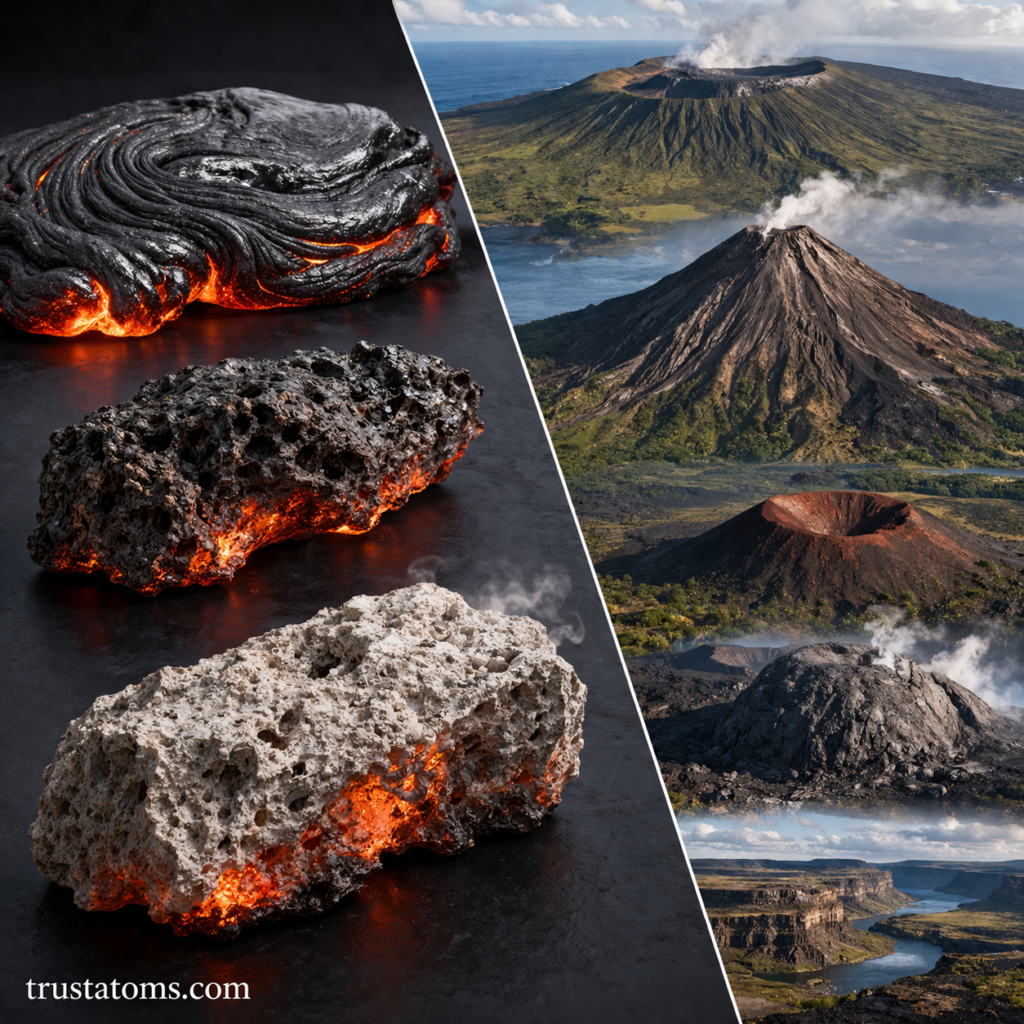
Basaltic Lava: Fluid and Far-Reaching
Basaltic lava has relatively low silica content and typically erupts at high temperatures. Its low viscosity allows it to spread readily, sometimes forming extensive lava fields and broad volcanic slopes.
Basaltic eruptions are often effusive, meaning they primarily release flowing lava. However, gas expansion or interaction with water can also make basaltic eruptions explosive.
Andesitic Lava: Thicker Flows
Andesitic lava has intermediate silica content and generally higher viscosity than basaltic lava. Its flows are often thicker and shorter, contributing to the growth of steeper volcanic slopes.
Andesitic magma can produce both lava flows and explosive eruptions. It is common in volcanic arcs associated with subduction zones.
Rhyolitic Lava: Highly Viscous
Rhyolitic lava is rich in silica and typically resists flowing. Instead of traveling far from a vent, it may accumulate as a thick mound called a lava dome.
When gas-rich rhyolitic magma rises, trapped gases can contribute to powerful explosions. However, rhyolitic magma does not always erupt explosively; some emerges slowly as lava.
Common Volcanic Landforms and How They Form
Volcanic landforms develop through repeated lava flows, explosive deposits, and changes to the ground surrounding volcanic vents. The same volcano may produce several features during its history.
Volcanic Eruption Patterns explains how differences in gas release and magma properties produce contrasting eruptive behaviors.
The underground processes supplying these eruptions are described in Volcanic Eruptions and Magma Movement, while Volcanic Rocks and Magma Formation examines the materials that eventually become volcanic rock.
Shield Volcanoes
Shield volcanoes are wide, gently sloping structures formed by fluid lava. Repeated basaltic flows spread outward from vents, gradually constructing a broad volcanic mountain.
Mauna Loa in Hawaii is a well-known example. Its enormous size reflects the accumulation of many lava flows rather than the construction of a steep cone from explosive debris.
Composite Volcanoes or Stratovolcanoes
Composite volcanoes are often steep-sided mountains built from repeated deposits of lava and fragmented volcanic material. Their eruptions may alternate between flowing lava and explosive activity.
Mount Fuji in Japan and Mount Rainier in Washington are examples. Their shapes reflect complex histories of eruptions, deposition, and erosion rather than a single event.
Cinder Cones
Cinder cones form when explosive bursts eject fragments of lava that cool and accumulate around a vent. These loose fragments, called scoria or cinders, build relatively steep slopes.
Cinder cones are often smaller than shield volcanoes or stratovolcanoes and may form during a relatively short eruptive episode. Lava flows can also emerge from their bases.
Lava Plateaus
Lava plateaus develop when repeated eruptions release large volumes of fluid lava across extensive areas, often through long fractures rather than a central volcanic cone.
Successive flows form thick layers of basalt. Later erosion may expose these layers as cliffs, valleys, and stepped terrain.
Lava Domes
Lava domes form when highly viscous lava accumulates close to an erupting vent. Their surfaces can become fractured as fresh lava pushes outward from within.
Domes may grow slowly, but unstable sections can collapse and generate dangerous pyroclastic density currents. Dome formation therefore does not necessarily mean an eruption is harmless.
Volcanoes also contain craters, vents, and collapse depressions. Crater Formation and Volcanic Features explains how these structures develop and change.
A Real Example: Paricutin’s Rapid Growth
In February 1943, a new volcano began erupting in a cornfield near Paricutin, Mexico. Explosive activity rapidly piled cinders around its vent, creating a growing cone.
According to the Smithsonian Institution’s Global Volcanism Program, the eruption continued until 1952. The volcano eventually reached roughly 424 meters above the surrounding terrain.
Paricutin demonstrates how volcanic landforms can develop within a human lifetime. Its cone formed mainly from erupted fragments, while associated lava flows spread across nearby land and damaged settlements.
Comparing Lava Types and Volcanic Landforms
| Lava or Material | Typical Behavior | Associated Landforms |
|---|---|---|
| Basaltic lava | Relatively fluid flows | Shield volcanoes, lava plateaus |
| Andesitic lava | Thicker flows and possible explosions | Stratovolcanoes, some lava domes |
| Rhyolitic lava | Highly viscous, limited flow distance | Lava domes, thick lava flows |
| Explosively ejected scoria | Fragments accumulate around vents | Cinder cones |
These relationships are common patterns, not absolute rules. Volcanic landforms reflect the combined effects of magma composition, gas content, eruption frequency, terrain, and erosion.
How Volcanic Landscapes Change After Eruptions
Volcanic landforms continue changing after lava solidifies. Rain, rivers, glaciers, and gravity erode volcanic rock, while new eruptions can cover older surfaces with fresh material.
Over time, weathering may release minerals that contribute to soil development. However, fresh lava and ash deposits can initially destroy vegetation, bury infrastructure, and disrupt waterways.
Studying landform shapes and rock layers helps geologists reconstruct eruption histories and identify areas exposed to future lava flows, ashfall, or slope failures.
Frequently Asked Questions
What type of lava forms shield volcanoes?
Shield volcanoes are built mainly from low-viscosity basaltic lava. Repeated flows spread outward over broad areas, producing gently sloping volcanic mountains.
Why does rhyolitic lava form domes?
Rhyolitic lava usually has high viscosity because of its silica-rich composition and relatively low eruption temperature. It often moves slowly and accumulates near the vent rather than spreading across large distances.
Are all volcanic mountains formed from lava flows?
No. Some volcanic mountains contain extensive lava flows, while others are built partly or mainly from ash, cinders, pumice, and other erupted fragments. Many volcanoes contain a combination of these materials.
Volcanic landforms record how molten rock and fragmented material reached Earth’s surface and accumulated over time. The broad slopes of Mauna Loa, the layered structure of stratovolcanoes, and the rapidly formed cone of Paricutin demonstrate how different eruption processes create distinct landscapes.
Sources: U.S. Geological Survey, Volcano Hazards Program; Smithsonian Institution, Global Volcanism Program; British Geological Survey, educational resources on volcanoes and igneous rocks.