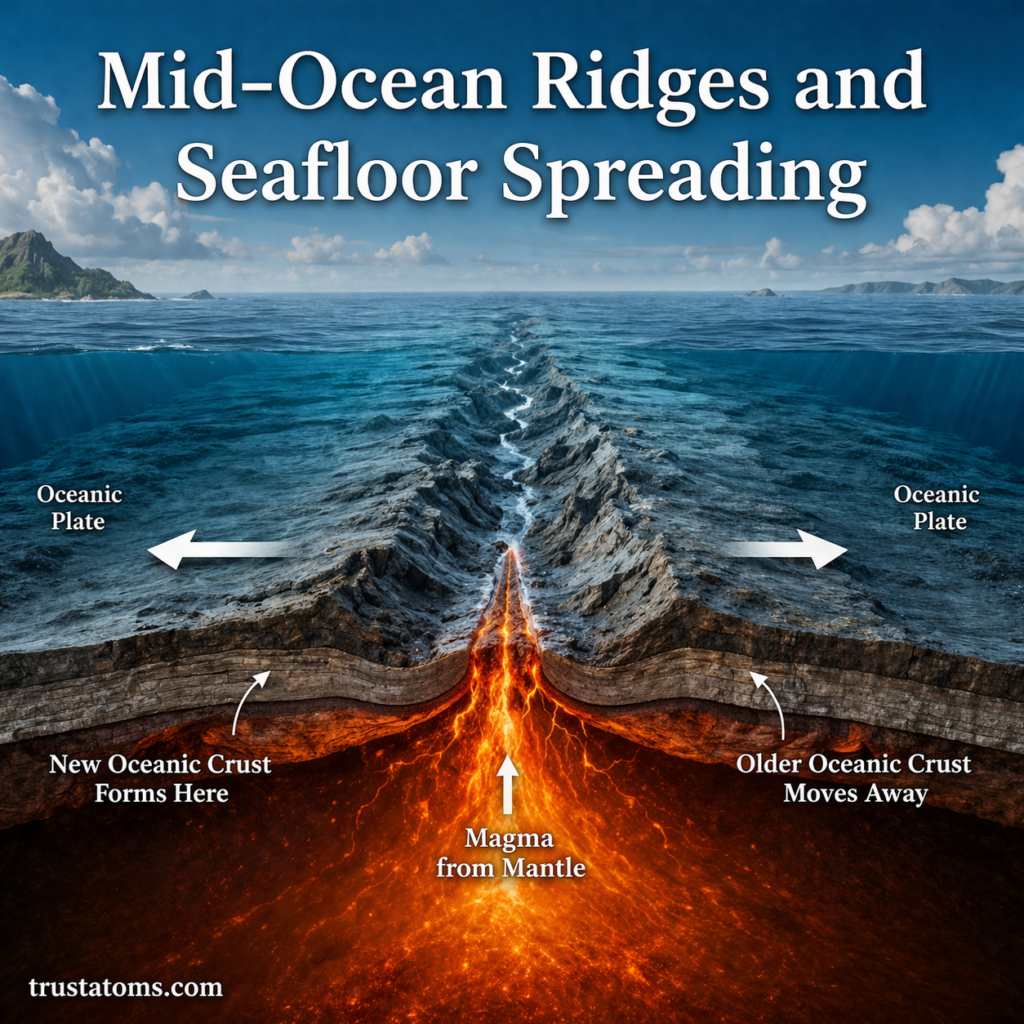
Mid-ocean ridges and seafloor spreading are key processes that shape Earth’s surface beneath the oceans. These underwater mountain chains mark places where new oceanic crust is continuously created, helping drive the movement of tectonic plates.
Understanding how these systems work provides insight into plate tectonics, ocean basin formation, and even the evolution of continents.
What Are Mid-Ocean Ridges?
Mid-ocean ridges are long, continuous underwater mountain ranges formed at divergent plate boundaries—where tectonic plates move apart.
They stretch across the globe like seams on a baseball and represent the longest mountain chain on Earth, extending over 40,000 miles (64,000 km).
Key Characteristics
- Located along divergent plate boundaries
- Formed by rising magma from the mantle
- Typically feature a central rift valley
- Found in all major ocean basins
One well-known example is the Mid-Atlantic Ridge, which runs down the center of the Atlantic Ocean.
What Is Seafloor Spreading?
Seafloor spreading is the process by which new oceanic crust forms at mid-ocean ridges and gradually moves outward.
As tectonic plates pull apart, molten rock (magma) rises from below the Earth’s crust. When it cools, it solidifies into new crust, pushing older crust away from the ridge.
How Seafloor Spreading Works
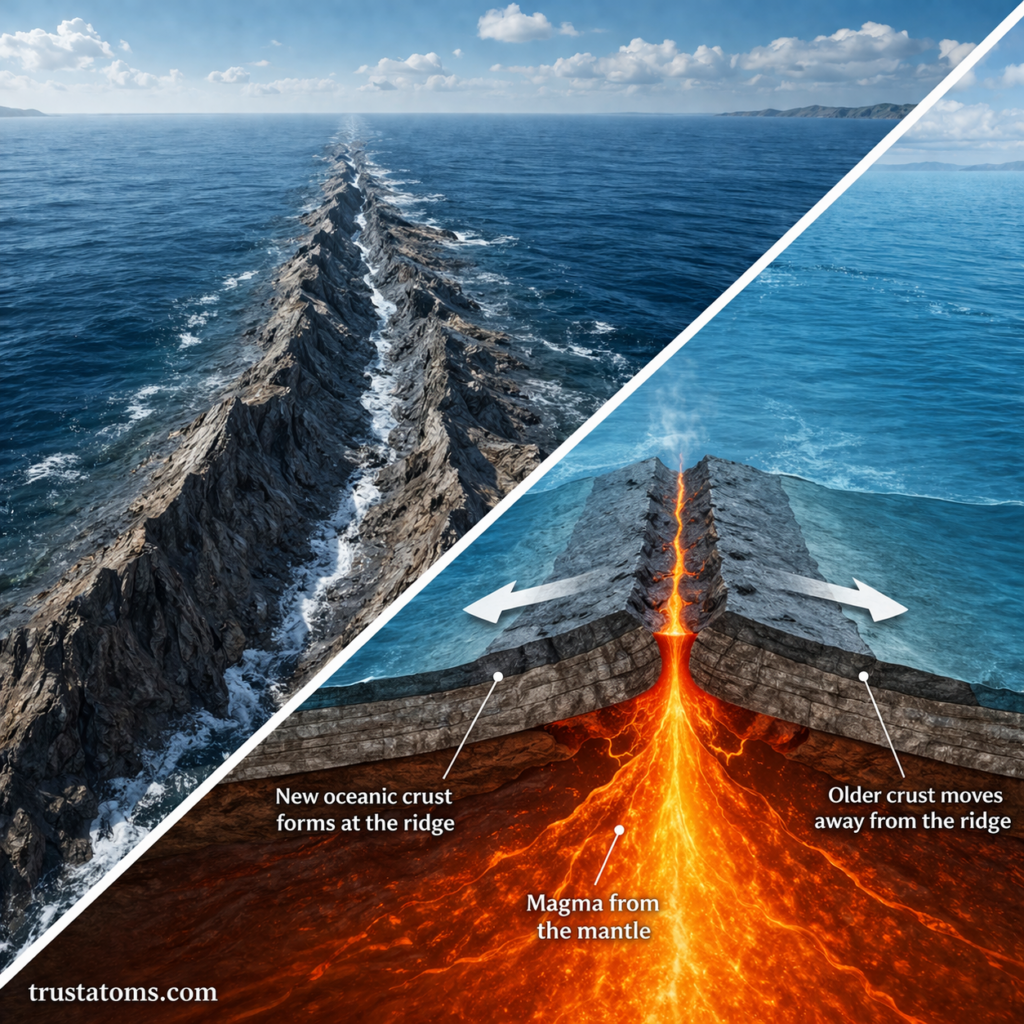
- Plates move apart at a divergent boundary
- Magma rises from the mantle through cracks
- Magma cools and forms new oceanic crust
- Newly formed crust moves outward on both sides
This process is continuous and occurs over millions of years.
Evidence Supporting Seafloor Spreading
Scientists have gathered multiple lines of evidence confirming seafloor spreading.
Magnetic Striping
As magma cools, iron minerals align with Earth’s magnetic field. Because the magnetic field reverses over time, the ocean floor records symmetrical patterns of magnetic stripes on either side of a ridge.
Age of Oceanic Crust
- Youngest rocks are found at the ridge
- Rocks become progressively older farther away
- Confirms outward movement of crust
Heat Flow
Higher heat flow is measured near mid-ocean ridges due to rising magma, decreasing as distance from the ridge increases.
Structure of a Mid-Ocean Ridge
Mid-ocean ridges are not uniform—they vary depending on spreading rates.
Slow-Spreading Ridges
- Prominent rift valleys
- Rough, uneven terrain
- Example: Mid-Atlantic Ridge
Fast-Spreading Ridges
- Smoother topography
- Less visible rift valley
- Example: East Pacific Rise
Why Mid-Ocean Ridges Matter
Mid-ocean ridges play a critical role in Earth’s geology and ocean systems.
Plate Tectonics
They are the primary sites where new lithosphere is created, driving plate movement.
Ocean Basin Formation
Seafloor spreading gradually widens ocean basins over time.
Hydrothermal Vents
Ridges host hydrothermal vents—hot, mineral-rich water sources that support unique ecosystems.
Connection to Plate Tectonics
Mid-ocean ridges are essential to the theory of plate tectonics, which explains the movement of Earth’s outer shell.
As new crust forms at ridges, it pushes tectonic plates apart. This movement is balanced by subduction zones, where old crust is recycled back into the mantle.
Together, these processes create a dynamic and constantly changing planet.
Real-World Examples
Mid-Atlantic Ridge
- Runs through the Atlantic Ocean
- Separates the Eurasian and North American plates in the north
- Separates the African and South American plates in the south
East Pacific Rise
- Located in the Pacific Ocean
- One of the fastest spreading centers on Earth
- Features smoother terrain compared to slower ridges
Common Misconceptions
“The Seafloor Is Static”
The ocean floor is constantly moving due to seafloor spreading.
“Mountains Only Form on Land”
Mid-ocean ridges are massive mountain ranges, but they exist underwater.
“All Ridges Look the Same”
Spreading rate significantly affects ridge shape and structure.
Key Takeaways
- Mid-ocean ridges are underwater mountain chains formed at divergent boundaries
- Seafloor spreading creates new oceanic crust as plates move apart
- Evidence includes magnetic striping, crust age, and heat flow
- Ridges vary based on spreading speed
- These processes are central to plate tectonics and Earth’s evolution
Final Thoughts
Mid-ocean ridges and seafloor spreading reveal how active and dynamic our planet truly is—even beneath the oceans. These hidden systems continuously reshape Earth’s crust, influence ocean basins, and support unique ecosystems.
By understanding these processes, we gain a deeper appreciation for the forces that have shaped—and continue to shape—our planet over geological time.