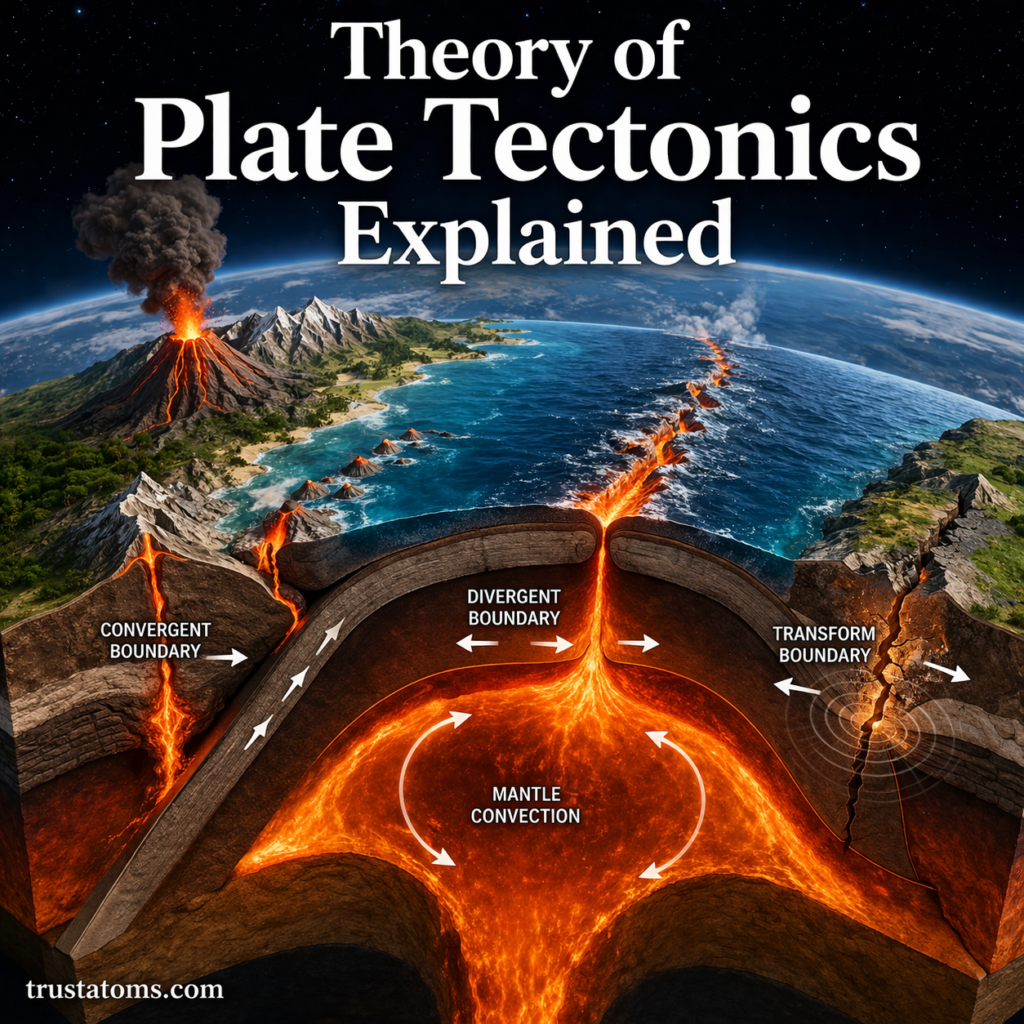
The theory of plate tectonics explains how Earth’s rigid outer shell is divided into moving plates that interact to form mountains, ocean basins, earthquakes, and volcanoes. These plates typically move a few centimeters each year, driven by forces associated with Earth’s internal heat, mantle motion, and the sinking of dense oceanic lithosphere.
Although the movement is usually too slow to notice directly, its effects accumulate across geological time. Plate tectonics is a central concept in Earth science because it connects processes deep inside the planet with changes visible at its surface.
What Is the Theory of Plate Tectonics?
Plate tectonics is the scientific theory that Earth’s lithosphere (its outer shell) is broken into large pieces called tectonic plates. These plates move slowly over the weaker, deformable layer beneath them, known as the asthenosphere.
The lithosphere includes Earth’s crust and the rigid uppermost mantle. A single plate can contain both continental and oceanic crust, so tectonic plates are not simply separate continents or pieces of ocean floor.
As plates move, they separate, collide, or slide alongside one another. Their interactions explain many major geological features, including deep ocean trenches, volcanic mountain chains, and extensive fault systems.
Scientists measure modern plate movement using satellite-based positioning systems and compare those observations with geological evidence preserved in rocks. The agreement between independent measurements makes plate tectonics a well-supported scientific framework.
The Structure of Earth and Its Moving Plates
Earth consists of several layers distinguished by composition and physical behavior. Understanding these layers helps explain why the planet has a mobile outer shell rather than a single unbroken surface.
- Crust: Earth’s thin outer rocky layer, divided into continental and oceanic crust.
- Mantle: A thick region of predominantly solid silicate rock that can deform and flow extremely slowly over geological timescales.
- Core: Earth’s central region, composed mainly of iron and nickel, with a liquid outer core and solid inner core.
The lithosphere is a mechanical layer rather than a purely compositional one. It combines the crust with the rigid uppermost mantle. Beneath it, the asthenosphere remains mostly solid but is sufficiently weak to deform over long periods.
Earth has several major plates, including the Pacific, North American, South American, African, Eurasian, Antarctic, and Indo-Australian plate system, alongside numerous smaller plates. Their locations and interactions are examined in Earth’s major tectonic plates.
Types of Plate Boundaries
Plate boundaries are regions where neighboring tectonic plates interact. Geologists distinguish three principal types according to their relative movement: divergent, convergent, and transform.
The different motions and geological results of transform, convergent, and divergent boundaries explain why some regions develop ocean ridges while others experience major earthquakes or mountain building.
Divergent Boundaries: Plates Move Apart
At divergent boundaries, neighboring plates separate. Hot mantle material rises as pressure decreases, allowing partial melting to generate magma. When magma cools and solidifies, it contributes to the formation of new oceanic crust.
The Mid-Atlantic Ridge is a prominent example. Divergence can also occur within continents, where stretching and faulting may eventually produce a new ocean basin if separation continues.
Convergent Boundaries: Plates Move Together
At convergent boundaries, plates approach one another. When dense oceanic lithosphere descends beneath another plate, the process is called subduction. It creates deep trenches and can contribute to volcanic activity above the descending slab.
When two continents collide, their relatively buoyant crust resists deep subduction. Compression thickens and deforms the crust, building large mountain systems such as the Himalayas.
Transform Boundaries: Plates Slide Past Each Other
At transform boundaries, plates move horizontally alongside each other. Their movement does not generally create or consume lithosphere, but friction can temporarily lock faults and allow elastic strain to accumulate.
When a locked fault suddenly slips, stored energy is released as an earthquake. California’s San Andreas Fault is a well-known transform boundary between the Pacific and North American plates.
Plate Boundary Comparison Table
| Boundary Type | Plate Movement | Typical Geological Features | Example |
|---|---|---|---|
| Divergent | Move apart | Mid-ocean ridges, rift valleys, new oceanic crust | Mid-Atlantic Ridge |
| Convergent with subduction | Move together; one descends | Ocean trenches, volcanic arcs, major earthquakes | Andes and Peru-Chile Trench |
| Continental collision | Continents converge | High mountains, crustal thickening, earthquakes | Himalayas |
| Transform | Slide horizontally past each other | Strike-slip faults, earthquakes | San Andreas Fault |
Real plate boundaries can be complex, with segments that bend, overlap, or combine different types of deformation. The table describes their dominant motions rather than every geological process occurring nearby.
What Drives Tectonic Plate Movement?
Plate movement results from gravity, the mechanical behavior of lithosphere, and the transfer of heat through Earth’s interior. Mantle convection, slab pull, and gravitational sliding away from elevated ocean ridges contribute to this system, although their relative importance varies among plates.
Mantle Convection
Heat from Earth’s interior helps produce slow movement and deformation within the mantle. Mantle rock remains predominantly solid, but it can flow over millions of years. This circulation interacts with the moving lithosphere rather than simply carrying plates on a liquid conveyor belt.
Ridge Push and Gravitational Sliding
Newly formed crust at mid-ocean ridges pushes older crust away, in the simplified description of ridge push. More precisely, elevated oceanic lithosphere tends to slide gravitationally away from the ridge as it cools, thickens, and becomes denser.
Slab Pull
As oceanic lithosphere ages, it cools and becomes denser. At some convergent boundaries, the descending portion of a plate exerts a gravitational pulling force on the connected lithosphere.
Slab pull is considered a major contributor to the movement of many plates with active subduction zones. Plate motion reflects the combined effects of these forces and resistance along plate boundaries and within the mantle.
Evidence Supporting the Theory of Plate Tectonics
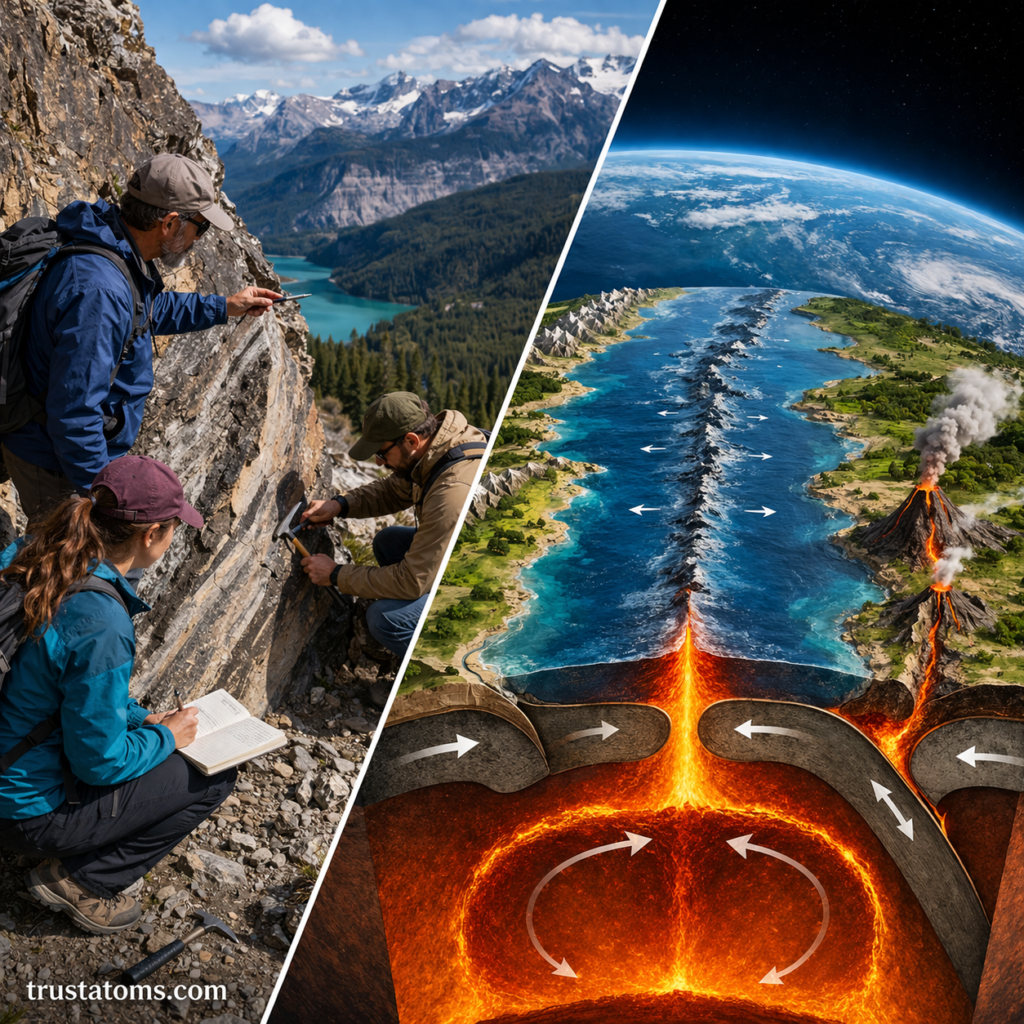
The theory developed from multiple independent lines of evidence. No single observation explains all plate motion, but geological, geophysical, and modern satellite measurements consistently support the same overall model.
Continental Drift and Matching Fossils
Alfred Wegener proposed continental drift in 1912, arguing that continents had once been joined and subsequently separated. Matching coastlines, similar rock formations, and fossils found on now-distant continents supported this interpretation.
Wegener could not provide a convincing mechanism for continental movement. Later discoveries about the ocean floor and Earth’s interior supplied the evidence needed to develop modern plate tectonics.
Seafloor Spreading and Magnetic Stripes
Oceanic crust forms at spreading ridges and moves outward as additional crust develops. Magnetic minerals in cooling basalt preserve information about Earth’s magnetic field, producing alternating magnetic patterns on opposite sides of many ridges.
The approximate symmetry of these patterns and the increasing age of oceanic crust away from ridges provide strong evidence for seafloor spreading. Geological dating and ocean drilling have helped confirm this relationship.
Earthquake Depths and Volcanic Belts
Earthquakes and volcanoes are concentrated in recognizable belts that correspond to tectonic boundaries. At subduction zones, earthquake locations can trace an inclined zone extending deep beneath the overriding plate, revealing the descending slab.
Modern Satellite Measurements
Global Navigation Satellite System instruments measure the positions of ground stations with high precision. Repeated observations reveal steady motion of several millimeters to centimeters per year, directly confirming that tectonic plates are moving today.
Worked Example: How Far Does a Tectonic Plate Move?
Imagine a plate moving steadily at 5 centimeters per year relative to another plate. This is a realistic illustrative speed, although actual rates differ by location and direction.
- Calculate movement over 100 years: 5 centimeters multiplied by 100 equals 500 centimeters, or 5 meters.
- Calculate movement over 10,000 years: 5 centimeters multiplied by 10,000 equals 50,000 centimeters, or 500 meters.
- Calculate movement over one million years: 5 centimeters multiplied by 1,000,000 equals 50 kilometers.
The example shows how small annual movements accumulate into large geological changes. Real plate velocities and directions can vary, so calculations over long intervals are approximations rather than exact reconstructions.
How Plate Tectonics Creates Mountains, Volcanoes, and Earthquakes
Plate tectonics explains the formation of many major landforms. Continental collision can thicken crust and raise mountain ranges, while subduction produces trenches and volcanic arcs. Divergence creates ocean ridges and continental rifts.
Most earthquakes occur along plate boundaries, not randomly. Stress accumulates where rocks resist movement, and sudden fault slip releases seismic energy. Earthquakes can also occur within plate interiors, although they are less common.
The Pacific Ring of Fire contains numerous subduction zones, volcanoes, and earthquake-producing faults around the Pacific Ocean. The Himalayas illustrate continental collision, while the Mid-Atlantic Ridge demonstrates the continuing creation of oceanic crust.
At subduction zones, old oceanic lithosphere returns to the mantle, while new oceanic crust forms at spreading centers. These processes continually reshape the ocean floor, although continental crust can survive much longer and preserve records of earlier geological events.
Common Misconceptions
Continents Float Freely Across the Ocean
Continents are embedded within tectonic plates that include rigid mantle rock. They do not move independently through ocean water or slide freely across the seafloor.
Tectonic Plates Float on a Liquid Mantle
The mantle is mostly solid rock. Its slow deformation over geological timescales allows plate movement without requiring a global layer of liquid magma beneath the crust.
Plate Movement Is Too Slow to Measure
Although movement is generally imperceptible without instruments, satellite positioning systems can measure plate motion directly. Many plates move several centimeters per year.
Every Earthquake Happens at a Plate Boundary
Most earthquakes are concentrated near plate boundaries, but earthquakes also occur within plates. Ancient faults and stresses transmitted through the lithosphere can produce intraplate earthquakes.
Frequently Asked Questions
What is the theory of plate tectonics in simple terms?
It is the scientific explanation that Earth’s rigid outer shell consists of moving plates. Their interactions produce earthquakes, volcanoes, mountains, ocean trenches, and new oceanic crust.
What causes tectonic plates to move?
Plate movement results from interacting forces associated with mantle circulation, gravitational sliding away from ocean ridges, and the sinking of dense oceanic lithosphere at subduction zones.
How fast do tectonic plates move?
Many plates move a few centimeters per year relative to neighboring plates. Rates vary depending on the plate, location, and reference frame used for measurement.
What are the three main types of plate boundaries?
They are divergent boundaries, where plates separate; convergent boundaries, where plates approach one another; and transform boundaries, where plates slide horizontally past each other.
What evidence proves tectonic plates are moving?
Evidence includes matching fossils and rock formations across continents, symmetrical magnetic patterns on the ocean floor, earthquake distributions, seafloor ages, and direct satellite measurements of plate motion.
Plate tectonics explains how Earth’s moving lithosphere produces ocean ridges, mountain belts, volcanic arcs, and many major earthquakes. Geological evidence and modern satellite measurements show that these movements continue today, even though they are usually too slow to observe directly. Understanding plate boundaries and the forces driving them helps scientists reconstruct Earth’s geological history and assess hazards in active regions.
Sources: U.S. Geological Survey (USGS), This Dynamic Earth: The Story of Plate Tectonics; National Oceanic and Atmospheric Administration (NOAA), Ocean Exploration; Encyclopaedia Britannica, Plate Tectonics; Steven Earle, Physical Geology (BCcampus).