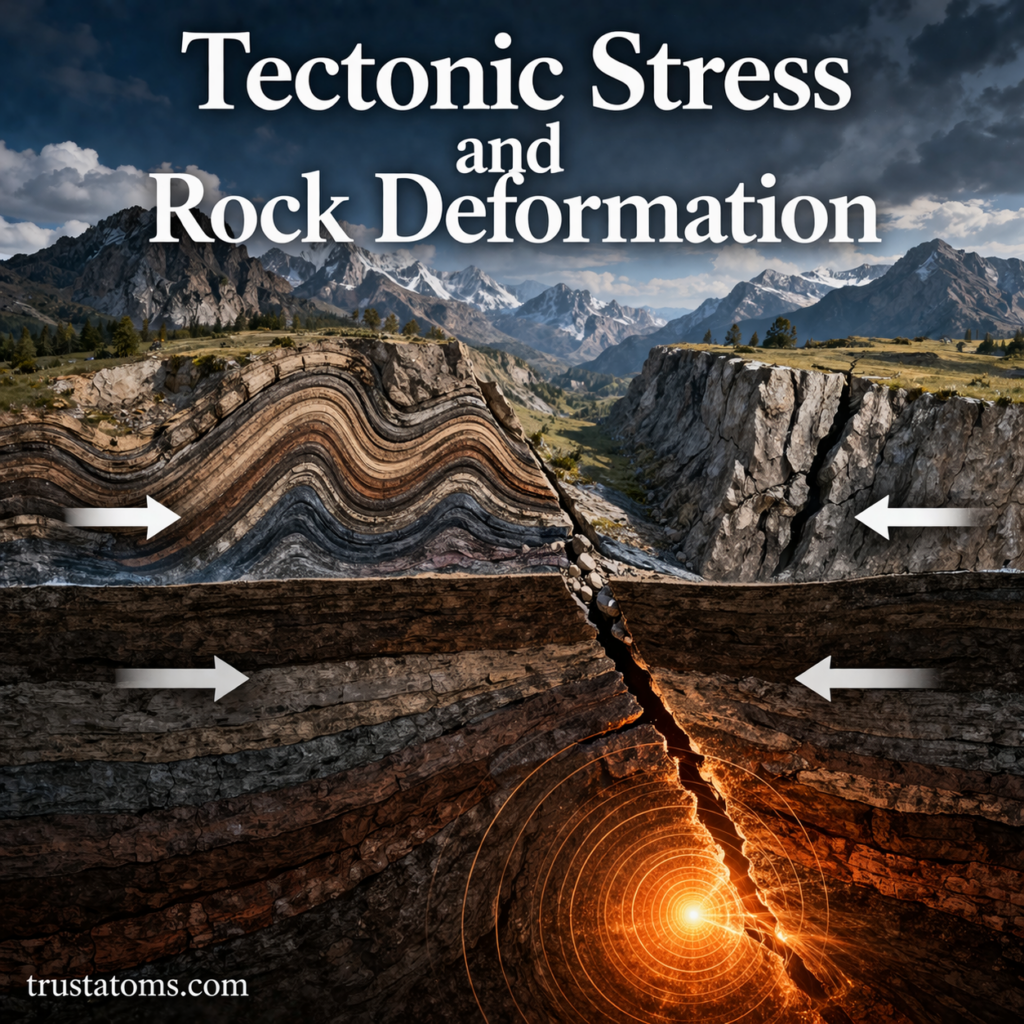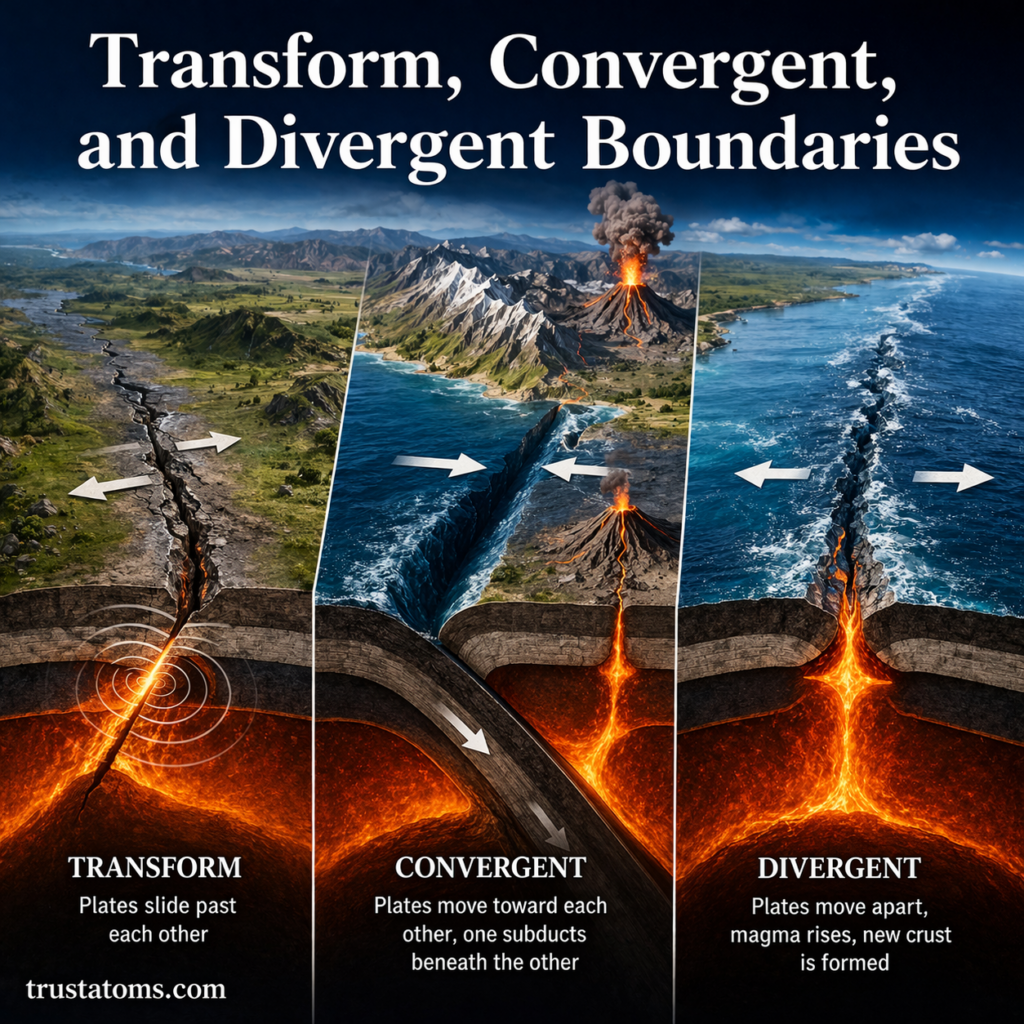
Tectonic plate boundaries are where Earth’s most powerful geological activity occurs. These boundaries define how plates interact—whether they collide, move apart, or slide past each other.
The three main types of plate boundaries are transform, convergent, and divergent. Each plays a unique role in shaping Earth’s surface and driving natural events like earthquakes, volcanoes, and mountain formation.
What Are Plate Boundaries?
Plate boundaries are the edges where tectonic plates meet. Since Earth’s lithosphere is divided into moving plates, these boundaries are zones of intense geological activity.
Why Plate Boundaries Matter
- They control where earthquakes and volcanoes occur
- They shape landforms like mountains and ocean basins
- They drive the recycling and creation of Earth’s crust
Divergent Boundaries
Divergent boundaries occur where tectonic plates move away from each other.
How Divergent Boundaries Work
- Plates pull apart due to mantle forces
- Magma rises from below the crust
- Magma cools and forms new crust
- Plates continue moving outward
This process is known as seafloor spreading when it occurs beneath oceans.
Key Features of Divergent Boundaries
- Formation of mid-ocean ridges
- Creation of new oceanic crust
- Shallow earthquakes
- Volcanic activity
Examples of Divergent Boundaries
- Mid-Atlantic Ridge
- East African Rift (on land)
These areas show how continents and ocean basins can form and expand over time.
Convergent Boundaries
Convergent boundaries occur where tectonic plates move toward each other.
Types of Convergent Boundaries
Oceanic–Continental Convergence
- Denser oceanic plate subducts beneath continental plate
- Forms volcanic mountain chains
Oceanic–Oceanic Convergence
- One oceanic plate subducts beneath another
- Creates volcanic island arcs
Continental–Continental Convergence
- Neither plate subducts easily
- Plates crumple and form large mountain ranges
Key Features of Convergent Boundaries
- Deep ocean trenches
- Powerful earthquakes
- Volcanic activity (in subduction zones)
- Mountain building
Examples of Convergent Boundaries
- Andes Mountains (oceanic–continental)
- Japan island arc (oceanic–oceanic)
- Himalayan Mountains (continental–continental)
Transform Boundaries
Transform boundaries occur where tectonic plates slide past each other horizontally.
How Transform Boundaries Work
- Plates move in opposite directions or at different speeds
- Friction causes stress to build up
- Sudden release of energy results in earthquakes
Key Features of Transform Boundaries
- Frequent earthquakes
- No creation or destruction of crust
- Linear fault zones
Examples of Transform Boundaries
- San Andreas Fault (California)
- Alpine Fault (New Zealand)
Comparing the Three Boundary Types
Divergent vs Convergent vs Transform
- Divergent: Plates move apart → new crust forms
- Convergent: Plates collide → crust is destroyed or uplifted
- Transform: Plates slide past → crust is neither created nor destroyed
Each type contributes differently to Earth’s dynamic system.
How Plate Boundaries Shape Earth
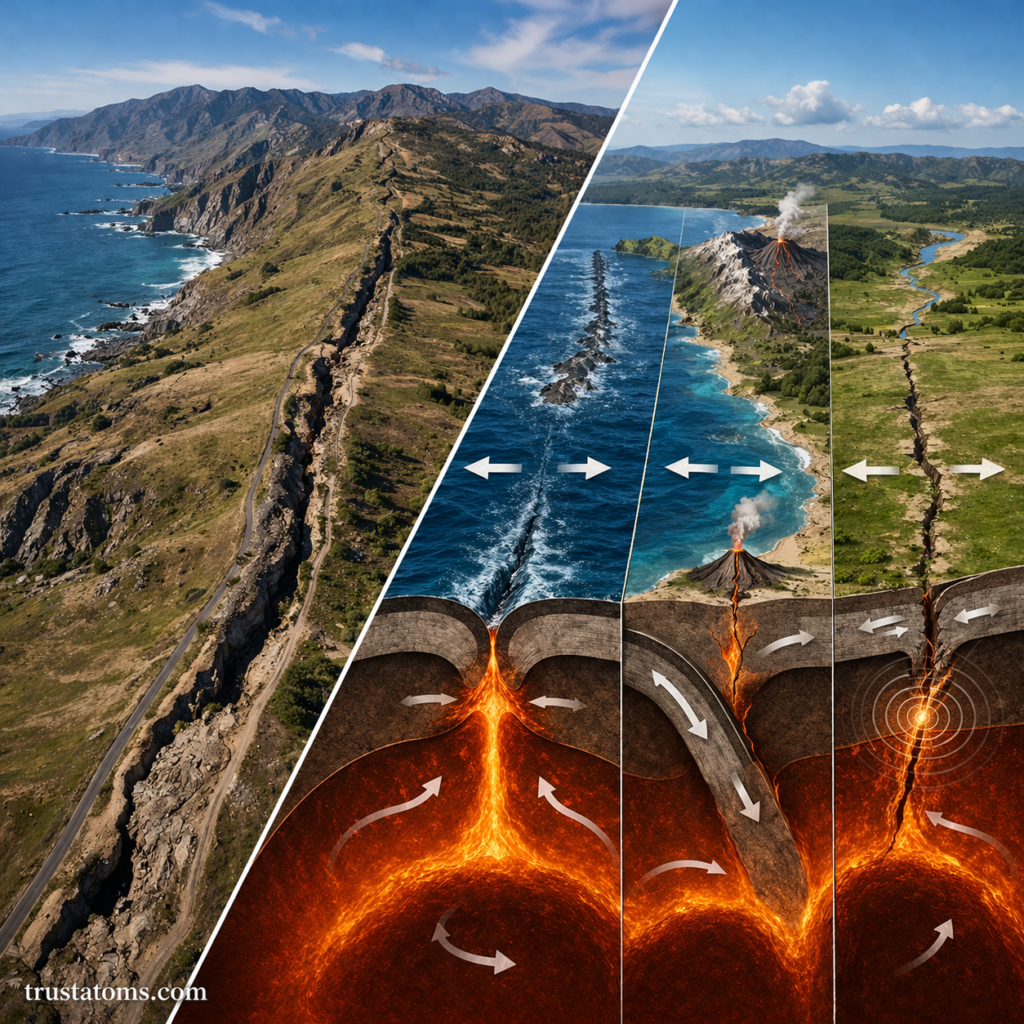
Plate boundaries are responsible for many of Earth’s major features and events.
Landforms
- Mountains form at convergent boundaries
- Ocean ridges form at divergent boundaries
- Fault lines form at transform boundaries
Natural Hazards
- Earthquakes occur at all boundary types
- Volcanoes are common at convergent and divergent boundaries
- Tsunamis often originate near convergent boundaries
Why Plate Boundaries Are Active
The constant motion of tectonic plates is driven by forces within Earth’s mantle.
Driving Forces
- Convection currents in the mantle
- Ridge push from new crust formation
- Slab pull from sinking plates
These forces ensure that plate boundaries remain active over millions of years.
Common Misconceptions
“All Boundaries Create Volcanoes”
Volcanoes mainly occur at convergent and divergent boundaries—not transform boundaries.
“Transform Boundaries Are Less Dangerous”
They can produce powerful earthquakes despite lacking volcanic activity.
“Plate Boundaries Are Fixed”
Plate boundaries shift and evolve over geological time.
Key Takeaways
- There are three main types of plate boundaries: divergent, convergent, and transform
- Divergent boundaries create new crust
- Convergent boundaries destroy or uplift crust
- Transform boundaries involve sliding motion and earthquakes
- Plate boundaries shape Earth’s surface and drive natural hazards
Final Thoughts
Transform, convergent, and divergent boundaries are essential to understanding how Earth works. These interactions between tectonic plates are responsible for shaping continents, forming oceans, and generating some of the planet’s most powerful natural events.
By studying these boundaries, scientists can better predict geological hazards and understand the ongoing evolution of Earth’s surface.