The universe is filled with extraordinary objects, but few are as powerful or mysterious as quasars. These incredibly bright sources of energy can outshine entire galaxies and are visible from billions of light-years away.
By studying quasars and other distant light sources, astronomers can look back in time and uncover the history of the universe itself.
What Is a Quasar?
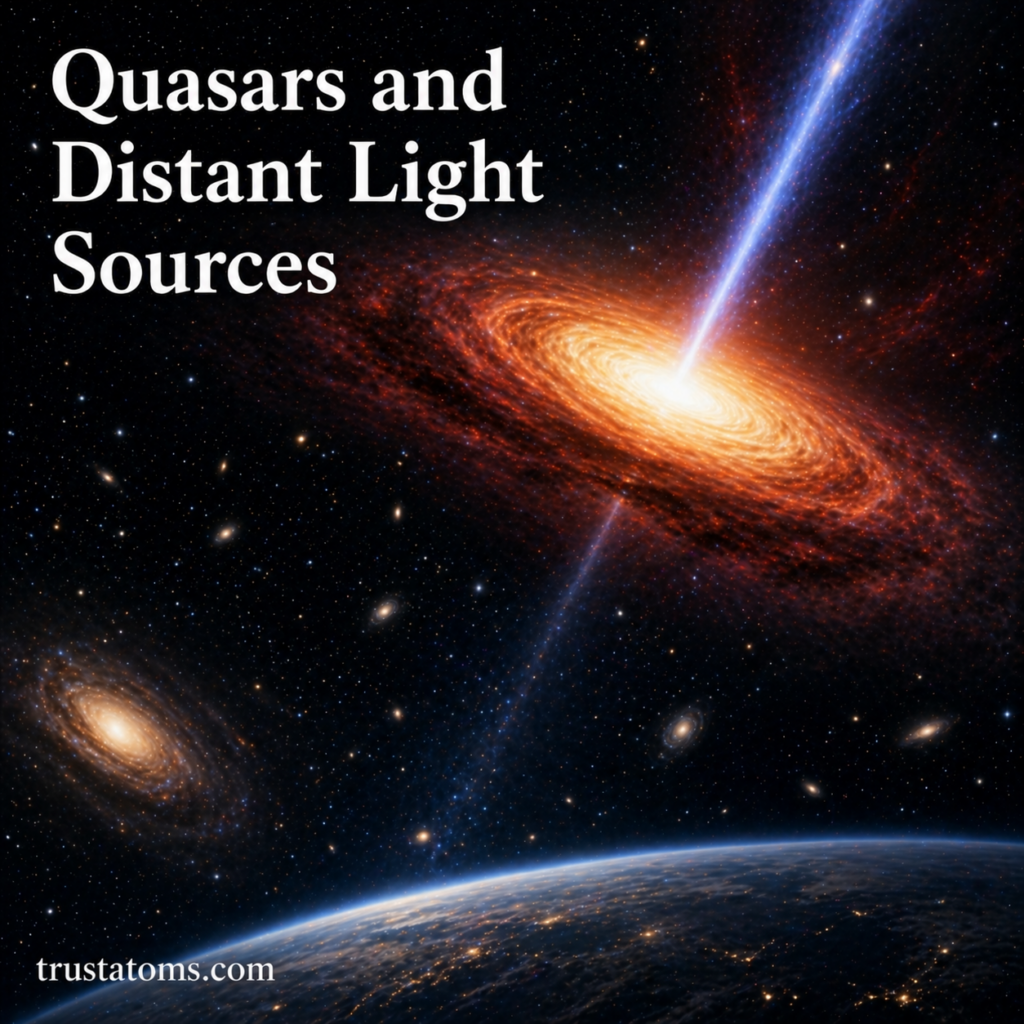
A quasar is a type of Active Galactic Nucleus (AGN) located at the center of a distant galaxy. It is powered by a supermassive black hole consuming vast amounts of matter.
As material spirals into the black hole, it forms a glowing accretion disk that releases enormous energy across the electromagnetic spectrum.
Key Features of Quasars
- Extremely bright—can outshine entire galaxies
- Powered by supermassive black holes
- Emit radiation across multiple wavelengths
- Often found billions of light-years away
Because of their brightness, quasars are among the most distant objects ever observed.
Why Quasars Are So Bright
The intense brightness of quasars comes from the process of accretion.
How It Works
- Gas and dust fall toward the black hole
- Material forms a rapidly spinning accretion disk
- Friction heats the disk to extreme temperatures
- Energy is released as light and radiation
This process is far more efficient than nuclear fusion, making quasars incredibly luminous.
Quasars as Distant Light Sources
Quasars act as cosmic lighthouses, shining across vast distances.
Why They Matter
- Their light travels for billions of years before reaching Earth
- Observing them allows scientists to study the early universe
- They help map the distribution of matter across space
When we observe a quasar, we are seeing it as it existed billions of years ago.
Redshift and the Expanding Universe
One of the most important properties of quasars is their redshift.
What Is Redshift?
Redshift occurs when light stretches to longer wavelengths as objects move away from us due to the expansion of the universe.
Why It Matters
- Higher redshift = greater distance
- Provides evidence for the expanding universe
- Helps measure how fast galaxies are moving away
Quasars often have very high redshift values, confirming their extreme distances.
Other Distant Light Sources in the Universe
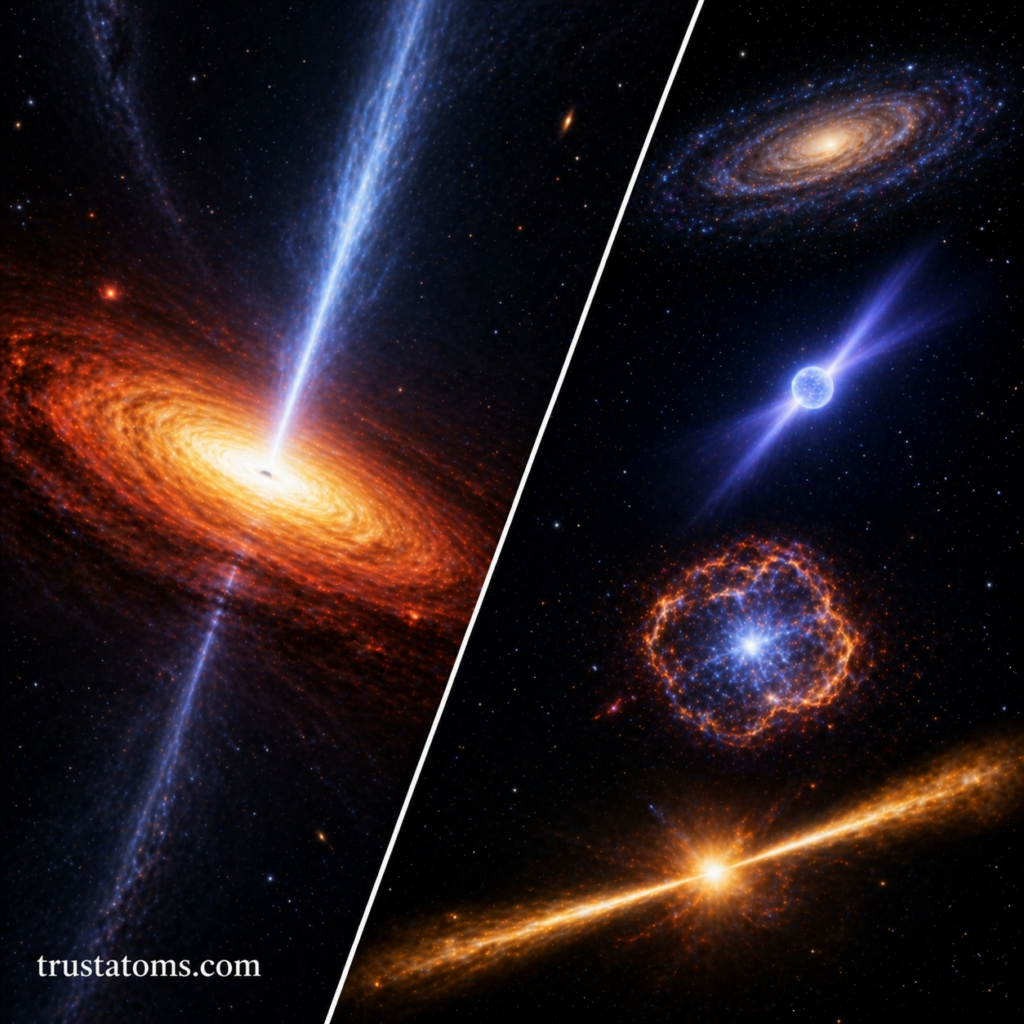
Quasars are not the only distant objects astronomers study.
Important Distant Light Sources
- Pulsar
- Rapidly rotating neutron stars emitting beams of radiation
- Supernova
- Exploding stars that briefly outshine entire galaxies
- Gamma-Ray Burst
- The most energetic explosions observed in the universe
Each of these objects provides unique insights into cosmic events and distances.
How Astronomers Study Quasars
Observing quasars requires advanced telescopes and instruments.
Tools and Methods
- Optical telescopes for visible light
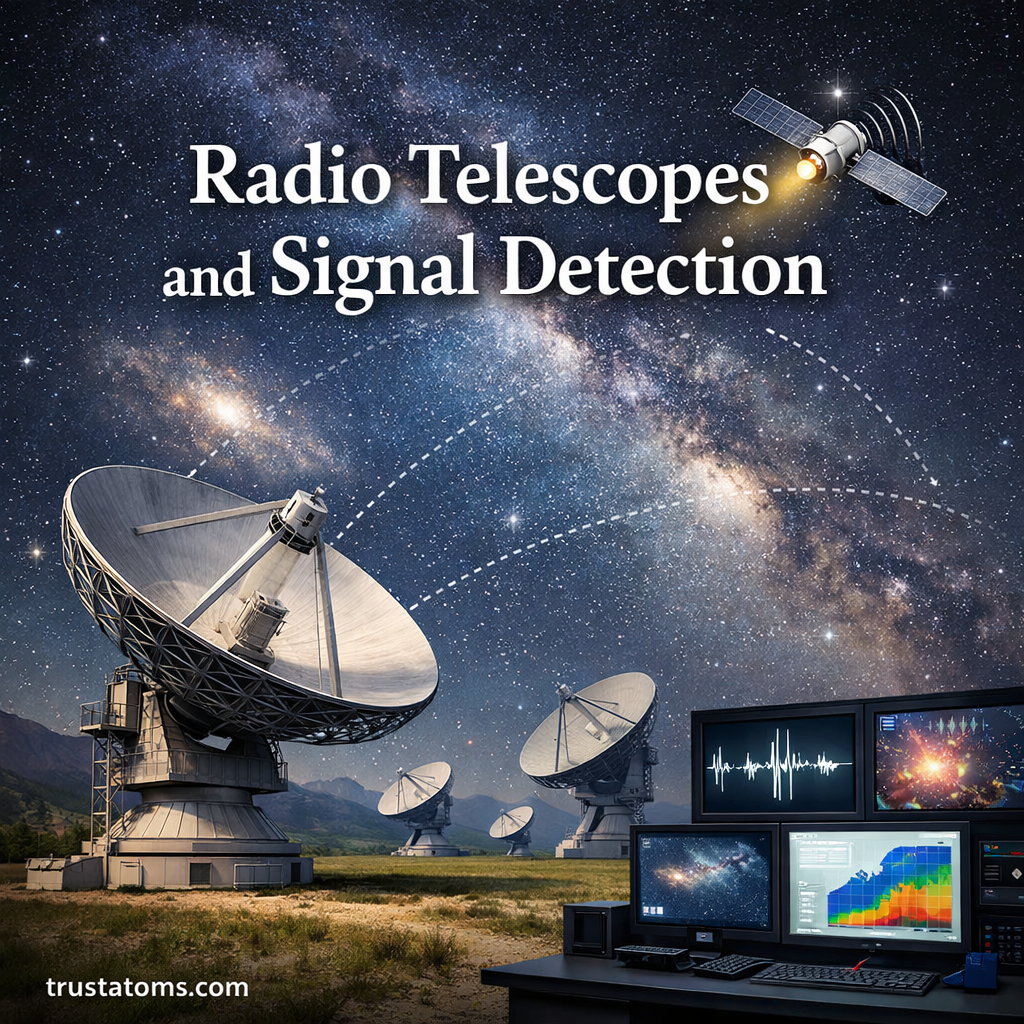
- Radio telescopes for detecting jets
- X-ray observatories for high-energy emissions
- Spectroscopy to measure redshift and composition
Facilities like the Hubble Space Telescope and the James Webb Space Telescope play a key role in studying distant light sources.
What Quasars Reveal About the Universe
Quasars are powerful tools for understanding cosmic history.
Scientific Insights
- Formation of early galaxies
- Growth of supermassive black holes
- Distribution of matter in the universe
- Evolution of cosmic structures over time
They act as probes, illuminating the space between galaxies.
Interesting Facts About Quasars
- Some quasars are billions of times brighter than the Sun
- They were first discovered in the 1960s
- Many quasars are located over 10 billion light-years away
- Not all galaxies have active quasars—many are dormant
Final Thoughts
Quasars and other distant light sources give us a unique window into the far reaches of the universe. Their incredible brightness allows astronomers to study objects that would otherwise be invisible across cosmic distances.
By observing these ancient signals of light, we gain insight into the origins, evolution, and structure of the universe—making quasars some of the most valuable tools in modern astronomy.